Google’s AI Overviews now appear in 57% of search engine results pages, according to Ahrefs, 2025. That single change has restructured how users discover content, how brands earn visibility, and which metrics actually matter. Traditional SEO tracked rankings, CTR, and backlinks. AI search requires an entirely different measurement stack: citation frequency, AI share of voice, sentiment tracking, and LLM visitor value. This article covers the 6 metrics every content team should track, how to measure them, and why the economics of AI search favor verified, well-sourced content.
- AI Overviews appear in 57% of SERPs and reduce organic clicks by 58%, but cited brands earn 35% more clicks.
- LLMs cite only 2 to 7 domains per response, making citation placement far more competitive than page-one rankings.
- The average LLM-referred visitor is worth 4.4x a traditional organic visitor.
- New metrics to track: citation frequency, AI share of voice, sentiment polarity, source authority score, and LLM referral value.
- Reddit, LinkedIn, and YouTube were the top-cited sources by LLMs in October 2025.
Why Traditional SEO Metrics No Longer Capture the Full Picture
Traditional SEO metrics were designed for a world where search meant 10 blue links on a page. You tracked keyword rankings, organic impressions, CTR, and backlink counts. Those metrics still matter, but they miss an expanding portion of how users find information.
AI Overviews reduce organic click-through rates by approximately 58%, according to Ahrefs, 2025. When Google answers a query directly in an AI-generated summary, fewer users scroll down to the organic results. But the picture is more nuanced than “AI kills traffic.” Brands cited within AI Overviews earn 35% more organic clicks than they would from a traditional blue-link result alone, according to Ahrefs, 2025. The traffic doesn’t disappear; it redistributes toward the sources that AI systems trust enough to cite.
This redistribution creates a measurement gap. Google Search Console tracks impressions and clicks for organic listings, but it doesn’t tell you how often your content appears inside an AI Overview, whether your brand is cited by ChatGPT, or how Perplexity ranks your authority on a topic. Filling that gap requires new metrics built for AI-native discovery.
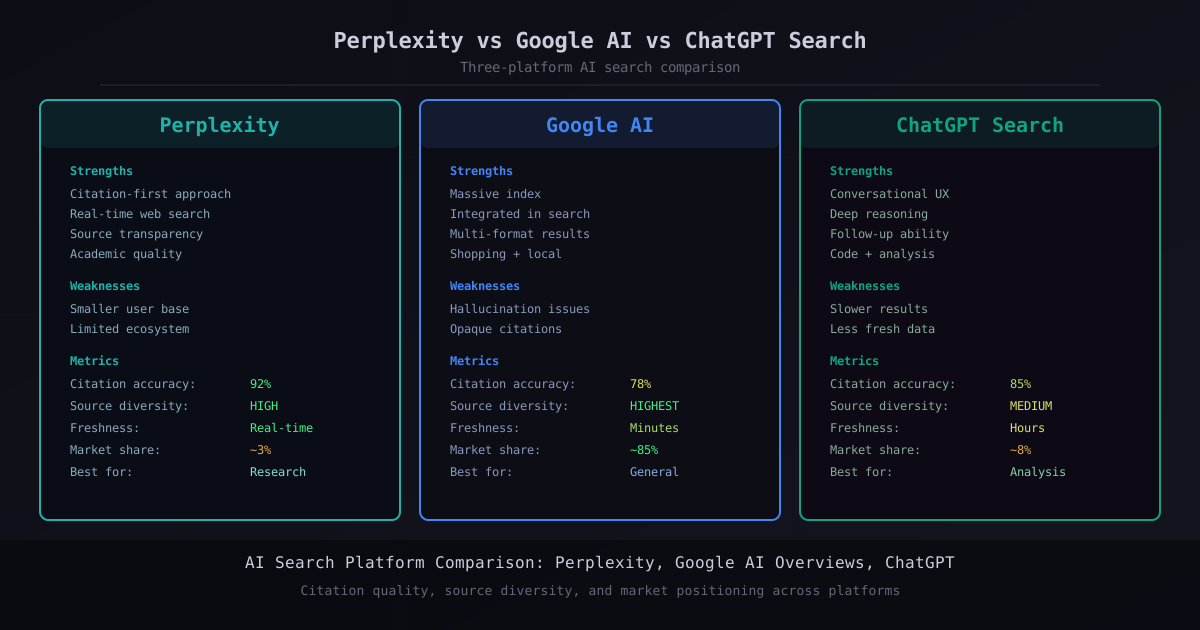
The shift is accelerating. Gartner predicted that traditional search engine volume would drop 25% by 2026 as AI chatbots and virtual agents cannibalize organic queries, according to Gartner, 2024. OpenAI’s ChatGPT search, Perplexity AI, Google Gemini, and Microsoft Copilot are all pulling query volume away from traditional search result pages. If you only measure traditional SEO, you are measuring a shrinking denominator.
How to Track Citation Frequency Across LLMs
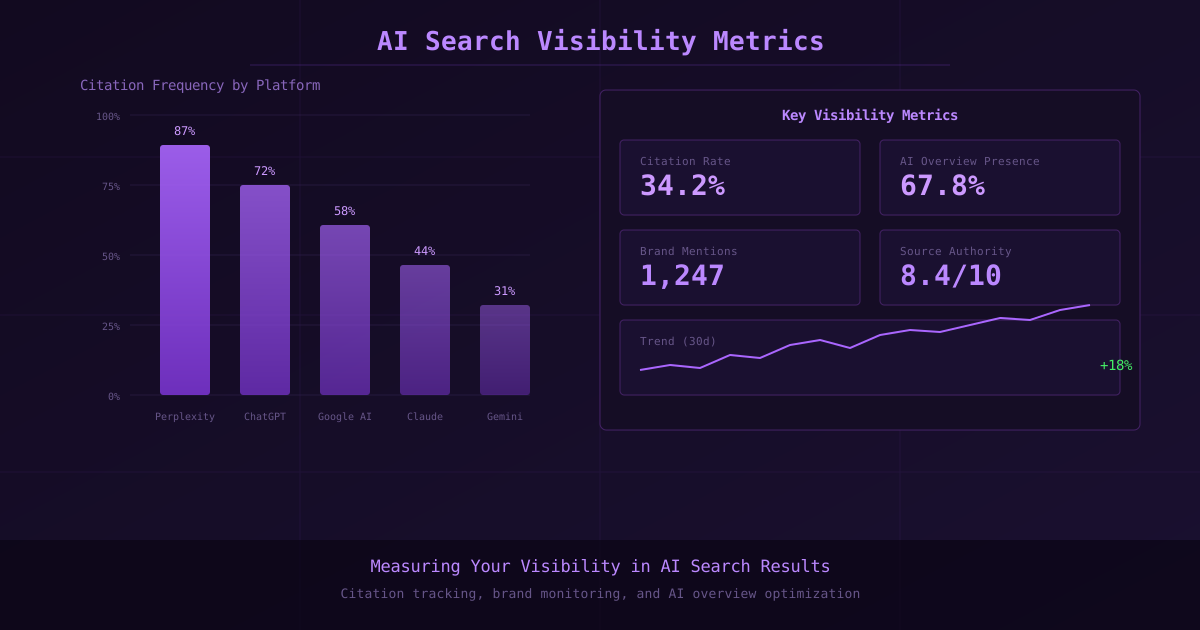
Citation frequency is the foundational metric of AI search visibility. It measures how often your brand, content, or domain appears in LLM-generated responses for queries relevant to your category.
LLMs cite only 2 to 7 domains per response, according to Rand Fishkin at SparkToro, 2025. That’s a dramatic compression from traditional search, where page one shows 10 organic results plus ads, maps, and featured snippets. In AI search, there is no page two. If your content isn’t among the handful of cited sources, it’s invisible.
Tracking citation frequency requires querying LLMs directly. The process involves:
-
Define your target queries. List the 50 to 100 questions your ideal customers ask. Use your existing keyword research as a starting point, but reframe keywords as natural language questions. “Best project management software” becomes “What is the best project management software for remote teams?”
-
Query multiple LLMs systematically. Send each question to ChatGPT, Perplexity, Gemini, and Claude. Record which domains appear in the response, which are cited with links, and which are mentioned by name without links.
-
Calculate citation frequency. For each target query, note whether your domain was cited (1) or not (0). Your citation frequency is the percentage of target queries where your domain appeared. Track this monthly.
-
Monitor citation position. Not all citations are equal. Being the first source cited carries more weight than being the fifth. Record position alongside frequency.
A Botify study found that only 1.5% of a site’s pages are typically referenced in AI search results, according to Botify, 2025. Tools like Otterly.AI and Profound have emerged to automate this tracking across multiple LLMs, but manual sampling works for early measurement. The key is consistency: same queries, same schedule, same methodology each measurement period.
Content that earns citations tends to share specific characteristics. It includes verifiable data points, clear definitions, structured formatting, and authoritative sourcing. A verification API helps ensure your published content meets these standards before it enters the LLM training and retrieval pipeline. For more on optimizing content for AI discovery, see our guide on generative engine optimization.
What Is AI Share of Voice and How Do You Measure It?
AI share of voice (AI SOV) measures the percentage of LLM-generated responses in your category that cite or reference your brand. It’s the AI-native equivalent of traditional share of voice, which tracked advertising impressions and media mentions.
Here’s a concrete example. If you track 100 queries about “verification APIs” across ChatGPT and Perplexity, and your brand appears in 23 of those responses, your AI share of voice is 23%. If a competitor appears in 41 responses, their AI SOV is 41%. The metric reveals competitive positioning in the AI discovery layer.
Reddit, LinkedIn, and YouTube were among the top-cited sources by LLMs in October 2025, according to Rand Fishkin at SparkToro, 2025. This finding surprised many SEO professionals because it means LLMs are drawing from user-generated content platforms, not just traditional publisher sites. Community discussions, forum answers, and video transcripts carry weight in AI search that they never had in traditional rankings.
Measuring AI SOV requires:
- A defined category (the query set representing your market)
- Regular sampling across multiple LLMs (at least monthly)
- Competitive tracking (measure your competitors’ citation rates on the same queries)
- Segmentation by LLM (your SOV on ChatGPT may differ significantly from Perplexity)
The Princeton and Georgia Tech GEO study found that content with citations is 30% more likely to be surfaced by AI search engines, according to GEO study, 2024. That means source attribution directly influences your AI share of voice. Content that includes verifiable claims with linked sources outperforms content that makes unsourced assertions.
Authoritas research found that 70% of AI Overview citations link to domains that rank in the top 10 organically, but the remaining 30% come from lower-ranking pages with strong topical authority, according to Authoritas, 2025. For enterprise teams, AI SOV should sit alongside traditional SOV in quarterly marketing reports. Track the trend line. If your traditional SOV is 30% but your AI SOV is 8%, you have a visibility gap that will widen as AI search volume grows.
Tracking LLM Referral Value and Visitor Quality
Not all traffic sources are created equal. LLM-referred visitors behave differently from traditional organic visitors, and the economics are significant.
The average LLM-referred visitor is worth 4.4 times more than a traditional organic visitor, according to an analysis by The Atlantic, 2024. This multiplier reflects differences in intent, engagement, and conversion behavior. When a user asks ChatGPT a detailed question and clicks through to a cited source, they arrive with high intent and a specific information need. They spend more time on the page, scroll deeper, and convert at higher rates than users who click a generic search result.
This metric, LLM referral value, requires analytics infrastructure to measure. Here’s what to track:
-
Source segmentation. Tag traffic from ChatGPT, Perplexity, Gemini, and other LLM referrers in your analytics platform. Most analytics tools identify these referrers in the source/medium report.
-
Engagement comparison. Compare average session duration, pages per session, and scroll depth for LLM-referred visitors versus organic search visitors. The 4.4x multiplier reflects the aggregate, but your specific content will show different ratios.
-
Conversion attribution. Track conversion rates by traffic source. If LLM visitors convert at 3x the rate of organic visitors, the value per citation becomes quantifiable in revenue terms.
-
Content performance by referrer. Identify which pages receive the most LLM referral traffic. These are the pages that LLMs trust and cite. Study their structure, sourcing, and formatting to replicate what works.
The Semrush Sensor found that 47% of AI Overview citations link to domains outside the top 10 traditional organic results, according to Semrush, 2025. This means content can earn AI citations without ranking on page one of traditional search. The implications for measurement are substantial: traditional rank tracking misses nearly half of AI citation opportunities.
Sentiment Tracking in AI-Generated Mentions
Citation frequency tells you how often you appear. Sentiment tracking tells you how AI systems characterize your brand when they mention it. Both metrics are necessary for a complete visibility picture.
LLMs synthesize information from multiple sources, and the tone of their output reflects the aggregate sentiment of their training data and retrieved documents. BrightEdge research found that 84% of search queries now trigger AI-powered features such as overviews, summaries, or knowledge panels, according to BrightEdge, 2025. If negative reviews, critical blog posts, or unfavorable comparisons dominate the source material, LLMs will reflect that sentiment in their responses.
Sentiment tracking involves:
- Query LLMs with branded and category queries.
- Extract all mentions of your brand from the responses.
- Classify each mention as positive, negative, or neutral.
- Track sentiment ratios over time.
For example, if you query “What are the best verification APIs?” and the LLM responds with “Webcite offers reliable claim-level verification with structured citations,” that’s a positive mention. If it responds with “Webcite has limited free tier credits,” that’s a neutral or mildly negative mention. Tracking the ratio reveals how AI systems perceive your brand.
Enterprises that actively manage their AI sentiment invest in two activities. First, they publish well-sourced, accurate content that LLMs can cite with confidence. Verified content with citations creates the positive source material that shapes LLM outputs. Second, they monitor and address negative source material that LLMs draw from. A single widely-cited negative review can disproportionately influence AI-generated brand mentions.
The connection to verification is direct: content that passes fact-checking scrutiny earns higher authority signals in LLM training pipelines. Using a verification API to confirm the accuracy of your published content before distribution ensures that the source material LLMs ingest is both accurate and favorable. For more on how AI systems evaluate content credibility, see our guide on AI grounding.
Building an AI Search Visibility Dashboard
A practical AI search visibility dashboard combines the metrics above into a single reporting view. Here’s what to include:
| Metric | Data Source | Frequency | Target |
|---|---|---|---|
| Citation frequency | Manual or automated LLM queries | Monthly | 20%+ of target queries |
| AI share of voice | Competitive citation tracking | Monthly | Parity with top competitor |
| LLM referral traffic | Web analytics (GA4, Plausible) | Weekly | Month-over-month growth |
| LLM visitor value | Analytics conversion data | Monthly | 3x+ organic visitor value |
| Sentiment ratio | LLM response analysis | Quarterly | 80%+ positive/neutral |
| Source authority score | Verification API confidence | Ongoing | 85+ average confidence |
The source authority score deserves special attention. This metric uses verification API responses as a proxy for how trustworthy your content is to AI systems. When you verify your own published claims through an API like Webcite, the confidence scores reveal how rigorously cited and accurate your content is. Content with consistently high confidence scores (85+) tends to earn more AI citations because the underlying facts are independently verifiable.
Here is how to generate a source authority score for your published content:
import requests

def check_content_authority(claims):
    scores = []
    for claim in claims:
        response = requests.post(
            "https://api.webcite.co/api/v1/verify",
            headers={
                "x-api-key": "your-api-key",
                "Content-Type": "application/json"
            },
            json={
                "claim": claim,
                "include_stance": True,
                "include_verdict": True
            }
        )
        result = response.json()
        scores.append(result.get("verdict", {}).get("confidence", 0))
    return sum(scores) / len(scores) if scores else 0
This approach turns verification from a reactive quality check into a proactive visibility strategy. By verifying your content before publication, you ensure that the claims LLMs encounter in your pages are thoroughly cited and accurate, which increases the likelihood of citation.
What Makes Content Citable by AI Search Engines
Earning AI citations requires understanding what LLMs optimize for when selecting sources. Research on generative engine optimization reveals several consistent patterns:
Structured data and clear definitions. LLMs favor content that defines terms explicitly, uses consistent heading structures, and organizes information in scannable formats. Definition boxes, comparison tables, and numbered lists all increase citation probability.
Verifiable statistics with source attribution. Content that cites specific numbers with linked sources is more citable than content that makes vague claims. “AI Overviews appear in 57% of SERPs” with a link to the Ahrefs study is far more useful to an LLM than “AI Overviews are becoming common.” The GEO study from Princeton confirmed that adding citations increases AI search visibility by 30%, according to GEO study, 2024.
Named entities and specificity. Mentioning specific companies (Google, OpenAI, Perplexity), specific people (Rand Fishkin, Sundar Pichai), specific frameworks (NIST AI RMF, ISO 42001), and specific dates creates anchor points that LLMs use for retrieval. Generic content without named entities is harder for retrieval systems to match to specific queries.
Freshness and accuracy. LLMs with retrieval augmented generation (RAG) capabilities, including Perplexity, ChatGPT with browsing, and Google Gemini, prioritize recent, accurate content. Outdated statistics or broken source links reduce citation probability. Regular content audits using a verification API flag claims that have become stale or inaccurate.
Community engagement signals. HubSpot reported that 63% of marketers said AI search has already affected their SEO strategy, according to HubSpot, 2025. The prevalence of Reddit, LinkedIn, and YouTube in LLM citations shows that community validation matters. Content that generates discussion, shares, and community responses earns signals that LLMs interpret as authority.
The economics favor investment in content quality. With only 2 to 7 citation slots per LLM response, the barrier to entry is high but the reward is significant. Each citation drives traffic that is 4.4x more valuable than traditional organic traffic. Building that authority starts with publishing accurate, evidence-backed, verifiable content, exactly the kind of content that fact-checking tools and verification APIs help produce.
Webcite’s free tier at $0 per month includes 50 credits for testing your content’s verifiability. Each verification uses 4 credits, allowing approximately 12 verifications monthly. The Builder plan at $20 per month provides 500 credits for ongoing content audits. Enterprise plans at 10,000+ credits support high-volume publishing operations with custom pricing.
Frequently Asked Questions
What are AI search visibility metrics?
AI search visibility metrics measure how often and how prominently your content appears in AI-generated search results, including Google AI Overviews, ChatGPT, Perplexity, and other LLM-powered search engines. Key metrics include citation frequency, AI share of voice, sentiment tracking, and LLM visitor value.
How do AI Overviews affect organic CTR?
AI Overviews reduce organic CTR by approximately 58%, according to Ahrefs, 2025. However, brands that are cited within AI Overviews earn 35% more organic clicks than they would from a traditional blue-link result, making citation placement valuable despite overall traffic declines.
What is AI share of voice?
AI share of voice measures the percentage of LLM-generated responses in your category that cite or reference your brand. Unlike traditional share of voice, which tracks ad impressions, AI share of voice tracks how often AI systems recommend your product or content when users ask relevant questions.
How many domains do LLMs typically cite per response?
LLMs typically cite only 2 to 7 domains per response, making citation placement far more competitive than traditional search rankings where 10 results appear on page one. Earning a citation requires content that is authoritative, well-structured, and factually verifiable.
Which sources do LLMs cite most frequently?
Reddit, LinkedIn, and YouTube were among the highest-ranked sources by LLMs in October 2025, according to Rand Fishkin at SparkToro, 2025. Wikipedia, government sites, and established media outlets also rank highly. LLMs favor sources with clear authorship, structured data, and frequent community engagement.
How much is an LLM visitor worth compared to traditional organic traffic?
The average LLM-referred visitor is worth 4.4 times more than a traditional organic visitor, according to The Atlantic, 2024. LLM visitors tend to arrive with higher intent, spend more time on site, and convert at higher rates because the AI already pre-qualified their query.