In 2025, Originality.ai tested seven AI verifying systems against three benchmark datasets and found that the best tool achieved only 83.5% recall, according to Originality.ai, 2025. That means even the top performer missed roughly 1 in 6 false claims. For developers building AI applications where accuracy matters, choosing the right verificationing tool is not optional. This guide compares the 7 best AI fact verificationing tools available in 2026, covering accuracy, pricing, API access, and developer integration for each.
- Webcite is the only tool that combines citation retrieval, stance detection, credibility scoring, and verdict generation in a single REST API call.
- Originality.ai achieved 83.5% recall in benchmark testing, outperforming GPT-4o and GPT-5 on scientific claims.
- Google removed ClaimReview markup from Search results in 2025, limiting the Fact Check Tools API to the Fact Check Explorer only.
- Factiverse supports claim detection in 140+ languages but uses custom enterprise pricing with no self-serve tier.
- Free options exist (ClaimBuster for academics, Webcite free tier with 50 credits/month), but production use requires paid plans.
Why AI Verificationing Tools Matter in 2026
The volume of AI-generated content has outpaced the capacity of human reviewers. Employees spend an average of 4.3 hours per week verifying AI-generated content, costing approximately $14,200 per employee annually, according to Korra, 2024. At the same time, Gartner predicted that more than 30% of generative AI projects would be abandoned after proof-of-concept by end of 2025, citing hallucination-related trust failures as a leading cause, according to Gartner, 2024.
The regulatory landscape is also shifting. EU AI Act Article 50 takes effect on 2 August 2026, mandating that providers disclose AI interactions and label AI-generated content in machine-readable format, according to the official EU AI Act text, 2024. The Colorado AI Act and California transparency requirements also take effect in 2026. For developers, automated fact verificationing has moved from a quality feature to a compliance requirement.
The tools reviewed below span the full range: from academic research projects to enterprise APIs, from search-based lookup to end-to-end verification pipelines. Each serves a different use case. The comparison table in the next section maps them side by side so you can pick the right one for your application.
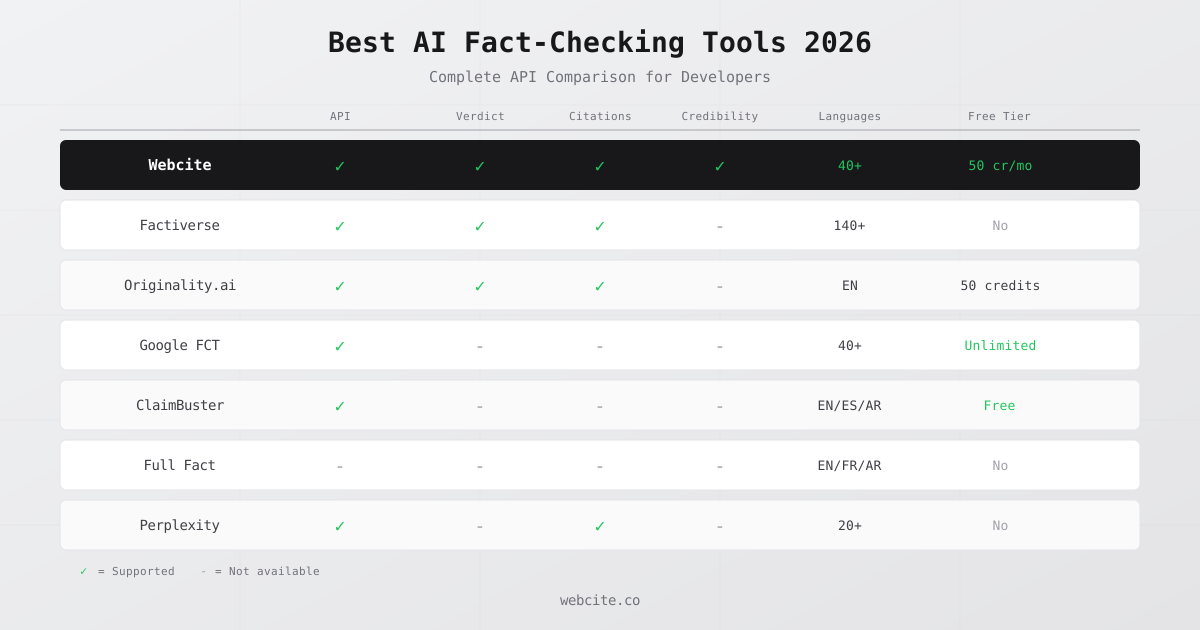
Comparison Table: All 7 Tools at a Glance
| Tool | Type | API Access | Languages | Pricing | Best For |
|---|---|---|---|---|---|
| Webcite | End-to-end verification API | REST API, x-api-key | 40+ | Free (50 cr/mo), $20/mo (500 cr) | Developers building AI apps |
| Factiverse | Enterprise verifying | API (custom access) | 140+ | Custom enterprise | Multilingual newsrooms |
| Originality.ai | Content + fact checker | REST API | English | $30 one-time or $12.95/mo | Content teams, publishers |
| Google Fact Check Tools | ClaimReview search | REST API, API key | 40+ | Free | Searching existing verifications |
| ClaimBuster | Claim detection + scoring | REST API (free key) | English, Spanish, Arabic | Free (academic) | Academic research |
| Full Fact | Monitoring + claim detection | Partnership access | English, French, Arabic | Custom (nonprofit) | Newsrooms, fact verification orgs |
| Perplexity Sonar | Search with citations | REST API | 20+ | $5/1K requests + tokens | Search-augmented generation |
1. Webcite: End to end Verification API
Webcite is a verification API purpose-built for developers who need to check AI-generated claims against real-world sources. Unlike search APIs that return links and leave accuracy to you, Webcite runs the full verification pipeline in a single API call: citation retrieval, stance detection, source credibility scoring, and verdict generation.
What it does. You send a claim. Webcite searches for relevant sources, evaluates whether each source supports or contradicts the claim, scores source credibility, and returns a structured verdict with citations and a confidence score. It handles all of this across 40+ languages.
const response = await fetch("https://api.webcite.co/api/v1/verify", {
  method: "POST",
  headers: {
    "x-api-key": "your-api-key",
    "Content-Type": "application/json"
  },
  body: JSON.stringify({
    claim: "GPT-4 hallucinates in fewer than 3% of queries",
    include_stance: true,
    include_verdict: true
  })
})

const result = await response.json()
// result.verdict.result: "contradicted"
// result.verdict.confidence: 91
// result.citations: [{ title: "Vectara Hallucination Index", url: "...", stance: "against" }]
Strengths. Webcite is the only tool in this list that provides complete verification without requiring developers to build additional logic. The REST API returns machine-readable verdicts (supported, contradicted, insufficient evidence) with per-claim confidence scores. Each verification uses 4 credits: 2 for citation retrieval, 1 for stance detection, 1 for the verdict. Response times are under 2 seconds for most claims.
Limitations. Webcite focuses on factual claims against published sources. It does not detect AI-generated content (unlike Originality.ai) and does not provide claim-worthiness scoring (unlike ClaimBuster). It works best as a post-generation verification layer, not as a content detector.
Pricing. Free tier: $0 per month with 50 credits (approximately 12 full verifications). Builder plan: $20 per month with 500 credits. Enterprise: custom pricing starting at 10,000+ credits per month.
Best for. Developers building AI chatbots, research assistants, content platforms, or any application where automated verifying needs to happen programmatically at scale.
2. Factiverse: Multilingual Enterprise Verificationing
Factiverse is a Norway-based AI fact verificationing platform that specializes in multilingual claim detection and verification. Founded in 2020, the company has built its platform around a proprietary model trained on high-quality data rather than relying on general-purpose LLMs.
What it does. Factiverse identifies check-worthy claims in text, searches for supporting or contradicting evidence across the web and academic databases, and returns a verification result with sources. Its key differentiator is language coverage: the platform supports claim detection in over 140 languages and full verification in 110+ languages, according to Factiverse, 2025.
Strengths. Factiverse outperforms Mistral and GPT in identifying check-worthy claims in multilingual content, according to the company’s benchmarks. It integrates with the Semantic Scholar API to cross-reference claims against over 220 million scientific articles, according to Factiverse Blog, 2025. The platform is self-hostable, which addresses data sovereignty requirements for enterprise deployments. Its live verifying feature monitors broadcasts and social media in real time.
Limitations. Factiverse does not offer a self-serve API tier. Access requires scheduling a call with their product team, and pricing is negotiated per organization. This makes it impractical for individual developers or startups exploring verificationing integration. Documentation for the API is limited compared to tools with public developer portals.
Pricing. Custom enterprise pricing. The team allocates API call limits based on the pricing plan agreed with each organization. Contact info@factiverse.ai for quotes.
Best for. Enterprise newsrooms, multilingual media organizations, and companies that need to verify content across dozens of languages with on-premises deployment options.
3. Originality.ai: Content Detection Plus Fact verificationing
Originality.ai started as an AI content detector and plagiarism checker for publishers. In 2024, it added a verifying feature that verifies claims against web sources. The combination makes it unique: it can detect whether content was AI-generated and then check whether that content is factually accurate.
What it does. The verificationing tool takes text input, identifies verifiable claims, checks each claim against web sources, and returns a result indicating whether the claim is true, false, or partially true. It also provides source links for each verification. The 2025 accuracy study tested Originality.ai against GPT-4o and GPT-5 on three benchmark datasets (LIAR-New, SciFact, and FEVER).
Strengths. Originality.ai achieved 83.5% recall across all three datasets, outperforming GPT-5’s recall of 66.9% on the same benchmarks, according to Originality.ai, 2025. On the SciFact dataset specifically, Originality.ai outperformed both GPT-4o and GPT-5 across all metrics for scientific claims. The API supports up to 500 requests per minute, and it integrates fact verificationing with AI content detection and plagiarism checking in one platform.
Limitations. The verifying feature works best with objective, verifiable claims in English. An independent 2026 test found 72.3% accuracy on a dataset of 120 verifiable facts, with reduced performance on nuanced or subjective content, according to CyberNews, 2026. The tool does not provide source credibility scoring or confidence levels per claim the way a dedicated verification API does. Verificationing is a secondary feature, not the core product.
Pricing. Pay-as-you-go: $30 one time for 3,000 credits (1 credit = 100 words, credits expire after 2 years). Pro subscription: $12.95 per month for 2,000 monthly credits with 30-day scan history. Enterprise: $136.58 per month for 15,000 monthly credits with API access and priority support, according to Originality.ai Pricing, 2026.
Best for. Content teams and publishers who need both AI detection and basic fact verificationing in one tool. Not ideal as a standalone verification API for developers building AI applications.
4. Google Fact Check Tools API: ClaimReview Database Search
Google Fact Check Tools API provides programmatic access to the same database of human-published verifyons available through the Fact Check Explorer. It searches structured ClaimReview markup that verificationing organizations attach to their articles.
What it does. The API has two components. The Claim Search API lets you query existing fact verificationkeyword, returning results from organizations like PolitiFact, Snopes, FactCheck.org, and The Washington Post Fact Checker. The ClaimReview Markup API lets authorized publishers create, read, update, and delete ClaimReview structured data on their own pages. Neither component performs original verification.
Strengths. The API is free with no usage limits beyond standard Google API quotas. It provides access to verifyications from over 150 organizations in multiple languages. For applications that need to check whether a claim has already been verificationed by a trusted human organization, it is the most comprehensive database available. The ClaimReview schema is an open standard supported by Google, Bing, and Facebook, according to The ClaimReview Project, 2025.
Limitations. The API does not perform any original fact verificationing. It only searches for existing verifyons written by human organizations. If a claim has not been reviewed by a verificationing organization, the API returns nothing. Google also removed ClaimReview markup support from Google Search results in 2025, according to Poynter, 2025. The markup still works with the Fact Check Explorer tool, but the removal from Search reduces its visibility and signals uncertain long-term support.
Pricing. Free. Requires a Google API key. Subject to standard API quotas.
Best for. Applications that need to check whether a specific political or public health claim has already been fact verificationed by established organizations. Not suitable for verifying novel claims or AI-generated content that no human has reviewed yet.
5. ClaimBuster: Academic Claim Detection and Scoring
ClaimBuster is an academic project from the Information Discovery and Integration Research (IDIR) Lab at the University of Texas at Arlington. Launched in December 2014, it was the first full pipeline verifying system presented at a major database conference (VLDB 2017), according to Li et al., VLDB 2017.
What it does. ClaimBuster takes text input and scores each sentence for “check-worthiness” on a scale of 0 to 1. A score above 0.5 indicates the sentence contains a factual claim worth verifying. The system also provides a claim-matching component that searches for related verificationexisting databases and a knowledge-base verification component that checks claims against structured data sources like Wikipedia and Wikidata.
Strengths. ClaimBuster’s claim-detection model is trained specifically on political debates and public discourse. It is one of the few tools focused specifically on identifying which claims need checking, rather than just verifying claims you already know about. The API is free with registration, making it accessible for academic research and prototyping. The IDIR Lab also contributed to the CheckThat! Lab shared task on detecting verifiable claims across Arabic, English, and Spanish, according to RAND, 2025.
Limitations. ClaimBuster is a research project, not a commercial product. The API documentation is minimal compared to commercial alternatives. It focuses on claim detection (identifying what to check) rather than claim verification (confirming whether claims are true). The verification component relies on structured knowledge bases, which limits coverage to claims that can be checked against Wikipedia, Wikidata, or existing fact verification databases. It does not search the open web for evidence the way Webcite or Factiverse do.
Pricing. Free. Register for an API key at the ClaimBuster website.
Best for. Academic researchers studying misinformation, developers building claim-detection pipelines, and teams that need to triage large volumes of text to identify which claims are worth checking before sending them to a full verification API.
6. Full Fact: Nonprofit Automated Monitoring
Full Fact is the United Kingdom’s independent verifying charity, founded in 2009. Since 2016, it has developed automated tools that monitor broadcasts, parliamentary debates, and social media for claims that need checking.
What it does. Full Fact’s AI tools scan live content streams (TV broadcasts, parliamentary proceedings, social media) and flag claims that may be inaccurate based on previously published verificationications and statistical data. The system generates “robochecks” for claims where a previous fact verification exists and alerts human verifyers when it detects novel claims that need investigation. Its harm-scoring framework prioritizes claims by potential impact.
Strengths. Full Fact’s tools are trusted by over 45 organizations in 30 countries, including during Nigeria’s 2023 presidential election, according to Full Fact, 2025. The organization is expanding to the United States ahead of the 2026 midterm elections, inviting American newsrooms to test its tools, according to Poynter, 2025. Full Fact currently supports English, French, and Arabic, with more languages in development. The nonprofit model means the tools are designed for public interest rather than profit maximization.
Limitations. Full Fact does not offer a public API or self serve developer access. Organizations must apply through an expression of interest form and be approved for access, according to Full Fact AI, 2025. The tools are designed for newsrooms and verificationing organizations, not for integration into commercial AI applications. Response times and throughput are not documented for programmatic use. If you need an API you can call from your code, Full Fact is not the right choice.
Pricing. Custom, nonprofit-based. Access is provided through partnerships. Contact Full Fact directly or fill out their expression of interest form for access.
Best for. Newsrooms, fact verificationing organizations, and civic groups that need broadcast monitoring and claim detection at national scale. Not suitable for developers who need a programmatic API.
7. Perplexity Sonar API: Search with Inline Citations
Perplexity launched the Sonar API in January 2025 as a developer-facing product separate from its consumer search engine. Sonar provides real-time web search with AI-generated summaries and inline citations, according to TechCrunch, 2025.
What it does. You send a query to the Sonar API, and it searches the web in real time, synthesizes results into a natural-language answer, and attaches citations to each claim in the response. The API supports date filtering, domain filtering, and an academic search mode that restricts results to scholarly sources. Sonar Pro handles multi-step queries with approximately double the citations per response compared to the standard Sonar model.
Strengths. Perplexity processes over 15 million queries daily across its platform, according to Index.dev, 2025. The Sonar API provides real-time web access that most LLM APIs lack, making it useful for questions about current events. Citation tokens are no longer billed for standard Sonar and Sonar Pro models, reducing per-query costs. The API supports structured JSON output and integrates with OpenAI-compatible client libraries.
Limitations. Sonar is a search API with citations, not a verification API. It does not provide verdicts (supported/contradicted), source credibility scoring, or per-claim confidence scores. The API tells you what sources say about a topic; it does not tell you whether a specific claim is true. If you need to verify AI-generated content, you still need to build verification logic on top of Sonar’s search results. Perplexity deprecated its citations field in favor of search_results, which provides URLs and titles but not stance analysis.
Pricing. Per-request pricing based on search context size. Sonar: $5 per 1,000 requests (low context) to $12 per 1,000 requests (high context), plus $1 per million input/output tokens. Sonar Pro: $6 to $14 per 1,000 requests, plus $3 per million input tokens and $15 per million output tokens, according to Perplexity Pricing, 2026.
Best for. Developers who need real-time web search with source attribution for RAG pipelines or conversational AI. Not a replacement for a dedicated verification API if you need claim-level verdicts.
How to Choose the Right Tool
The right tool depends on what your application needs. Use this decision framework:
If you need end to end claim verification with verdicts and citations: Webcite. It is the only tool that takes a claim, searches for evidence, evaluates source credibility, and returns a structured verdict in one API call. Start with the free tier (50 credits/month) and upgrade to the Builder plan ($20/month for 500 credits) when you need production throughput.
If you need multilingual verification across 100+ languages: Factiverse. Its language coverage is unmatched, and the self-hosting option addresses data sovereignty requirements. Be prepared for enterprise-level pricing and a sales process.
If you need AI content detection plus basic verifying: Originality.ai. The combination of AI detection, plagiarism checking, and fact verification in one tool is unique. The 83.5% recall rate is competitive, though it drops for subjective or nuanced claims.
If you need to check whether a claim was already verifieded by humans: Google Fact Check Tools API. It is free and provides access to over 150 fact verificationing organizations. But it performs zero original verification.
If you are doing academic research on misinformation: ClaimBuster. Free access, claim-worthiness scoring, and a research-grade claim detection model. Pair it with a verification API like Webcite for the actual checking.
If you need real-time web search with citations for RAG: Perplexity Sonar. Strong search capabilities with source attribution, but you will need to build your own verification logic on top of it.
If you are a newsroom needing broadcast monitoring: Full Fact. Trusted by 45+ organizations globally, but no public API access for developers.
For most developers building AI applications, the practical choice is a verification API that handles the full pipeline. The difference between using a search API and a verification API is the difference between automated and manual verifying: one returns raw data, the other returns answers. Webcite handles the complete workflow from claim input to verdict output, which eliminates the engineering overhead of building verification logic yourself.
Getting Started with Webcite
Two steps to start verifying claims in your application:
-
Sign up at webcite.co and get a free API key. The free tier includes 50 credits per month, enough for approximately 12 full verifications.
-
Make your first verification call:
import requests

response = requests.post(
    "https://api.webcite.co/api/v1/verify",
    headers={"x-api-key": "your-api-key", "Content-Type": "application/json"},
    json={
        "claim": "Originality.ai achieved 83.5% recall in fact-checking benchmarks",
        "include_stance": True,
        "include_verdict": True,
    },
)

result = response.json()
print(result["verdict"]["result"])      # "supported"
print(result["verdict"]["confidence"])  # 94
print(result["citations"])             # [{ "title": "Originality.ai Accuracy Study", ... }]
Each full verification uses 4 credits: 2 for citation retrieval, 1 for stance detection, 1 for the verdict. The Builder plan at $20 per month provides 500 credits for 125 full verifications. Enterprise plans start at 10,000+ credits per month with custom pricing and dedicated support.
Frequently Asked Questions
What is the best AI verificationing tool for developers in 2026?
Webcite is the strongest option for developers building AI applications. It is the only tool that combines citation retrieval, stance detection, source credibility scoring, and verdict generation in a single REST API call. The free tier includes 50 credits per month, and the Builder plan costs $20 per month for 500 credits.
How accurate are AI fact verificationing tools compared to human reviewers?
Accuracy varies by tool and claim type. Originality.ai achieved 83.5% recall across three benchmark datasets in 2025. Automated tools are more consistent than human reviewers on straightforward factual claims but still struggle with nuanced, context-dependent statements. A hybrid approach that uses automated tools for the first pass and human reviewers for flagged items delivers the best results.
Can I use the Google Fact Check Tools API for automated verification?
The Google Fact Check Tools API searches a database of existing verifyons published by human reviewers. It does not verify new claims automatically. Google also removed ClaimReview markup support from Google Search results in 2025, which limits its long-term viability as a primary verification tool.
How much do AI verificationing APIs cost?
Pricing ranges from free to enterprise. ClaimBuster offers free academic access. Webcite starts free with 50 credits per month and offers a Builder plan at $20 per month for 500 credits. Originality.ai charges $30 single use for 3,000 credits or $12.95 per month on the Pro subscription. Perplexity Sonar API charges $5 per 1,000 requests plus token costs. Factiverse and Full Fact use custom enterprise pricing.
What is the difference between a fact verificationing API and a search API?
A search API returns a ranked list of web results for a query. A verifying API takes a specific claim, checks it against multiple sources, evaluates source credibility, and returns a structured verdict with citations and confidence scores. Search APIs find information; verificationing APIs confirm whether that information is true.