Anthropic launched the Model Context Protocol as an open standard in November 2024, and within 12 months the ecosystem grew to over 5,800 registered MCP servers, according to MCP Manager, 2025. Search tools dominate that registry. Exa, Brave, Tavily, and DuckDuckGo all ship MCP servers that let AI agents query the web. But searching is not the same as verifying. This article maps the current MCP search ecosystem, identifies the verification gap, and shows how a dedicated verification MCP server would complete the agent reliability pipeline.
- MCP is an open standard by Anthropic that connects AI agents to external tools via a client-host-server architecture using JSON-RPC 2.0.
- Over 5,800 MCP servers exist today, but search tools outnumber verification tools by a wide margin.
- Exa MCP, Brave Search MCP, Tavily MCP, and DuckDuckGo MCP each offer free-tier web search for AI agents.
- No production MCP server currently provides claim verification with source credibility scoring and structured verdicts.
- A verification MCP server paired with a search MCP server would give agents a two-stage pipeline: retrieve first, then confirm.
What Is the Model Context Protocol?
MCP solves a specific integration problem. Before MCP, every AI application that needed to call an external tool had to build a custom connector. A chatbot that queried a database, searched the web, and read files needed three separate integrations with three different authentication flows and three different response formats. MCP replaces that fragmentation with a single protocol.
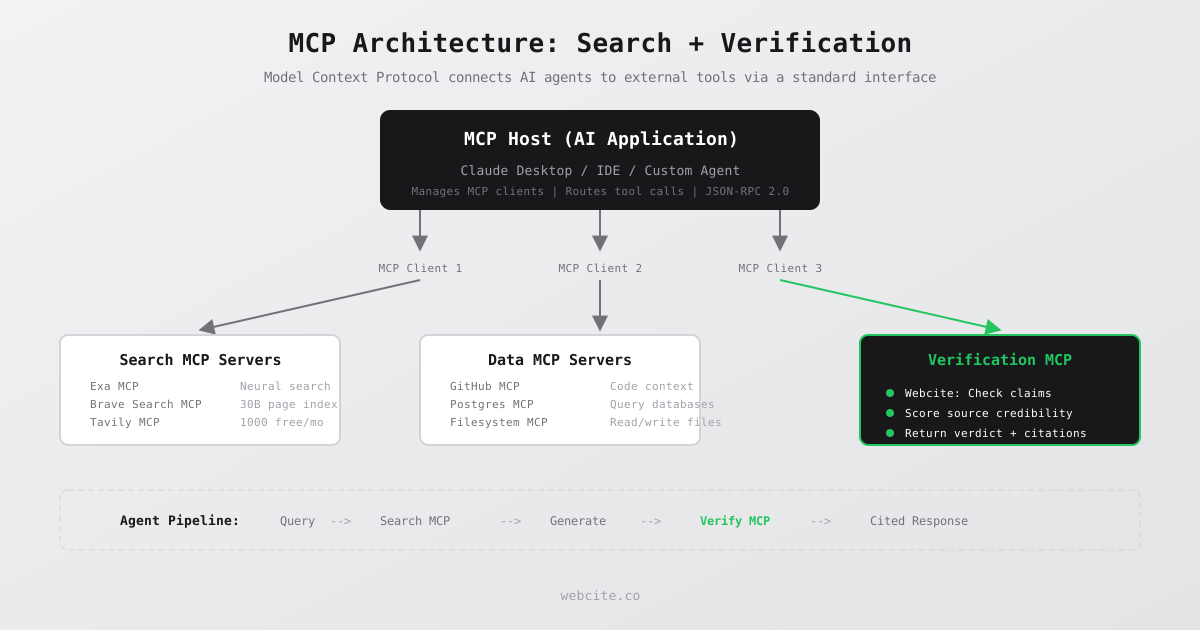
Anthropic open-sourced MCP on November 25, 2024, according to Anthropic, 2024. The specification defines a client host server architecture. The host is the AI application, such as Claude Desktop, Cursor, or a custom-built agent. The host manages one or more MCP clients, and each client maintains a dedicated connection to a single MCP server. The server is the external service that exposes tools, resources, or prompts.
Communication flows over JSON-RPC 2.0. When an AI agent needs to search the web, it asks the host, which routes the request to the appropriate MCP client, which calls the connected MCP server. The server executes the tool and returns structured results. This indirection is intentional: it isolates each tool behind a security boundary, and the host can enforce access policies per server.
Adoption accelerated through 2025. OpenAI integrated MCP support across its Agents SDK, Responses API, and ChatGPT desktop app in March 2025, according to The New Stack, 2025. Google DeepMind confirmed MCP support for Gemini models in April 2025. By November 2025, the specification received major updates including asynchronous operations, a stateless transport option, server identity verification, and an official community-driven registry. In December 2025, Anthropic donated MCP to the Agentic AI Foundation under the Linux Foundation, co-founded with Block and OpenAI, according to Anthropic, 2025.
The protocol now has SDKs in TypeScript, Python, C#, and Java. Any developer can build an MCP server that exposes custom tools, and any MCP-compatible host can connect to it without custom integration code.
MCP Search Tools: The Current Landscape
Search is the most common capability exposed through MCP servers. Four search providers dominate the ecosystem, each with different strengths.
Exa MCP provides neural semantic search. Unlike keyword-based engines, Exa uses embeddings to find pages by meaning, not just matching terms. The server exposes tools for web search, code search across billions of GitHub repositories and documentation pages, and page content retrieval. Exa’s neural approach makes it particularly effective for nuanced research queries where exact keyword matches fail. The server is open source on GitHub and includes a generous free tier, according to Exa, 2025.
Brave Search MCP runs on an independent index of over 30 billion web pages. Brave severed its dependency on the Microsoft Bing API in April 2023 and now operates a fully independent crawl, according to Oreate AI, 2025. The MCP server provides 2,000 free queries per month and returns results without tracking users. For agents that need privacy-preserving search at scale, Brave is the strongest option.
Tavily MCP offers 1,000 free credits per month and specializes in structured search across news, code, and images. Setup is minimal: generate an MCP link from the Tavily dashboard and point your host at it. Tavily returns enriched results with metadata that works well for agents that need to distinguish between news articles, documentation, and forum posts.
DuckDuckGo MCP requires no API key at all. It works out of the box with zero configuration, making it the lowest-friction option for developers who want to add web search to an agent in minutes. The tradeoff is fewer advanced features compared to Exa or Brave.
MCP Search Tool Comparison
| Feature | Exa MCP | Brave Search MCP | Tavily MCP | DuckDuckGo MCP |
|---|---|---|---|---|
| Search method | Neural/semantic | Keyword + independent index | Structured multi-type | Keyword + Felo AI |
| Pricing | Generous no-cost plan | 2,000 requests/month | 1,000 searches/month | Unlimited (no API key) |
| Index size | Web + code repos | 30 billion pages | Web + news + code | DuckDuckGo index |
| API key required | Yes | Yes | Yes | No |
| Code search | Yes (GitHub, docs) | No | Yes | No |
| Privacy focus | Standard | Strong (no tracking) | Standard | Strong (no tracking) |
| Setup complexity | Moderate | Moderate | Low | Minimal |
These tools solve the retrieval problem. An agent can query any of them and get back relevant web pages, code snippets, or news articles. But retrieval is not verification.
The Verification Gap in MCP
Search MCP servers answer the question “What information exists about this topic?” They do not answer “Is this claim true?” That distinction matters.
A Stanford Law study found that even RAG-powered legal AI tools from LexisNexis and Thomson Reuters hallucinate in 17 to 33 percent of queries, according to Magesh et al., Stanford Law School, 2024. RAG uses retrieval to ground LLM output, and it still gets claims wrong almost a third of the time. Search MCP tools provide the raw material, but they do not tell the agent whether the retrieved information actually supports a specific claim.
Today, the MCP ecosystem has early experiments in fact-checking. The mcp-factcheck project validates content against the MCP specification itself. The news-factchecker-mcp server checks news headlines using Google Gemini and web search. These are useful starting points, but neither provides the full verification pipeline that production AI applications need: claim decomposition, multi-source evidence retrieval, source credibility scoring, stance detection, and structured verdicts with citations.
This gap creates a concrete problem. An AI agent using Exa MCP can find ten articles about a topic. It can synthesize those articles into a coherent answer. But it cannot tell the user which claims in that answer are well-supported, which are contested, and which have no credible evidence at all. The agent retrieves, generates, and hopes for the best.
A verification API closes that gap by adding a post-generation check. Instead of trusting that retrieved information is accurate, the agent sends each claim to a verification service that independently checks it against multiple sources, scores source credibility, and returns a verdict. This is the difference between search and trust.
How a Verification MCP Server Would Work
A verification MCP server would expose three core tools through the standard MCP interface:
Tool 1: verify_claim. Takes a text claim as input, searches for evidence across independent sources, scores each source for credibility, and returns a structured verdict (supported, contradicted, or insufficient evidence) with a confidence score and citations.
Tool 2: detect_stance. Takes a claim and a source passage, and determines whether the source supports, contradicts, or is neutral toward the claim.
Tool 3: retrieve_citations. Takes a claim and returns a ranked list of sources with relevance scores, publication dates, and domain authority ratings.
Here is what the MCP server configuration would look like in a Claude Desktop setup:
{
  "mcpServers": {
    "exa-search": {
      "command": "npx",
      "args": ["-y", "exa-mcp-server"],
      "env": { "EXA_API_KEY": "your-exa-key" }
    },
    "verify": {
      "command": "npx",
      "args": ["-y", "verification-mcp-server"],
      "env": { "VERIFY_API_KEY": "your-api-key" }
    }
  }
}
With both servers connected, an agent’s workflow becomes a two stage pipeline:
- The agent uses exa-search to find information about a topic.
- The LLM generates a response grounded in the search results.
- The agent sends each claim to the verification server for independent checking.
- Claims that pass verification get citations appended. Claims that fail get flagged or regenerated.
The underlying Webcite API already supports this workflow. A verification call looks like this:
const response = await fetch("https://api.webcite.co/api/v1/verify", {
  method: "POST",
  headers: {
    "x-api-key": "your-api-key",
    "Content-Type": "application/json"
  },
  body: JSON.stringify({
    claim: "OpenAI adopted MCP in March 2025",
    include_stance: true,
    include_verdict: true
  })
})

const result = await response.json()
// result.verdict.result: "supported"
// result.verdict.confidence: 94
// result.citations: [{ title: "...", url: "...", stance: "for" }]
Wrapping this API in an MCP server means any MCP-compatible host can invoke it as a tool, no custom integration required. The agent does not need to know about HTTP headers or API keys beyond what the MCP server configuration provides. It invokes verify_claim and web_search through the same standardized interface.
For a deeper look at how verification APIs fit into agent testing pipelines, see AI Agent Testing: Fact-Check Output.
Architecture: Search Plus Verification
The complete architecture combines three layers: an MCP host, one or more search MCP servers, and a verification MCP server.
MCP Host (Claude Desktop / Custom Agent)
  |
  +-- MCP Client 1 --> Search MCP Server (Exa / Brave / Tavily)
  |                     Tools: web_search, code_search, get_contents
  |
  +-- MCP Client 2 --> Verification MCP Server
  |                     Tools: verify_claim, detect_stance, retrieve_citations
  |
  +-- MCP Client 3 --> Data MCP Server (Postgres / GitHub / Filesystem)
                        Tools: query, read_file, list_repos
Each MCP client maintains a separate connection to its server. The host orchestrates calls across clients. This separation has three benefits.
First, security isolation. The search server has access to web APIs but not to your database. The verification server has access to the Webcite API but not to your filesystem. Each server operates within its own permission boundary.
Second, independent scaling. If your agent makes 100 search calls per minute but only 10 verification calls, you can scale each server independently. You can also swap providers without changing the agent code. Replace Exa with Brave by updating the MCP configuration, not the application logic.
Third, composability. Any MCP-compatible host can use the same verification server. A Claude Desktop user, a Cursor IDE extension, and a custom production agent can all connect to the same Webcite MCP server with identical configurations.
The November 2025 MCP specification update added asynchronous operations, which matter for verification. A search call might return in 200 milliseconds, but a thorough verification that checks multiple sources might take 1 to 3 seconds. Async support means the agent can fire a verification request and continue processing while waiting for the result, rather than blocking the entire pipeline.
Building the Pipeline: A Practical Example
Here is a concrete example of how an AI agent would use both search and verification MCP tools in a single workflow.
The user asks: “What percentage of AI-generated legal briefs contain hallucinations?”
Step 1: Search. The agent calls the search MCP server:
Tool call: web_search
Input: { "query": "AI legal brief hallucination rate study" }
Output: [
  { "title": "Stanford Law: Legal RAG Hallucinations", "url": "..." },
  { "title": "LexisNexis AI accuracy report", "url": "..." },
  { "title": "Thomson Reuters AI benchmark", "url": "..." }
]
Step 2: Generate. The LLM reads the search results and produces a response: “A Stanford Law study found that RAG-based legal AI tools hallucinate in 17 to 33 percent of queries.”
Step 3: Verify. The agent calls the verification MCP server:
Tool call: verify_claim
Input: { "claim": "RAG-based legal AI tools hallucinate in 17 to 33 percent of queries" }
Output: {
  "verdict": "supported",
  "confidence": 96,
  "citations": [
    { "title": "Magesh et al., Stanford Law", "url": "...", "stance": "for" }
  ]
}
Step 4: Respond. The agent delivers the verified response with citations attached. If the verdict had been “contradicted,” the agent would flag the claim or regenerate.
This pipeline takes an unreliable search-and-generate loop and adds an evidence-based checkpoint. The Webcite free tier provides 50 credits per month at no cost. Each full verification consumes 4 credits: 2 for citation retrieval, 1 for stance detection, and 1 for the verdict. The Builder plan at $20 per month provides 500 credits, enough for 125 verifications. Enterprise plans start at 10,000+ credits for high-volume agent deployments.
What MCP Means for AI Agent Reliability
The MCP ecosystem has grown from zero to over 5,800 servers in 14 months. Gartner projects that 75 percent of API gateway vendors will have MCP features by 2026, according to K2View, 2025. That growth rate signals that MCP is becoming the default integration layer for AI agents.
But growth concentrated in search and data connectors creates a lopsided ecosystem. Agents can find information and access databases, but they cannot independently verify what they generate. Enterprises lost an estimated $67.4 billion to AI hallucinations in 2024, according to Korra, 2024. As AI agents move from prototypes to production, that verification gap becomes a liability.
The EU AI Act Article 50 mandates AI output transparency by August 2026, according to EUR-Lex, 2024. Agents that generate claims without citations will not meet that requirement. A verification MCP server provides the structured evidence trail that compliance demands.
Three trends will shape MCP verification tooling in the near term:
-
Registry maturity. The official MCP registry launched in September 2025 and has grown to nearly 2,000 entries, according to MCP Blog, 2025. As the registry matures, verification servers will be discoverable alongside search servers.
-
Remote server growth. Remote MCP servers are up nearly 4x since May 2025, according to MCP Manager, 2025. Cloud-hosted verification services like Webcite fit naturally into this trend, no local installation required.
-
Multi-tool orchestration. The January 2026 update to Anthropic’s API introduced Tool Search and Programmatic Tool Calling, which let agents efficiently select from thousands of available tools, according to Anthropic, 2026. An agent with access to both search and verification MCP servers can automatically choose which to call based on the task.
Getting Started with MCP Search and Verification
If you are building an AI agent today, here is a practical starting path.
For search, start with DuckDuckGo MCP if you want zero configuration, Brave Search MCP if you need a large independent index, Exa MCP if your use case benefits from semantic search, or Tavily MCP if you need structured results across content types. All four are open source and documented on the MCP servers GitHub repository.
For verification, the Webcite REST API is available now at api.webcite.co. Authenticate using the x-api-key header, send claims to /api/v1/verify, and get back verdicts with citations. The free tier requires no credit card. When a verification MCP server package ships, configuration will be a single entry in your MCP host config.
For the full pipeline, combine both. Use a search MCP server to give your agent access to current information. Use the Webcite API (or future MCP server) to verify claims before they reach users. That dual stage approach is what separates an agent that retrieves from an agent that is reliable.
The MCP specification is open, the SDKs are free, and the search tools are ready. The missing piece is verification. Closing that gap turns MCP from a search integration standard into a trust infrastructure for AI agents.
Frequently Asked Questions
What is the Model Context Protocol?
MCP is an open standard created by Anthropic in November 2024 that defines how AI applications connect to external tools and data sources. It uses a client host server architecture with JSON-RPC 2.0 messaging. OpenAI, Google DeepMind, and Microsoft have all adopted MCP, and Anthropic donated it to the Linux Foundation’s Agentic AI Foundation in December 2025.
Which MCP search tools are available today?
The main MCP search servers are Exa MCP (neural semantic search), Brave Search MCP (independent 30-billion-page index with 2,000 free queries per month), Tavily MCP (1,000 free credits per month with news and code search), and DuckDuckGo MCP (privacy-focused, no API key required). All are open source and available on GitHub.
Is there an MCP server for fact-checking AI output?
No production-grade MCP server exists specifically for claim verification with source credibility scoring. Early projects like mcp-factcheck validate content against the MCP specification itself, and news-factchecker-mcp checks headlines using Gemini. A dedicated verification MCP server exposing tools like claim checking, stance detection, and citation retrieval would close the gap between search and trust.
How would a verification MCP server work with a search MCP server?
An AI agent would first call a search MCP server to retrieve information, then generate a response, and finally call a verification MCP server to check each claim against independent sources. The verification server returns a verdict, confidence score, and citations. This two stage approach separates retrieval from trust.
Can I build my own MCP server?
Yes. The MCP specification is open source with SDKs available in TypeScript, Python, C#, and Java. You define tools, resources, and prompts that your server exposes. Any MCP-compatible host like Claude Desktop, Cursor, or a custom agent can then connect to your server and invoke those tools.