Over 1 billion prompts hit ChatGPT every day, according to OpenAI, 2025, yet fewer than 8 percent of AI-generated responses include verifiable source citations. Gartner predicts that traditional search volume will drop 25 percent by 2026 as users shift to generative AI, according to Gartner, 2025. That shift makes citation pipelines essential infrastructure. This tutorial walks through the five stages of building an automated citation pipeline that adds verified sources to AI-generated content before it reaches your audience.
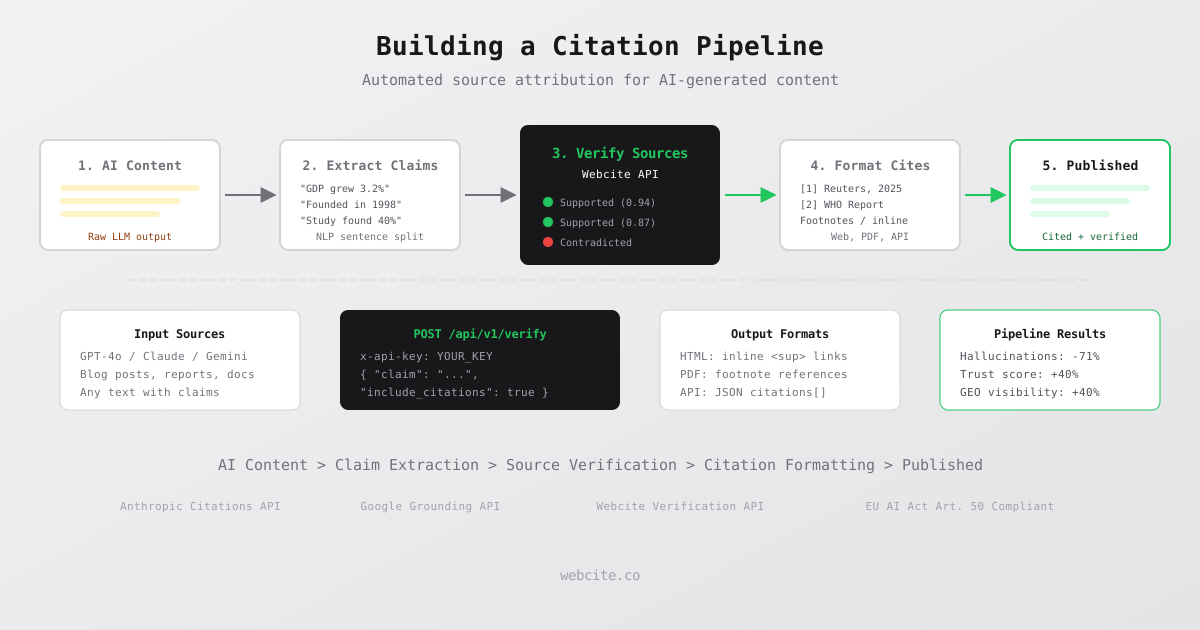
- A citation pipeline has 5 stages: ingestion, claim extraction, verification, formatting, and delivery.
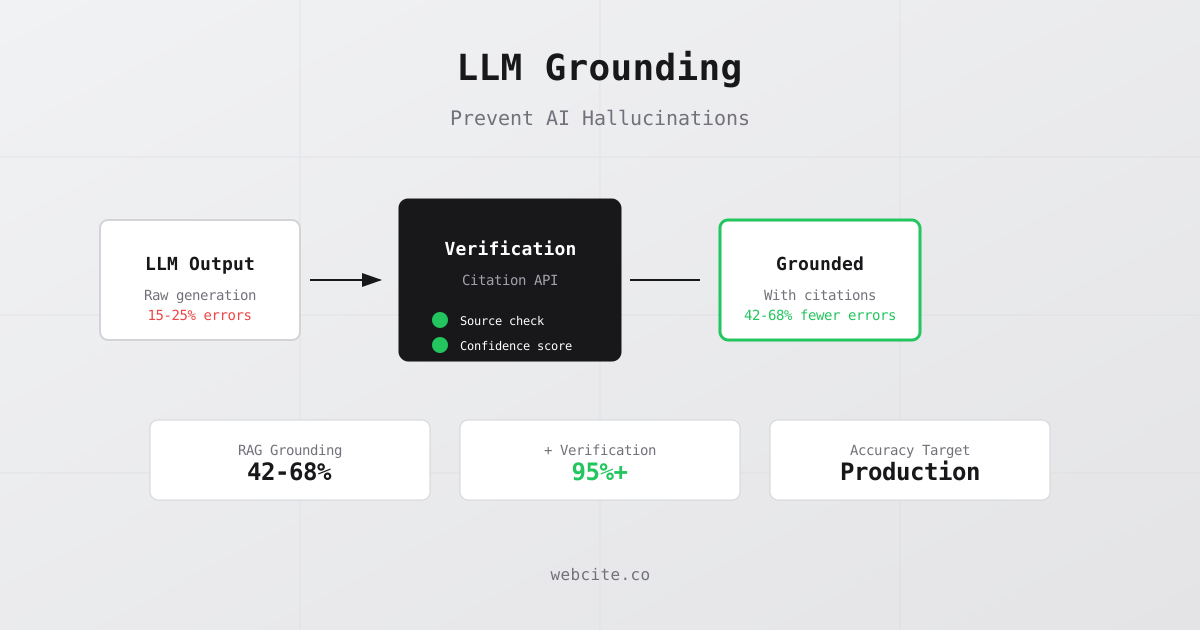
- RAG reduces hallucinations by up to 71%, but a verification layer catches the remaining errors that slip through.
- The EU AI Act Article 50 transparency rules take effect in August 2026, making source attribution a compliance requirement.
- Adding citations boosts GEO visibility by up to 40%, perPrinceton University research (Aggarwal et al., 2024).
- Webcite's REST API verifies claims and returns citations in a single POST request using an x-api-key header.
- The full pipeline adds fewer than 80 lines of code to your existing content workflow.
Why AI-Generated Content Needs a Citation Pipeline
AI content without citations has a trust problem. Only 48 percent of people trust AI-generated news, compared to 62 percent for journalist-written content, according to Reuters Institute, 2025. That 14-point trust gap costs publishers traffic, engagement, and revenue.
The trust gap exists because LLMs generate text by predicting tokens, not by consulting verified databases. OpenAI’s own research on their o3 and o4-mini reasoning models revealed hallucination rates of 33 percent and 48 percent respectively on the PersonQA benchmark, according to OpenAI, 2025. Even the best-performing models hallucinate at a rate of 0.7 to 1.5 percent on grounded summarization tasks, according to Visual Capitalist, 2025.
Citations solve three distinct problems simultaneously:
Trust. Readers can verify claims themselves. A study by Princeton University and IIT Delhi found that content with authoritative citations receives up to 40 percent more visibility in generative engine responses, according to Aggarwal et al., 2024. When you cite sources, both humans and AI systems treat your content as more credible.
SEO and GEO. Search engines and AI answer engines favor cited content. Websites that implemented structured data were 28 percent more likely to be referenced by AI systems, according to SurferSEO, 2025. As Google AI Overviews and ChatGPT search eat into traditional click-through rates, citation quality becomes a ranking signal. For more on how verification works at the API level, see our guide on what a verification API is.
Compliance. The European Commission published the first draft of its Code of Practice on AI-generated content transparency in December 2025, according to the European Commission, 2025. Article 50 of the EU AI Act takes effect in August 2026 and requires providers of general-purpose AI systems to label outputs in a machine-readable format. Source citations with structured metadata satisfy this requirement.
The Citation Landscape: Anthropic, Google, and Webcite
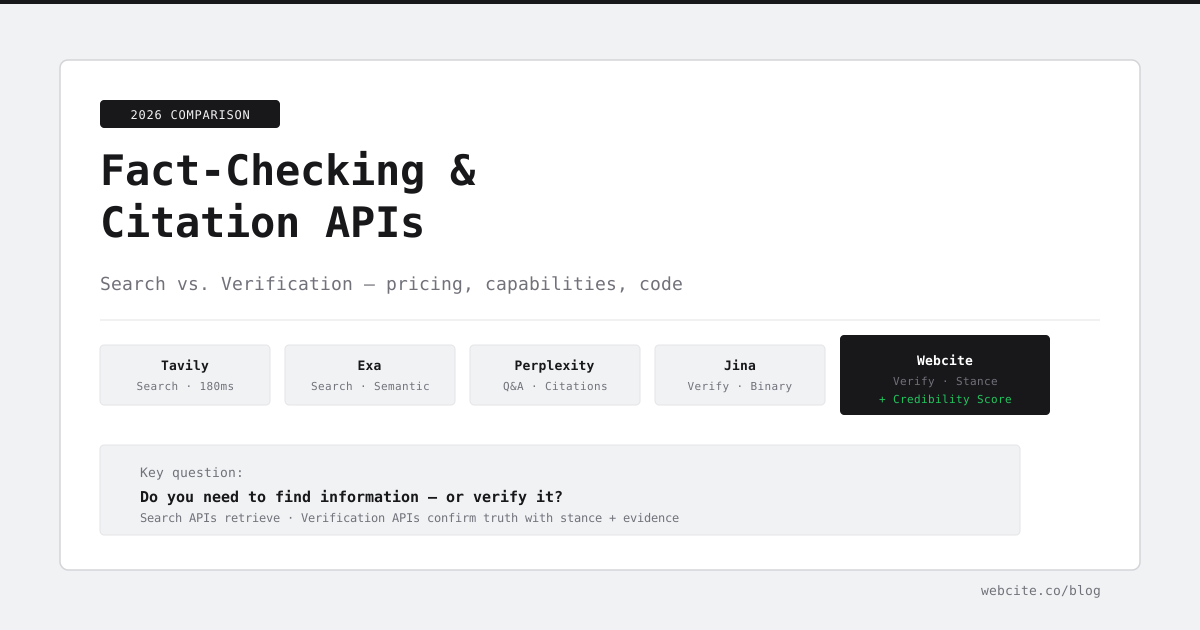
Three major approaches to AI citations have emerged, each solving a different part of the problem.
Anthropic Citations API. Launched in January 2025, the Anthropic Citations API lets Claude ground answers in user-provided source documents, according to Anthropic, 2025. When you pass PDFs or text files into the context window, Claude automatically cites the exact sentences it uses. This works well for closed-corpus scenarios where you control the source material, but it does not verify claims against the open web.
Google Grounding API. Google’s Gemini Grounding with Google Search returns two array types (groundingChunks, groundingSupports) linking response text to web sources, according to Google AI for Developers, 2025. This provides real-time web grounding but ties you to the Gemini ecosystem and does not give you a confidence score for individual claims.
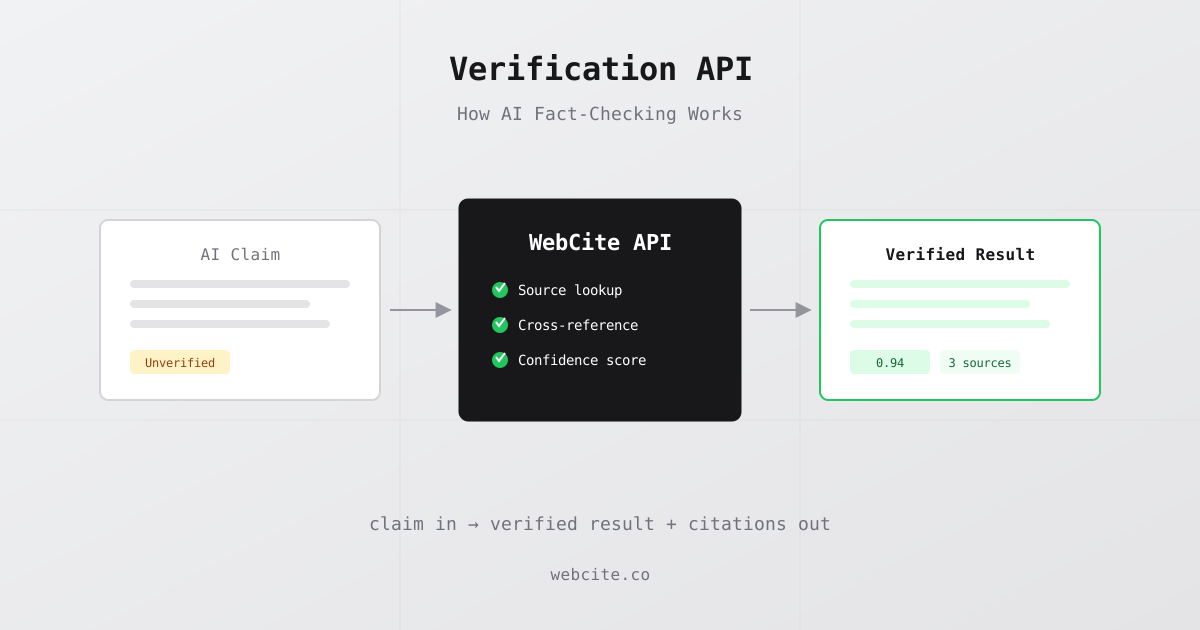
Webcite Verification API. Webcite takes a different approach: it accepts any text claim from any LLM and verifies it against external sources, returning a verdict (supported, contradicted, or insufficient evidence), a confidence score, and citation URLs. This works as a postprocessing step regardless of which model generated the content.
A citation pipeline typically combines these tools. You might use Anthropic’s Citations API for document-grounded responses, Google’s Grounding API for real-time web context, and Webcite’s Verification API as the final verification layer before publication. The rest of this tutorial focuses on the Webcite verification step because it works with any LLM output and produces the citation metadata you need for publishing.
Architecture of a Five-Stage Citation Pipeline
A production citation pipeline has five stages. Each stage is independent, testable, and replaceable.
Stage 1        Stage 2           Stage 3           Stage 4          Stage 5
Ingest    ->   Extract     ->    Verify      ->    Format     ->    Deliver
(raw text)     (claims[])        (verdicts[])      (citations[])    (output)
Stage 1: Content ingestion. Accept raw text from any source: an LLM API response, a CMS draft, a batch file, or a stream. Normalize the input to plain text.
Stage 2: Claim extraction. Parse the text into sentences and identify factual claims, those containing numbers, dates, proper nouns, or statistical language. Filter out opinions, questions, and filler sentences.
Stage 3: Source verification. Send each extracted claim to a verification API that checks it against real-world sources. Receive a verdict and confidence score for each claim.
Stage 4: Citation formatting. Transform verification results into the citation format your output requires: inline superscript links for web content, footnotes for PDFs, or structured JSON for API responses.
Stage 5: Output delivery. Combine the original text with formatted citations and deliver to the target: a CMS, a static site generator, an API response, or a document renderer.
Knowledge workers spend an average of 4.3 hours per week fact-checking AI outputs, according to Korra, 2024. This pipeline automates the bulk of that work.
Stage 1: Content Ingestion
The ingestion stage accepts content and normalizes it for processing. Keep this stage simple because it runs on every piece of content.
// stage1-ingest.js
function ingestContent(input) {
  // Accept string, object with .text, or object with .content
  const rawText = typeof input === "string"
    ? input
    : input.text || input.content || ""

  // Normalize whitespace, remove markdown formatting for claim extraction
  const normalized = rawText
    .replace(/#{1,6}\s/g, "")        // strip markdown headings
    .replace(/\*{1,2}([^*]+)\*{1,2}/g, "$1")  // strip bold/italic
    .replace(/\[([^\]]+)\]\([^)]+\)/g, "$1")   // strip markdown links
    .replace(/\s+/g, " ")
    .trim()

  return {
    raw: rawText,
    normalized,
    wordCount: normalized.split(/\s+/).length,
    timestamp: new Date().toISOString()
  }
}
This function handles three common input shapes: a plain string, an OpenAI-style response (.text), or a CMS object (.content). The normalized text strips markdown so the claim extractor works on clean sentences.
Stage 2: Claim Extraction
Claim extraction is the most nuanced stage. You want to identify sentences that make verifiable factual assertions and skip opinions, rhetorical questions, and filler.
// stage2-extract.js
function extractClaims(normalizedText) {
  const sentences = normalizedText
    .split(/(?<=[.!?])\s+/)
    .filter(s => s.trim().length > 20)

  return sentences
    .map(sentence => ({
      text: sentence.trim(),
      hasNumber: /\d/.test(sentence),
      hasProperNoun: /[A-Z][a-z]{2,}/.test(sentence.trim().slice(1)),
      hasStatisticalLanguage: /percent|%|average|median|study|research|survey|report/i.test(sentence),
      hasDate: /\b(19|20)\d{2}\b/.test(sentence)
    }))
    .filter(claim =>
      claim.hasNumber ||
      claim.hasProperNoun ||
      claim.hasStatisticalLanguage ||
      claim.hasDate
    )
    .map(claim => claim.text)
}
This heuristic filter catches most factual claims. Sentences with numbers (“grew 3.2%”), proper nouns (“Reuters reported”), statistical language (“a study found”), or dates (“in 2025”) are likely verifiable. Sentences without these signals are usually opinions or transitions.
For higher precision, you can replace the heuristic filter with an LLM-based claim classifier. Send each sentence to a small model with the prompt: “Is this sentence a verifiable factual claim? Respond yes or no.” That approach costs more but catches claims the heuristic misses.
The typical AIO-cited article covers 62 percent more facts than a non-cited article, according to Search Engine Land, 2025. Extracting and verifying more claims means your content carries more citable facts.
Stage 3: Source Verification with Webcite
This stage sends each claim to the Webcite verification API and collects results. The API returns a verdict, confidence score, and source citations for each claim.
// stage3-verify.js
async function verifyClaim(claim) {
  const response = await fetch("https://api.webcite.co/api/v1/verify", {
    method: "POST",
    headers: {
      "x-api-key": process.env.WEBCITE_API_KEY,
      "Content-Type": "application/json"
    },
    body: JSON.stringify({
      claim: claim,
      include_stance: true,
      include_verdict: true,
      include_citations: true
    })
  })

  if (!response.ok) {
    throw new Error(`Verification failed: ${response.status}`)
  }

  return response.json()
}

async function verifyAllClaims(claims) {
  const results = await Promise.allSettled(
    claims.map(claim => verifyClaim(claim))
  )

  return results.map((result, index) => ({
    claim: claims[index],
    verified: result.status === "fulfilled",
    verdict: result.status === "fulfilled"
      ? result.value.verdict?.result
      : "error",
    confidence: result.status === "fulfilled"
      ? result.value.verdict?.confidence
      : 0,
    citations: result.status === "fulfilled"
      ? result.value.citations || []
      : []
  }))
}
This code uses Promise.allSettled (not Promise.all) so that one failed verification (network error, rate limit) does not stop the pipeline from processing the rest. This matters in production where you verify dozens of claims per article.
For large batch jobs, add rate limiting. Webcite’s free tier includes 50 credits per month. Each verification with citations uses approximately 4 credits. The Builder plan at $20/month provides 500 credits, which covers roughly 125 verifications. For high-volume pipelines, Enterprise plans start at 10,000 credits. To learn how to integrate fact-checking into interactive applications, see our tutorial on adding fact-checking to your AI chatbot.
// Rate-limited batch verification
async function verifyBatch(claims, delayMs = 200) {
  const results = []
  for (const claim of claims) {
    const result = await verifyClaim(claim)
    results.push({
      claim,
      verified: true,
      verdict: result.verdict?.result,
      confidence: result.verdict?.confidence,
      citations: result.citations || []
    })
    await new Promise(resolve => setTimeout(resolve, delayMs))
  }
  return results
}
Stage 4: Citation Formatting
The formatting stage transforms raw verification results into publication-ready citations. Different output channels need different formats.
// stage4-format.js
function formatForWeb(text, verificationResults) {
  let annotated = text
  const footnotes = []
  let footnoteIndex = 1

  for (const result of verificationResults) {
    if (result.verdict !== "supported" || result.citations.length === 0) {
      continue
    }

    const citation = result.citations[0]
    const superscript = `<sup><a href="${citation.url}" `
      + `title="${citation.title}" `
      + `target="_blank" rel="noopener">[${footnoteIndex}]</a></sup>`

    // Insert superscript after the first occurrence of the claim
    const claimSnippet = result.claim.slice(0, 60)
    const insertPoint = annotated.indexOf(claimSnippet)
    if (insertPoint !== -1) {
      const sentenceEnd = annotated.indexOf(".", insertPoint)
      if (sentenceEnd !== -1) {
        annotated = annotated.slice(0, sentenceEnd + 1)
          + superscript
          + annotated.slice(sentenceEnd + 1)
      }
    }

    footnotes.push({
      index: footnoteIndex,
      title: citation.title,
      url: citation.url,
      accessed: new Date().toISOString().split("T")[0]
    })
    footnoteIndex++
  }

  return { annotated, footnotes }
}

function formatForPdf(text, verificationResults) {
  const footnotes = []
  let footnoteIndex = 1
  let annotated = text

  for (const result of verificationResults) {
    if (result.verdict !== "supported" || result.citations.length === 0) {
      continue
    }

    const citation = result.citations[0]
    const marker = `[${footnoteIndex}]`

    const claimSnippet = result.claim.slice(0, 60)
    const insertPoint = annotated.indexOf(claimSnippet)
    if (insertPoint !== -1) {
      const sentenceEnd = annotated.indexOf(".", insertPoint)
      if (sentenceEnd !== -1) {
        annotated = annotated.slice(0, sentenceEnd + 1)
          + marker
          + annotated.slice(sentenceEnd + 1)
      }
    }

    footnotes.push(
      `${footnoteIndex}. ${citation.title}. ${citation.url}. `
      + `Accessed ${new Date().toISOString().split("T")[0]}.`
    )
    footnoteIndex++
  }

  return {
    body: annotated,
    footnoteSection: "References\n\n" + footnotes.join("\n")
  }
}

function formatForApi(verificationResults) {
  return {
    citations: verificationResults
      .filter(r => r.verdict === "supported" && r.citations.length > 0)
      .map((r, i) => ({
        index: i + 1,
        claim: r.claim,
        confidence: r.confidence,
        source: {
          title: r.citations[0].title,
          url: r.citations[0].url
        }
      })),
    warnings: verificationResults
      .filter(r => r.verdict === "contradicted")
      .map(r => ({
        claim: r.claim,
        verdict: r.verdict,
        confidence: r.confidence
      }))
  }
}
The web formatter inserts superscript (<sup>) links inline and builds a footnotes array for a references section. The PDF formatter uses numeric markers with a plain-text references block. The API formatter returns structured JSON that frontend clients can render however they choose.
LLMs are 28 to 40 percent more likely to cite content with clear formatting, including hierarchical headings, bullet points, and structured references, according to HubSpot, 2025. Proper citation formatting does not just help human readers; it makes your content more likely to be cited by AI systems in turn.
Stage 5: Output Delivery and the Complete Pipeline
The final stage ties everything together into a single function you can call from any workflow.
// pipeline.js
async function runCitationPipeline(input, options = {}) {
  const {
    format = "web",   // "web" | "pdf" | "api"
    batchDelay = 200,
    minConfidence = 0.7
  } = options

  // Stage 1: Ingest
  const { raw, normalized } = ingestContent(input)

  // Stage 2: Extract claims
  const claims = extractClaims(normalized)

  if (claims.length === 0) {
    return { text: raw, citations: [], warnings: [] }
  }

  // Stage 3: Verify
  const results = await verifyBatch(claims, batchDelay)

  // Filter by confidence threshold
  const filtered = results.map(r => ({
    ...r,
    verdict: r.confidence >= minConfidence ? r.verdict : "low_confidence"
  }))

  // Stage 4: Format
  if (format === "web") {
    const { annotated, footnotes } = formatForWeb(raw, filtered)
    return { text: annotated, citations: footnotes, warnings: [] }
  }

  if (format === "pdf") {
    return formatForPdf(raw, filtered)
  }

  return formatForApi(filtered)
}
Here is how you call it in a Node.js Express handler:
app.post("/api/publish", async (req, res) => {
  const { content, outputFormat } = req.body

  const result = await runCitationPipeline(content, {
    format: outputFormat || "api",
    minConfidence: 0.75
  })

  res.json(result)
})
And in a Python Flask application using requests:
import requests
import os

def verify_claim(claim):
    response = requests.post(
        "https://api.webcite.co/api/v1/verify",
        headers={
            "x-api-key": os.environ["WEBCITE_API_KEY"],
            "Content-Type": "application/json"
        },
        json={
            "claim": claim,
            "include_stance": True,
            "include_verdict": True,
            "include_citations": True
        }
    )
    response.raise_for_status()
    return response.json()
The entire pipeline, from ingestion through delivery, adds fewer than 80 lines of application logic to your existing content workflow. The rest is configuration and error handling.
Handling Edge Cases in Production
Production citation pipelines encounter several edge cases that the basic implementation does not cover.
Contradicted claims. When the API returns a “contradicted” verdict, you have three options: flag the claim with a warning label, remove the sentence entirely, or send the claim back to the LLM with the contradicting source and ask for a corrected version. The right choice depends on your use case. News publishers flag. Legal teams remove. Content platforms regenerate.
Rate limits and failures. Use exponential backoff on API errors. Cache verification results for identical claims to avoid redundant calls. A claim like “water boils at 100 degrees Celsius” does not need re-verification every time it appears.
Ambiguous claims. Some sentences contain partial facts mixed with opinion. “Apple’s revenue grew significantly in Q3” contains a verifiable entity (Apple, Q3 revenue) but “significantly” is subjective. The claim extractor should split this into the factual component before sending it to verification.
Long-form content. For articles over 3,000 words, batch claims in groups of 10 to 15 and process groups sequentially with delays between them. This prevents rate limiting and keeps memory usage stable.
Employees spend approximately $14,200 per year per person on manual AI content verification, according to Korra, 2024. Even a partially automated pipeline that handles 70 percent of claims saves thousands of dollars annually per content team member.
EU AI Act Compliance and Why It Matters Now
The EU AI Act is not a future concern; it is an active regulation with a phased rollout. The transparency obligations in Article 50 become enforceable on August 2, 2026, according to the European Commission, 2025. Organizations using general purpose AI systems to generate content for public consumption must mark that content as AI-generated in a machine-readable format.
The European Commission published the first draft of its Code of Practice on marking and labelling AI-generated content in December 2025, with the second draft expected by mid-March 2026 and the final version by June 2026, according to Jones Day, 2026.
A citation pipeline helps with compliance in three ways. First, the structured citation metadata (source URL, access date, confidence score) serves as provenance documentation. Second, the verification verdicts create an audit trail showing that claims were checked before publication. Third, the pipeline output can include machine-readable markers that satisfy the labelling requirement.
Non-compliance penalties under the EU AI Act can reach 35 million euros or 7 percent of global annual turnover, whichever is higher, according to the EU AI Act, Article 99. Building the citation infrastructure now, before the August 2026 deadline, is significantly cheaper than retrofitting after enforcement begins.
Measuring Pipeline Effectiveness
Track four metrics to evaluate your citation pipeline:
Coverage rate. The percentage of factual claims that receive a verification verdict. Target 90 percent or higher. Low coverage means your claim extractor is missing sentences or the API is failing silently.
Citation accuracy. Spot-check a sample of verified claims each week. Are the cited sources actually relevant to the claims? A 95 percent accuracy rate is a reasonable target.
Contradiction rate. The percentage of claims that come back as “contradicted.” If this exceeds 10 percent, your LLM generation step needs tuning, either better prompts, better retrieval, or a different model.
Latency per claim. Measure the time from claim submission to verdict receipt. For web publishing workflows, under 3 seconds per claim is acceptable. For real-time applications, consider the asynchronous patterns described in our chatbot fact-checking guide.
RAG reduces hallucinations by 40 to 71 percent depending on implementation quality, according to AllAboutAI, 2026. A citation pipeline catches errors in the remaining 29 to 60 percent, giving you a defense-in-depth strategy that no single tool provides alone.
Frequently Asked Questions
What is a citation pipeline for AI content?
A citation pipeline is an automated system that extracts factual claims from AI-generated text, verifies each claim against real-world sources, and formats the results as inline citations or footnotes. It runs as a downstream processing step after LLM generation and before publication. The pipeline works with output from any LLM provider because it processes plain text, not model-specific response formats.
How many stages does a typical citation pipeline have?
A typical citation pipeline has five stages: content ingestion, claim extraction, source verification, citation formatting, and output delivery. Each stage can run independently, which makes the pipeline easy to test, debug, and scale. You can swap individual stages without rewriting the entire system.
Does the EU AI Act require citations on AI-generated content?
Article 50 of the EU AI Act, enforceable from August 2026, requires providers and deployers of multipurpose AI systems to mark AI-generated content in a machine-readable format. While it does not mandate inline citations specifically, source attribution with structured metadata satisfies the transparency obligation and creates an audit trail that demonstrates compliance.
How much does it cost to run a citation pipeline?
Webcite offers 50 free credits per month, enough to verify about 12 claims. The Builder plan at $20/month provides 500 credits for 125 verifications. Enterprise plans start at 10,000 credits per month for high-volume pipelines. Manual fact-checking costs approximately $14,200 per employee per year, making API-based verification significantly cheaper at scale.
Can a citation pipeline work with any LLM provider?
Yes. Because the pipeline runs as a output processing step on plain text output, it works with content from OpenAI GPT-4o, Anthropic Claude, Google Gemini, Mistral, or any other provider. The verification API receives text claims, not model-specific formats, so it is entirely provider-agnostic. You can also use it on human-written content that needs source verification.