AI search adoption nearly doubled from 14% to 29.2% in 2025, according to SparkToro, 2025. Three platforms now dominate AI-powered search: Perplexity with 22 million monthly active users, Google AI Overviews integrated into 57% of all search results, and ChatGPT processing approximately 2.5 billion daily prompts across 800 million weekly users. Each platform cites sources differently, rewards different content attributes, and reaches different audiences. This comparison breaks down citation models, user demographics, accuracy characteristics, and the optimization strategies that work for each platform.
- ChatGPT reaches 800M weekly users with 2.5B daily prompts; Google AI Overviews appear in 57% of 8.5B daily searches; Perplexity has 22M+ monthly active users.
- Each platform has a distinct citation model: Perplexity leads with citations, Google leads with summaries, ChatGPT blends retrieval with training data.
- AI search adoption nearly doubled from 14% to 29.2% in 2025 (SparkToro).
- An average LLM visitor is worth 4.4x a traditional organic search visitor in engagement metrics.
- Content verification (factual accuracy plus source attribution) improves citation probability across all three platforms.
- Optimizing for shared citation signals, including sourced statistics, entity density, and leading with direct answers, works across all platforms.
Platform Overview: Scale, Model, and Approach
The three AI search platforms differ fundamentally in architecture, audience, and citation philosophy. Understanding these differences is essential before optimizing content for any of them.
Perplexity: Citation-First Search
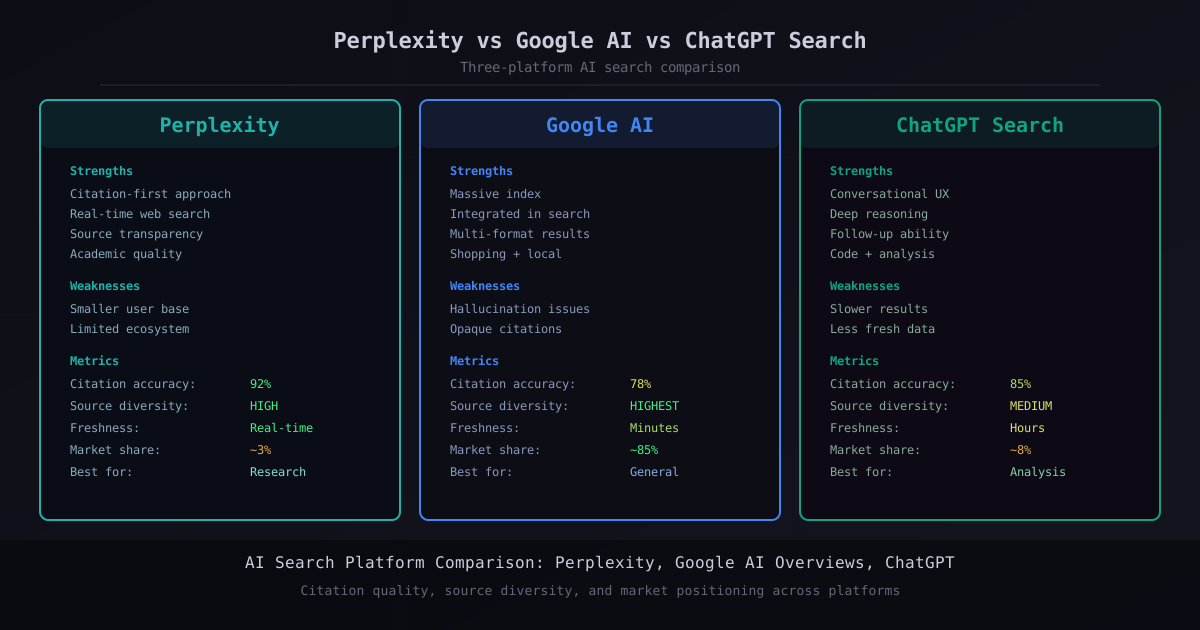
Perplexity was purpose-built for AI-native search. It launched in 2022 and reached 22 million monthly active users by late 2025, processing over 780 million search queries per month, according to DemandSage, 2026. Perplexity raised $500 million in funding and reached a $9 billion valuation in December 2024, according to The Verge, 2024.
Perplexity’s defining characteristic is its citation-first model. Every factual statement in a Perplexity response is attributed to a specific source with a numbered inline reference. Users can see exactly which source supports which claim. This transparency makes Perplexity the preferred tool for researchers, journalists, and professionals who need to verify the provenance of information.
The platform offers focus modes that let users restrict searches to specific source types: academic papers, Reddit discussions, YouTube videos, or recent news. This targeting produces more precise citations for specialized queries. Perplexity Pro uses multiple models (including GPT-4o, Claude 3.5, and Perplexity’s own models) and supports file uploads, image understanding, and multi-step research workflows.
Google AI Overviews: Integrated Search Summaries
Google AI Overviews are not a separate product. They are an AI layer integrated into Google’s existing search experience, appearing above the traditional organic results. When triggered, they generate a summary answer and display source links alongside or below the generated text.
Google processes 8.5 billion searches per day, according to Internet Live Stats, 2024. AI Overviews appear in approximately 57% of search results pages, according to Seer Interactive, 2025. That means AI Overviews reach a far larger audience than any standalone AI search product. Even at 57% coverage, the raw volume of AI Overview impressions dwarfs Perplexity’s and ChatGPT Search’s combined query volume.
Google AI Overviews use a summary-first approach. The system generates the answer, then attributes it to sources from Google’s existing search index. Source links appear as expandable citations or card-style links. The citation model favors authoritative domains that already rank well in traditional organic search, creating a strong correlation between existing SEO performance and AI Overview citation.
ChatGPT Search: Conversational Discovery
OpenAI introduced ChatGPT’s Browse with Bing feature and iteratively expanded it into a full search capability. ChatGPT now serves over 800 million weekly active users and processes approximately 2.5 billion daily prompts, according to DemandSage, 2026. Not all of those prompts are search queries, but OpenAI reported that ChatGPT Search handles millions of search sessions daily and continues to grow.
ChatGPT Search blends two information sources: real-time web retrieval (via Bing) and the model’s training data. For current events and recent information, ChatGPT retrieves and cites live web sources. For foundational knowledge, it draws on training data without specific citation. This hybrid approach means some claims in a ChatGPT response have inline source links while others do not.
The conversational interface is ChatGPT’s primary differentiator for search. Users can ask follow-up questions, refine their query, and explore topics through multi-turn dialogue. This interaction pattern produces longer sessions and deeper engagement compared to single-query search models.
Side-by-Side Comparison
| Dimension | Perplexity | Google AI Overviews | ChatGPT Search |
|---|---|---|---|
| Monthly active users | 22M+ | Billions (integrated into Google) | 800M+ weekly |
| Daily queries | ~26M | ~4.8B with AI Overviews | ~2.5B prompts (not all search) |
| Citation model | Citation-first, per-claim | Summary-first, source cards | Hybrid: retrieval + training data |
| Sources per response | 5-7 average | 3-5 average | 3-6 average |
| Real-time retrieval | Yes, always | Yes, always | Yes, when triggered |
| Training data fallback | Minimal | No | Significant |
| Source transparency | High (numbered refs) | Medium (expandable links) | Medium (inline links, some uncited) |
| Preferred content signals | Specific passages, data tables | Domain authority, structured data | Comprehensive coverage, freshness |
| Multi-turn conversation | Yes | Limited | Yes (core feature) |
| Academic/research focus | Yes (focus modes) | No | Limited |
| API available | Yes (paid) | No (integrated into Search) | Yes (via function calling) |
| Revenue model | Subscription ($20/mo Pro) + ads | Ad-supported search | Subscription ($20/mo Plus) |
How Each Platform Selects Sources to Cite
The citation selection process differs across all three platforms, and understanding these differences is the key to optimization.
Perplexity’s Citation Selection
Perplexity retrieves sources in real time for every query and evaluates them at the passage level. The system looks for specific, attributable passages that directly answer the user’s question. Content with data tables, step-by-step instructions, and sourced statistics performs disproportionately well because Perplexity can extract and cite specific claims.
Perplexity’s citation behavior favors specificity over authority. A blog post from a niche expert with detailed, sourced data can outperform a generic overview from a major publication. This makes Perplexity the most accessible platform for smaller publishers to earn citations.
The platform also has a recency bias for queries where freshness matters. Perplexity’s real-time retrieval means it often cites content published within the past 24 to 48 hours for news-related queries, giving timely publishers an advantage.
Google AI Overviews’ Citation Selection
Google AI Overviews draw from Google’s existing search index, which means domain authority and traditional SEO signals carry significant weight. Research from Authoritas found that 78% of URLs cited in AI Overviews already ranked on page one for the triggering query, according to Authoritas, 2025. The correlation between organic rank and AI Overview citation is strong.
However, not every page-one result gets cited. Google AI Overviews favor pages with structured data markup (FAQ schema, HowTo schema, article schema), clear heading hierarchy, and extractable answer passages. Pages that bury their key points in dense paragraphs without structure are less likely to be cited even if they rank well organically.
Brands cited in AI Overviews earn 35% more organic clicks and 91% more paid clicks than non-cited brands, according to BrightEdge, 2025. For queries where AI Overviews appear, organic click-through rates drop 58% for non-cited results, according to Seer Interactive, 2025. The citation effect is a massive differentiator in traffic outcomes.
ChatGPT Search’s Citation Selection
ChatGPT’s citation behavior is the least transparent of the three. The system retrieves real-time results via Bing for current-events queries and appends source links to the generated response. For knowledge queries, ChatGPT relies more heavily on its training data, which means some information in the response has no specific citation.
ChatGPT favors comprehensive, authoritative content. Pages that cover a topic thoroughly with multiple sections, examples, and supporting evidence are more likely to be cited than pages that cover a narrow aspect. This rewards pillar-style content over short-form articles.
The training data dimension is unique to ChatGPT. Content that was available during the model’s training cutoff (and indexed by Common Crawl, Wikipedia, or other training data sources) can influence ChatGPT’s responses even without real-time retrieval. This creates a long-tail citation effect where well-established, frequently referenced content receives implicit citation weight.
Optimization Strategies by Platform
Optimizing for Perplexity
Perplexity rewards passage-level specificity. Structure your content so that individual paragraphs contain complete, citable claims with source attribution.
- Use data tables. Perplexity frequently cites content that contains structured data in table format. Tables with comparison data, pricing information, or statistical summaries are high-value citation targets.
- Include sourced statistics in standalone sentences. “The deepfake detection market is growing 42% annually to $15.7 billion by 2026, per MarketsandMarkets” is more citable than a statistic buried in a paragraph alongside unrelated information.
- Leverage focus modes. Perplexity users can restrict searches to specific source types. Academic content performs well in the “Academic” focus mode. Recent blog posts and articles perform well in the “All” mode.
- Publish frequently. Perplexity’s recency bias means that fresh content has an advantage for time-sensitive queries.
Optimizing for Google AI Overviews
Google AI Overviews reward domain authority combined with on-page structure.
- Maintain strong traditional SEO. If you don’t rank on page one, AI Overviews are unlikely to cite you. Domain authority, backlink profile, and technical SEO remain essential.
- Add structured data markup. FAQ schema, article schema, and HowTo schema help Google parse your content into citable segments.
- Use clear heading hierarchy with search-query phrasing. H2s that match common search queries (like “How does X work?” or “What is the cost of Y?”) align your content with the queries that trigger AI Overviews.
- Keep content updated. Google AI Overviews weight freshness signals. Update key pages with current statistics and “last modified” dates.
Optimizing for ChatGPT Search
ChatGPT Search rewards comprehensive coverage and authoritative depth.
- Create pillar content. Long-form, comprehensive guides that cover a topic from multiple angles are more likely to be cited than narrow articles.
- Include multiple evidence types. ChatGPT responds well to content that combines statistics, examples, code samples, and expert quotations in a single piece.
- Ensure broad indexing. ChatGPT’s retrieval is powered by Bing. Make sure your content is indexed in Bing Webmaster Tools, not just Google Search Console.
- Build topic authority. ChatGPT’s training data gives weight to content from domains that are frequently referenced across the web. Publishing consistently on your core topics builds the topical authority that influences ChatGPT’s training data weighting.
The Cross-Platform Optimization Stack
Despite platform differences, a core set of optimization techniques works across all three. These shared signals form the foundation of any AI citation strategy.
Sourced statistics with inline citations. Princeton and Georgia Tech research found that adding cited statistics improved AI visibility by 32%, and this effect held across different generative engines, according to Aggarwal et al., KDD 2024. All three platforms prioritize content with verifiable, attributed claims.
Answer-first content structure. Leading with the direct answer in each section helps all three platforms extract citable passages. AI systems parse content top-down; burying key information reduces citation probability across the board.
Entity density. Named entities (companies, people, tools, standards, organizations) provide anchoring points for all three AI systems. Content with 10+ unique named entities outperforms low-entity content in citation frequency across platforms.
Factual accuracy. This is the universal citation signal. All three platforms aim to cite reliable content, and content that passes verification checks is more likely to be selected. Verification through a tool like Webcite ensures your claims are accurate and produces the source citations that improve citation structure. For a deep dive into GEO techniques, see our guide on what is Generative Engine Optimization.
Content Verification as Cross-Platform Insurance
Different platforms have different hallucination and accuracy profiles, but all three aim to cite accurate content. Content that is demonstrably accurate through source attribution performs well everywhere.
A verification API provides two benefits for AI citation optimization. First, it confirms that your claims are factually correct, preventing the credibility damage that comes from being cited for incorrect information. Second, the verification process produces structured citations (source URLs, relevant passages, confidence scores) that you can incorporate into your content, directly improving its citation-worthiness.
import requests

def verify_and_cite(claim):
    response = requests.post(
        "https://api.webcite.co/api/v1/verify",
        headers={
            "x-api-key": "your-api-key",
            "Content-Type": "application/json"
        },
        json={
            "claim": claim,
            "include_stance": True,
            "include_verdict": True
        }
    )
    result = response.json()
    verdict = result.get("verdict", {})
    citations = result.get("citations", [])
    return {
        "is_supported": verdict.get("result") == "supported",
        "confidence": verdict.get("confidence"),
        "sources": [
            {"title": c.get("title"), "url": c.get("url")}
            for c in citations
        ]
    }

## Verify a claim before publishing
result = verify_and_cite("AI search adoption doubled from 14% to 29.2% in 2025")
## Use the returned sources as inline citations in your content
Webcite’s free tier includes 50 credits per month (12 full verifications). The Builder plan at $20 per month provides 500 credits for 125 verifications. Enterprise plans start at 10,000+ credits with custom pricing.
The Future of AI Search: Convergence and Competition
The three platforms are converging in capabilities while differentiating on user experience.
Google is making AI Overviews more conversational, adding suggested next questions and expanding the query types that trigger overviews. Sundar Pichai stated that AI Overviews are already increasing search usage, and Google plans to expand them to all markets, according to The Verge, 2025.
Perplexity is expanding beyond search into “answer engine” territory, adding features like Perplexity Pages (long-form AI-generated articles) and Perplexity Spaces (collaborative research). The platform is also building an advertising model to supplement subscription revenue, according to TechCrunch, 2025.
OpenAI continues to integrate search deeper into ChatGPT, making real-time retrieval a default behavior rather than an opt-in feature. The boundary between “chatbot” and “search engine” is dissolving, and ChatGPT’s 800 million weekly users represent a massive audience that publishers can reach through citation optimization.
For content creators, the strategic implication is clear: optimize for the shared signals (sourced statistics, entity density, answer-first structure, factual accuracy) and layer platform-specific techniques on top. The shared foundation works across all three platforms, reducing the marginal cost of optimizing for each additional platform.
Gartner predicts traditional search volume will drop 25% by 2026, according to Gartner, 2024. The traffic that leaves traditional search will flow to these three platforms and their successors. Content that is optimized for AI citation captures that traffic. Content that is not will see organic visibility erode steadily as users migrate from clicking links to reading AI-generated answers.
Frequently Asked Questions
Which AI search platform has the most users?
ChatGPT has the largest user base with over 800 million weekly active users and approximately 2.5 billion daily prompts. Google AI Overviews reaches the broadest audience by appearing in 57% of all search results across Google’s 8.5 billion daily queries. Perplexity has over 22 million monthly active users, the smallest of the three but the fastest growing in percentage terms.
How does Perplexity cite sources differently from Google AI Overviews?
Perplexity uses a citation-first model that attributes every factual claim to a specific source with numbered inline references. Google AI Overviews use a summary-first model that generates the answer and appends source links below or beside the generated text. Perplexity’s approach provides more granular attribution at the claim level.
Does ChatGPT Search cite sources?
Yes. ChatGPT’s search feature (Browse with Bing) retrieves real-time information and includes inline citations with source links. However, ChatGPT also draws on its training data for context, which means some claims in a response may be sourced from pre-training rather than live retrieval. The training data portion is not individually cited.
Which AI search platform is best for research?
Perplexity is generally considered the best for research because of its source attribution design, transparency, and focus mode options that let users restrict searches to academic papers, recent news, or specific domains. Google AI Overviews are best for quick factual answers. ChatGPT Search is best for conversational exploration where users want to ask follow-up questions.
How do you optimize content to be cited by all three platforms?
Focus on the shared citation signals: sourced statistics with inline references, answer-first content structure, high entity density, and factual accuracy. Content that passes verification checks performs well across all three platforms because each engine prioritizes reliable, well-attributed claims. Platform-specific optimizations layer on top of this shared foundation.
Is AI search replacing traditional Google search?
AI search is supplementing, not fully replacing, traditional search. AI search adoption nearly doubled from 14% to 29.2% in 2025. Gartner predicts traditional search volume will drop 25% by 2026. Google is adapting by integrating AI Overviews into its existing search rather than building a separate product, which means traditional and AI search will coexist for the foreseeable future.