A verification API is a programmatic interface that checks claims against real-world sources and returns structured citations with confidence scores. The global AI market is projected to reach $254 billion in 2025, according to Statista, 2025, and as AI-generated content scales, automated fact-checking has shifted from optional to essential. This article explains how verification APIs work, how they differ from search APIs, and when your application needs one.
- A verification API checks claims against sources and returns citations with confidence scores, not just links.
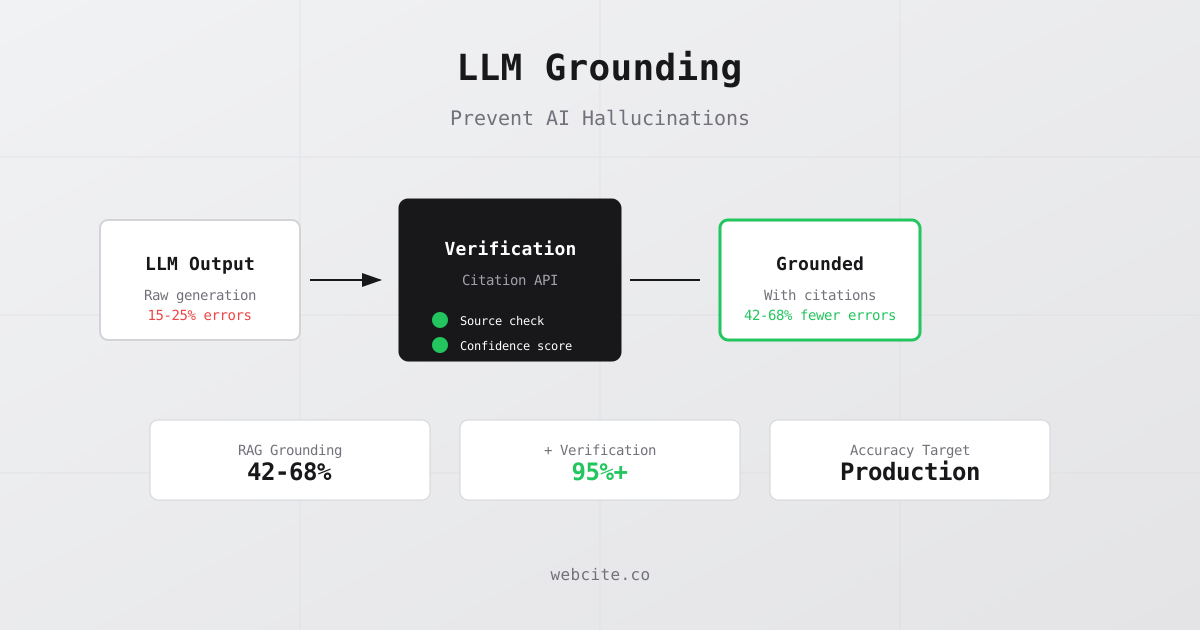
- Stanford researchers found that even RAG-based AI tools hallucinate in 17 to 33 percent of queries.
- Search APIs retrieve information; verification APIs confirm whether that information is true.
- Webcite provides end-to-end fact-checking with source credibility scoring in a single API call.
- EU AI Act Article 50 mandates AI output transparency by August 2026, making verification a compliance requirement.
How Does a Verification API Work?
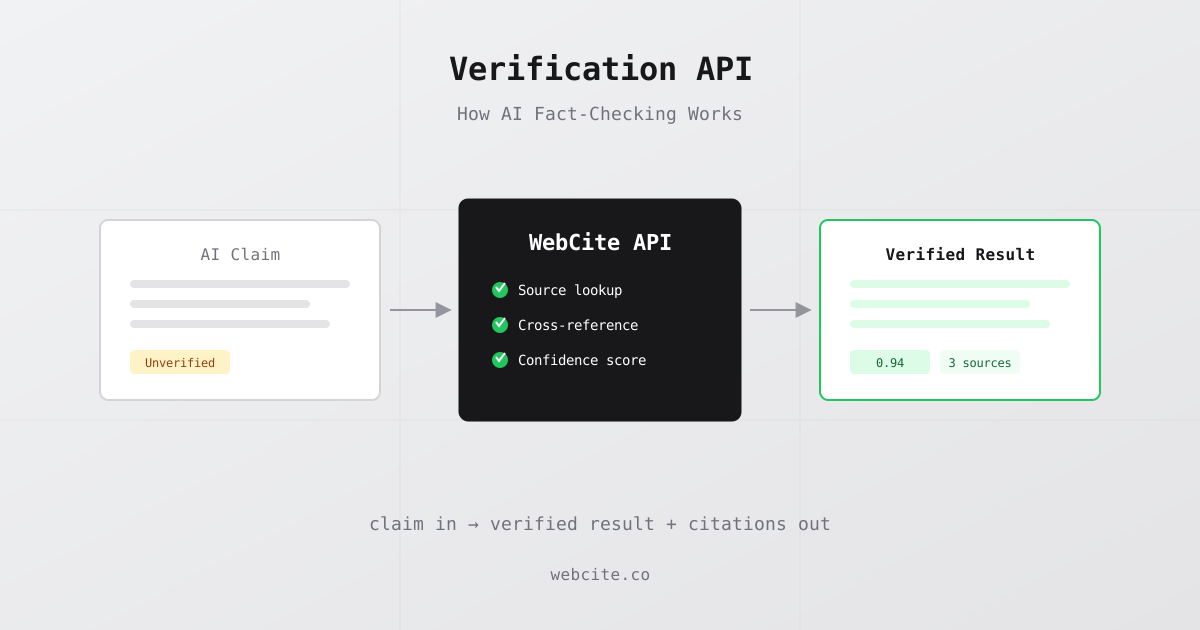
A verification API processes claims through a multi-stage pipeline that retrieves sources, evaluates credibility, and returns structured results. Unlike a search API that stops at returning links, a verification API completes the full verification loop.
The pipeline has four stages:
-
Claim extraction: The API identifies discrete, verifiable claims within the input text. A single paragraph with three factual statements produces three separate verification tasks.
-
Source retrieval: For each claim, the API searches across web, academic, and news sources to find relevant evidence. This step resembles what search APIs do, but the scope is targeted to the specific claim rather than a broad keyword query.
-
Credibility assessment: The API evaluates each source for reliability. A peer-reviewed paper from Stanford carries more weight than an anonymous blog post. Source type, publication date, domain authority, and cross-reference frequency all factor into the credibility score.
-
Verdict generation: The API returns a structured response for each claim, including a verdict (supported, refuted, or insufficient evidence), a confidence score, and the citations that support the verdict.
Webcite completes all four stages in a single API call. The response includes confidence scores for each claim, source-type metadata, and extracted passages with page-level precision. Here is what a typical call looks like:
curl -X POST https://api.webcite.co/api/v1/verify \
  -H "x-api-key: YOUR_API_KEY" \
  -H "Content-Type: application/json" \
  -d '{
    "claim": "RAG eliminates AI hallucinations",
    "sources": 5,
    "format": "structured"
  }'
{
  "verdict": "refuted",
  "confidence": 0.89,
  "citations": [{ "source": "Stanford Law (2024)", "..." }]
}
This is a fundamentally different operation from a search query. A search returns ten blue links. A verification returns a verdict.
How Is a Verification API Different from a Search API?
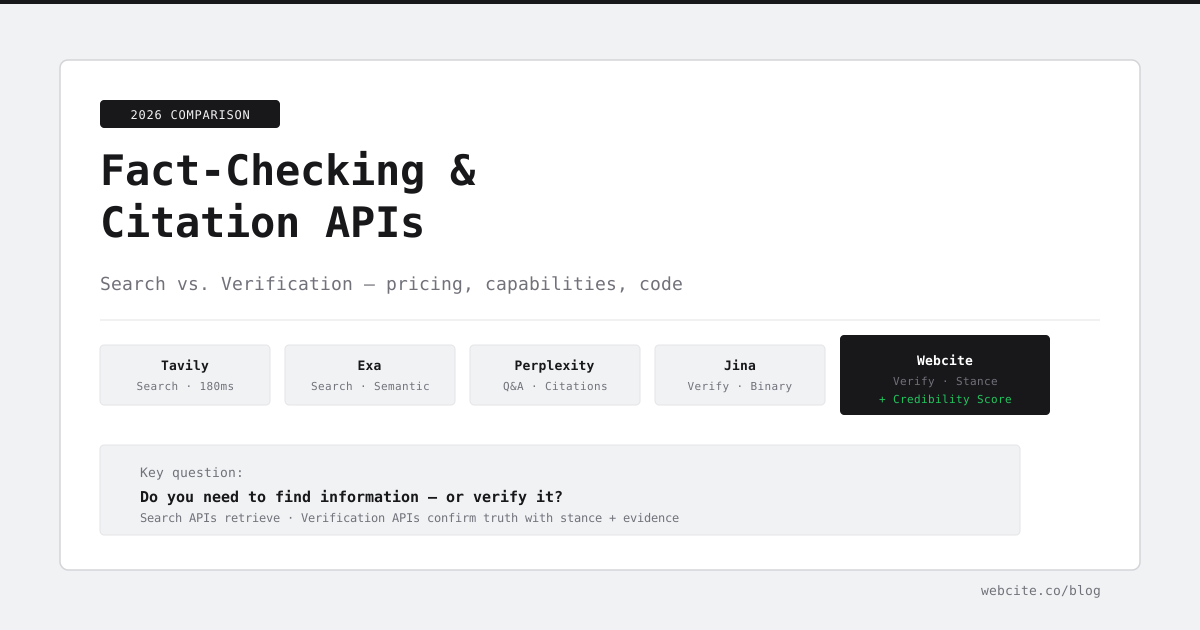
Search APIs and verification APIs serve different purposes. A search API takes a query and returns a ranked list of web results. A verification API takes a claim and returns a verdict with evidence.
The distinction matters because search results don’t tell you whether a claim is true. They tell you which web pages mention the topic. A developer building an AI writing tool with Tavily or Brave Search API still has to build their own verification logic on top of the search results. With a verification API like Webcite, the verification is the product.
| Capability | Search API | Verification API |
|---|---|---|
| Input | Keyword or query | Specific claim |
| Output | Ranked list of URLs | Verdict + citations + confidence |
| Source evaluation | None | Credibility scoring |
| Claim extraction | None | Automatic |
| Citation format | Raw links | Structured with passages |
| Confidence scoring | None | Per-claim scores |
Consider how Perplexity, Exa, and Tavily handle a request. You send a search query. You receive results, sometimes with snippets. Your application then determines which results are relevant, whether they support or contradict the claim, and how credible each source is. That entire verification layer is left to you.
A verification API eliminates that engineering burden. It is the difference between buying lumber and buying a house.
Why Search Alone Does Not Prevent AI Hallucinations
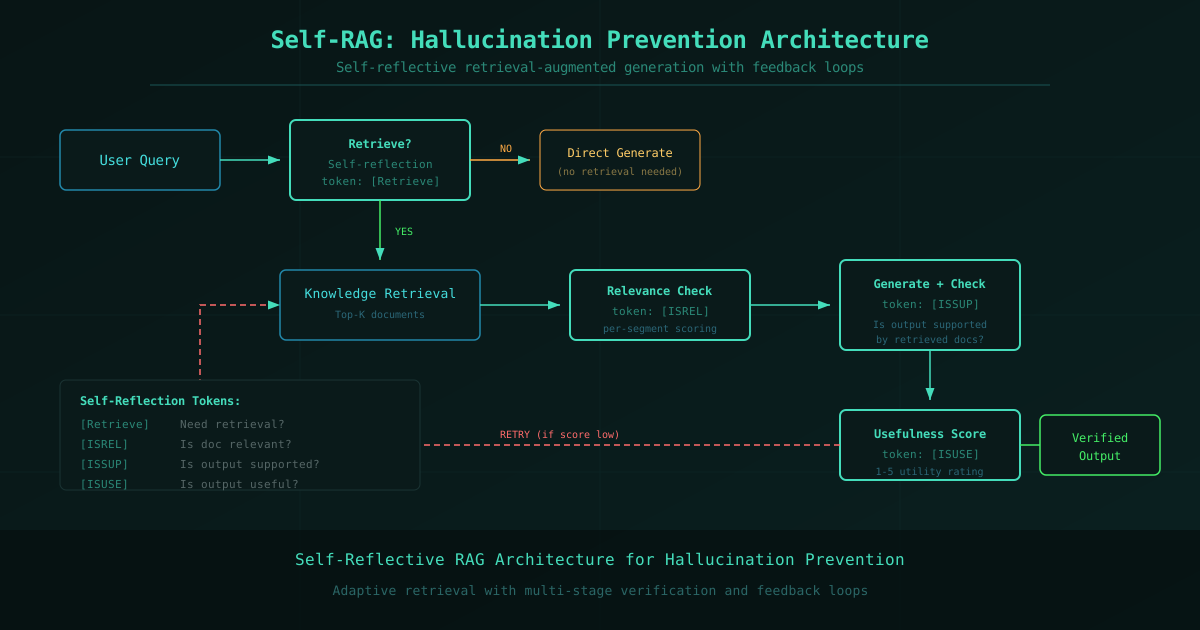
RAG (Retrieval-Augmented Generation) was supposed to solve the hallucination problem by grounding LLM outputs in retrieved documents. It didn’t. A 2024 Stanford study found that leading RAG-based legal AI tools, including Lexis+ AI and Westlaw AI-Assisted Research, still hallucinate in 17 to 33 percent of queries, according to Magesh et al., Stanford Law School, 2024.
The reason is straightforward. RAG retrieves documents, but it doesn’t verify whether the LLM’s generated response faithfully represents those documents. The model can still paraphrase incorrectly, misattribute a claim, or synthesize information from multiple sources in a way that distorts the original meaning.
Gartner predicted in July 2024 that at least 30 percent of generative AI projects would be abandoned after the proof-of-concept stage by end of 2025, citing poor data quality and inadequate risk controls, according to Gartner, 2024. Hallucination-related trust failures are a leading contributor to these abandonments.
The verification gap looks like this:
- Search API approach: Retrieve documents, generate response, hope it’s accurate.
- RAG approach: Retrieve documents, inject into context, generate response, hope it’s accurate.
- Verification API approach: Generate response, verify each claim against sources, return only supported claims with citations.
The third approach is the only one that includes an explicit accuracy check. Search and RAG both assume the LLM will correctly use the retrieved information. A verification API confirms it.
What Does a Verification API Return?
A verification API returns structured data that your application can render directly, without additional processing. The response from Webcite includes five components for each verified claim.
Verdict: A classification of the claim as supported, refuted, or having insufficient evidence. This is not a probability. It is a discrete judgment based on the available sources.
Confidence score: A numerical score from 0 to 1 indicating how strongly the evidence supports the verdict. A score of 0.92 means multiple high-credibility sources agree. A score of 0.45 means the evidence is mixed.
Citations: An array of source objects, each containing the source URL, title, publication date, source type (academic, news, government, blog), and the specific passage that relates to the claim.
Source credibility metadata: Each cited source includes a credibility indicator based on domain authority, publication history, and cross-reference frequency. A government statistical agency scores higher than an anonymous forum post.
Claim mapping: When verifying longer text, the API maps each citation back to the specific sentence or claim it supports. This enables inline citation rendering in your UI, similar to how Wikipedia links individual claims to footnotes.
Here is a sample response:
{
  "claim": "The global AI market reached $254 billion in 2025",
  "verdict": "supported",
  "confidence": 0.94,
  "citations": [
    {
      "source": "Statista Market Forecast",
      "url": "https://www.statista.com/forecasts/...",
      "type": "market_research",
      "passage": "Revenue in the AI market is projected to reach US$254.50bn in 2025.",
      "credibility": 0.91
    }
  ]
}
This structure is designed for direct integration. Developers don’t need to parse search results, write source-ranking heuristics, or build their own citation extraction. The API handles the pipeline end to end.
Who Needs a Verification API?
Any developer building an AI application where factual accuracy affects user trust or business outcomes needs a verification API. Five use cases generate the most demand.
AI writing and content platforms: Tools like Jasper, Writer, and Copy.ai generate content at scale. The AI content generation market is expected to surpass $2 billion by 2026, according to Markets and Markets, 2024. Without verification, every article is a potential liability. A verification API checks facts before publication and adds source citations automatically.
Research assistants: Applications that summarize academic papers, analyze legal documents, or compile market research need accurate citations. The Vectara Hallucination Leaderboard tracks hallucination rates across models, and even the best frontier models produce factual errors in over 15 percent of outputs, according to Vectara, 2024. Research tools without verification risk sending users to wrong conclusions.
Customer support chatbots: When a chatbot tells a customer their warranty covers a specific repair, that claim needs to be verifiable. A 2024 survey found that 57 percent of consumers have received inaccurate information from AI chatbots, according to Salesforce State of the Connected Customer, 2024. Wrong information from a support bot creates refund liability and erodes trust. A verification API checks bot responses against company documentation before they reach the user.
Legal and healthcare applications: These are high-stakes domains where inaccurate information has regulatory and legal consequences. A Deloitte consulting report on an Australian government welfare reform project contained AI-generated hallucinations, resulting in a $290,000 refund, according to Fortune, 2025. Verification isn’t optional in regulated industries.
Agentic AI systems: Autonomous agents that browse the web, gather information, and take actions need to verify what they find before acting on it. The official MCP Registry grew to nearly 2,000 servers by November 2025, a 407 percent increase from its September launch, according to the Model Context Protocol Blog, 2025. As the agent ecosystem expands, verification becomes the trust layer between retrieval and action.
How to Integrate a Verification API
Integration follows three patterns depending on where in your pipeline you need verification.
Post-generation verification is the most common pattern. Your application generates a response using any LLM (OpenAI, Anthropic Claude, Google Gemini, or an open-source model), then sends the output to the verification API before showing it to the user. This works with any model and framework. Over 80 percent of enterprise AI deployments now include some form of output validation layer, according to McKinsey Global AI Survey, 2024. It adds less than two seconds of latency for most claims.
curl -X POST https://api.webcite.co/api/v1/verify \
  -H "x-api-key: YOUR_API_KEY" \
  -H "Content-Type: application/json" \
  -d '{"claim": "The EU AI Act was signed into law in 2024."}'
{"verdict": "supported", "confidence": 0.96}
Inline verification during generation works for streaming applications. The API verifies claims as they are generated. Each sentence is checked in parallel with the generation stream, and unsupported claims are flagged in real time. This pattern requires webhook or WebSocket integration.
Batch verification serves content pipelines that generate hundreds of articles per day. Send a JSON array of claims, and the API returns verified results asynchronously. Webcite supports webhook callbacks for batch operations.
Framework integrations make setup faster. LangChain users can add Webcite as a tool in their agent chain, giving the agent the ability to self-verify its outputs. LlamaIndex users can use Webcite as a post-processor in their query pipeline. Both integrations require fewer than ten lines of code.
The Regulatory Case for Verification APIs
EU AI Act Article 50 comes into force on 2 August 2026, mandating that providers disclose AI interactions and label AI-generated content in machine-readable format, according to the official EU AI Act text, 2024. The European Commission published a first draft Code of Practice for this requirement in December 2025.
This regulation changes verification from a quality-of-service feature to a compliance requirement. Applications that generate AI content for European users need to demonstrate transparency and source attribution. A verification API that logs every claim, source, and confidence score provides auditable evidence of compliance.
The EU isn’t alone. The Colorado AI Act and California transparency requirements also take effect in 2026, creating overlapping regulations that all point in the same direction: AI applications need provable accuracy, according to Wilson Sonsini, 2026.
For developers, this means verification API logs become compliance documentation. Every API call produces a record of what was checked, against which sources, with what confidence, and what verdict was returned. That audit trail is exactly what regulators require.
Teams that build verification into their pipeline now won’t have to retrofit it under regulatory pressure later. The API call is cheaper than the lawyer.
Getting Started with Webcite
Webcite is the verification API built for this exact problem. It provides end-to-end fact-checking with source credibility scoring, structured citations, and individual confidence scores for every claim in a single call.
Two steps to start:
-
Sign up at webcite.co and get a free API key. The free tier includes 50 credits per month, enough for approximately 12 full verifications.
-
Make your first verification call:
curl -X POST https://api.webcite.co/api/v1/verify \
  -H "x-api-key: YOUR_API_KEY" \
  -H "Content-Type: application/json" \
  -d '{
    "claim": "Stanford found that RAG tools hallucinate 17 to 33 percent of the time",
    "sources": 5,
    "format": "structured"
  }'
{
  "verdict": "supported",
  "confidence": 0.93,
  "citations": [{ "source": "Stanford Law...", "..." }]
}
The Builder plan at $20 per month provides 500 credits and is the most popular option for production applications. Enterprise plans start at 10,000+ credits per month with custom pricing and dedicated support.
For a detailed comparison of how Webcite stacks up against other APIs in this space, see our fact-checking API comparison guide.
Frequently Asked Questions
What is a verification API?
A verification API is a programmatic interface that checks claims against real-world sources in real time. Unlike search APIs that return links, it evaluates source credibility, extracts relevant passages, and returns structured citations with per-claim confidence scores. It completes the verification loop that search APIs leave open.
How is a verification API different from a search API?
A search API takes a query and returns a ranked list of web results. A verification API takes a specific claim and returns a verdict with evidence. Search finds information; verification confirms it. Developers using search APIs for fact-checking still have to build their own source evaluation, credibility scoring, and citation extraction. A verification API handles all of that in one call.
Can a verification API reduce AI hallucinations?
Yes. A verification API acts as a post-generation check that catches factual errors before they reach users. Stanford researchers found that even RAG-based AI tools hallucinate in 17 to 33 percent of queries. By verifying each claim against real sources and flagging unsupported statements, a verification API reduces the risk of hallucinated content in production applications.
Who needs a verification API?
Any developer building AI applications where accuracy matters needs one. This includes AI writing tools, research assistants, customer support chatbots, legal tech platforms, healthcare information systems, and content platforms that generate or summarize information. With EU AI Act Article 50 taking effect in August 2026, verification is becoming a compliance requirement as well.
How much does a verification API cost?
Webcite offers a free tier with 50 credits per month and a Builder plan at $20 per month with 500 credits. Each full verification consumes 4 credits: 2 for citation retrieval, 1 for stance detection, and 1 for the final verdict. Enterprise plans start at 10,000+ credits per month with custom pricing.