Adobe, Microsoft, Intel, and the BBC co-founded C2PA in 2021, and by 2025 the standard reached version 2.1 with stricter tamper-resistance requirements and a formal conformance certification program, according to C2PA, 2025. Google shipped C2PA support in the Pixel 9 and Pixel 10 camera apps. The standard is on a fast track to become an ISO specification. This guide covers how C2PA Content Credentials work, the open-source libraries available for integration, and step-by-step patterns for reading, creating, and validating provenance data in your applications.
- C2PA v2.1 introduced stricter tamper resistance and a formal conformance certification program in 2025.
- Three official open-source libraries exist: c2pa-rs (Rust), c2pa-js (JavaScript), and c2pa-python (Python).
- Google Pixel 9 and Pixel 10 embed C2PA Content Credentials directly into photos at capture time.
- C2PA is being fast-tracked as an ISO standard, giving it regulatory weight alongside the EU AI Act.
- Content Credentials complement verification APIs by proving provenance while verification confirms factual accuracy.
What Is C2PA and How Does It Work?
C2PA is a technical specification that answers three questions about any piece of digital content: who created it, how was it created, and has it been modified since creation? It answers these questions using cryptographic signing, not by altering the content itself.
The Coalition for Content Provenance and Authenticity was established in February 2021 by Adobe, Microsoft, Intel, Arm, and the BBC, according to C2PA, 2021. The coalition merged two earlier initiatives: Adobe’s Content Authenticity Initiative (CAI) and Microsoft’s Project Origin. The goal was to create a single open standard for digital content provenance that any tool, platform, or device could implement.
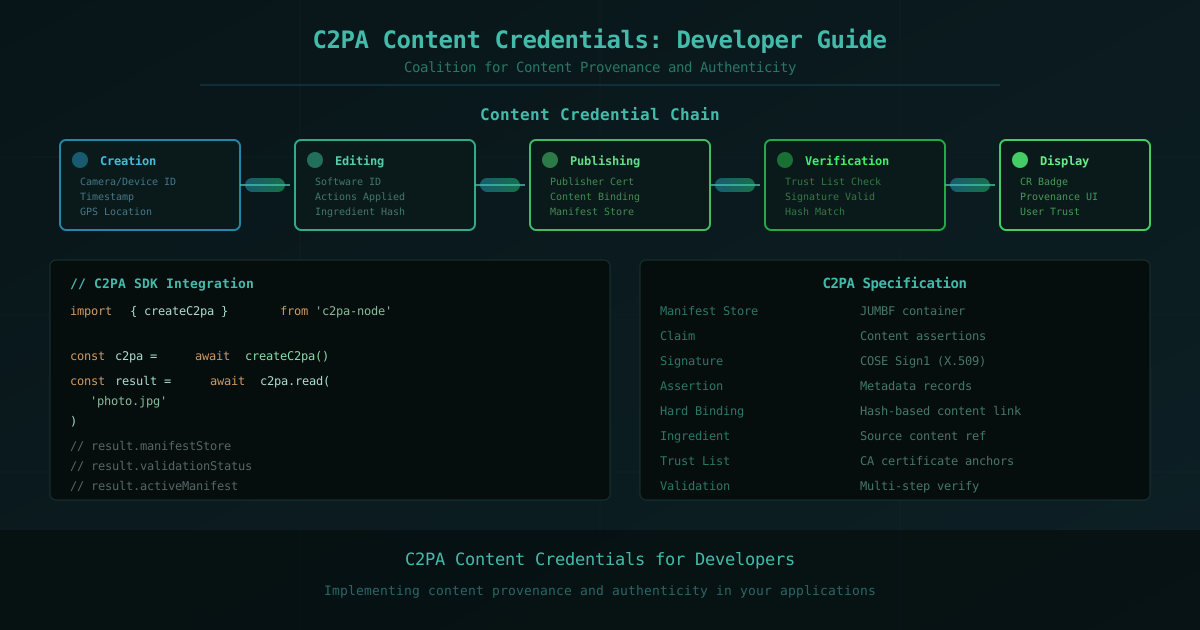
The architecture has four components:
-
A manifest store attached to the content file. This is the container for all provenance data. For JPEG images, the manifest is embedded in the file’s metadata segments. For other formats, it can be embedded or sidecar.
-
Claims within the manifest. Each claim represents a statement about the content, such as “this image was captured by a Google Pixel 10 camera” or “this image was edited in Adobe Photoshop.”
-
Assertions within each claim. Assertions are the individual metadata statements: creation tool, timestamp, GPS coordinates (if permitted), AI model used, editing actions performed.
-
A cryptographic signature that binds the claim to the content. The tool that creates or edits the content signs the claim with a certificate from a trusted certificate authority. The signature covers both the claim’s assertions and a hash of the content, creating a tamper-evident seal.
When someone receives a C2PA-signed file, they can validate it by checking the signature chain against trusted certificate authorities, verifying that the content hash matches the signed hash (detecting any post-signing modifications), and reading the claims to understand the content’s history.
C2PA Spec v2.1: What Changed in 2025
C2PA v2.1, published in 2025, introduced several changes that matter for developers integrating the standard, according to C2PA Specification v2.1.
Stricter tamper-resistance requirements formalize how implementations must handle content modifications after signing. In v2.0, some edge cases allowed manifests to be stripped without detection. The v2.1 spec closes these gaps by requiring hard bindings between manifests and content, making it computationally infeasible to remove credentials without invalidating the signature.
The C2PA Conformance Program launched alongside v2.1, according to Content Authenticity Initiative, 2025. This certification program verifies that implementations correctly follow the specification. Without conformance testing, two implementations might interpret the spec differently, leading to interoperability failures where one tool’s credentials can’t be validated by another tool’s reader.
Support for AI-generated content declarations was expanded. v2.1 includes specific assertion types for declaring that content was generated or modified by an AI model, which model was used, and what type of generation occurred (text-to-image, image-to-image, inpainting). This directly supports compliance with the EU AI Act, which requires AI-generated content labeling by August 2026, according to the EU AI Act full text.
C2PA is also being fast-tracked as an ISO standard through ISO/IEC JTC 1, according to C2PA, 2025. ISO standardization gives C2PA regulatory weight. National and international regulations can reference the ISO standard directly, making C2PA the de facto compliance mechanism for content provenance requirements.
Open-Source Libraries: c2pa-rs, c2pa-js, c2pa-python
The Content Authenticity Initiative maintains three official open-source libraries that developers can use to integrate C2PA into their applications. All are available on GitHub under the contentauth organization.
c2pa-rs (Rust)
The core implementation. All other official libraries build on c2pa-rs through bindings. It provides full support for reading, creating, and validating C2PA manifests, according to c2pa-rs GitHub. Supported formats include JPEG, PNG, WebP, TIFF, GIF, AVIF, HEIF, MP4, MOV, and PDF.
use c2pa::{ManifestStore, Result};

fn read_credentials(path: &str) -> Result<()> {
    let manifest_store = ManifestStore::from_file(path)?;

    for manifest in manifest_store.manifests().values() {
        println!("Claim generator: {}", manifest.claim_generator());
        for assertion in manifest.assertions() {
            println!("  Assertion: {} = {:?}", assertion.label(), assertion.value());
        }
    }
    Ok(())
}
c2pa-js (JavaScript/WebAssembly)
A WebAssembly build of c2pa-rs that runs in browsers and Node.js environments, according to c2pa-js GitHub. This library enables web applications to read and validate C2PA manifests client-side, without sending content to a server.
import { createC2pa } from "c2pa";

async function readCredentials(imageUrl) {
    const c2pa = await createC2pa({
        wasmSrc: "/c2pa.wasm",
        workerSrc: "/c2pa.worker.js"
    });

    const { manifestStore } = await c2pa.read(imageUrl);

    if (manifestStore) {
        const activeManifest = manifestStore.activeManifest;
        console.log("Claim generator:", activeManifest.claimGenerator);
        console.log("Assertions:", activeManifest.assertions);
        console.log("Signature info:", activeManifest.signatureInfo);
    } else {
        console.log("No C2PA credentials found");
    }
}
c2pa-python (Python)
Python bindings for c2pa-rs, suitable for server-side processing, batch validation, and integration with data pipelines, according to c2pa-python GitHub.
from c2pa import Reader

def validate_credentials(file_path):
    reader = Reader.from_file(file_path)
    manifest_store = reader.json()

    for manifest_id, manifest in manifest_store["manifests"].items():
        print(f"Manifest: {manifest_id}")
        print(f"Claim generator: {manifest['claim_generator']}")
        print(f"Signature valid: {manifest['signature_info']['is_valid']}")

        for assertion in manifest.get("assertions", []):
            print(f"  {assertion['label']}: {assertion['data']}")
All three libraries are Apache 2.0 licensed. The Rust implementation supports the full C2PA v2.1 specification. The JavaScript and Python libraries cover the most common read and validate operations, with creation support available through the Rust bindings.
Integration Patterns for Developers
C2PA integration follows three primary patterns depending on where your application sits in the content lifecycle.
Pattern 1: Read and Display Credentials
The simplest integration. Your application receives content that may contain C2PA credentials and displays the provenance information to users. This pattern is relevant for social media platforms, news sites, content management systems, and search engines.
Use c2pa-js for client-side reading in web applications, or c2pa-python for server-side processing during upload. Display the claim generator (tool that created the content), the signature issuer (certificate authority), and any AI generation declarations.
LinkedIn, for example, displays C2PA information on images and videos uploaded to its platform, allowing viewers to see whether content was AI-generated and what tool created it.
Pattern 2: Sign Content at Creation or Editing
Your application creates or modifies content and needs to embed C2PA credentials. This pattern applies to content creation tools, AI image generators, camera applications, and editing software.
Signing requires a certificate from a C2PA-trusted certificate authority. The Content Authenticity Initiative maintains a trust list of approved CAs. The application creates a manifest with claims describing the creation or editing action, signs it with the certificate, and embeds the signed manifest into the output file.
Google implemented this pattern in the Pixel camera app. Every photo captured on a Pixel 9 or Pixel 10 includes C2PA credentials declaring the device, timestamp, and that no AI generation was involved (for standard photos), according to Google, 2024.
Pattern 3: Validate and Verify
Your application validates C2PA credentials and additionally verifies the factual content. C2PA proves provenance: who created this content and how. It does not verify whether the content’s claims are true. An image with valid C2PA credentials proving it was created by a legitimate news organization still contains claims that may be inaccurate.
This is where C2PA and verification APIs serve complementary roles. C2PA answers “is this content authentic and unmodified?” A verification API answers “are the claims in this content factually accurate?” For applications that need both provenance and accuracy, combining C2PA validation with Webcite claim verification covers both dimensions. For more on how content verification works at the claim level, see our guide on building a citation pipeline for AI-generated content.
Device and Platform Adoption
C2PA adoption has accelerated across hardware, software, and platform layers.
Hardware
Google embedded C2PA support in the Pixel 9 (2024) and Pixel 10 (2025) camera apps, making it the first major smartphone manufacturer to ship C2PA at scale, according to Google, 2024. Leica and Sony have implemented C2PA in professional camera bodies. Qualcomm announced Snapdragon support for C2PA credential generation at the chip level, which could bring hardware-backed signing to a broader range of Android devices.
Software
Adobe is the most aggressive C2PA implementer. Photoshop, Lightroom, Firefly (Adobe’s AI image generator), and Premiere Pro all embed Content Credentials, according to Adobe Content Authenticity Initiative. Microsoft has integrated C2PA into Bing Image Creator and Designer. Truepic provides C2PA-based capture verification for insurance, journalism, and legal evidence.
Platforms
Social media and content platforms are beginning to surface C2PA data. LinkedIn displays Content Credentials on uploaded media. The BBC participates in C2PA and is exploring integration into their content distribution pipeline. News organizations including The New York Times, The Wall Street Journal, and Nikkei have joined the Content Authenticity Initiative.
Over 3,500 organizations are now members of the Content Authenticity Initiative, according to CAI, 2025. The breadth of adoption, spanning hardware manufacturers, software vendors, news organizations, and social platforms, creates the network effect that content provenance standards need to succeed.
C2PA Limitations and Complementary Approaches
C2PA is a provenance standard, not a truth standard. Understanding its limitations helps developers build complete content integrity solutions.
C2PA credentials can be stripped. If someone screenshots a C2PA-signed image and uploads the screenshot, the credentials are lost. Social media platforms that re-encode uploaded images may strip metadata, including C2PA manifests. The v2.1 spec improved tamper detection, but metadata stripping during format conversion remains a practical challenge.
C2PA doesn’t cover all content types equally. Image support is mature. Video support is functional but less widely implemented. Text content has minimal C2PA support. AI-generated text, the content type most prone to hallucination, currently has no practical C2PA integration.
Credentials prove creation context, not factual accuracy. A C2PA manifest proves that Adobe Firefly generated an image, but it says nothing about whether the image depicts something real. A C2PA-signed article from a credible news outlet still needs fact-checking.
For these reasons, production content integrity systems should combine multiple approaches:
- C2PA for provenance (who created this, how, and has it been modified)
- Verification APIs for factual accuracy (are the claims in this content true)
- AI detection for synthetic content classification (was this generated by AI)
The Webcite verification API addresses the factual accuracy layer. It takes a claim, checks it against independent sources, and returns a verdict with citations. C2PA tells you the content hasn’t been tampered with; verification tells you the content is accurate. Both are necessary for comprehensive content integrity. For teams working on AI trust frameworks, C2PA and verification represent two of the foundational pillars.
Frequently Asked Questions
What is C2PA?
C2PA (Coalition for Content Provenance and Authenticity) is a technical standard that embeds cryptographic provenance metadata into digital content at the point of creation or editing. It records who created the content, what tools were used, and whether the content was modified, all signed with a cryptographic certificate. The standard was co-founded by Adobe, Microsoft, Intel, and others.
How do C2PA Content Credentials work?
When content is created or edited, the C2PA-enabled tool generates a manifest containing claims about the content’s origin and history. Each claim includes assertions (metadata statements), a cryptographic signature from the tool’s certificate, and a hash binding the manifest to the content. Validators can verify the signature chain and detect any tampering after signing.
What open-source libraries exist for C2PA?
The Content Authenticity Initiative maintains three official open-source libraries: c2pa-rs (Rust, the core implementation), c2pa-js (JavaScript/WebAssembly for browser and Node.js), and c2pa-python (Python bindings). All three are available on GitHub under the contentauth organization and support reading, creating, and validating C2PA manifests.
Which devices and platforms support C2PA?
Google Pixel 9 and Pixel 10 phones ship with built-in C2PA support for photos. Adobe Photoshop, Lightroom, and Firefly embed Content Credentials. Microsoft has integrated C2PA into Designer and Bing Image Creator. Camera manufacturers Leica and Sony support C2PA in select models. Social platforms are beginning to display C2PA information on uploaded media.
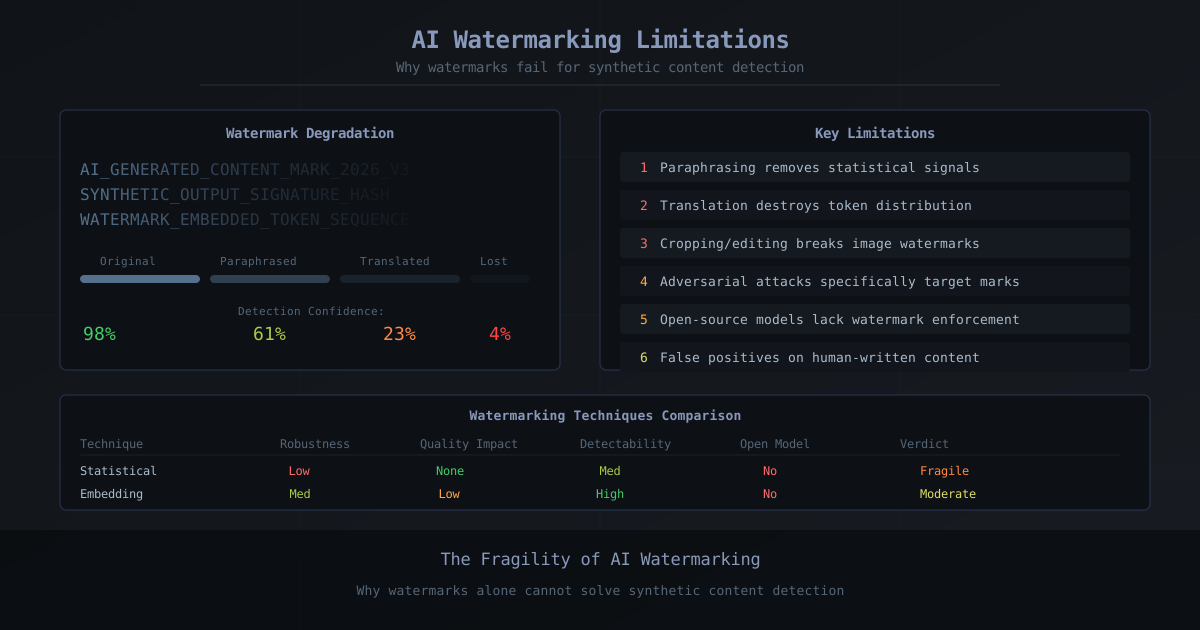
How is C2PA different from watermarking?
Watermarking embeds a hidden signal into the content pixels or text tokens. C2PA attaches a cryptographic manifest alongside the content as metadata. Watermarks can be removed or degraded by editing, compression, or format conversion. C2PA manifests survive format changes if the tool chain supports them, and tampering with the content invalidates the cryptographic signature, making modification detectable.