Google introduced Grounding with Google Search in Vertex AI in 2024, giving Gemini models the ability to cite real web sources in their responses. Anthropic followed with a Citations API for Claude. Microsoft added Bing Grounding to Azure AI Foundry. AI hallucinations cost enterprises an estimated $67.4 billion in 2024, according to Korra, 2024, which is why every major provider now invests in grounding. This article explains what grounding in AI means, compares 5 grounding techniques, and shows when each one applies.
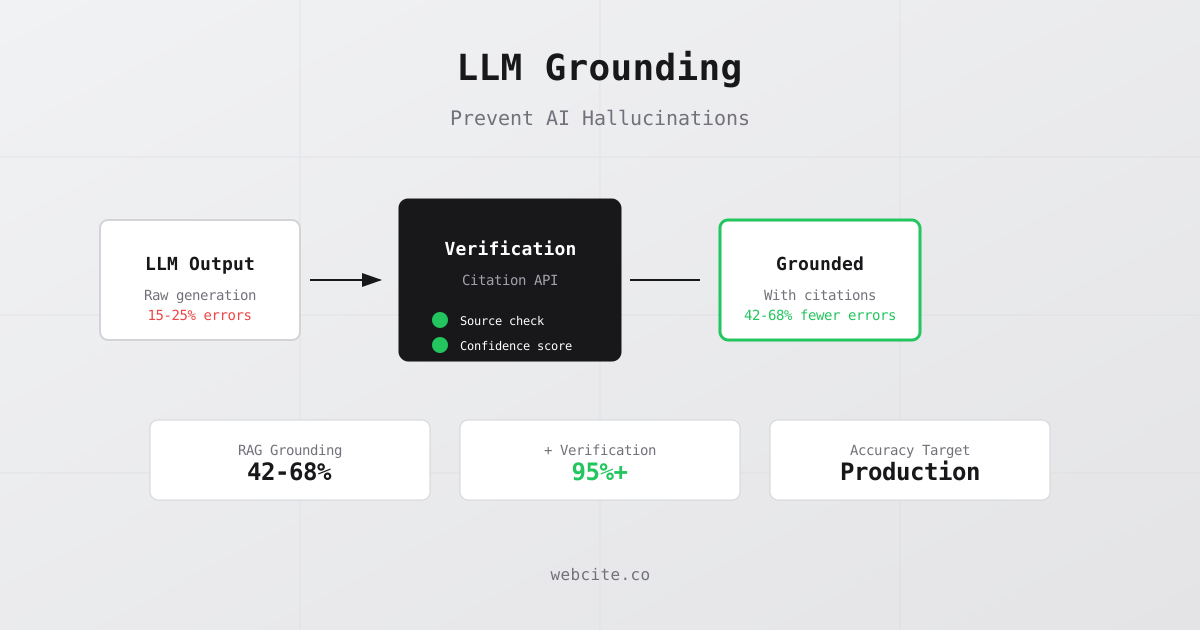
- Grounding connects LLM output to verifiable external sources. RAG reduces hallucinations by up to 71% (AllAboutAI, 2026).
- Google, Anthropic, and Microsoft each offer grounding features, but each is locked to their own model family.
- Model agnostic grounding works with any LLM and avoids vendor lock-in.
- Stanford researchers found that even RAG-grounded legal AI tools hallucinate in 17-33% of queries.
- Layering RAG with postgenerationerification catches errors that any single technique misses.
Why LLMs Need Grounding
Large language models generate text by predicting the next token based on patterns learned during training. They do not consult a database of verified facts. This architecture means every response carries some probability of fabrication, regardless of how confident the output sounds.
The scale of the problem is well-documented. Stanford researchers found that RAG-powered legal AI tools from LexisNexis and Thomson Reuters hallucinate in 17 to 33 percent of queries, according to Magesh et al., Stanford Law School, 2024. These are not small models running without context. These are production systems with retrieval pipelines that still get facts wrong one-third of the time.
The financial impact is equally clear. Enterprises lost an estimated $67.4 billion to AI hallucinations in 2024, according to Korra, 2024. That figure includes customer support errors, incorrect legal advice, flawed medical information, and fabricated citations in professional reports.
Grounding addresses this by giving the model access to real-world evidence, either before generation (retrieval), during generation (tool use), or after generation (verification). Each approach has tradeoffs, and most production systems combine multiple techniques.
The 5 Core Grounding Techniques
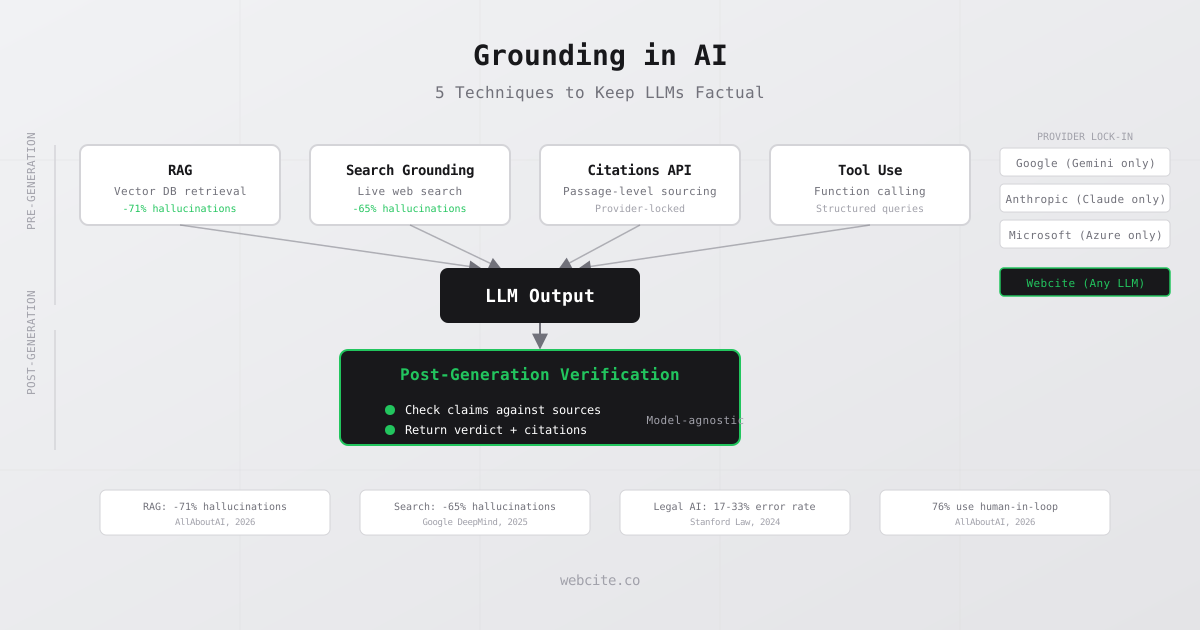
Grounding is not a single method. It is a category of techniques that share one goal: connecting LLM output to verifiable sources. Here are the five approaches used in production today.
1. Retrieval-Augmented Generation (RAG)
RAG retrieves relevant documents from a vector database or search index and injects them into the model’s context window before generation. The model then generates its response using both its training data and the retrieved documents.
RAG is the most widely deployed grounding technique. It reduces hallucinations by 71 percent when properly implemented, according to AllAboutAI, 2026. Frameworks like LangChain and LlamaIndex have made RAG accessible to any developer with a document collection.
The limitation is that RAG grounds the model in your documents, not in the broader world. If your documents are outdated, incomplete, or the model misinterprets a retrieved passage, the output can still be wrong. RAG also does not verify its own output. It trusts the model to faithfully represent the retrieved content.
For a deeper look at how RAG-based systems still produce errors, see our guide on RAG hallucination detection.
2. Search Grounding
Search grounding connects an LLM to a live web search engine. Instead of querying a static vector database, the model searches the open web for current information during generation. This is particularly useful for time-sensitive queries where training data is stale.
Google’s Grounding with Google Search is the most prominent implementation. Available through the Gemini API, it lets Gemini models query Google Search in real time and cite the results inline. Google reports that their reasoning models with search grounding reduce hallucinations by 65 percent, according to Google DeepMind, 2025.
Microsoft offers a similar capability through Bing Grounding in Azure AI Foundry, which connects Azure-hosted models to Bing search results.
The tradeoff: search grounding depends on the quality and relevance of search results. It works well for general knowledge queries but less well for domain-specific or proprietary information. It also adds latency because each grounded response requires a search round-trip. Even with search grounding, frontier models like GPT-4o still hallucinate at a rate of 0.7 percent on factual benchmarks, according to Visual Capitalist, 2025.
3. Citations and Source Attribution APIs
Some providers offer APIs that attach source citations directly to generated text, mapping each claim to the specific passage that supports it.
Anthropic’s Citations API lets developers pass source documents to Claude and receive responses where each claim includes a pointer to the exact passage in the source material. This is not just a footnote. The API returns character-level spans identifying which text in the source document supports which claim in the response.
This approach is powerful for document-grounded applications where you control the source material. It tells you exactly which parts of which documents the model relied on. The limitation is that it only works with documents you provide. It does not verify claims against external sources.
4. Tool Use and Function Calling
Tool use (also called function calling) lets an LLM call external APIs, databases, or calculators during generation. Instead of guessing a number, the model calls a calculator. Instead of recalling a stock price from training data, it queries a financial API.
OpenAI, Anthropic, Google, and most major providers support tool use. The model decides when to call a tool, structures the API call, and incorporates the result into its response. This grounds specific claims in real-time data rather than stale training knowledge.
Tool use is effective for structured, well-defined queries: current weather, stock prices, database lookups, and mathematical calculations. It is less effective for open-ended factual claims where no single API provides the answer.
5. After generationnn Verification
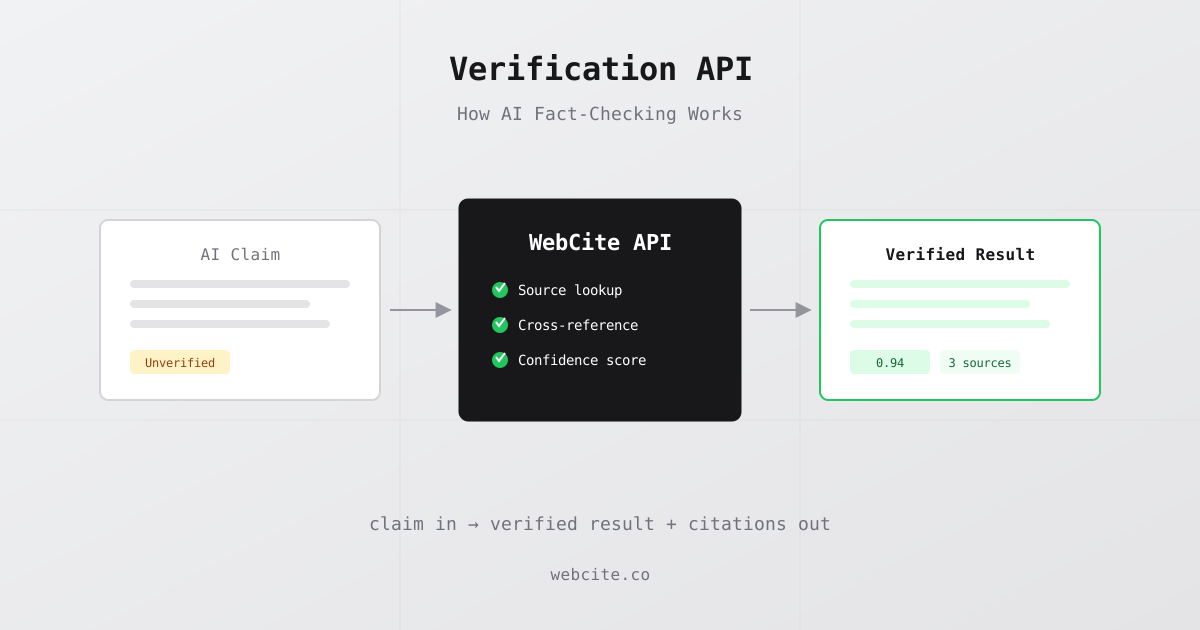
Output stageication checks claims after the model generates them, before showing the response to the user. A verification API takes each claim, searches for evidence across multiple sources, evaluates source credibility, and returns a verdict: supported, contradicted, or insufficient evidence.
This approach is unique because it works regardless of how the response was generated. Whether the claim came from a vanilla LLM, a RAG pipeline, or an agentic workflow, verification catches errors at the output layer. A Deloitte report on Australian welfare reform contained AI hallucinations that led to a $290,000 refund, according to Fortune, 2025, illustrating why output-stage verification matters even for grounded systems.
Postgenerationerification adds 1-3 seconds of latency but provides the strongest factual guarantee because it does not trust the model at all. It independently confirms each claim against external evidence. A survey of enterprise AI teams found that 76 percent now include human-in-the-loop processes to catch hallucinations, according to AllAboutAI, 2026. Verification APIs automate that human review step.
Provider-Specific vs LLM agnosticrounding
One of the most important distinctions in grounding is whether a technique is locked to a specific model family or works with any LLM. This decision has long-term implications for vendor lock-in, flexibility, and cost.
Here is how the major provider offerings compare:
| Grounding Approach | Provider | Works With | Lock in Risk |
|---|---|---|---|
| Grounding with Google Search | Gemini models only | High | |
| Citations API | Anthropic | Claude models only | High |
| Bing Grounding | Microsoft | Azure AI Foundry models | High |
| RAG (self-hosted) | Any | Any LLM | Low |
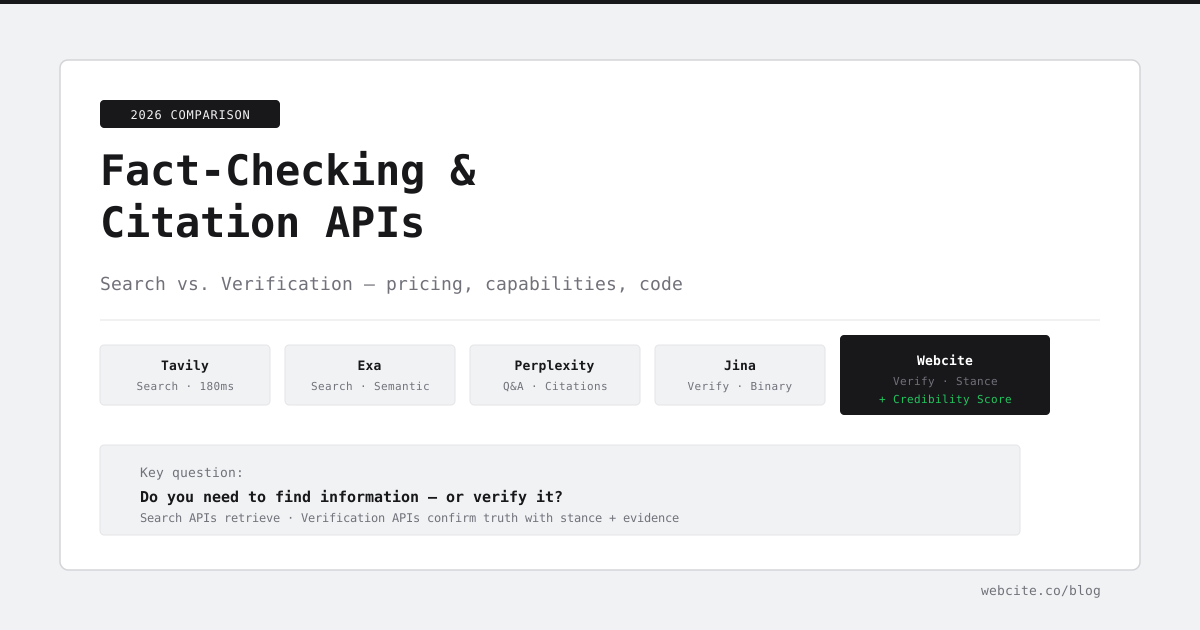
| Verification API (Webcite) | Webcite | Any LLM | None |
Google’s Grounding with Google Search is powerful but only works with Gemini models through Vertex AI or the Gemini API. If you switch to Claude or GPT-4o, you lose your grounding layer entirely.
Anthropic’s Citations API provides precise source attribution but only for Claude. If your application serves multiple models or you want to A/B test providers, Citations API cannot follow you.
Microsoft’s Bing Grounding works within the Azure AI Foundry ecosystem. It is available for multiple models hosted on Azure, but ties your infrastructure to the Azure platform.
Provider neutralal approaches avoid this problem. RAG is inherently model agnostic because you control the retrieval pipeline. After generationnn verification is also LLM agnosticecause it checks the output, not the generation process. A verification API like Webcite works with GPT-4o, Claude, Gemini, Llama 3, Mistral, or any other model because it operates on the text after generation.
For teams that use multiple models or anticipate switching providers, provider neutralal grounding protects against vendor lock in while maintaining factual accuracy. RAG reduces hallucinations by 71 percent when properly implemented, according to AllAboutAI, 2026, but combining RAG with a model-agnostic verification layer pushes accuracy even higher.
Comparison: When to Use Each Grounding Technique
No single grounding technique is best for every use case. The right choice depends on your data, latency requirements, and accuracy needs.
| Technique | Best For | Latency Impact | Hallucination Reduction | Limitations |
|---|---|---|---|---|
| RAG | Internal documents, knowledge bases | +200-500ms | ~71% | Stale docs, misinterpretation |
| Search Grounding | Current events, general knowledge | +500-1500ms | ~65% | Search quality varies |
| Citations API | Document QA with precise attribution | +100-300ms | High (within provided docs) | Only works with provided sources |
| Tool Use | Structured data, calculations, APIs | +200-1000ms | High (for supported queries) | Limited to available tools |
| Output stageication | Any claim, any model, any pipeline | +1-3s | Highest (independent check) | Adds latency |
Use RAG when you have a corpus of internal documents and need the model to answer questions grounded in your data. Pair it with a framework like LangChain or LlamaIndex. RAG is the baseline grounding technique that most production systems start with.
Use Search Grounding when your users ask about current events, recent data, or topics that change frequently. Google’s Gemini with search grounding or Microsoft’s Bing Grounding handles this well if you are already on those platforms.
Use Citations API when you need exact passage-level attribution for a fixed set of documents, such as legal briefs, medical records, or compliance filings where you must show precisely which source supports each claim.
Use Tool Use when you need real-time structured data: stock prices, weather, database queries, or calculations. This is the right approach for agents that take actions based on current data.
Use Postgenerationerification when accuracy is non-negotiable and you need to catch errors from any source. This is the safety net that catches what other techniques miss. It is especially valuable when you use multiple models, when your RAG corpus might be outdated, or when the consequences of a wrong answer are high.
Layering Grounding Techniques for Production
The strongest production systems combine multiple grounding techniques. Here is a practical architecture that layers three approaches:
User query
  -> RAG retrieval (ground in your documents)
    -> LLM generation with tool use (ground in real-time data)
      -> Post-generation verification (confirm against external sources)
        -> Verified response with citations
Each layer catches different types of errors:
- RAG ensures the model has relevant context from your documents
- Tool use provides current data for structured queries
- Verification independently confirms the final output against the open web
Here is how the verification layer works with Webcite’s REST API:
const response = await fetch("https://api.webcite.co/api/v1/verify", {
  method: "POST",
  headers: {
    "x-api-key": process.env.WEBCITE_API_KEY,
    "Content-Type": "application/json"
  },
  body: JSON.stringify({
    claim: "Google's Gemini models reduce hallucinations by 65% with search grounding",
    include_stance: true,
    include_verdict: true
  })
})

const result = await response.json()
// result.verdict.result: "supported"
// result.verdict.confidence: 91
// result.citations: [{ title: "Google AI...", url: "...", snippet: "..." }]
This call works regardless of which model generated the claim. Whether it came from GPT-4o, Claude, Gemini, or Llama 3, the verification is the same. That is the value of model agnostic grounding.
Webcite offers 50 free credits per month for testing. The Builder plan at $20/month provides 500 credits. Each verification uses 4 credits (2 for citation retrieval, 1 for stance detection, 1 for verdict). Enterprise plans start at 10,000+ credits for high-volume pipelines.
How Google, Anthropic, and Microsoft Approach Grounding
Each major AI provider has invested in grounding, but their implementations reflect different priorities.
Google has been the most aggressive. Grounding with Google Search is available through both the Gemini API and Vertex AI. Google also offers Grounding with Google Maps for location queries and supports custom data stores through Vertex AI Search. Google’s approach leverages its search infrastructure advantage, providing high-quality web grounding but only for Gemini models.
Anthropic focused on precision. The Citations API does not search the web. Instead, it maps Claude’s responses to specific passages in documents you provide. This gives developers exact source attribution at the character level. It is ideal for document-heavy workflows like legal analysis, compliance review, and research synthesis.
Microsoft took the platform approach. Bing Grounding in Azure AI Foundry is available as a tool for any model deployed on Azure, not just Microsoft’s own models. This makes it more flexible than Google’s approach, though it still requires Azure infrastructure.
OpenAI offers web search through ChatGPT and its API with the web_search tool, but does not market a dedicated “grounding” product in the same way Google and Microsoft do. OpenAI’s approach relies more on tool use and function calling as general grounding mechanisms.
The common thread across all providers: grounding is no longer optional. Every major AI company now offers some mechanism for connecting model outputs to external evidence. EU AI Act Article 50 mandates AI output transparency by August 2, 2026, according to the official EU AI Act text, 2024, which makes grounding a compliance requirement in addition to a quality feature. The question for developers is which mechanism fits their architecture.
Grounding and Compliance
Grounding is not just a quality concern. It is becoming a regulatory requirement.
The EU AI Act Article 50, effective August 2026, mandates transparency in AI-generated content, according to the official EU AI Act text, 2024. Applications that generate content for European users must demonstrate source attribution and output transparency. Grounded responses with citations provide auditable evidence of compliance.
The Colorado AI Act and California transparency requirements also take effect in 2026, creating overlapping regulations that all point in the same direction: AI applications need provable accuracy, according to Wilson Sonsini, 2026.
For developers, grounding logs become compliance documentation. Every verification call produces a record of what was checked, against which sources, with what confidence, and what verdict was returned. That audit trail is exactly what regulators require.
Getting Started: A Practical Grounding Checklist
If you are building an AI application and want to add grounding, here is a prioritized approach:
Step 1: Add RAG for your internal data. If you have documents, knowledge bases, or product catalogs, RAG is the fastest way to reduce hallucinations. A survey found that 76 percent of enterprise AI teams already include human-in-the-loop processes to catch errors, according to AllAboutAI, 2026. Use LangChain, LlamaIndex, or a managed service like Pinecone or Weaviate for the vector store.
Step 2: Add after generationnn verification for external claims. RAG grounds the model in your data, but it does not catch errors about the outside world. Add a verification API to check factual claims before they reach users. Webcite handles this in a single REST call that works with any model.
Step 3: Add search grounding or tool use for real-time queries. If your users ask about current events, stock prices, or weather, connect the model to live data sources through search grounding or function calling.
Step 4: Monitor and iterate. Track which claims get flagged by verification. Use those patterns to improve your RAG corpus, fine-tune prompts, or add new tools. Grounding is not a one-time setup. It is an ongoing process of closing accuracy gaps.
For a detailed walkthrough of adding verification to an existing chatbot, see our step-by-step integration tutorial.
Frequently Asked Questions
What is grounding in AI?
Grounding in AI is the process of connecting a large language model’s output to verifiable external sources. Instead of relying solely on patterns from training data, grounded systems retrieve real-world evidence and attach it to generated claims. This reduces hallucinations and gives users citations they can independently verify.
What is the difference between RAG and grounding?
RAG is one grounding technique among several. It retrieves documents before generation and injects them into the model’s context window. Grounding is the broader category that includes RAG, search grounding, citation APIs, tool use, and output stageication. RAG grounds during generation; verification APIs ground after generation.
Does grounding eliminate AI hallucinations?
No. Grounding reduces hallucinations significantly but does not eliminate them entirely. RAG cuts hallucinations by 71%, according to AllAboutAI, 2026, but the remaining errors still require additional checks. Layering multiple grounding techniques, such as RAG plus a verification API, catches errors that any single technique misses.
What is LLM agnosticrounding?
Provider neutralal grounding works with any LLM regardless of provider. Google’s Grounding with Google Search only works with Gemini models. Anthropic’s Citations API only works with Claude. A model agnostic approach like Webcite’s verification API checks claims from any model, whether it is GPT-4o, Claude, Gemini, Llama 3, or Mistral.
How do I ground an LLM in production?
Start with RAG for your internal documents, then add postgenerationerification for external claims. Send each claim to a verification API that checks it against real-world sources and returns a verdict with citations. This two-layer approach catches errors that RAG alone misses while adding only 1-3 seconds of latency per claim.