Roughly 500,000 deepfake videos circulated online in 2023, and that number surged past 4 million by the end of 2025, according to Sumsub, 2024. The deepfake detection market is growing 42% annually, projected to reach $15.7 billion by 2026, according to MarketsandMarkets, 2024. With the EU AI Act’s Article 50 transparency requirements taking effect in August 2026, organizations that generate, distribute, or host media content face new obligations around synthetic content disclosure. This guide covers the leading detection tools, their API capabilities, compliance implications, and how deepfake detection fits alongside text verification in a complete content integrity strategy.
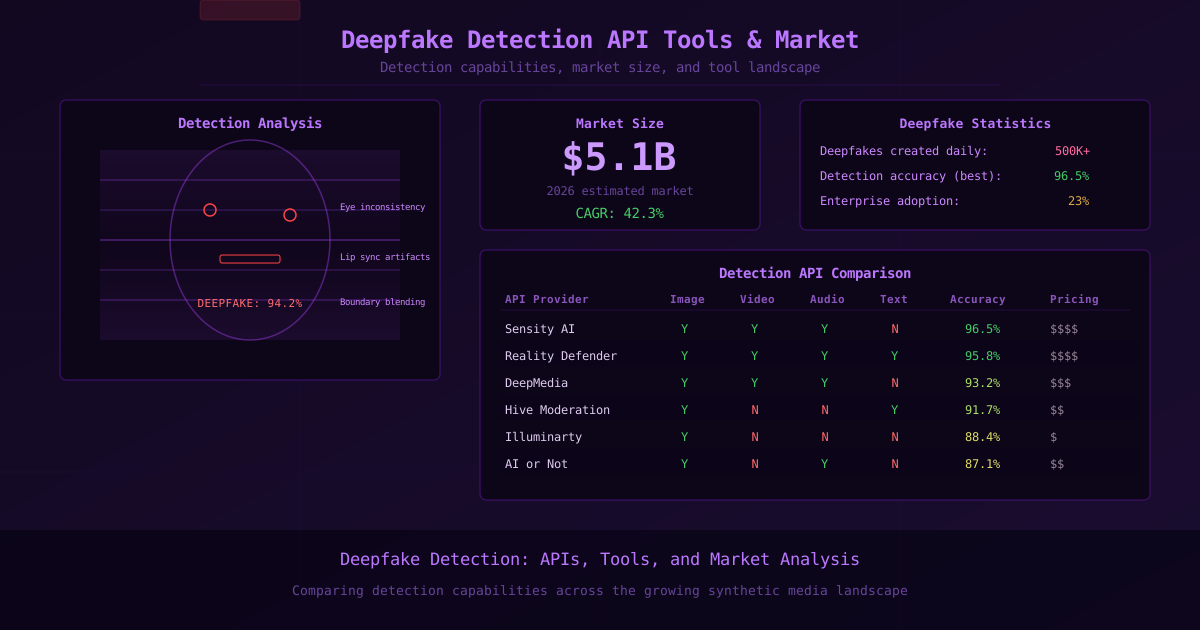
- The deepfake detection market is growing 42% annually, reaching an estimated $15.7 billion by 2026.
- Leading tools include Sensity, Reality Defender, Intel FakeCatcher, and Microsoft Video Authenticator, each with different detection approaches.
- EU AI Act Article 50 requires synthetic media labeling by August 2, 2026, with fines up to 15 million EUR for non-compliance.
- API-based detection enables real-time analysis for media platforms processing thousands of uploads per hour.
- Deepfake detection covers visual and audio content; text verification tools like Webcite cover factual claims, and both are needed for full content integrity.
How Deepfake Detection APIs Work
Deepfake detection APIs accept media files or URLs and return analysis results indicating whether the content is authentic or synthetically generated. The underlying detection approaches fall into three categories, each with distinct strengths.
Biological signal analysis examines physiological cues that current generation models struggle to replicate. Intel’s FakeCatcher uses photoplethysmography (PPG), analyzing subtle blood flow patterns visible in facial video to distinguish real from synthetic faces. Intel reports 96% accuracy with this approach, and the system processes video in milliseconds rather than minutes, according to Intel, 2022. The advantage of biological signal analysis is that it targets a signal deepfake generators don’t explicitly model, making it resilient to visual quality improvements.
Artifact-based detection looks for digital fingerprints left by generation models. These include inconsistent lighting across facial features, misaligned eye reflections, irregular skin texture patterns, and temporal inconsistencies between video frames. Sensity AI’s detection platform uses convolutional neural networks trained on over 100,000 deepfake samples to identify these artifacts across multiple generation methods including face swaps, reenactments, and fully synthetic faces, according to Sensity AI, 2024.
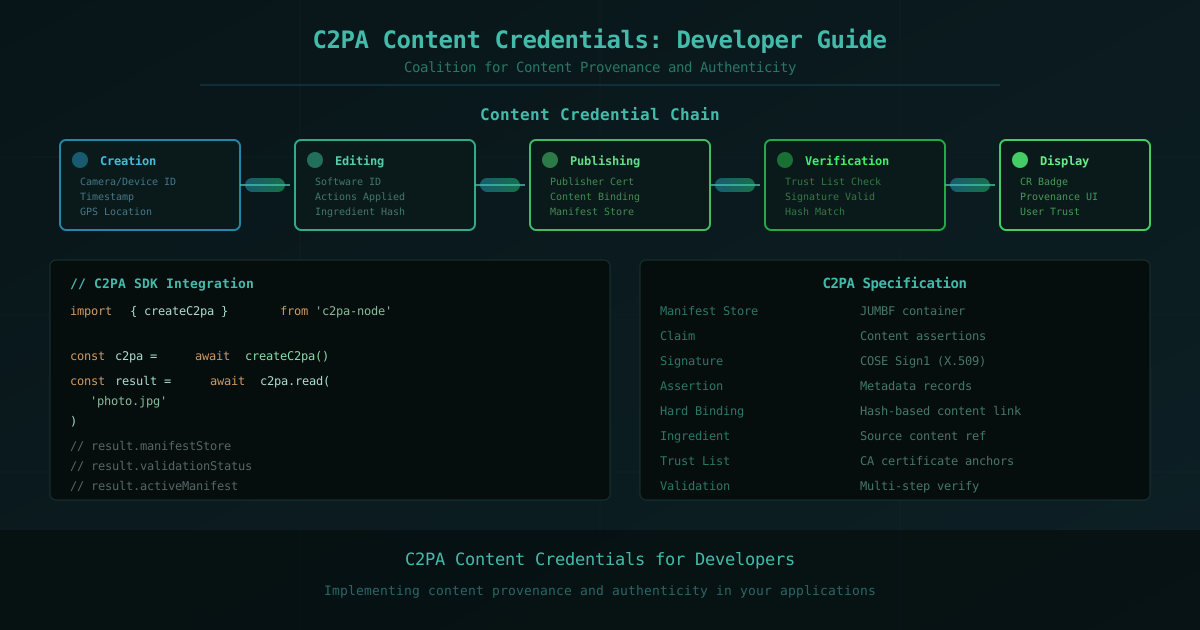
Provenance-based verification checks the metadata and cryptographic signatures of media files to verify their origin and edit history. The Coalition for Content Provenance and Authenticity (C2PA), founded by Adobe, Microsoft, Intel, and the BBC, developed an open standard for embedding tamper-evident metadata into media files at the point of creation, according to C2PA, 2024. Adoption has been substantial. Over 2,500 organizations now use C2PA-based content credentials, and Adobe’s Content Authenticity Initiative has integrated the standard into Photoshop, Lightroom, and Firefly, according to Adobe, 2025.
A typical API integration for detection looks like this:
import requests

def detect_deepfake(media_url):
    response = requests.post(
        "https://api.sensity.ai/v1/detect",
        headers={
            "Authorization": "Bearer your-api-key",
            "Content-Type": "application/json"
        },
        json={
            "url": media_url,
            "models": ["face_swap", "face_reenactment", "full_synthetic"]
        }
    )
    return response.json()

result = detect_deepfake("https://example.com/video.mp4")
print(result["is_deepfake"])    # true/false
print(result["confidence"])     # 0.97
print(result["detected_technique"])  # "face_swap"
Leading Deepfake Detection Tools Compared
The market has consolidated around a handful of vendors, each targeting different use cases and media types.
| Tool | Detection Method | Media Types | Real-Time API | Notable Clients |
|---|---|---|---|---|
| Sensity AI | CNN artifact detection | Image, Video | Yes | Social platforms, KYC providers |
| Reality Defender | Multi-model ensemble | Image, Video, Audio | Yes | Government agencies, media companies |
| Intel FakeCatcher | PPG biological signals | Video | Yes | Enterprise, research institutions |
| Microsoft Video Authenticator | Frame-level artifact analysis | Image, Video | Limited | Microsoft ecosystem partners |
| Deepware Scanner | GAN fingerprint analysis | Video | No (app-based) | Individual users, journalists |
| C2PA/Content Credentials | Provenance metadata | Image, Video, Audio | Yes (verification) | Adobe, BBC, New York Times |
Sensity AI processes over 1 million media analyses per month across its platform and has identified deepfakes in over 100 countries, according to Sensity AI, 2024. The platform offers both a web interface and a REST API for integration into content moderation pipelines. It specializes in face-related manipulations including face swaps, face reenactments, and GAN-generated synthetic faces.
Reality Defender raised $15 million in Series A funding in 2024 to expand its multi-model detection platform, according to TechCrunch, 2024. Rather than relying on a single detection method, Reality Defender runs multiple models in parallel and aggregates their results, which improves resilience against novel generation techniques. The platform covers image, video, and audio deepfakes, making it one of the more comprehensive solutions.
Microsoft Video Authenticator analyzes still photos and videos, providing a real-time confidence score for each frame. Microsoft developed it in partnership with the AI Foundation and has deployed it through its Responsible AI program, according to Microsoft, 2020. However, Microsoft has limited the tool’s public availability to prevent adversarial actors from using it to improve their generation techniques.
The open-source ecosystem also contributes detection capabilities. FaceForensics++, developed by researchers at the Technical University of Munich, provides a benchmark dataset and baseline models for face manipulation detection, according to Rossler et al., ICCV 2019. DeepFaceLab’s detection counterpart and various Hugging Face-hosted models offer free alternatives, though they require significant engineering effort to deploy at production scale.
EU AI Act and Synthetic Media Compliance
The EU AI Act establishes specific requirements for synthetic media that took effect or will take effect across its phased rollout. Article 50 mandates that providers of AI systems generating synthetic audio, image, video, or text content must ensure the outputs are marked in a machine-readable format and are detectable as artificially generated or manipulated, according to the EU AI Act text, Article 50.
Three specific obligations apply to deepfake and synthetic media:
First, deployers who create deep fakes must disclose that the content has been artificially generated or manipulated. This disclosure requirement applies regardless of the content’s purpose, with narrow exceptions for law enforcement and artistic expression. The obligation extends to anyone who publishes or distributes a deepfake, not just the person who created it.
Second, providers of AI systems that generate synthetic content must implement technical solutions enabling detection. This means generation tools must embed machine-readable markers (such as C2PA metadata or watermarks) into their outputs. OpenAI’s DALL-E 3 and Midjourney both embed C2PA metadata in generated images, according to OpenAI, 2024.
Third, the penalties for non-compliance with Article 50 transparency obligations reach 15 million EUR or 3% of global annual turnover. The EU modeled these penalties on the GDPR enforcement pattern, which has produced over 2,000 fines totaling more than 4.5 billion EUR since 2018, according to the GDPR Enforcement Tracker. Organizations should expect similar enforcement rigor for AI Act violations.
For platforms that host user-generated content, the compliance challenge is operational: how do you detect and label synthetic media across millions of daily uploads? API-based detection is the only scalable answer. Manual review cannot keep pace with upload volumes that reach hundreds of thousands of files per hour on major platforms. For a deeper analysis of EU AI Act compliance infrastructure, see our EU AI Act verification API compliance guide.
API Integration Patterns for Media Platforms
Media platforms, news organizations, and social networks face the most immediate need for deepfake detection at scale. Three integration patterns have emerged for embedding detection into content pipelines.
The upload-time screening pattern runs detection on every piece of media at the point of upload. The platform sends each file to a detection API before making it publicly available. Files that score above a manipulation threshold are flagged for human review or automatically labeled as potentially synthetic. This approach catches deepfakes before they spread but adds latency to the upload process. For platforms where speed matters, asynchronous processing with temporary holds works well.
const response = await fetch("https://api.realitydefender.com/v1/analyze", {
  method: "POST",
  headers: {
    "x-api-key": process.env.DETECTION_API_KEY,
    "Content-Type": "application/json"
  },
  body: JSON.stringify({
    media_url: uploadedFileUrl,
    analysis_types: ["face_swap", "voice_clone", "full_synthetic"]
  })
})

const result = await response.json()
if (result.confidence > 0.85) {
  // Flag for review or auto-label as synthetic
  await labelContent(contentId, "ai_generated", result.confidence)
}
The on-demand verification pattern allows users or moderators to request analysis of specific content. This is common in newsrooms and fact-checking organizations where journalists need to verify the authenticity of media shared on social platforms or submitted as evidence. The Associated Press and Reuters both use detection tools in their verification workflows, according to Reuters Institute, 2024.
The batch processing pattern runs detection across existing content libraries. This is relevant for platforms that need to retroactively scan archives for synthetic media ahead of the EU AI Act deadline. Batch processing typically runs during off-peak hours and prioritizes high-engagement content that has the widest reach.
The global deepfake incident count grew 550% between 2019 and 2023, according to the World Economic Forum, 2024. For media platforms, the combination of regulatory pressure and rising synthetic media volume makes detection infrastructure a necessity, not a feature request.
Limitations and the Adversarial Arms Race
Deepfake detection is not a solved problem. It is an ongoing adversarial competition between generation and detection technologies, and generators currently hold the advantage in several areas.
Detection accuracy degrades on novel generation methods. Models trained to detect GAN-generated faces may miss diffusion-model outputs entirely. When Stable Diffusion and Midjourney shifted from GAN to diffusion architectures, many existing detectors saw accuracy drops of 20 to 40 percentage points on the new outputs, according to Carlini and Farid, 2020. Detection models need continuous retraining to keep pace with generation advances.
Compression and re-encoding destroy detection signals. When a deepfake video is downloaded, re-encoded, and re-uploaded (common on social media), the compression artifacts from the platform’s transcoding process can mask the artifacts from the generation process. Detectors trained on high-quality source files perform significantly worse on compressed, re-shared copies.
Audio deepfakes are harder to detect than video. Voice cloning tools from ElevenLabs, Resemble AI, and open-source projects like Bark can produce synthetic speech that passes human perception tests over 50% of the time, according to University College London, 2023. Audio detection APIs exist, but they lag behind video detection in both accuracy and availability.
These limitations underscore an important point: no single detection tool provides complete protection. A layered approach combining artifact detection, biological signal analysis, and provenance verification offers the strongest defense. And for text-based content, deepfake detection is irrelevant. Factual claims in articles, reports, and chatbot responses require a different verification approach entirely.
Deepfake Detection and Text Verification: Complementary Layers
Content integrity requires coverage across all media types, and no single tool covers everything. Deepfake detection addresses synthetic images, video, and audio. Text verification addresses factual accuracy in written content. Together, they form a complete content trust stack.
Consider a news article that contains both a video clip and written claims about its contents. Deepfake detection can confirm whether the video is authentic. But it cannot verify whether the article’s claim that “the video shows Senator X at location Y on date Z” is accurate. That requires cross-referencing the claim against independent sources, which is what a verification API does.
Webcite focuses on the text verification layer: checking factual claims against credible sources and returning confidence-scored verdicts with citations. The API does not analyze images or video. It verifies whether written statements are supported by evidence. Each verification uses 4 credits, and the free tier provides 50 credits per month for testing. The Builder plan at $20 per month includes 500 credits for production use. Enterprise plans start at 10,000+ credits with custom pricing.
The complementary relationship works as follows:
| Content Type | Detection Tool | What It Checks |
|---|---|---|
| Video | Sensity, Reality Defender, Intel FakeCatcher | Synthetic manipulation, face swaps, reenactment |
| Audio | Reality Defender, Resemble Detect | Voice cloning, speech synthesis |
| Images | C2PA verification, Sensity | Generation artifacts, provenance metadata |
| Text claims | Webcite | Factual accuracy, source attribution, claim support |
Organizations building comprehensive content integrity programs need both layers. A media platform that only detects deepfake video but ignores false text claims, or that only verifies text but cannot flag synthetic images, leaves half the content trust problem unaddressed. For more on building a complete citation and verification pipeline, see our guide on building a citation pipeline for AI-generated content.
Getting Started with Detection Infrastructure
Implementing deepfake detection follows a three-phase approach.
Phase 1: Assess your exposure. Inventory all content types your platform handles. Identify which media types carry the highest risk of synthetic manipulation. For most organizations, video and images from user submissions carry the highest risk. Audio deepfakes are a growing concern for call centers, podcast platforms, and voice authentication systems.
Phase 2: Choose your detection stack. Select detection tools based on your media types, volume, and accuracy requirements. For video-heavy platforms, Sensity or Reality Defender provide the broadest coverage. For organizations focused on provenance, C2PA verification through the Content Authenticity Initiative is the most standards-aligned approach. For text-based content, integrate Webcite for claim verification.
Phase 3: Build the integration. Start with the highest-risk content type and expand from there. Most detection APIs offer free tiers or trial periods for evaluation. Test against known deepfakes in your domain before committing to a vendor.
The deepfake detection market is projected to grow from $3.6 billion in 2024 to $15.7 billion by 2026 at a 42% CAGR, according to MarketsandMarkets, 2024. That growth is driven by regulatory pressure from the EU AI Act, rising synthetic media volumes, and increasing enterprise awareness of content integrity risks. Organizations that build detection infrastructure now will be positioned for compliance when Article 50 enforcement begins in August 2026.
Frequently Asked Questions
What is a deepfake detection API?
A deepfake detection API is a programmatic interface that analyzes images, video, or audio to determine whether the media has been synthetically generated or manipulated. These APIs use machine learning models trained on datasets of real and fake media to return confidence scores and manipulation indicators.
How accurate are current deepfake detection tools?
Accuracy varies by tool and media type. Intel FakeCatcher reports 96% accuracy on video deepfakes. Reality Defender claims over 98% detection rates on known deepfake techniques. However, accuracy drops significantly on novel generation methods, and adversarial attacks can reduce detection rates by 20 to 40 percentage points.
Does the EU AI Act require deepfake detection?
The EU AI Act does not mandate deepfake detection specifically, but Article 50 requires that synthetic media depicting real people be clearly labeled as AI-generated. Organizations that produce or distribute synthetic media must implement disclosure mechanisms. Detection tools help platforms comply with these transparency obligations.
How much do deepfake detection APIs cost?
Pricing varies widely. Sensity offers custom enterprise pricing starting at several thousand dollars per month. Reality Defender charges per analysis, with volume discounts for enterprise contracts. Open-source alternatives like FaceForensics++ are free but require significant infrastructure investment to deploy at scale.
What is the difference between deepfake detection and text verification?
Deepfake detection analyzes visual and audio signals to identify synthetic manipulation in images, video, and audio files. Text verification checks whether written claims are factually accurate by cross-referencing them against credible sources. They address different content integrity challenges and are complementary in a full content trust stack.