Google AI Overviews now appear in 57% of search engine results pages, according to Seer Interactive, 2025. For queries where AI Overviews appear, organic clicks drop by 58% on average. Yet brands that get cited within AI Overviews see 35% more organic clicks and 91% more paid clicks compared to non-cited brands, according to BrightEdge, 2025. The gap between being cited and being invisible is now the single largest variable in organic search performance. This guide covers how AI Overviews select sources, what makes content citation-worthy, and the specific optimization techniques backed by research from Princeton, Georgia Tech, and Gartner.
- AI Overviews appear in 57% of SERPs and reduce organic clicks by 58% for non-cited content (Seer Interactive, 2025).
- Brands cited in AI Overviews earn 35% more organic clicks and 91% more paid clicks (BrightEdge, 2025).
- AI engines cite only 2-7 domains per response, creating extreme scarcity for citation slots.
- Gartner predicts a 25% drop in traditional search volume by 2026 due to AI chatbots and virtual agents.
- Citation optimization techniques (sourced statistics, direct answer structure, entity density) outperform traditional SEO signals for AI visibility.
- Verified, fact-checked content is prioritized by AI engines because it signals reliability.
How AI Overviews Select and Cite Sources
AI Overviews do not randomly select sources. Google’s system uses a multi-stage process that evaluates authority, relevance, recency, and whether content merits citation before assembling the generated summary.
The first stage retrieves candidate pages from Google’s existing search index. Pages that already rank in the top 20 organic results for a given query are the primary candidate pool. Research from Authoritas analyzed 712,000 queries and found that 78% of URLs cited in AI Overviews already ranked on page one of traditional search results, according to Authoritas, 2025. This means traditional SEO is still the foundation: if you don’t rank organically, AI Overviews won’t cite you.
The second stage evaluates citation-worthiness. Not every ranking page gets cited. Google’s system favors pages that contain specific, verifiable claims with source attribution. Pages with statistics, named entities, and structured data score higher than pages with generic advice or unsourced assertions. This is where traditional SEO and Generative Engine Optimization diverge.
The third stage assembles the overview by selecting passages that directly answer the query, then attributing each passage to its source page with an inline citation. Each AI Overview typically cites 3 to 5 distinct sources, creating the winner-take-all dynamic: for any given query, only a handful of domains earn citation slots.
Over 1 billion daily prompts now go to ChatGPT alone, according to DemandSage, 2026. An average LLM-referred visitor is worth 4.4x a traditional organic search visitor based on engagement metrics, according to Rand Fishkin, SparkToro, 2025. The value per citation is rising even as the number of available citation slots stays small.
The Citation Scarcity Problem
Traditional search shows 10 blue links per page. AI-generated responses cite 2 to 7 sources. This compression creates extreme citation scarcity.
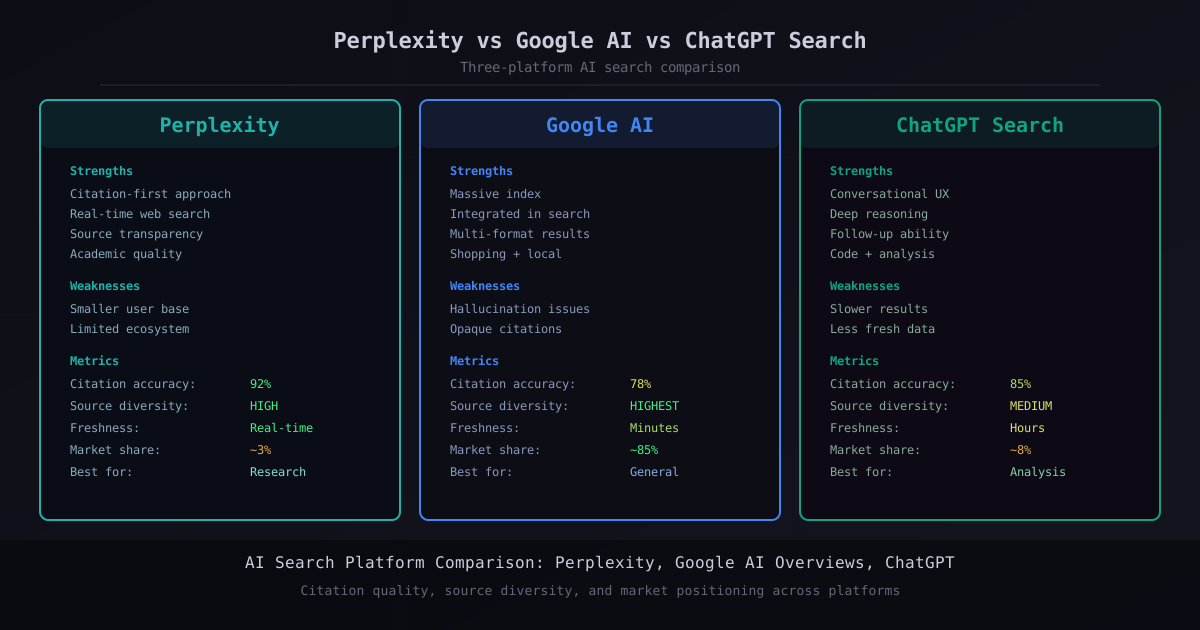
Perplexity cites an average of 5 to 7 sources per response based on its citation model, which attributes each factual claim to a specific web source. Google AI Overviews cite 3 to 5 sources. ChatGPT’s search feature (Browse with Bing) typically cites 3 to 6 sources per response. In every case, the vast majority of web pages on a topic receive zero citations.
The implications for content strategy are significant. Ranking on page one of Google used to mean visibility to every searcher. Now, ranking on page one is necessary but not sufficient. Only the pages that AI systems judge as most citation-worthy earn the 2 to 7 available slots.
Gartner predicts that traditional search engine volume will drop 25% by 2026 as users shift to AI chatbots and virtual agents, according to Gartner, 2024. AI search adoption nearly doubled from 14% to 29.2% in 2025, according to SparkToro, 2025. The shift means that citation optimization is not a future concern; it is a present-day traffic variable.
For a deeper exploration of how GEO techniques work, see our comprehensive guide on what is Generative Engine Optimization.
6 Techniques That Increase Citation Probability
Princeton University, Georgia Tech, the Allen Institute for AI, and IIT Delhi published the foundational GEO research paper at ACM SIGKDD 2024, testing nine content optimization strategies against AI citation rates, according to Aggarwal et al., KDD 2024. Their findings identify the techniques that work, ranked by citation visibility improvement.
1. Sourced Statistics (+32% visibility)
Adding statistics with source attribution improved content visibility in generative engines by 32% compared to unsourced content. The format matters: citing a specific source alongside the statistic performs better than naked numbers without attribution.
This technique works because AI engines can trace the claim back to a verifiable source. If the AI model can confirm the statistic against its training data or live retrieval, it trusts the content enough to cite it. Unsourced statistics are indistinguishable from hallucinations, and AI systems have learned to deprioritize them.
2. Quotation Addition (+41% visibility)
Including direct quotations from named experts improved visibility by 41%, the highest single-technique gain in the study. Quotations signal primary source access. An article that quotes a CEO, researcher, or industry analyst demonstrates first-hand information that the AI cannot fabricate.
3. Source Citations (+28% visibility)
Adding inline citations to external authoritative sources improved visibility by 28%. This is distinct from statistics; it applies to any factual claim backed by a linked source. The mechanism is similar: AI engines prefer content that does the attribution work, reducing the model’s uncertainty about claim accuracy.
4. Answer-First Structure
Content that leads with the direct answer in the first 1 to 2 sentences of each section performs better in AI citation selection. AI Overviews need extractable passages, not buried conclusions. If your key point is in paragraph six after five paragraphs of context, AI systems often skip it.
The pattern is: answer the question in the first sentence, then provide context, evidence, and nuance in subsequent sentences. This mirrors the inverted pyramid structure used in journalism, which has been effective for decades because it frontloads the most important information.
5. Entity Density
Content with a high density of named entities (companies, tools, people, standards, organizations) performs better in AI citation contexts. Entities give AI models anchoring points. An article mentioning Google, OpenAI, Anthropic, Perplexity, BrightEdge, Gartner, Princeton, and specific product names provides more indexable signals than generic text about “AI companies” and “search tools.”
The GEO research found that content with 10+ unique named entities per article significantly outperformed lower-entity content in citation frequency. Entities also improve traditional SEO through Google’s Knowledge Graph matching.
6. Factual Verification
Content that demonstrably prioritizes accuracy earns more citations. AI engines increasingly use signals like source diversity, claim consistency across sources, and citation density to assess content reliability. Content verified through tools like Webcite benefits because the verification process naturally produces the sourced, attributed, entity-rich structure that AI engines prefer.
Princeton’s research explicitly found that keyword stuffing decreased visibility by 10%, according to Aggarwal et al., KDD 2024. Traditional SEO tactics that game ranking signals actively hurt AI citation performance. The optimization direction has reversed: depth and accuracy win, not keyword density.
Optimizing for Google AI Overviews Specifically
Google AI Overviews have unique selection characteristics that differ from ChatGPT and Perplexity. Understanding these differences helps prioritize optimization efforts.
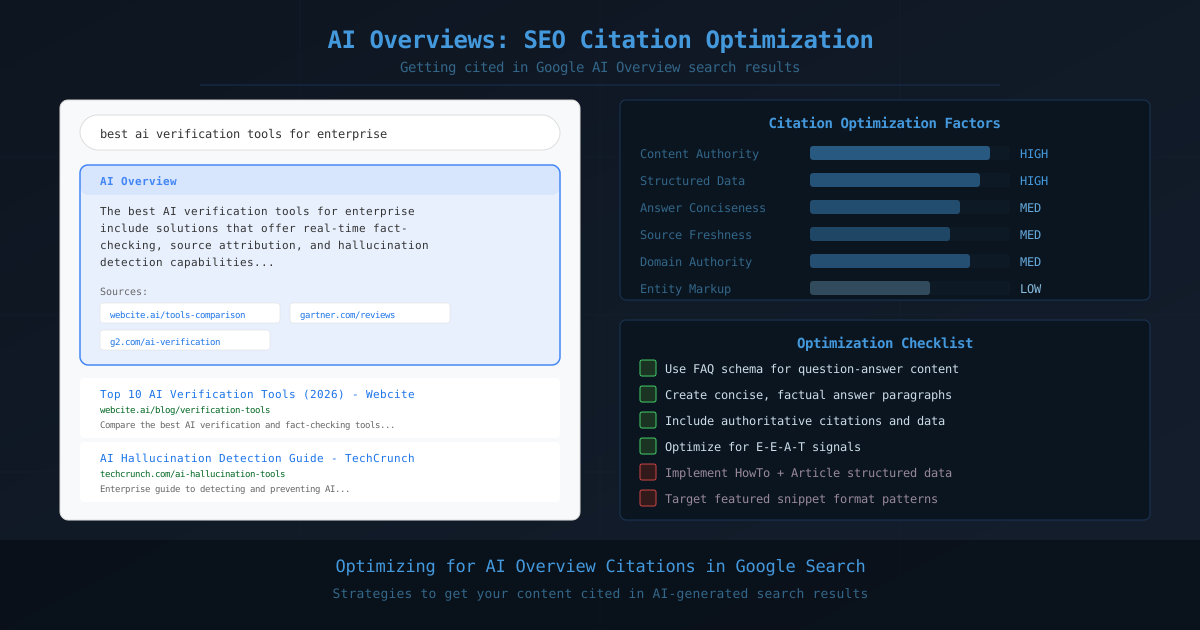
Google AI Overviews favor authoritative domains. Established media outlets, government sites, educational institutions, and recognized industry publications receive disproportionate citation share. This means newer domains need stronger on-page signals (statistics, citations, entity density) to compete against the domain authority advantage.
Google AI Overviews appear most frequently on informational and “how to” queries. They are less common on navigational queries (where users want a specific website) and transactional queries (where users want to buy something). Optimizing informational content with the GEO techniques above has the highest expected return.
Structured data markup helps Google identify extractable passages. FAQ schema, HowTo schema, and article schema all provide signals that help Google’s AI system parse your content into citable segments. Ahrefs analyzed 300,000 keywords and found that AI Overviews are more likely to appear for long-tail informational queries than for short head terms, according to Ahrefs, 2024.
Freshness matters more in AI Overviews than in traditional search. Google’s system weights recent publication dates and “last updated” timestamps when selecting sources for time-sensitive queries. Keeping content current with the latest statistics and references improves citation probability for queries where recency is relevant.
The Content Verification Advantage
Fact-checked, verified content has a structural advantage in AI citation selection. The reason is mechanical: the GEO techniques that boost citation probability (sourced statistics, inline citations, high entity density, leading with the answer) are the same techniques that verification naturally requires.
When you verify a claim through a verification API, the process produces sourced citations and confidence scores. Incorporating those citations into your content creates exactly the attribution structure that AI engines prioritize. Verification and citation optimization are not separate activities; they are the same workflow.
Webcite’s verification API checks claims against independent sources and returns structured citations with confidence scores. Each verification uses 4 credits. The free tier provides 50 credits per month for testing. The Builder plan at $20 per month includes 500 credits for 125 verifications. Enterprise plans start at 10,000+ credits.
const response = await fetch("https://api.webcite.co/api/v1/verify", {
  method: "POST",
  headers: {
    "x-api-key": process.env.WEBCITE_API_KEY,
    "Content-Type": "application/json"
  },
  body: JSON.stringify({
    claim: "AI Overviews appear in 57% of search results pages",
    include_stance: true,
    include_verdict: true
  })
})

const result = await response.json()
// result.verdict.result: "supported"
// result.verdict.confidence: 91
// result.citations: [{ title: "Seer Interactive", url: "...", snippet: "..." }]
The verification response gives you the exact source URL, the relevant passage, and a confidence score. Publishing your content with these verified citations creates a page that AI engines can easily validate and cite.
Research from the same Princeton and Georgia Tech team found that content with citations was 30% more likely to be surfaced by generative engines compared to equivalent content without source references, according to GEO study, 2024. Verification infrastructure does not just improve accuracy; it directly improves citation probability and, by extension, traffic from AI search.
Measuring AI Citation Performance
Traditional SEO metrics (rankings, impressions, clicks) do not capture AI citation performance. New measurement approaches are needed.
Google Search Console now reports AI Overview impressions and clicks separately from traditional organic results. Monitor these metrics to understand which queries trigger AI Overviews for your content and how citation affects click-through rates. Semrush and Ahrefs have both added AI Overview tracking features to their rank-tracking products, according to Semrush, 2025.
For ChatGPT and Perplexity, direct analytics are limited. Track referral traffic from chat.openai.com and perplexity.ai in your web analytics platform. Monitor which pages receive AI-referred traffic and correlate that with content characteristics to identify citation patterns.
Set up a citation monitoring workflow:
- Track which of your pages appear in AI Overviews using Search Console
- Log referral traffic from ChatGPT, Perplexity, and Copilot in your analytics platform
- Correlate cited pages with content attributes: word count, number of citations, entity count, statistics count
- A/B test content optimizations (add statistics, add citations, restructure to lead with answers) and measure citation impact over 30-day cycles
The measurement challenge is real, but the traffic impact is too large to ignore. An average LLM visitor is worth 4.4x a traditional organic search visitor, according to SparkToro, 2025. Even modest improvements in citation rate translate to meaningful traffic gains.
Common Mistakes That Kill Citation Probability
Several common content practices actively reduce the likelihood of AI citation.
Thin content without sources. Pages that make claims without providing evidence are indistinguishable from AI-generated filler to generative engines. If your page says “AI adoption is growing rapidly” without a statistic or source, AI systems have no reason to cite it over a competitor’s page that provides specific numbers with attribution.
Paywalled or gated content. AI systems cannot crawl or cite content behind login walls or paywalls. If your best content is gated, it does not exist for AI citation purposes. Consider publishing summary versions of gated content with key statistics accessible to crawlers.
Excessive internal linking without external citations. Pages that link extensively to your own site but never cite external sources signal self-promotion rather than authority. AI engines weight external source diversity as a trust signal. A healthy citation profile includes both internal links (for context) and external links (for credibility).
Keyword stuffing. The Princeton GEO research explicitly found that keyword optimization decreased visibility by 10% in generative engines. AI systems penalize content that prioritizes keyword density over substance. Write for clarity and depth, not for keyword ratios.
Stale content with outdated statistics. AI engines check recency. A page citing 2021 data when 2025 data is available will lose citation slots to competitors who cite current numbers. Update your key pages quarterly with the latest available statistics and research.
Building a Citation-Optimized Content Workflow
A production workflow for citation-optimized content has five stages.
Stage 1: Research and entity mapping. Identify the target query, compile relevant statistics from authoritative sources, and list all named entities (companies, people, tools, standards) that should appear in the content. Aim for 10+ unique entities and 1 sourced statistic per 200 words.
Stage 2: Answer-first drafting. Write each section with the direct answer in the first sentence. Add context, evidence, and nuance in subsequent paragraphs. Use the inverted pyramid structure throughout.
Stage 3: Citation insertion. Add inline citations for every statistic and factual claim. Link to authoritative external sources (research papers, official company pages, government databases, recognized industry reports). Include 3+ external links and 2+ internal links to your own related content.
Stage 4: Verification. Run key claims through the Webcite API to confirm accuracy and collect additional source citations. Replace any unsourced claims with verified, cited alternatives. This step simultaneously improves accuracy and citation structure.
Stage 5: Structured data markup. Add FAQ schema for your FAQ section, article schema for the page, and any relevant HowTo or dataset schema. These markup types help AI systems parse your content into citable segments.
This workflow produces content that satisfies both traditional SEO requirements and GEO citation optimization. The verification step in stage 4 is the bridge: it ensures factual accuracy while producing the source attribution structure that AI engines reward.
Frequently Asked Questions
What are Google AI Overviews?
Google AI Overviews are AI-generated summaries that appear at the top of search results for eligible queries. They synthesize information from multiple web sources and display inline citations. AI Overviews appear in approximately 57% of search engine results pages, depending on query type, and provide direct answers rather than a list of links.
How do AI Overviews affect organic click-through rates?
AI Overviews reduce organic clicks by approximately 58% on average for queries where they appear, according to Seer Interactive, 2025. However, brands cited within AI Overviews earn 35% more organic clicks and 91% more paid clicks than brands that are not cited. Being cited transforms the negative impact into a traffic advantage.
How do you optimize content to be cited in AI Overviews?
Focus on answer-first content structure, sourced statistics with citations, high entity density (named companies, tools, people, standards), and authoritative expertise signals. Princeton research found that adding cited statistics improved AI visibility by 32% and adding quotations improved it by 41%. Factual accuracy and source attribution are the strongest signals.
How many sources do AI engines typically cite per response?
AI engines cite 2 to 7 domains per response, creating a winner-take-all citation dynamic. Google AI Overviews typically reference 3 to 5 sources. ChatGPT and Perplexity cite similar numbers but with different selection criteria. The limited citation slots make optimization critical for capturing one of the few available positions.
Does fact-checked content get cited more often by AI engines?
Yes. AI engines prioritize content with verifiable claims, sourced statistics, and clear attribution because these signals indicate reliability. Content that includes cited sources was 28% more likely to be surfaced by generative engines compared to unsourced content, according to Aggarwal et al., KDD 2024.
What is the difference between SEO and GEO?
SEO optimizes for ranking in traditional search results (ten blue links). GEO, or Generative Engine Optimization, optimizes for being cited inside AI-generated responses from ChatGPT, Perplexity, Google AI Overviews, and similar engines. SEO focuses on keywords and backlinks; GEO focuses on citation-worthiness, sourced claims, and entity density.