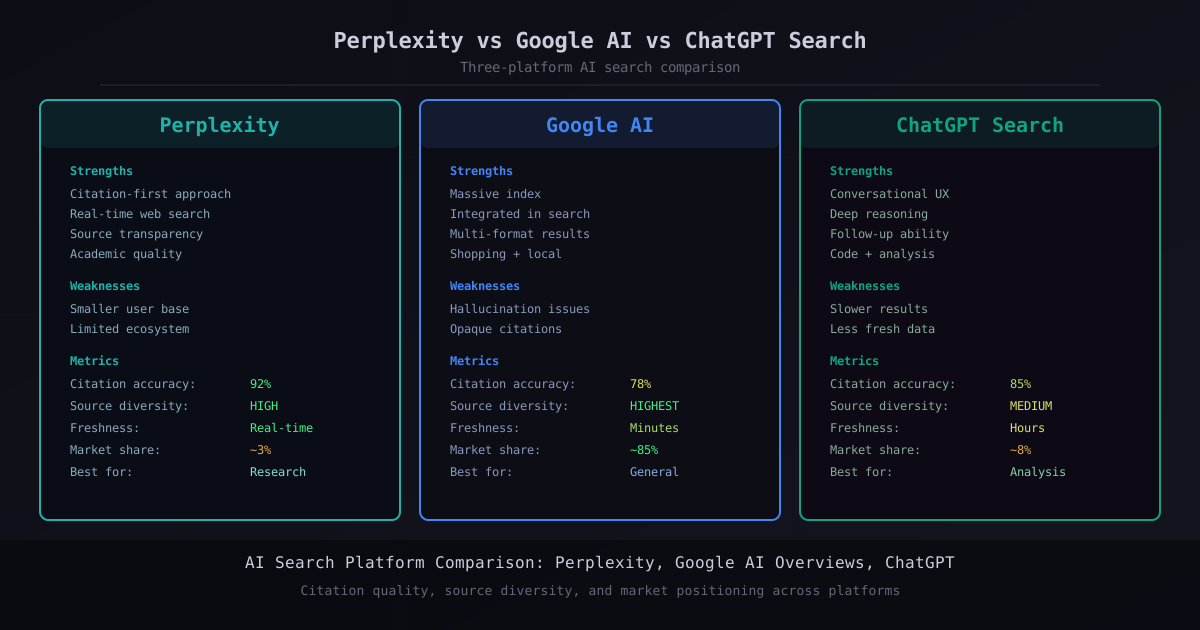
Gartner predicts traditional search engine volume will drop 25% by 2026 as users shift to AI chatbots and virtual agents, according to Gartner, 2024. ChatGPT now serves over 800 million weekly active users, according to DemandSage, 2026. Perplexity processes 780 million search queries per month, according to DemandSage, 2026. The question is no longer whether AI will reshape search. The question is whether your content will be cited when it does. Generative Engine Optimization (GEO) is the discipline that answers that question.
- GEO optimizes content to be cited by AI engines like ChatGPT, Perplexity, and Google Gemini, not just ranked in traditional search.
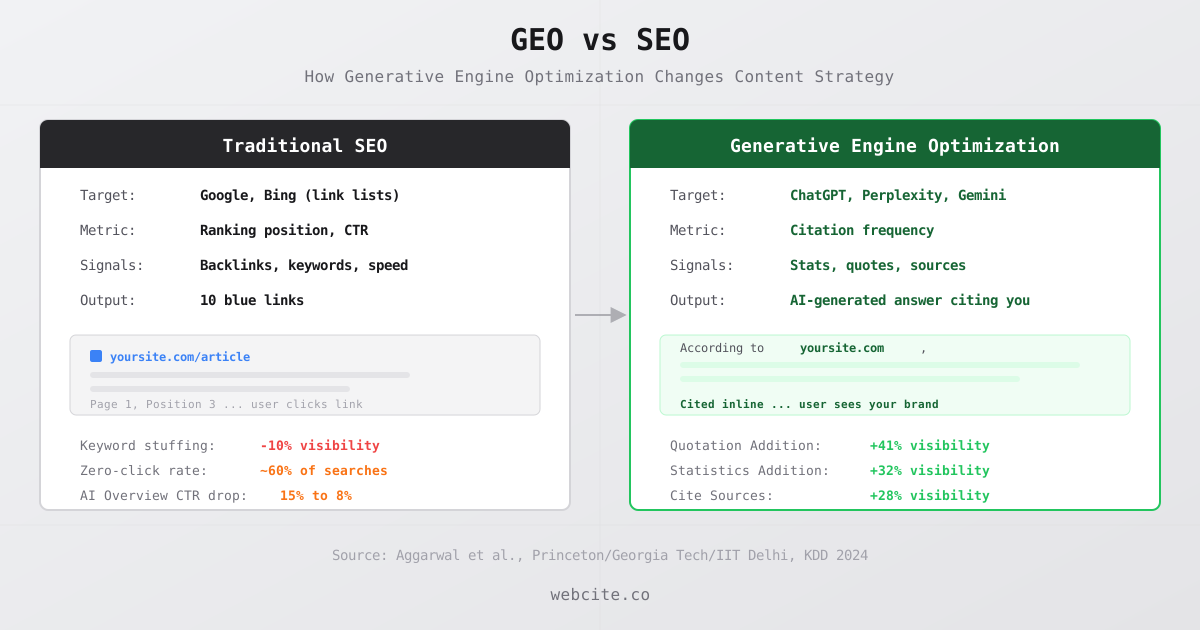
- Princeton, Georgia Tech, and IIT Delhi researchers found that Quotation Addition improved AI visibility by 41% in their KDD 2024 study.
- The top 3 GEO techniques (quotations, statistics, source citations) outperformed every traditional SEO tactic, while keyword stuffing decreased visibility by 10%.
- Approximately 60% of Google searches now end with zero clicks, pushing content strategy toward AI citation models.
- Verified, source-attributed content gets cited more by AI engines because models prioritize claims they can trace back to evidence.
What Is GEO and Why Does It Matter?
Generative Engine Optimization is the practice of structuring content so that AI search engines cite it in their answers. When a user asks ChatGPT “What is the best way to verify AI claims?” or asks Perplexity “How do citation APIs work?”, the AI generates a response by synthesizing information from multiple sources. GEO determines whether your content is one of those sources.
This is fundamentally different from traditional SEO. Google Search ranks pages in a list and sends users to your site. ChatGPT, Perplexity, and Google Gemini synthesize an answer and may cite your content inline, but users often never visit your page. The value shifts from ranking to being referenced.
The term was formalized by researchers at Princeton University, Georgia Tech, the Allen Institute for AI, and IIT Delhi in their paper “GEO: Generative Engine Optimization,” published at ACM SIGKDD 2024, according to Aggarwal et al., KDD 2024. The paper introduced GEO-bench, a benchmark of diverse queries, and tested nine optimization strategies against a baseline. The results upended conventional SEO wisdom.
The scale of the shift makes GEO urgent. Google AI Overviews now appear in approximately 13% of all search queries, more than doubling from 6.49% in January 2025, according to BrightEdge, 2025. When AI Overviews are present, click-through rates drop from 15% to 8%, a 47% decline, according to HubSpot, 2025. Content that is not optimized for AI citation is invisible in a growing share of searches.
The Princeton GEO Study: What Actually Works
The KDD 2024 paper tested nine content optimization methods across hundreds of queries on the GEO-bench benchmark. Researchers measured visibility using Position-Adjusted Word Count, which tracks how much of a source’s content appears in AI-generated responses and where it appears. Here are the results, according to Aggarwal et al., 2024:
| Method | Visibility Improvement |
|---|---|
| Quotation Addition | +41% |
| Statistics Addition | +32% |
| Cite Sources | +28% |
| Fluency Optimization | +28% |
| Technical Terms | +18% |
| Easy-to-Understand | +14% |
| Authoritative Tone | +12% |
| Unique Words | +6% |
| Keyword Stuffing | -10% |
Three findings stand out.
First, the top three methods (quotations, statistics, source citations) all involve adding verifiable evidence to content. AI engines are not looking for keyword density. They are looking for claims they can attribute. When your content includes a direct quote from a named expert, a specific statistic with a source, or an inline citation to a credible reference, AI models can extract and present that information with confidence.
Second, keyword stuffing, the backbone of early SEO, actually decreased visibility by 10%. Generative engines penalize content that looks optimized for algorithms rather than humans. This is the clearest signal that GEO requires a different playbook than SEO.
Third, the effectiveness varies by domain. Quotation Addition performed best for People and Society, Explanation, and History queries. Statistics Addition dominated Law and Government topics. Cite Sources was most effective for factual, verifiable queries. There is no single GEO strategy; the right approach depends on your content domain.
GEO vs SEO: A Direct Comparison
SEO and GEO share the goal of increasing content visibility, but they target different systems with different mechanics. Here is how they compare:
| Dimension | Traditional SEO | GEO |
|---|---|---|
| Target system | Google, Bing (link-based search) | ChatGPT, Perplexity, Gemini, Copilot (AI-generated answers) |
| Success metric | Ranking position, click through rate | Citation frequency, source attribution |
| Primary signals | Backlinks, keywords, page speed, domain authority | Statistics, quotations, source citations, structured claims |
| User behavior | User clicks a link and visits your page | User reads AI answer that cites your content |
| Content format | Keyword-optimized pages, meta tags, alt text | Evidence-rich paragraphs, inline citations, named sources |
| Negative signal | Thin content, broken links | Keyword stuffing (-10% visibility), unsourced claims |
| Measurement tools | Google Search Console, Ahrefs, SEMrush | GEO-bench, AI citation tracking, brand mention monitoring |
GEO does not replace SEO. Traditional search still drives the majority of referral traffic. But the balance is shifting. BrightEdge found that AI search visits are surging while organic search remains the foundation, but clickthrough rates on queries with AI Overviews have dropped by nearly half, according to BrightEdge, 2025. The global GEO market is projected to grow from $886 million in 2024 to $7.3 billion by 2031, a 34% compound annual growth rate, according to AllAboutAI, 2025.
The practical takeaway: optimize for both. SEO gets your page indexed and ranked. GEO gets your content cited inside AI answers. The content that does both captures traffic from traditional search and visibility from AI-generated responses.
How AI Search Engines Decide What to Cite
Understanding GEO requires understanding how generative engines select sources. Unlike Google, which uses PageRank and backlink analysis, AI search engines evaluate content through a different lens.
ChatGPT (powered by OpenAI), Perplexity, Google Gemini, and Microsoft Copilot all use retrieval-augmented generation (RAG) or similar architectures. They retrieve candidate documents, then generate a response that synthesizes information from those documents. The key decision point is which retrieved passages get cited in the final answer.
Research and observed behavior suggest AI engines favor content that meets these criteria:
Attributable claims. Statements that include a source, statistic, or named reference are easier for models to cite because they come with built-in attribution. The Princeton study confirmed this: Cite Sources improved visibility by 28%.
Specificity over generality. “Revenue grew 23% in Q3 2025” is more citable than “Revenue grew significantly.” AI models extract specific numbers because they make the generated response more useful and verifiable.
Structured formatting. Content organized with clear headings, tables, and lists is easier for retrieval systems to parse. HubSpot found that listicles achieve a 25% citation rate versus 11% for narrative posts, according to HubSpot, 2025.
Freshness and accuracy. AI engines prefer recent, accurate content. Outdated statistics or claims that contradict newer sources get deprioritized. This is where verification APIs become a GEO tool: content that has been verified against current sources is less likely to contain outdated claims that reduce citation potential.
The Role of Source Attribution in GEO
Source attribution is the mechanism that connects GEO to trust. When your content includes inline citations, named experts, and linked references, you are doing two things: making the content more useful to human readers and making it more extractable by AI engines.
The Princeton study showed this directly. The three highest-performing GEO methods (Quotation Addition at +41%, Statistics Addition at +32%, Cite Sources at +28%) all involve adding external evidence. These methods work because AI engines need to justify their answers. A model that cites “A Stanford study found…” is more defensible than one that asserts a fact without attribution.
This creates a virtuous cycle. Content with strong source attribution gets cited more by AI engines. AI citations increase the content’s visibility and perceived authority. Higher authority leads to more citations in subsequent queries.
For content teams, the implication is clear: every claim in your content should be attributable. Not because a human reader will check every citation (most won’t), but because AI engines will use those citations to decide whether your content is worth referencing.
Reddit saw a 450% increase in AI citations from March to June 2025, according to HubSpot, 2025. The reason: Reddit content is full of specific claims, named sources, and direct quotations from real people. It is, unintentionally, well-optimized for GEO.
How Verification APIs Strengthen GEO
A verification API checks claims against real-world sources and returns structured citations with confidence scores. This has direct implications for GEO.
Content verified through an API like Webcite gains three GEO advantages:
Accurate statistics. Verification ensures that the numbers in your content match current sources. AI engines cross-reference claims; content with outdated or incorrect statistics gets deprioritized. Each Webcite verification checks a claim against multiple sources and returns a confidence score, so you publish only claims that can withstand scrutiny.
Structured citations. The API returns source URLs, relevant passages, and credibility scores. You can use these to add inline citations to your content, directly implementing the Cite Sources technique that improved visibility by 28% in the Princeton study.
Freshness validation. Markets change, statistics get updated, and policies shift. A quarterly verification pass through your existing content library catches stale claims before AI engines notice them and stop citing your pages.
Here is how a content team might use Webcite to strengthen GEO:
const response = await fetch("https://api.webcite.co/api/v1/verify", {
  method: "POST",
  headers: {
    "x-api-key": process.env.WEBCITE_API_KEY,
    "Content-Type": "application/json"
  },
  body: JSON.stringify({
    claim: "The global GEO market will reach $7.3 billion by 2031",
    include_stance: true,
    include_verdict: true
  })
})

const result = await response.json()
// result.verdict.result: "supported"
// result.verdict.confidence: 91
// result.citations: [{ title: "AllAboutAI...", url: "...", stance: "for" }]
If the verdict is “supported,” you publish the claim with the returned citation. If it’s “contradicted,” you update the claim. If there’s “insufficient evidence,” you either find a better source or remove the claim. This workflow ensures every published statistic is verifiable, which is exactly what AI engines reward.
A Practical GEO Checklist
Based on the Princeton research and observed AI engine behavior, here is a checklist for optimizing content for generative engine citation:
1. Add at least one sourced statistic per 200 words. The Statistics Addition method improved visibility by 32%. Use specific numbers with named sources: “Gartner projects search volume will drop 25% by 2026” is citable. “Search volume is declining” is not.
2. Include direct quotations from named experts or studies. Quotation Addition was the single most effective GEO technique at +41%. Quote researchers, industry analysts, or company leaders by name. AI engines can attribute named quotes directly.
3. Cite your sources inline. Do not save all references for a bibliography at the bottom. Cite Sources improved visibility by 28% when citations appeared next to the claims they supported. Use inline attribution such as “Source Name (Year) found that…” or link directly to the original.
4. Structure content with clear H2 and H3 headings. Retrieval systems parse heading hierarchies to identify relevant sections. A well-structured article lets AI engines extract the specific section that answers a query rather than ignoring the entire page.
5. Use tables for comparisons. AI engines frequently pull structured data from tables. The GEO vs SEO comparison table in this article is more likely to be cited than the same information written as prose.
6. Verify claims before publishing. Use a verification API to confirm that every statistic and factual claim in your content is accurate and current. Outdated claims reduce citation potential and erode trust with both human readers and AI engines.
7. Avoid keyword stuffing. The Princeton study measured a 10% decrease in visibility from keyword stuffing. Write for information density, not keyword density.
8. Update existing content quarterly. AI engines prefer fresh, accurate sources. A quarterly review of your top-performing pages, checking statistics and updating citations, keeps your content in the citation pool.
9. Include named entities. Reference specific companies (Google, OpenAI, Anthropic), institutions (Princeton, Stanford), products (ChatGPT, Perplexity, Gemini), and people by name. Named entities are how AI engines establish relevance and authority.
10. Write answer-first paragraphs. AI engines extract the first sentence of a paragraph more often than the last. Lead with the answer, then provide supporting evidence. This mirrors how Perplexity and ChatGPT construct their responses.
What Comes Next for GEO
The GEO landscape is evolving fast. Google AI Overviews now trigger on over 172,000 keywords, up from 10,000 in August 2024, a 1,620% increase in under a year, according to Semrush via HubSpot, 2025. OpenAI launched SearchGPT features that directly compete with traditional search. Perplexity raised its valuation to $18 billion on the strength of its AI search product, according to Business of Apps, 2025.
Three trends will shape GEO in 2026 and beyond:
AI search fragmentation. There is no single AI search engine that dominates the way Google dominates traditional search. ChatGPT, Perplexity, Gemini, Copilot, and smaller players like You.com each have different retrieval and citation behaviors. GEO strategies will need to account for multiple engines, much like early SEO had to account for Google, Yahoo, and Bing simultaneously.
Citation verification as ranking signal. As AI engines mature, they will increasingly verify the sources they cite. Content with accurate, verifiable claims will outperform content with plausible-sounding but unverified assertions. This is where tools like Webcite create compounding value: verified content gets cited more, which increases authority, which leads to more citations.
Measurement maturity. GEO measurement is still in its early stages. GEO-bench from the Princeton study is a start, but the industry needs tools that track citation frequency across multiple AI engines in real time. Expect dedicated GEO analytics platforms to emerge alongside traditional SEO tools like Ahrefs and SEMrush.
The content teams that invest in GEO now will have a structural advantage as AI search grows. The Princeton research gives us the playbook: statistics, quotations, source citations, and structured content. The tools to execute that playbook, from verification APIs to AI citation trackers, are available today.
Frequently Asked Questions
What is Generative Engine Optimization (GEO)?
GEO is the practice of optimizing web content so that AI-powered search engines like ChatGPT, Perplexity, and Google Gemini cite it in their responses. Unlike traditional SEO, which targets ranking in link-based results, GEO focuses on making content citation-worthy through statistics, quotations, and source references. The term was formalized by researchers at Princeton, Georgia Tech, and IIT Delhi in their KDD 2024 paper.
How is GEO different from traditional SEO?
SEO optimizes for ranking in a list of ten blue links on Google or Bing. GEO optimizes for being cited inside an AI-generated answer on ChatGPT, Perplexity, or Gemini. SEO relies on backlinks, keyword density, and click through rate. GEO relies on cited sources, statistical evidence, and structured claims that AI models can extract and attribute.
What are the most effective GEO techniques?
Princeton, Georgia Tech, and IIT Delhi researchers found that Quotation Addition improved AI visibility by 41%, Statistics Addition by 32%, and Cite Sources by 28% on the Position-Adjusted Word Count metric. These three methods outperformed every traditional SEO tactic tested. Keyword stuffing, a common SEO practice, actually decreased visibility by 10%.
Does GEO replace SEO?
No. GEO complements SEO. Traditional search still drives the majority of web traffic, but Gartner predicts search engine volume will drop 25% by 2026 due to AI alternatives. Content teams that invest in both GEO and SEO capture traffic from traditional search results and citations from AI-generated answers.
How do verification APIs help with GEO?
Verification APIs like Webcite check claims against real sources and return structured citations with confidence scores. Content that includes verified statistics and cited sources ranks higher in GEO because AI engines prioritize attributable, evidence-backed claims over unsourced assertions. The Cite Sources technique improved visibility by 28% in the Princeton study.