Perplexity processes over 100 million queries per month, and every answer includes numbered citations linking back to original sources, according to CNBC, 2024. That design choice is not cosmetic. Source attribution is the mechanism that separates trustworthy AI from confident guesswork. This article explains what source attribution is, why it matters for trust, compliance, and search visibility, and how to implement it in AI applications.
- Source attribution links every AI claim to the original source, letting users verify answers themselves.
- Content with citations is 30% more likely to be surfaced by AI search engines like Google AI Overviews.
- EU AI Act Article 50 mandates AI transparency by August 2, 2026, making attribution a compliance requirement.
- Grounding retrieves sources during generation; attribution shows users those sources after generation.
- Webcite provides verified citations that attribution systems can display inline, as footnotes, or as structured JSON.
What Is Source Attribution in AI?
Source attribution is how an AI system tells you where its answer came from. When an AI writes “the global AI market reached $184 billion in 2024,” attribution means attaching a link to the Statista report that contains that figure. Without attribution, the user has no way to know whether the number is real or hallucinated.
This is not a new concept. Academic papers have used citations for centuries. Wikipedia requires inline references for every factual claim. Journalism attributes quotes and data to named sources. What is new is applying this discipline to AI-generated content at scale.
The problem is urgent. Stanford HAI researchers found that legal AI tools hallucinate in 1 out of 6 or more benchmarking queries, even when using retrieval-augmented generation, according to Stanford HAI, 2025. When AI systems produce errors that look identical to accurate statements, the only defense is giving users a way to check the sources themselves.
Source attribution serves three functions. First, it builds user trust by providing verifiable evidence. Second, it creates accountability by making it possible to trace errors back to their origin. Third, it enables compliance with emerging regulations that require AI transparency.
Attribution vs Grounding: A Critical Distinction
These two terms get conflated constantly, but they solve different problems.
Grounding happens during generation. It connects the AI model to external data sources so the model can base its answers on real information rather than its training data alone. Retrieval-augmented generation (RAG) is the most common grounding technique: the system retrieves relevant documents and feeds them into the model’s context window before generating a response. Google Vertex AI, Amazon Bedrock, and Microsoft Azure AI all offer grounding APIs.
Attribution happens after generation. It identifies which specific sources the model used and presents them to the user in a verifiable format. Attribution answers the question: “Where did this answer come from?”
You can have grounding without attribution. A RAG system might retrieve 10 documents and generate a fluent paragraph, but if it does not tell the user which documents it drew from, the user cannot verify anything. This is where most enterprise AI deployments sit today.
You can also have attribution without grounding. A system can generate an answer from its training data, then run a post-generation verification step to find supporting sources and attach them as citations. This is the pattern that verification APIs like Webcite enable.
The ideal system uses both: grounding to improve accuracy during generation, and attribution to prove that accuracy to the user after generation.
Why Source Attribution Matters for Trust
Trust in AI is measurable and declining. An Edelman survey in 2024 found that only 35% of the global population trusts AI companies to do the right thing, according to Edelman Trust Barometer, 2024. The gap between AI capability and AI trust is widening, and the primary cause is the inability to verify AI outputs.
Citations close that gap. When a user sees that an AI answer includes links to the New York Times, the Bureau of Labor Statistics, and a peer-reviewed paper from MIT, they can click through and check. The citation transforms the AI from an oracle into a research assistant.
Three specific trust mechanisms are at work:
Verifiability. Users can confirm claims independently. A 2024 Reuters Institute study found that 52% of respondents were concerned about identifying AI-generated misinformation, according to Reuters Institute, 2024. Attribution gives users the tool to address that concern.
Error containment. When an AI does hallucinate, attribution makes the error visible. A claim without a citation signals to the user that it may be unverified. A claim with a citation that leads to a contradictory source signals an error. Either way, the user is informed.
Source quality transparency. Not all sources are equal. A citation from the World Health Organization carries more weight than a citation from an anonymous blog. Attribution systems that include source metadata let users evaluate credibility themselves.
The Regulatory Case: EU AI Act Article 50
Attribution is no longer just a trust feature. It is becoming a legal requirement.
EU AI Act Article 50 mandates that providers of AI systems that generate synthetic audio, image, video, or text content must ensure outputs are marked as AI-generated in a machine-readable format. The regulation also requires that AI systems designed to interact with people must inform users that they are interacting with AI, according to the official EU AI Act text, Article 50. The compliance deadline is August 2, 2026.
The implications for source attribution are direct. AI systems that generate text for European users will need to demonstrate transparency about their outputs. Showing users which sources informed an answer is one of the most straightforward ways to meet that requirement.
The European Commission published its first draft Code of Practice in December 2025, and compliance advisors expect additional guidance on citation and transparency requirements throughout 2026, according to Secure Privacy, 2026.
The EU is not acting alone. The Colorado AI Act requires disclosures about AI decision-making and California’s transparency requirements take effect in 2026, creating overlapping regulations for AI providers, according to Wilson Sonsini, 2026. Canada’s AIDA (Artificial Intelligence and Data Act) includes similar provisions. Organizations building AI products for global markets face overlapping mandates that all point toward the same requirement: show your sources.
For developers, this means attribution infrastructure built now avoids costly retrofitting later. Every citation logged by a verification API creates an auditable record of what was checked, against which sources, and with what confidence.
How Source Attribution Boosts AI Search Visibility
Source attribution is not just about trust and compliance. It directly affects whether AI search engines surface your content.
Researchers at Princeton University and Georgia Tech published findings showing that content with properly formatted citations is approximately 30% more likely to be referenced by generative AI engines, including Google AI Overviews and Perplexity, according to Princeton/Georgia Tech GEO Study, 2024. The study introduced the concept of Generative Engine Optimization (GEO) and found that citation inclusion was among the most effective optimization strategies.
This finding has significant implications for content publishers. Traditional SEO optimized for search engine result pages. GEO optimizes for AI-generated answers. When Google AI Overviews or Perplexity compose a response, they prefer to cite sources that themselves cite other authoritative sources. It is a citation chain: well-attributed content gets attributed more often.
The GEO research tested nine optimization strategies. Three stood out:
- Citing sources increased visibility by approximately 30% across all generative engines tested.
- Including statistics with attribution boosted relevance scores by 20-25%.
- Using quotations from authoritative figures improved citation rates by 15%.
For organizations building AI applications, this creates a dual incentive. Attribution makes your AI outputs more trustworthy for end users, and it makes the content those outputs reference more likely to appear in AI search results. The developers who build citation pipelines into their products gain both trust and distribution.
Citation Formats in AI Systems
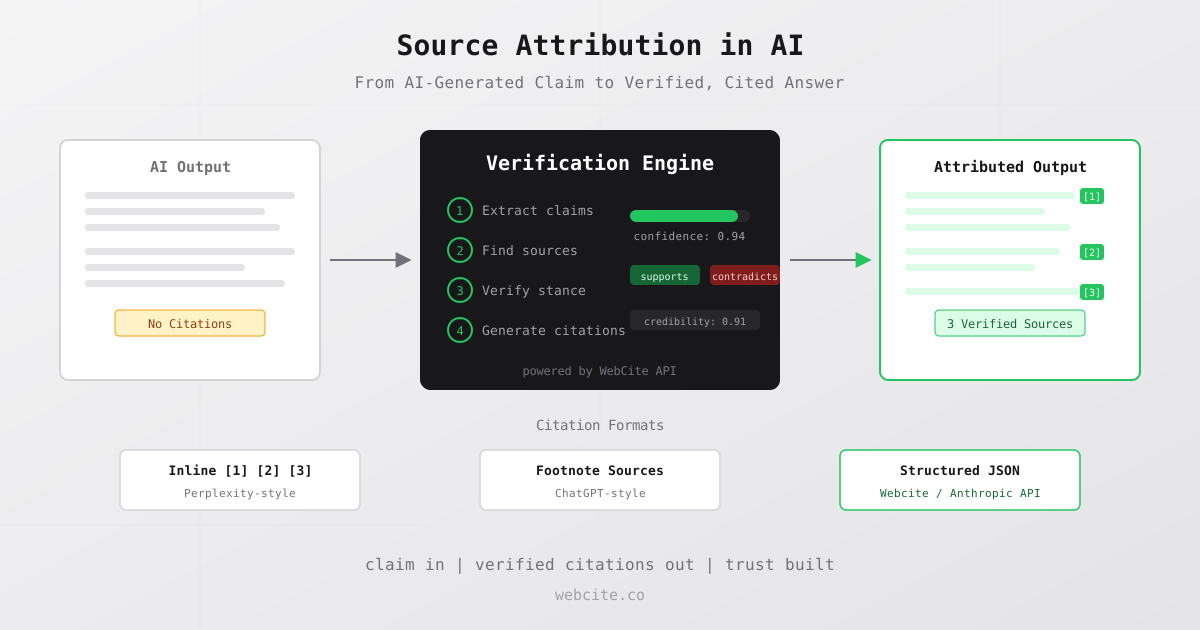
Not all AI systems handle citations the same way. The three dominant formats each serve different use cases.
Inline Citations
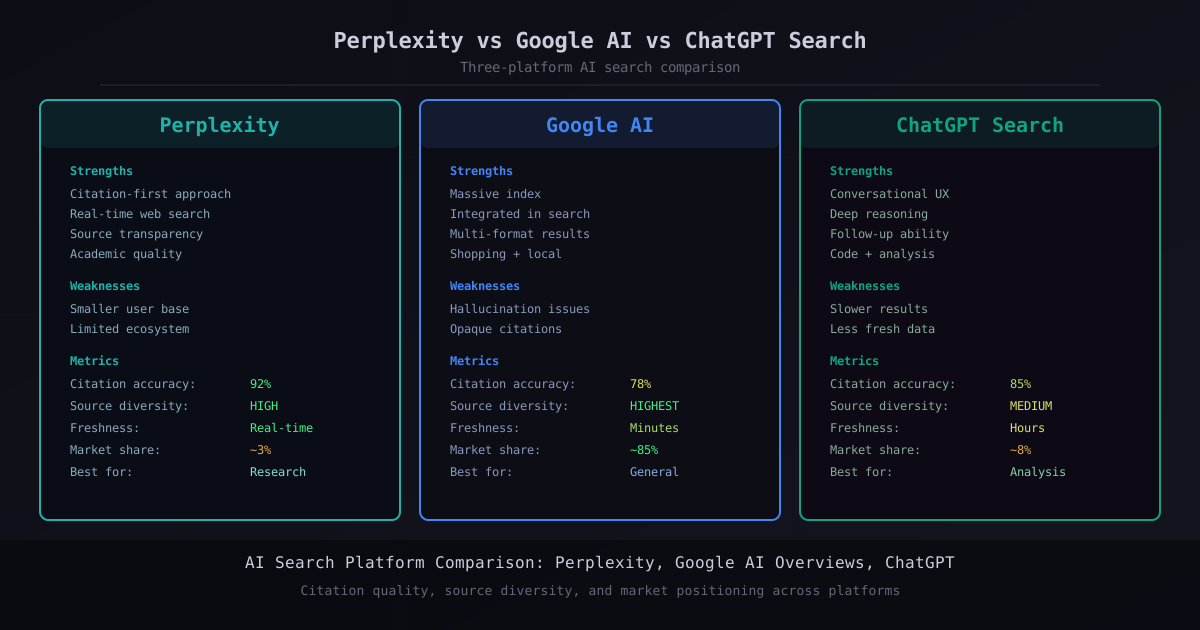
Inline citations embed numbered references directly in the text, similar to academic papers. Perplexity pioneered this format in consumer AI, placing bracketed numbers like [1], [2], [3] next to each claim and listing full sources at the bottom of the response.
Inline citations have the highest user engagement because they are visible and immediately clickable. The downside is that they can clutter dense text.
Footnote Citations
Footnote citations list sources at the end of the response without inline markers. ChatGPT uses this approach when browsing the web: it generates a response and appends “Sources” at the bottom. Google Gemini follows a similar pattern with expandable source panels.
Footnotes are cleaner visually but make it harder for users to connect specific claims to specific sources. Users must trust that the listed sources actually support the claims in the text.
Structured JSON Citations
Structured citations are machine-readable and designed for developer integration rather than direct user display. Anthropic launched its Citations API in early 2025, returning structured citation objects that include the source document, the specific passage, and character-level offsets showing exactly which part of the response each citation supports, according to Anthropic, 2025.
Webcite also returns structured citations in JSON format. Each citation includes the source URL, the relevant passage, a credibility score, and a stance indicator (supports, contradicts, or neutral). This format is ideal for developers who want to render citations in their own UI or process them programmatically.
Here is what a Webcite structured citation response looks like:
const response = await fetch("https://api.webcite.co/api/v1/verify", {
  method: "POST",
  headers: {
    "x-api-key": process.env.WEBCITE_API_KEY,
    "Content-Type": "application/json"
  },
  body: JSON.stringify({
    claim: "The EU AI Act takes effect in August 2026",
    include_stance: true,
    include_verdict: true
  })
})

const result = await response.json()
// result.citations: [
//   {
//     "title": "EU AI Act Article 50",
//     "url": "https://artificialintelligenceact.eu/article/50/",
//     "snippet": "...shall apply from 2 August 2026...",
//     "stance": "supports",
//     "credibility": 0.97
//   }
// ]
The right format depends on your application. Consumer-facing products benefit from inline citations. API-first products need structured JSON. Most production systems support both by storing structured data and rendering it in different formats for different interfaces.
How the Major AI Platforms Handle Attribution
The differences between platforms reveal the current state of the industry.
Perplexity leads in user-facing attribution. Every response includes numbered inline citations. Users can click any citation to see the source. This approach drove Perplexity’s growth to a $1 billion valuation, according to CNBC, 2024. The trade-off is that Perplexity does not expose per-source credibility scores or stance data through its API.
ChatGPT from OpenAI provides footnote-style citations when using its web browsing feature, but standard chat responses include no citations at all. This means the same model can produce a fully sourced answer or an unsourced one depending on whether the user enables browsing. OpenAI has not released a dedicated citations API.
Claude from Anthropic launched its Citations API in 2025, which returns document-level and character-level citation data, according to Anthropic, 2025. This is the most granular attribution API from a major model provider. Developers can map each sentence in a Claude response back to the specific passage in the source document that informed it.
Google Gemini shows expandable source panels and “double-check” buttons that let users verify claims against Google Search. Google also uses AI-generated citations in its AI Overviews feature, which appears at the top of search results for many queries.
The pattern is clear: every major AI platform is moving toward better attribution. But most rely on their own retrieval systems, which means they can only cite sources they found. A verification API like Webcite adds an independent verification layer that confirms whether cited sources actually support the claims they are attached to.
Building an Attribution Pipeline
Implementing source attribution in a production AI application requires four components.
Claim extraction. Before you can attribute, you need to identify which statements in the AI output are factual claims that require sources. Not every sentence needs a citation. Opinions, instructions, and connecting phrases do not require attribution. The extractable claims are statements of fact: numbers, dates, names, events, and cause-effect relationships.
Source retrieval. Each extracted claim needs supporting evidence. This is where grounding and attribution overlap. If your system uses RAG, you already have retrieved documents. The attribution step maps specific claims to specific passages in those documents.
Verification. Retrieval alone is not sufficient. The AI may have paraphrased a source incorrectly or drawn a conclusion that the source does not actually support. Verification checks whether the source genuinely supports the claim. Webcite handles this step with stance detection, returning “supports,” “contradicts,” or “neutral” for each claim-source pair.
Citation formatting. Finally, the verified citations need to be rendered in a format the user can consume: inline references, footnotes, expandable panels, or structured JSON for downstream processing.
Here is a minimal attribution pipeline using Webcite:
import requests

def attribute_claims(ai_response, claims):
    attributed = []
    for claim in claims:
        result = requests.post(
            "https://api.webcite.co/api/v1/verify",
            headers={
                "x-api-key": "your-api-key",
                "Content-Type": "application/json"
            },
            json={
                "claim": claim,
                "include_stance": True,
                "include_verdict": True,
            },
        )
        data = result.json()
        supporting = [
            c for c in data.get("citations", [])
            if c.get("stance") == "supports"
        ]
        attributed.append({
            "claim": claim,
            "verdict": data.get("verdict", {}).get("result"),
            "citations": supporting
        })
    return attributed
This pipeline extracts claims, verifies each against real sources, and returns only citations where the source genuinely supports the claim. It filters out contradicting sources and flags unsupported claims, giving your UI exactly what it needs to display trustworthy, cited answers.
What Webcite Adds to Attribution Systems
Webcite is not an attribution renderer. It is the verification engine that produces the citations attribution systems display.
Most AI applications generate text first and worry about citations second. The problem is that without independent verification, citations can be fabricated. Enterprises lost an estimated $67.4 billion to AI hallucinations in 2024, according to Korra, 2024. Stanford HAI researchers documented that AI systems hallucinate not just facts but also fake citations, inventing source titles, authors, and URLs that do not exist, according to Stanford HAI, 2025.
Webcite solves this by independently verifying claims against real sources and returning only citations that actually exist and actually support the claim. Each citation includes a credibility score, a stance indicator, and the relevant passage, giving the attribution layer everything it needs to render trustworthy references.
The integration pattern is straightforward: generate with any LLM (OpenAI GPT-4, Anthropic Claude, Google Gemini, Meta Llama, or open-source models), then verify claims through Webcite before displaying the response. The result is an AI output where every citation points to a real source that genuinely supports the claim it is attached to.
For teams building AI products that need to meet EU AI Act transparency requirements by August 2026, Webcite’s verification logs serve as compliance documentation. Every API call records which claims were checked, which sources were found, and what verdict was returned.
Sign up at webcite.co and get a free API key with 50 credits per month. The Builder plan at $20/month provides 500 credits for production use. For a deeper look at how verification APIs work, see our guide to verification APIs.
Frequently Asked Questions
What is source attribution in AI?
Source attribution is the practice of linking each claim in an AI-generated response to the original source that supports it. It gives users a way to verify the information themselves, which builds trust and reduces the impact of hallucinations. Think of it as footnotes for AI answers.
How does source attribution differ from grounding?
Grounding connects an AI model to external data during generation so the model can use real sources. Attribution happens after generation and shows the user which specific sources were used. Grounding improves accuracy; attribution proves it. The ideal system uses both.
Does the EU AI Act require source attribution?
Yes. EU AI Act Article 50 mandates that AI providers disclose AI-generated content and enable transparency for users. The compliance deadline is August 2, 2026. Systems that generate text for European users will need to demonstrate source transparency, and attribution is one of the most direct ways to comply.
How do AI citations improve search visibility?
Research from Princeton and Georgia Tech found that content with citations is approximately 30% more likely to be surfaced by AI search engines like Google AI Overviews and Perplexity. Well-attributed content signals authority to generative engines, creating a feedback loop where cited content gets cited more often.
What citation formats do AI systems use?
The three main formats are inline citations (numbered references within text, used by Perplexity), footnote citations (end-of-response source lists, used by ChatGPT), and structured JSON citations (machine-readable metadata returned by APIs like Webcite and Anthropic’s Citations API). Most production systems store structured data and render it in multiple formats.
How does Webcite help with source attribution?
Webcite independently verifies claims against real sources and returns structured citations with credibility scores, stance indicators, and relevant passages. It acts as the verification engine behind attribution systems, ensuring that every displayed citation points to a real source that genuinely supports the claim. Each API call costs 4 credits, with 50 free credits per month on the free tier.