A 2025 survey by Korra found that 76% of enterprises rely on human-in-the-loop processes to catch AI hallucinations, costing an average of $14,200 per employee annually, according to Korra, 2024. That manual approach does not scale. Sub-1% hallucination rates are now achievable with automated detection: Amazon Bedrock’s automated reasoning checks claim up to 99% verification accuracy on grounded content, according to AWS, 2025. This article compares 7 hallucination detection tools across detection approach, accuracy, pricing, and integration so you can replace manual review with automated quality gates.
- 76% of enterprises still use human reviewers to catch hallucinations, costing $14,200 per employee per year (Korra, 2024).
- Two detection approaches exist: statistical evaluation (Galileo, TruLens, Fiddler) and source-based verification (Webcite, Amazon Bedrock Guardrails).
- Sub-1% hallucination rates are achievable with automated reasoning on grounded content (AWS, 2025).
- Key metrics to evaluate: faithfulness score, groundedness, citation accuracy, and latency per check.
- Webcite is the only tool that verifies claims against external sources in a single REST API call at 4 credits per check.
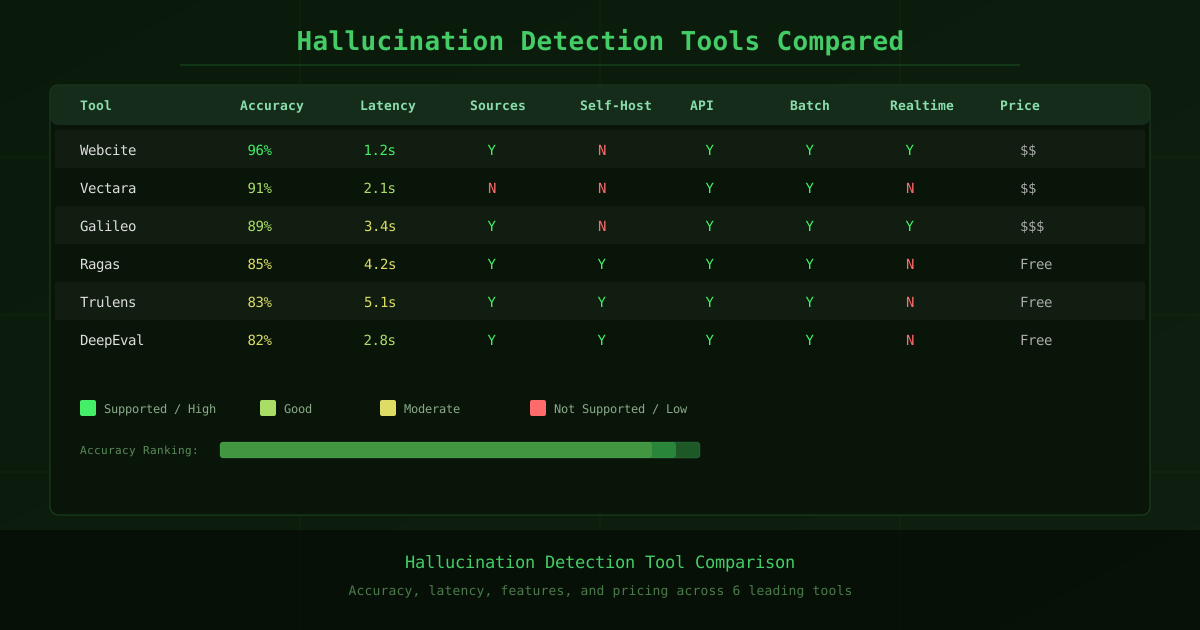
Comparison Table: 7 Tools at a Glance
| Tool | Detection Type | Approach | Open Source | RAG Support | Pricing | Best For |
|---|---|---|---|---|---|---|
| Galileo AI | Intrinsic | Luna evaluator models | No | Yes | Custom enterprise | Enterprise LLM evaluation |
| Patronus Lynx | Intrinsic | Fine-tuned judge model | Yes (weights) | Yes | Custom enterprise | RAG groundedness |
| Fiddler AI | Intrinsic | Trust models | No | Yes | Custom enterprise | Real-time monitoring |
| TruLens | Intrinsic | Feedback functions | Yes (MIT) | Yes | Free / hosted tiers | RAG evaluation |
| Webcite | Extrinsic | Source verification API | No | Yes | $0 free, $20/mo Builder | Factual claim verification |
| Patronus AI | Both | Evaluation platform | Partial | Yes | Custom enterprise | Comprehensive evaluation |
| Amazon Bedrock | Intrinsic + rules | Automated reasoning | No | Yes | Pay-per-use | AWS-native applications |
Two Approaches to Hallucination Detection
Hallucination detection tools split into two fundamentally different approaches. Understanding this distinction is essential before choosing a tool.
Intrinsic Detection: Is the Output Consistent with Its Context?
Intrinsic detection checks whether the model’s output is faithful to its input. For RAG systems, this means asking: “Does the response contain only information present in the retrieved documents?” For chat applications, it means: “Is the response consistent with the conversation history?”
This approach catches confabulation, where the model generates content from its training data rather than from the provided context. General purpose LLMs exhibit hallucination rates ranging from 17% to 45% depending on the model and domain, according to AIMultiple, 2025. Galileo AI’s Luna evaluators, TruLens’s feedback functions, and Patronus Lynx all operate in this category.
The key metric is the faithfulness score. A faithfulness score of 0.95 means that 95% of the claims in the output are traceable to the input context. Scores below 0.80 typically indicate significant hallucination.
The limitation is that intrinsic detection cannot catch errors in the context itself. If the retrieved documents contain false information, an intrinsically faithful response will still be factually wrong.
Extrinsic Detection: Is the Output True?
Extrinsic detection verifies claims against external real-world evidence. Instead of asking “does this match the context?”, it asks “is this actually true?” This approach catches factual errors regardless of their source, including errors in the context, errors from the model, or errors from the retrieval step.
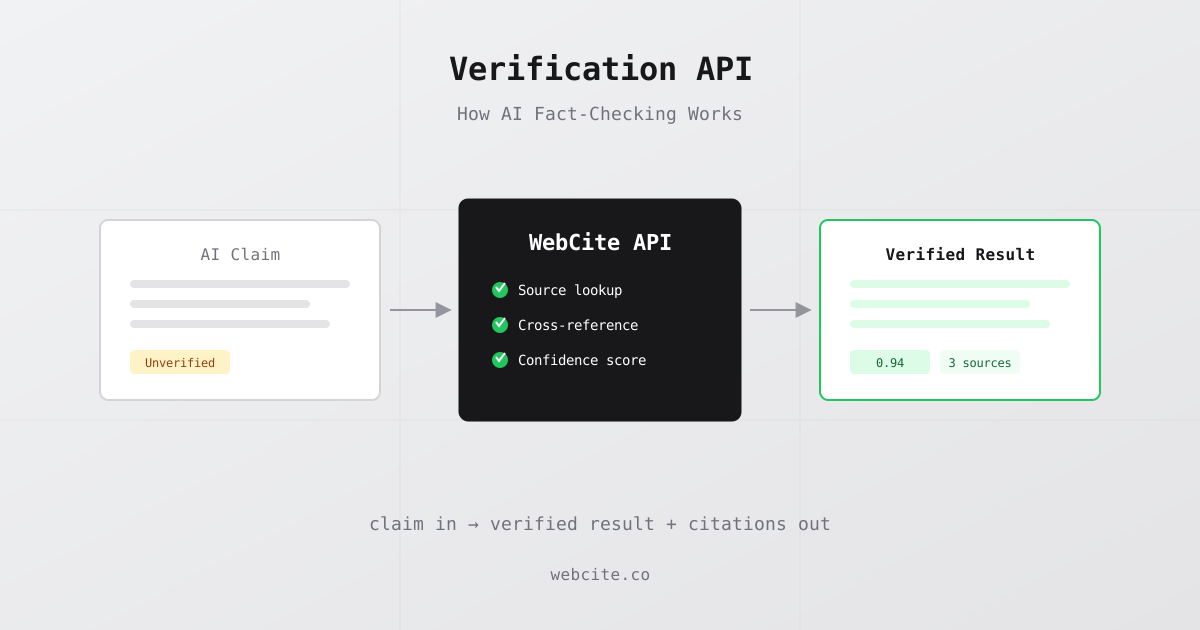
Webcite operates in this category. It takes a claim, searches for relevant external sources, evaluates whether those sources support or contradict the claim, and returns a structured verdict with confidence scores and citations.
The limitation is latency. External verification requires web searches and source evaluation, which takes more time than a local consistency check. It is best suited as a post-generation quality gate rather than an inline filter.
For a deeper comparison of these approaches, see the hallucination detection build vs buy guide.
Galileo AI: Enterprise Evaluation Platform
Galileo AI is an enterprise LLM evaluation and observability platform. Its core differentiator is the Luna family of purpose-built evaluator models, small language models fine-tuned specifically for hallucination detection.
Detection approach. Luna models evaluate LLM outputs for hallucination, instruction adherence, and quality without relying on external model evaluation calls. This avoids the cost and latency of using GPT-4 or Claude as evaluators. Galileo reported that Luna models match or exceed GPT-4 evaluation quality at a fraction of the cost, according to Galileo AI, 2025.
Metrics. Galileo tracks context adherence (faithfulness to retrieved documents), completeness (whether the response fully addresses the query), and chunk attribution (which specific retrieved chunks support each output claim).
RAG support. Full RAG pipeline evaluation including retrieval quality, context relevance, and response faithfulness. The platform integrates with LangChain, LlamaIndex, and custom RAG implementations.
Pricing. Custom enterprise pricing. No self-serve tier as of February 2026.
Limitations. Enterprise-only pricing puts Galileo out of reach for startups and individual developers. The platform is intrinsic-only; it does not verify claims against external sources.
Patronus Lynx: Open-Weight RAG Judge
Patronus Lynx is a fine-tuned hallucination detection model released with open weights. Built on a large language model foundation, Lynx is trained specifically to judge whether an LLM response is faithful to a given context.
Detection approach. Lynx takes three inputs: a question, a context (retrieved documents), and a response. It outputs a binary judgment (hallucinated or not) with an explanation of its reasoning, according to Patronus AI, 2025. The model is optimized for RAG groundedness checking.
Metrics. Lynx focuses on a single metric: whether the response is grounded in the provided context. It does not score nuanced dimensions like completeness, relevance, or safety.
Open source. The model weights are publicly available, enabling local deployment and fine tuning. This makes Lynx attractive for teams with data residency requirements. Patronus reported that Lynx 2.0 achieves state of the art accuracy on the HaluBench hallucination benchmark, according to Patronus AI, 2025.
Pricing. The model is free to use. Compute costs for hosting depend on infrastructure. The Patronus platform, which offers additional evaluation capabilities, uses custom enterprise pricing.
Limitations. Lynx is a single-purpose tool. It checks groundedness only, which means teams need additional tools for comprehensive evaluation. Self-hosting requires GPU infrastructure.
Fiddler AI: Real-Time Trust Monitoring
Fiddler AI provides AI observability with a focus on trust and safety. The platform monitors LLM outputs in real time for hallucination, toxicity, PII exposure, and other trust-related metrics.
Detection approach. Fiddler uses proprietary trust models that evaluate outputs across multiple dimensions simultaneously: faithfulness, safety, coherence, and compliance. The platform provides real-time dashboards and alerts when trust scores drop below configured thresholds, according to Fiddler AI, 2025.
Metrics. Hallucination score, toxicity score, PII detection rate, and custom trust metrics. Fiddler’s multi-dimensional approach is unique among the tools in this comparison.
Production focus. Fiddler is designed for production monitoring rather than development evaluation. It integrates into CI/CD pipelines and provides automated quality gates.
Pricing. Custom enterprise pricing. The platform targets mid-to-large enterprises with production AI deployments.
Limitations. Enterprise pricing and production focus make Fiddler unsuitable for early-stage projects. The platform lacks the dataset management and experiment capabilities that evaluation-focused tools like Galileo and TruLens provide.
TruLens: Open-Source RAG Evaluation
TruLens is an open source library for evaluating and tracking LLM applications, with particular strength in RAG evaluation. Originally developed by TruEra, now part of Snowflake after its 2024 acquisition, it provides feedback functions for measuring response quality. TruLens has accumulated over 6,800 GitHub stars, according to TruLens GitHub, 2025.
Detection approach. TruLens defines “feedback functions” that score LLM outputs on dimensions like groundedness, answer relevance, and context relevance. These functions can use model evaluation approaches (calling GPT-4 or Claude to score outputs) or custom classifier-based scoring, according to TruLens Documentation, 2025.
RAG triad. TruLens popularized the “RAG Triad” evaluation framework: Context Relevance (are the retrieved documents relevant to the query?), Groundedness (is the response grounded in the retrieved documents?), and Answer Relevance (does the response actually answer the question?). This three-metric approach has become a standard pattern in RAG evaluation.
Open source. TruLens is released under the MIT license and can be used freely. The Snowflake-hosted version adds storage, collaboration, and enterprise features.
Pricing. Free and open source. Hosted versions integrate with Snowflake pricing.
Limitations. Model evaluation scoring adds latency and cost (each evaluation requires an LLM API call). The feedback function approach requires careful configuration; poorly chosen evaluators produce unreliable scores. TruLens is evaluation-focused and does not provide real-time production monitoring.
Webcite: External Source Verification
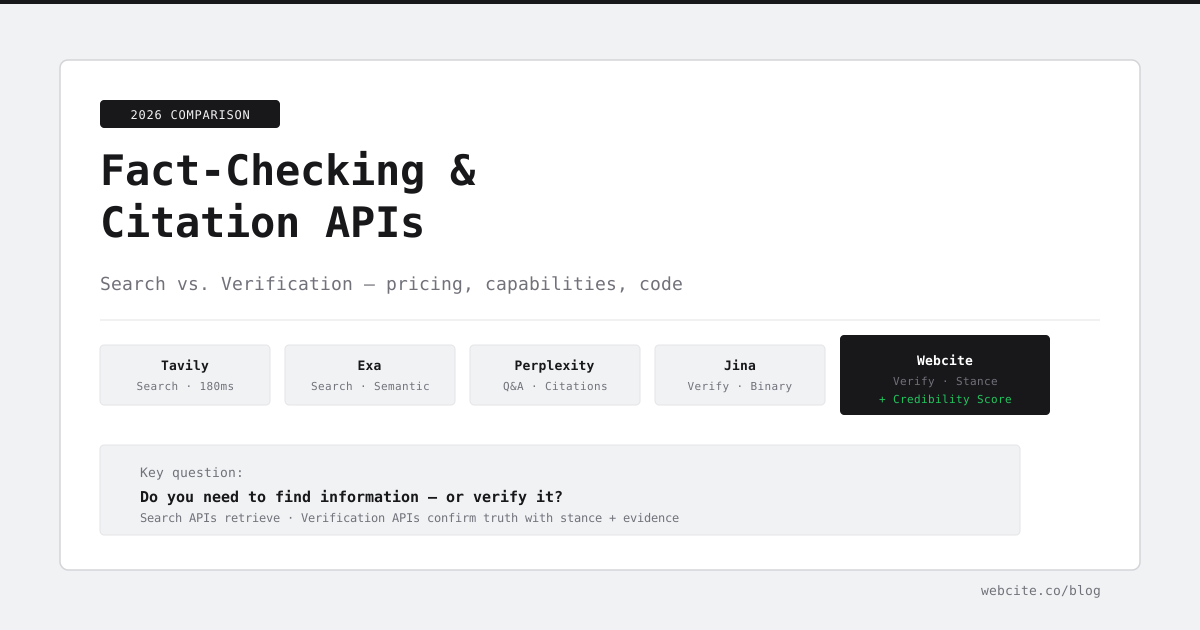
Webcite takes a fundamentally different approach from the other tools on this list. Instead of checking whether the output matches its context (intrinsic), Webcite checks whether the output matches reality (extrinsic) by verifying claims against independent external sources.
Detection approach. You send a claim to the Webcite verification API. The API searches for relevant sources across the web, evaluates whether each source supports or contradicts the claim, scores source credibility, and returns a structured verdict with citations and a confidence score. This is end-to-end verification in a single REST call.
import requests

response = requests.post(
    "https://api.webcite.co/api/v1/verify",
    headers={
        "x-api-key": "your-api-key",
        "Content-Type": "application/json"
    },
    json={
        "claim": "GPT-4o hallucinates in fewer than 3% of queries",
        "include_stance": True,
        "include_verdict": True
    }
)

result = response.json()
verdict = result["verdict"]["result"]      # "contradicted" or "supported"
confidence = result["verdict"]["confidence"]  # 0-100
citations = result["citations"]             # [{url, title, stance, snippet}]
Metrics. Verdict (supported, contradicted, insufficient evidence), confidence score (0-100), per-source stance, and source credibility scores. Each verification uses 4 credits: 2 for citation retrieval, 1 for stance detection, 1 for the verdict.
Pricing. Free tier: $0 per month, 50 credits (approximately 12 verifications). Builder plan: $20 per month, 500 credits (125 verifications). Enterprise: custom pricing, 10,000+ credits. For detailed pricing breakdowns, see the Webcite API pricing guide.
Limitations. Webcite verifies claims against published web sources. It does not evaluate faithfulness to a specific context (use Galileo or TruLens for that). It is an extrinsic verifier, not an intrinsic consistency checker. Response time is typically under 2 seconds per claim, which adds latency compared to local evaluation models.
Patronus AI: Comprehensive Evaluation Platform
Patronus AI is the parent company behind Lynx and offers a broader evaluation platform that combines multiple detection approaches. The platform includes automated red-teaming, compliance testing, and hallucination detection in a single interface.
Detection approach. Patronus combines Lynx for groundedness checking with additional evaluation models for safety, compliance, and factual accuracy. The platform can run multiple evaluation models in parallel on the same output, according to Patronus AI, 2025.
Enterprise features. Custom evaluation criteria, automated red-teaming for adversarial testing, compliance checking against regulatory requirements, and integration with CI/CD pipelines.
Pricing. Custom enterprise pricing. The Lynx model itself is free; the platform adds management, orchestration, and enterprise features.
Limitations. Enterprise-only pricing. The platform is newer than Galileo and Arize, with a smaller customer base and community.
Amazon Bedrock Guardrails: AWS-Native Detection
Amazon Bedrock Guardrails provides hallucination detection as a built-in feature of the AWS AI infrastructure. Its automated reasoning checks use formal verification methods to validate LLM outputs.
Detection approach. Bedrock Guardrails combines contextual grounding checks with automated reasoning. The contextual grounding check measures whether the response is faithful to provided reference material. The automated reasoning check uses formal methods to verify logical consistency, claiming up to 99% accuracy on grounded content, according to AWS, 2025.
AWS integration. Native integration with Amazon Bedrock models (Claude, Llama, Mistral on Bedrock), Amazon Kendra for retrieval, and AWS security services.
Pricing. Pay-per-use pricing aligned with AWS Bedrock. Guardrails pricing is based on the number of text units processed, according to AWS Bedrock Pricing, 2025.
Limitations. AWS-only. Applications running on Google Cloud, Azure, or on-premises infrastructure cannot use Bedrock Guardrails. The 99% accuracy claim applies specifically to grounded content with clear reference material; open-ended generation produces lower accuracy.
How to Choose the Right Tool
Selection depends on three factors: your detection approach, your infrastructure, and your budget.
If you need intrinsic faithfulness checking for RAG, start with TruLens (free, open source) or Patronus Lynx (free model weights). Scale to Galileo AI or Fiddler for enterprise production monitoring.
If you need extrinsic factual verification, use Webcite. It is the only tool in this comparison that verifies claims against independent external sources rather than checking consistency with provided context. Start with the free tier (50 credits per month) and scale to Builder ($20 per month) or Enterprise.
If you run on AWS, Amazon Bedrock Guardrails provides native integration with minimal setup. The automated reasoning capability is unique in the market.
If you need both approaches, combine an intrinsic tool with Webcite. Use TruLens or Galileo to check faithfulness to context, and Webcite to verify that the context-faithful claims are actually true. This layered approach catches both types of errors: confabulation (model making things up) and source errors (context containing false information).
For a detailed analysis of building your own detection system versus buying, see the hallucination detection build vs buy guide. For comprehensive AI hallucination statistics across models and domains, see the linked reference.
Frequently Asked Questions
What is the best hallucination detection tool in 2026?
It depends on your detection approach. For statistical observability and LLM evaluation, Galileo AI leads with its Luna evaluator models. For factual verification against external sources, Webcite provides end-to-end claim verification in a single API call. For RAG-specific groundedness checking, TruLens and Patronus Lynx are strong options. Most production systems benefit from combining intrinsic and extrinsic approaches.
Can AI hallucination rates go below 1%?
Yes. Amazon Bedrock’s automated reasoning checks claim up to 99% verification accuracy on grounded content, translating to sub-1% error rates for specific use cases. However, these rates depend heavily on domain, question type, and whether the model has grounding material. Open-ended generation without grounding material still produces hallucination rates of 3-15% depending on the model.
What is faithfulness scoring in hallucination detection?
Faithfulness scoring measures whether an LLM’s output is consistent with its input context or retrieved documents. A score of 0.95 means 95% of output claims are supported by the provided context. It is a core metric for RAG systems. TruLens, Galileo, and Lynx all compute faithfulness scores, though each uses different evaluation methods.
How much does hallucination detection cost?
Costs range from free to enterprise pricing. TruLens is free and open source. Webcite starts at $0 with 50 credits per month. Galileo AI, Fiddler, and Patronus use custom enterprise pricing. LLM-as-judge approaches like TruLens incur additional costs for the judge model API calls (typically $0.01-0.03 per evaluation using GPT-4).
What is the difference between hallucination detection and fact-checking?
Hallucination detection identifies outputs inconsistent with the model’s input context or expected behavior. Fact-checking verifies whether specific claims are true based on external evidence. An output can be faithful to its context (no detected hallucination) but still factually wrong if the context itself contains errors. Both capabilities are needed for comprehensive accuracy.
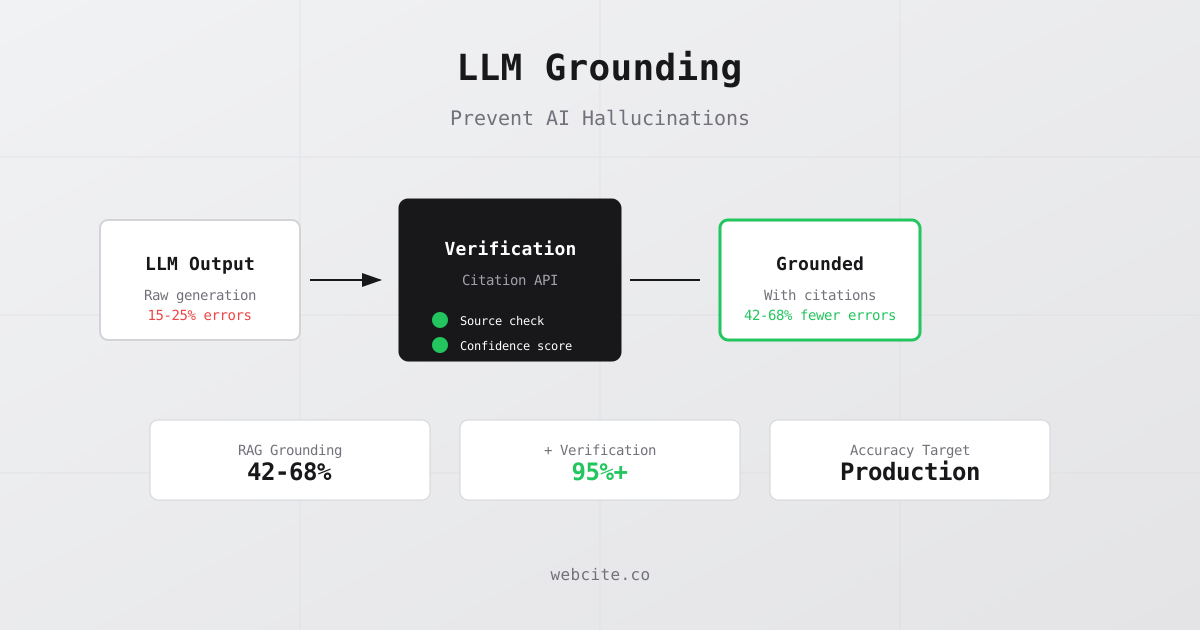
Do I need hallucination detection if I already use RAG?
Yes. RAG reduces hallucination rates by providing relevant context, but does not eliminate them. Models still hallucinate 3-15% of the time with RAG, depending on the model and domain. The model can misinterpret retrieved documents, combine information incorrectly, or inject parametric knowledge that contradicts retrieved context. Hallucination detection catches these residual errors.