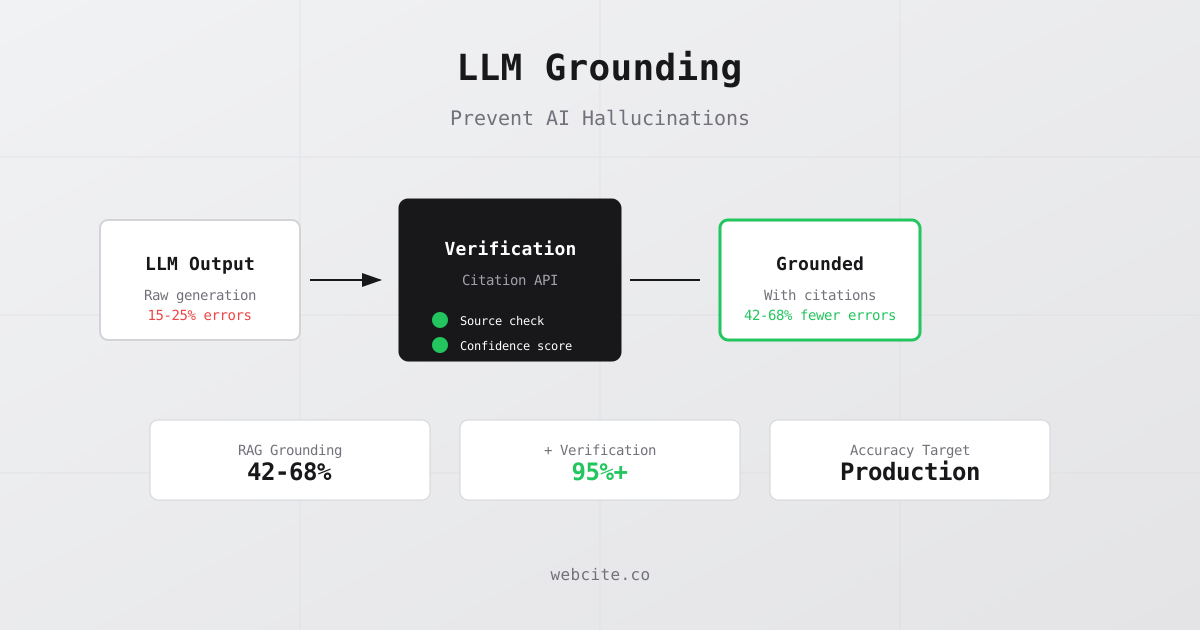
Large language models hallucinate. According to research from Vectara’s Hallucination Index, 2024, even the best LLMs produce factual errors in 15-25% of their outputs. For enterprises deploying AI at scale, this is not a minor inconvenience - it is a fundamental reliability problem. This article covers the grounding techniques that actually work to reduce hallucinations in production systems.
- RAG-based grounding reduces hallucinations by 42-68%.
- Faithfulness checking compares each claim against retrieved context.
- Output verification with citation APIs catches errors that RAG misses.
- Combine multiple techniques: RAG, verification, and confidence scoring.
Why LLMs Hallucinate (And Why Grounding Fixes It)
Hallucinations are not bugs - they are features of how transformer models work. LLMs are trained to predict the most likely next token given the context. They have no internal fact database and no mechanism to verify whether their outputs are true. When the training data is sparse on a topic or when the prompt asks for specifics the model cannot know, it fills the gap with plausible-sounding fabrications.
Grounding solves this by providing external knowledge at inference time. Instead of relying solely on compressed training data, grounded systems retrieve relevant information from trusted sources and use it to constrain or verify the model’s output. According to a comprehensive survey on arXiv, 2026, retrieval-based methods are among the most effective approaches for ensuring factual consistency.
The key insight is that grounding shifts the burden of truth from the model’s parameters to external, verifiable sources. This is why citation-backed outputs are inherently more trustworthy than raw LLM generations.
RAG: The Foundation of Grounded AI
Retrieval-Augmented Generation has become the standard approach for grounding LLMs. The pattern is straightforward: before the model generates a response, a retrieval system fetches relevant documents from a knowledge base. These documents are injected into the prompt as context, giving the model factual material to reference.
Research from the DEV Community, 2026 shows that RAG-based grounding alone reduces hallucinations by 42-68%, depending on the quality of the retrieval system and the domain. This is a significant improvement, but it is not enough for high-stakes applications.
RAG has limitations. The model can still ignore the retrieved context. It can misinterpret documents. It can generate claims that sound like they come from the sources but actually do not. This is why RAG alone is insufficient for production systems that require high factual accuracy.
A well-implemented RAG pipeline includes:
- Semantic search over a curated knowledge base
- Chunk-level retrieval with relevance scoring
- Context window management to avoid truncation
- Source attribution in the output
Even with these components, post-generation verification is essential for catching the errors that slip through.
Faithfulness Checking: Verify Before You Serve
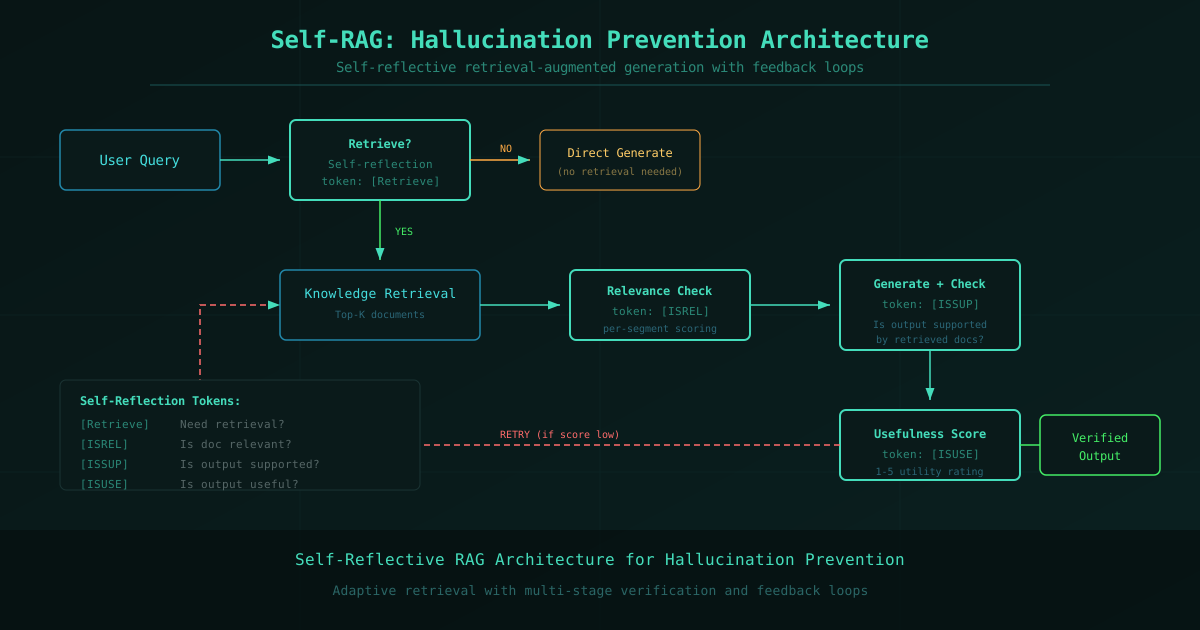
The most reliable approach for production systems is faithfulness checking, which compares each claim in the generated output against the retrieved context. According to Deepchecks, 2026, this is the gold standard for hallucination detection in enterprise deployments.
Faithfulness checking works in three steps:
- Extract individual claims from the LLM output
- Compare each claim against the source documents
- Flag claims that cannot be supported by the provided context
Many teams combine deterministic checks (citation format validation, quote matching) with an additional LLM call that evaluates semantic consistency. This “LLM-as-judge” pattern has gained significant traction because it catches subtle inconsistencies that rule-based systems miss. According to Microsoft Research, 2024, multi-agent verification approaches can catch up to 90% of factual errors.
The challenge with faithfulness checking is latency. Running verification adds processing time, which may not be acceptable for real-time applications. However, for use cases where accuracy matters more than speed, the tradeoff is worth it. According to Gartner, 2025, 30% of generative AI projects will be abandoned by 2025 due to trust and accuracy issues.
Output Verification with Citation APIs
While RAG and faithfulness checking operate on retrieved context, output verification goes further by checking claims against external authoritative sources. This catches errors that originate from the retrieval system itself or from gaps in the knowledge base.
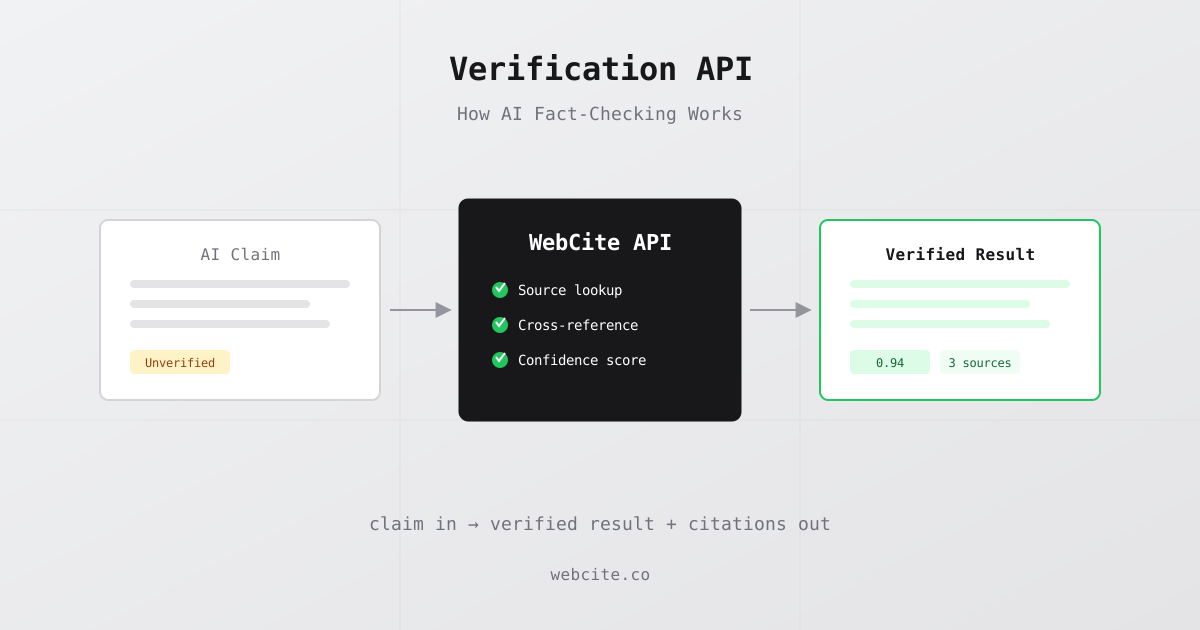
Citation verification APIs like Webcite work as a final layer of defense. After the LLM generates a response, the verification API:
- Parses the output into individual claims
- Searches authoritative sources (journals, news, government records) for each claim
- Returns a verification verdict with confidence scores
- Provides citations that can be displayed to users
This approach is particularly valuable because it grounds outputs in sources that may not be in your RAG knowledge base. A claim about a recent event, a statistic from a new study, or a fact about a public figure can be verified against the open web.
The credit-based pricing of verification APIs makes this practical for production. Webcite’s Free plan includes 50 credits per month for testing, with the Builder plan at $20/month providing 500 credits for production workloads. Each full verification (citation retrieval, stance analysis, verdict) costs 4 credits.
Building a Multi-Layer Grounding Stack
Production systems should not rely on a single grounding technique. The most robust architectures combine multiple layers, each catching different types of errors.
A recommended stack includes:
Layer 1: RAG for Context Retrieve relevant documents before generation. This reduces hallucinations by providing factual material for the model to reference.
Layer 2: Constrained Generation Use system prompts that instruct the model to cite sources, acknowledge uncertainty, and avoid speculation. This does not eliminate hallucinations but reduces their frequency.
Layer 3: Faithfulness Checking After generation, verify that each claim is supported by the retrieved context. Flag or filter unsupported claims.
Layer 4: External Verification For high-stakes outputs, run claims through a citation verification API. This catches errors from retrieval gaps and validates against authoritative sources.
Layer 5: Confidence Scoring Present users with confidence scores alongside citations. This allows them to make informed decisions about how much to trust the output.
According to IBM, 2026, ensuring AI models are trained on diverse, balanced data is also critical - but for deployed models, runtime verification is the most practical intervention.
Monitoring Hallucinations in Production
Grounding is not a one-time implementation. Production systems need ongoing monitoring to detect when hallucination rates increase. According to Maxim AI, 2026, hallucinations represent one of the most critical challenges in deploying LLMs at scale.
Key metrics to track:
- Verification failure rate over time
- Confidence score distribution
- User feedback on incorrect responses
- Citation coverage (percentage of claims with sources)
Automated hallucination detectors that identify inconsistent or unsupported outputs before consumers see them are becoming standard in 2026. These systems run continuously, flagging anomalies that may indicate model drift or retrieval system degradation.
When hallucination rates spike, the root cause is often a change in query patterns, a gap in the knowledge base, or a model update. Monitoring enables rapid response before users lose trust.
Frequently Asked Questions
What is LLM grounding and why does it matter?
LLM grounding is the practice of connecting AI model outputs to verified external sources. It matters because ungrounded LLMs hallucinate 15-25% of the time, generating confident but false information that can damage user trust and cause real-world harm.
How much do grounding techniques reduce hallucinations?
According to DEV Community research, 2026, RAG-based grounding alone reduces hallucinations by 42-68%. Combining retrieval with verification layers can push accuracy to 95% factual consistency.
What is the difference between RAG and verification?
RAG (Retrieval-Augmented Generation) provides context to the model before generation. Verification checks the output after generation against trusted sources. The most robust systems use both: RAG for context and verification APIs for output fact-checking.
Can I use Webcite for LLM grounding?
Yes. Webcite’s verification API checks AI-generated claims against authoritative sources in real-time, returning confidence scores and citations. It works as an output verification layer that catches hallucinations before they reach users. The Free plan includes 50 credits per month, and the Builder plan provides 500 credits at $20/month.
What is faithfulness checking in LLM systems?
Faithfulness checking compares each claim in an LLM output against the retrieved context to ensure the response is actually supported by the sources. Claims that cannot be grounded in the provided documents are flagged for review or filtered from the output.
How do I monitor hallucinations in production?
Track verification failure rates, confidence score distributions, user feedback on incorrect responses, and citation coverage. Set up automated detectors that flag anomalies in real-time. When rates spike, investigate retrieval gaps, query pattern changes, or model updates.