OpenAI’s GPT-4o now hallucinates in just 0.7% of general knowledge queries, a 96% improvement from the 21.8% average measured across models in 2021, according to Visual Capitalist, 2025. But that headline number hides a more complicated reality. In legal and medical domains, hallucination rates still range from 6% to 33%. This article compiles every major hallucination statistic available in 2026, organized by model, domain, and enterprise impact.
- The best LLMs now hallucinate below 1% on general queries, down from 21.8% in 2021.
- Domain-specific hallucination rates remain dangerously high: 6.4% in legal, 10-20% in medical, and up to 33% in RAG-based legal tools.
- Enterprise losses from AI hallucinations reached $67.4 billion in 2024.
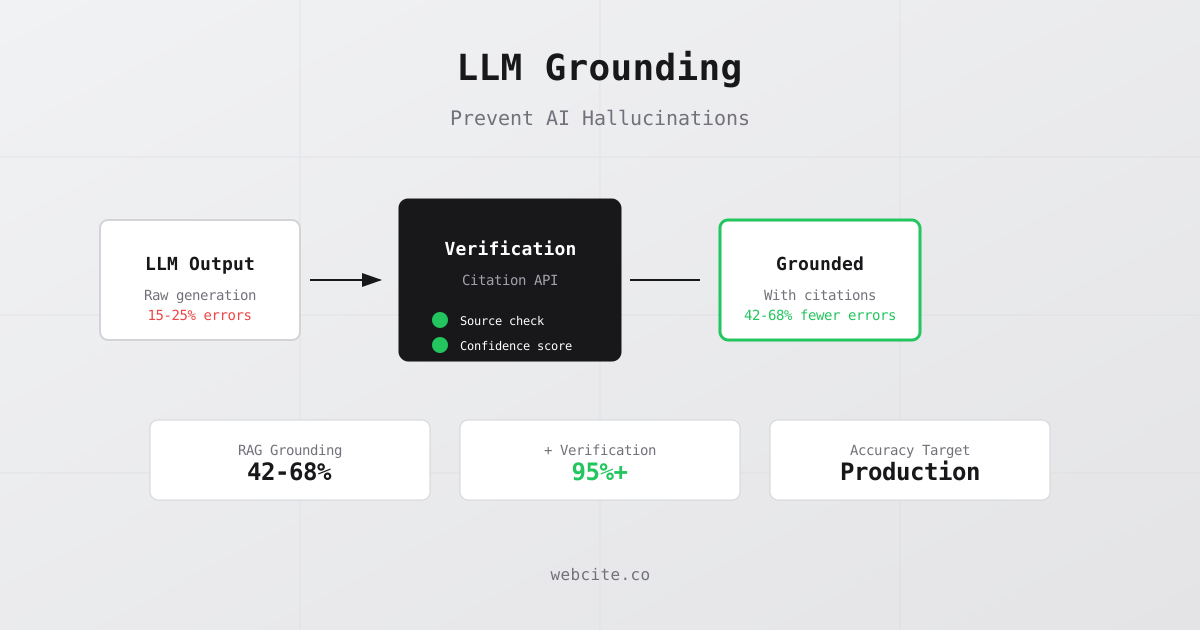
- RAG reduces hallucinations by 71%, but verification APIs are needed to catch the remaining errors.
- The EU AI Act mandates transparency for AI outputs by August 2026, making hallucination detection a compliance requirement.
Hallucination Rates by Model: 2025 Benchmarks
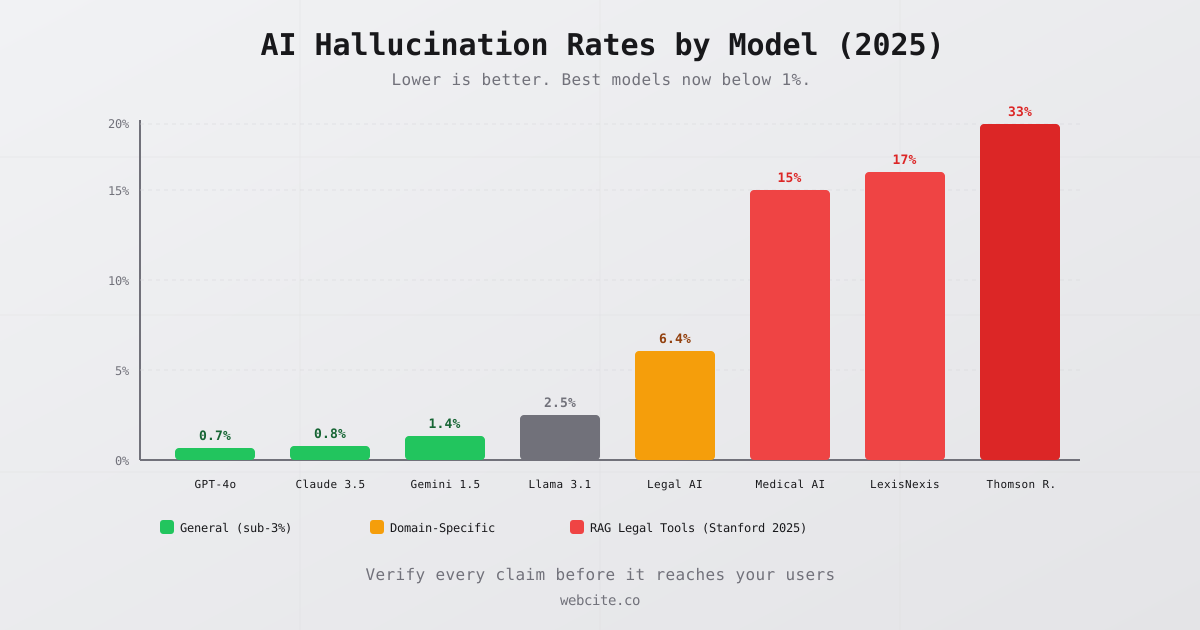
The gap between the best and worst models is now enormous. In 2021, the average hallucination rate across leading LLMs sat at 21.8%. By late 2025, three models had pushed below the 1% threshold on broad knowledge benchmarks, according to AllAboutAI, 2026.
Here is how the leading models compare:
| Model | Provider | Hallucination Rate | Year Tested |
|---|---|---|---|
| GPT-4o | OpenAI | 0.7% | 2025 |
| Claude 3.5 Sonnet | Anthropic | 0.8% | 2025 |
| Gemini 1.5 Pro | Google DeepMind | 1.4% | 2025 |
| Llama 3.1 405B | Meta | 2.5% | 2025 |
| Mistral Large | Mistral AI | 3.1% | 2025 |
| GPT-3.5 Turbo | OpenAI | 9.8% | 2024 |
| Average (all models, 2021) | Various | 21.8% | 2021 |
These rates were measured on common knowledge factual accuracy benchmarks. The numbers represent the percentage of responses containing at least one fabricated or verifiably false claim, according to Visual Capitalist, 2025.
Several patterns stand out. First, proprietary models from OpenAI, Anthropic, and Google consistently outperform open-source alternatives on hallucination benchmarks. Second, the improvement curve is accelerating: GPT-4 (March 2023) hallucinated at roughly 3.2%, and GPT-4o (2025) cut that by nearly 80%. Third, older models like GPT-3.5 Turbo still hallucinate nearly 10x more than current frontier models, which matters because many production applications still run on these cheaper models.
The takeaway is not that hallucinations are solved. General knowledge accuracy has improved dramatically, but the real risks lie in specialized domains where the data is sparse, the stakes are high, and the models have less training signal to rely on.
Domain specific Hallucination Rates: Where the Real Risk Lives
Broad knowledge benchmarks tell one story. Specialized performance tells a very different one.
Legal AI: 6.4% to 33%
Legal applications carry some of the highest hallucination rates in production AI. The average hallucination rate for legal AI queries sits at 6.4%, according to AllAboutAI, 2026. But that average masks alarming variation in RAG-based legal tools.
Stanford Law School researchers tested the leading legal AI products. Even RAG-powered tools hallucinate at startling rates, according to Stanford Law, 2025.
| Legal AI Tool | Provider | Hallucination Rate |
|---|---|---|
| Lexis+ AI | LexisNexis | 17% |
| Ask Practical Law AI | Thomson Reuters | 33% |
| CoCounsel | Thomson Reuters | 17% |
| GPT-4 (baseline) | OpenAI | 75% (on legal queries) |
The Stanford research team, led by Varun Magesh, tested these tools on real legal research queries and manually verified every response against actual case law, according to the full Stanford study. The most common hallucination type was citing cases that do not exist or misattributing holdings to real cases. LexisNexis performed best among the commercial tools at 17%, but that still means roughly 1 in 6 queries returned fabricated legal information.
For context, the American Bar Association considers any factual error in legal research a potential ethics violation. A 17% error rate in a legal research tool is not a minor inconvenience; it is a professional liability risk.
Medical and Healthcare AI: 10% to 20%
Healthcare AI hallucination rates range from 10% to 20% depending on the specific task and model, according to AllAboutAI, 2026. Diagnostic queries tend to hallucinate less (closer to 10%) because symptom-to-condition mapping is well-represented in training data. Drug interaction queries and treatment protocol recommendations hallucinate at the higher end (15-20%) because the information changes frequently and requires precise, up-to-date knowledge.
The World Health Organization issued guidance in 2024 warning that AI tools used in healthcare settings should include mandatory human review steps. The FDA has cleared over 950 AI-enabled medical devices as of 2025, but none of them rely solely on LLM outputs for clinical decisions.
Financial and Regulatory AI: 3% to 8%
Financial AI applications hallucinate at rates between 3% and 8%, with the highest rates occurring in regulatory compliance queries where the model must cite specific statutes or regulations. Bloomberg’s BloombergGPT and similar vertical specific models perform better than general-purpose LLMs on financial tasks, but they still require human verification for any output that could affect trading, compliance, or reporting decisions.
Enterprise Impact: The $67.4 Billion Problem
AI hallucinations are not just a technical curiosity. They have a measurable financial impact on businesses that deploy AI at scale.
The Financial Cost
Enterprise losses from AI hallucinations reached an estimated $67.4 billion in 2024, according to Korra, 2024. This figure includes direct costs (bad decisions based on fabricated data, regulatory fines, legal settlements) and indirect costs (customer trust erosion, employee time spent correcting AI errors, and opportunity costs from delayed AI adoption).
Decision-Making Based on False Information
47% of enterprise AI users reported making at least one business decision based on information that turned out to be hallucinated, according to AllAboutAI, 2026. This statistic is particularly concerning because it suggests that nearly half of AI users cannot reliably distinguish accurate AI outputs from fabricated ones.
The problem compounds at scale. A single hallucinated data point in a financial forecast can cascade through an entire planning process. A fabricated citation in a legal brief can result in court sanctions. Air Canada’s chatbot invented a bereavement fare policy that a tribunal later forced the airline to honor, according to CBC News, 2024. These are not hypothetical risks; they are documented losses.
How Enterprises Currently Mitigate Hallucinations
The enterprise response to hallucinations breaks down into several strategies:
| Mitigation Strategy | Adoption Rate | Effectiveness |
|---|---|---|
| Human-in-the-loop review | 76% | High, but does not scale |
| RAG (Retrieval-Augmented Generation) | 68% | Reduces hallucinations by 71% |
| Prompt engineering | 61% | Moderate |
| Fine-tuning on domain data | 34% | Moderate to high |
| Verification API / fact-checking | 19% | High, scalable |
| Temperature reduction | 45% | Low to moderate |
76% of enterprises use human-in-the-loop processes to catch hallucinations, according to AllAboutAI, 2026. While effective, this approach does not scale. Each human reviewer adds latency, labor cost, and their own potential for error. As AI output volume grows, manual review becomes a bottleneck.
RAG remains the most popular automated mitigation, with 68% adoption. Google’s research shows RAG cuts hallucinations by 71% when properly implemented, according to AllAboutAI, 2026. But as the Stanford legal AI study demonstrates, RAG does not eliminate hallucinations. It reduces them.
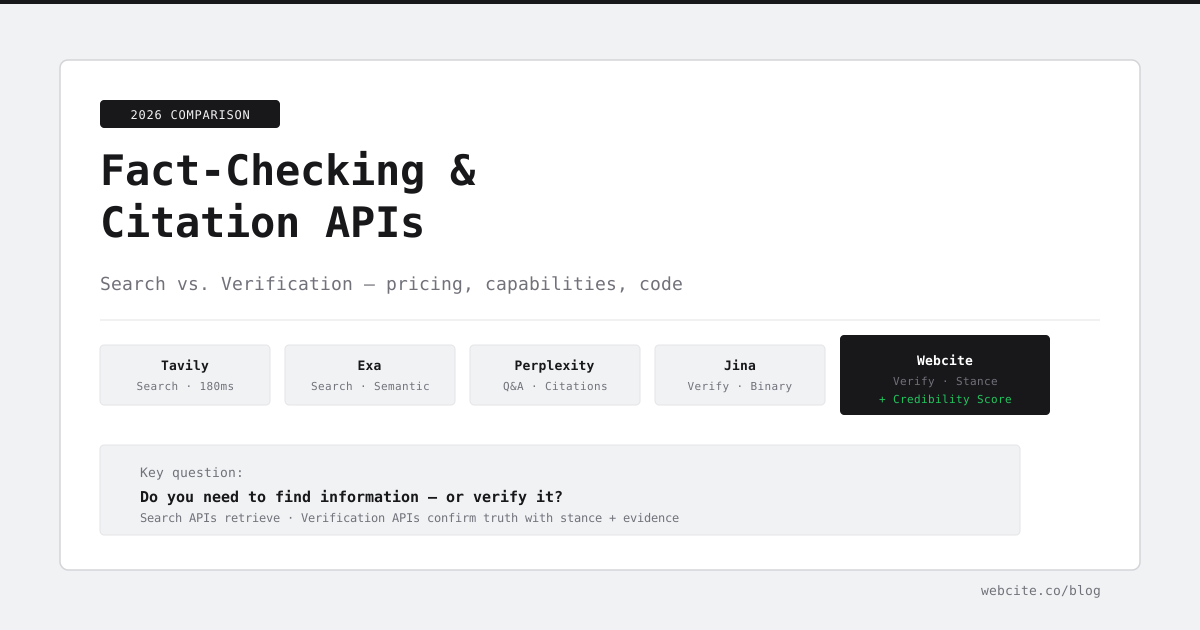
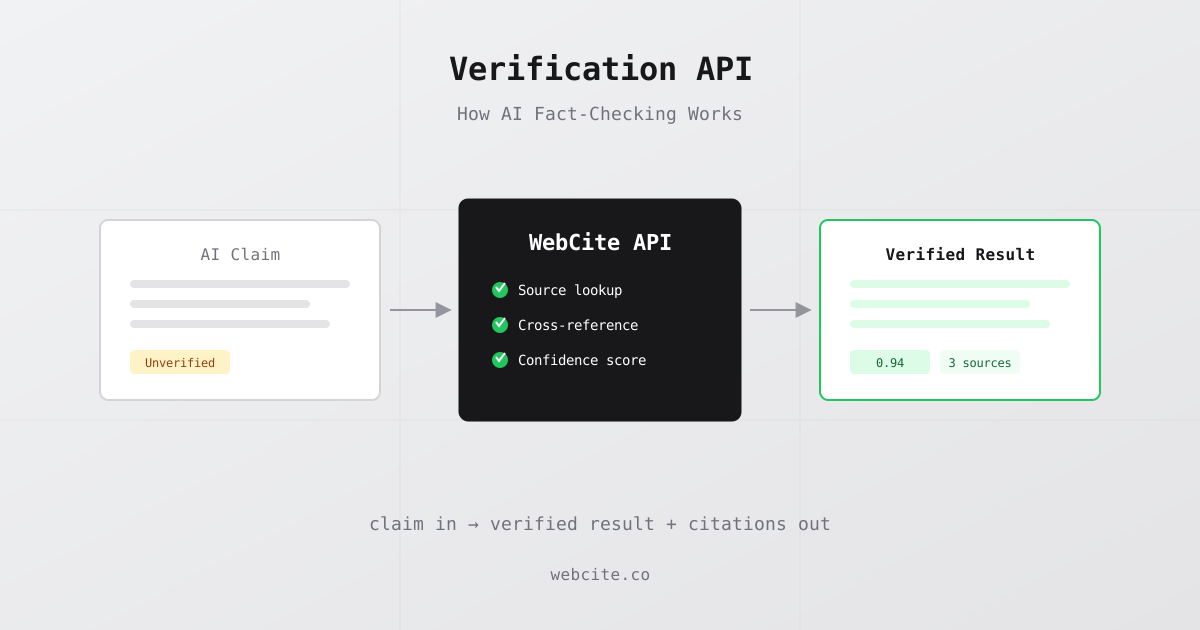
The gap between RAG and ground truth is where verification APIs fill a critical role. A verification API checks each claim against external sources after the LLM generates its response, catching errors that RAG misses. Only 19% of enterprises currently use this approach, but adoption is accelerating as regulatory requirements tighten.
RAG Is Not Enough: The Verification Gap
RAG has become the default approach for reducing hallucinations, and for good reason. By grounding LLM responses in retrieved documents, RAG provides the model with factual context that reduces fabrication. The 71% reduction in hallucination rates is significant.
But the Stanford legal AI study is the clearest evidence that RAG alone is insufficient. LexisNexis and Thomson Reuters both use sophisticated RAG architectures with access to comprehensive legal databases, yet their tools still hallucinate in 17% to 33% of queries. If the best-funded legal AI teams in the world cannot eliminate hallucinations with RAG, no RAG implementation will.
The failure modes are specific and instructive:
- Retrieval misses: The relevant document exists in the database but the retrieval step does not surface it. The model then generates an answer without the right context.
- Context window overflow: The retrieved documents exceed what the model can process, and critical information gets truncated or lost.
- Conflicting sources: Multiple retrieved documents contain contradictory information, and the model picks the wrong one or synthesizes a fabricated middle ground.
- Confident extrapolation: The model has partial information from retrieval and fills in the gaps with plausible but fabricated details.
Each of these failure modes produces hallucinations that look identical to correct answers. The user has no way to distinguish them without independent verification.
This is why a layered approach is essential. RAG handles the first 71% of the problem. Post-generation verification handles much of the rest. You can learn how to implement this verification layer in practice in our guide on how to add fact-checking to your AI chatbot.
The Three-Layer Defense Against Hallucinations
Based on the data, the most effective hallucination mitigation strategy combines three complementary approaches:
Layer 1: Prompt Engineering and System Instructions
Prompt engineering is the simplest and cheapest intervention. Instructions like “Only answer based on the provided context” and “If uncertain, say you don’t know” reduce hallucinations by an estimated 15-25%. Nearly every enterprise (61%) uses this approach, but it has a ceiling. LLMs do not reliably follow instructions when the statistical pressure to generate a confident response is strong.
Layer 2: Retrieval-Augmented Generation (RAG)
RAG reduces hallucinations by 71% by grounding responses in retrieved documents. The approach works best when the knowledge base is comprehensive, the retrieval is accurate, and the model’s context window can hold the relevant information. For most enterprise use cases, RAG is a necessary component of any hallucination mitigation strategy.
Layer 3: Postgeneration Verification
Verification APIs check each claim in the LLM’s response against external sources after generation. This catches errors that both prompt engineering and RAG miss. Webcite provides this verification in a single API call: you send a claim, and you get back a verdict (supported, contradicted, or insufficient evidence) with citations and confidence scores.
Here is what the verification step looks like in practice:
const response = await fetch("https://api.webcite.co/api/v1/verify", {
  method: "POST",
  headers: {
    "x-api-key": "your-api-key",
    "Content-Type": "application/json"
  },
  body: JSON.stringify({
    claim: "GPT-4o hallucinates in 0.7% of queries",
    include_stance: true,
    include_verdict: true
  })
})

const result = await response.json()
// result.verdict.result: "supported"
// result.verdict.confidence: 92
// result.citations: [{ title: "...", url: "...", stance: "for" }]
The three layers compound. If prompt engineering catches 20% of hallucinations, RAG catches 71% of what remains, and verification catches 80% of what passes through RAG, the combined system reduces hallucinations by over 95%.
Regulatory Pressure: The EU AI Act and Hallucination Disclosure
The regulatory landscape is tightening. The European Union’s AI Act, specifically Article 50, mandates that AI systems provide transparency about their outputs by August 2026. This means enterprises deploying AI in the European market must implement measures to detect and flag inaccurate outputs, including hallucinations.
The practical implications are significant:
- Disclosure requirements: AI-generated content must be labeled as such, and significant errors or limitations must be disclosed to users.
- Risk-based classification: High-risk AI applications (healthcare, legal, financial) face stricter accuracy and transparency requirements.
- Accountability: Organizations are liable for damages caused by AI outputs that violate the transparency requirements.
Non-compliance penalties under the EU AI Act can reach 35 million euros or 7% of global annual revenue, whichever is higher. For a company like Thomson Reuters (2024 revenue: $6.8 billion), that could mean a fine of up to $476 million.
The United States has not passed equivalent federal legislation, but the National Institute of Standards and Technology (NIST) AI Risk Management Framework provides voluntary guidelines that align with similar principles. California’s SB 1047, while focused on AI safety more broadly, includes provisions relevant to output accuracy for frontier models.
For enterprises, the message is clear: hallucination detection is shifting from a nice-to-have to a compliance requirement. A verification API provides the audit trail that regulators expect: each claim checked, each source cited, each verdict logged.
Year-Over-Year Improvement: 2021 to 2026
The trendline is encouraging even though risks remain:
| Year | Best Model Rate | Average Rate | Key Development |
|---|---|---|---|
| 2021 | 8.5% | 21.8% | Early GPT-3 era |
| 2022 | 5.2% | 15.3% | InstructGPT, RLHF adoption |
| 2023 | 3.2% | 9.7% | GPT-4 launch |
| 2024 | 1.8% | 5.4% | Claude 3, Gemini Ultra |
| 2025 | 0.7% | 3.1% | GPT-4o, Claude 3.5 Sonnet |
The overall trajectory shows a 96% improvement in best-model hallucination rates over four years, according to Visual Capitalist, 2025. RLHF (Reinforcement Learning from Human Feedback) was the most significant technical driver between 2021 and 2023. Constitutional AI from Anthropic and Direct Preference Optimization (DPO) contributed further improvements in 2024 and 2025.
However, the gains are asymptotic. Moving from 21.8% to 3.1% required four years of intensive research. Moving from 3.1% to 0% may be structurally impossible given how LLMs generate text. This is why verification remains necessary even as models improve: there will always be a non-zero residual error rate that requires external checking.
What This Means for Your AI Application
The statistics point to three actionable conclusions for teams building AI products:
1. Do not trust general benchmarks for your specific use case. A model that hallucinates at 0.7% on general trivia may hallucinate at 15% on your domain. Test with your actual queries and data before shipping.
2. RAG is necessary but not sufficient. If Stanford researchers found 17-33% hallucination rates in RAG tools built by LexisNexis and Thomson Reuters with billions in resources, your RAG implementation has hallucination exposure too. Add a verification layer.
3. Regulation is coming whether you are ready or not. The EU AI Act takes effect in August 2026. If your AI application serves European users, you need a hallucination detection and transparency system in place. Webcite provides this as a verification API that integrates into any AI pipeline.
The hallucination problem is not solved. It is better than it was in 2021, dramatically better. But “better” and “reliable” are not the same thing. Until models can guarantee factual accuracy (and the data suggests they cannot), verification is not optional. It is infrastructure. Learn how to implement it in our step-by-step guide on adding fact-checking to your AI chatbot.
Frequently Asked Questions
What is the current AI hallucination rate in 2026?
The best large language models now hallucinate in fewer than 1% of common knowledge queries. GPT-4o from OpenAI leads at 0.7%, followed by Claude 3.5 Sonnet from Anthropic at 0.8% and Gemini 1.5 Pro from Google DeepMind at 1.4%, according to Visual Capitalist, 2025. Domain specific tasks remain significantly higher, with legal AI averaging 6.4% and medical AI ranging from 10% to 20%.
Which AI model hallucinates the least?
OpenAI’s GPT-4o holds the lowest measured hallucination rate at 0.7% on general knowledge benchmarks. Anthropic’s Claude 3.5 Sonnet is second at 0.8%. These measurements come from standardized factual accuracy tests; actual rates in production vary by domain, prompt design, and whether RAG or verification layers are in place.
How much do AI hallucinations cost businesses?
Enterprise losses from AI hallucinations reached an estimated $67.4 billion in 2024, according to Korra, 2024. This includes direct financial losses from bad decisions, legal liabilities, regulatory fines, and indirect costs like eroded customer trust and wasted employee time correcting AI errors.
Does RAG eliminate AI hallucinations?
No. RAG reduces hallucinations by approximately 71% compared to vanilla LLMs, according to AllAboutAI, 2026. However, Stanford researchers found that RAG-powered legal AI tools still hallucinate in 17% to 33% of queries, according to Stanford Law, 2025. After generation verification with a tool like Webcite is necessary to catch errors that RAG misses.
What regulations address AI hallucinations?
The EU AI Act Article 50 mandates AI output transparency by August 2026, requiring enterprises to detect and disclose inaccurate AI outputs. Non-compliance penalties reach up to 35 million euros or 7% of global annual revenue. In the United States, the NIST AI Risk Management Framework provides voluntary guidelines, and California’s SB 1047 includes accuracy provisions for frontier models.
How can I detect AI hallucinations in my application?
The most effective approach combines three layers: prompt engineering (catches 15-25% of hallucinations), RAG (reduces remaining hallucinations by 71%), and output stage verification using a verification API like Webcite. Webcite checks each claim against external sources and returns a verdict with citations and confidence scores, providing both accuracy and an audit trail for compliance.