Gartner reported that 50% of generative AI projects were abandoned after proof of concept by the end of 2025, up from their original 30% prediction, according to Gartner, 2024. Hallucination-related trust failures are a leading driver of those abandonments. If you are deciding whether to build or buy your hallucination detection system, this guide covers the two main detection approaches, total cost of ownership, timeline comparisons, and a decision framework for enterprise teams.
- 76% of enterprise AI use cases are now purchased rather than built, up from 53% in 2024 (Menlo Ventures, 2025).
- Building a custom hallucination detection system costs $500,000 to $1.2 million in the first year and takes 6-12 months.
- Two detection approaches exist: statistical observability (Galileo AI, Arize, Fiddler AI) and external source verification (Webcite, Amazon Bedrock Guardrails).
- API-based detection starts at $0/month with Webcite Free and scales to $20/month for 125 verifications.
- The hybrid approach, using APIs for verification and custom models for domain-specific checks, delivers the best accuracy-to-cost ratio.
Two Approaches to Hallucination Detection
Hallucination detection is not a single technology. It is two fundamentally different approaches that solve different parts of the problem. Understanding the distinction is the first step in any build-vs-buy decision.
Approach 1: Statistical Observability
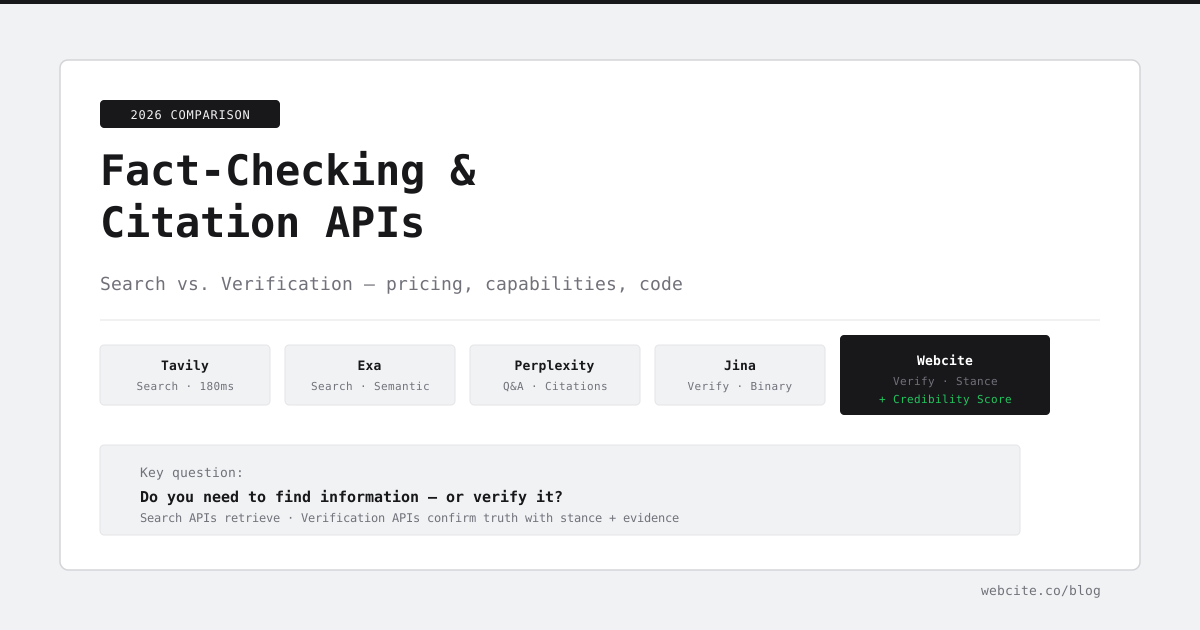
Statistical observability platforms monitor LLM outputs for anomalies. They track metrics like faithfulness scores, answer relevance, and groundedness, flagging responses that deviate from expected patterns. Galileo AI uses fine-tuned small language models called Luna to evaluate outputs for hallucination likelihood, according to Galileo AI, 2025. Arize AI analyzes embedding drift and performance degradation to detect when models start producing unreliable outputs. Fiddler AI monitors hallucination, toxicity, and PII metrics in real time with proprietary trust models, according to Fiddler AI, 2025.
These platforms answer the question: “Is this output statistically unusual compared to what the model normally produces?” They excel at catching systemic issues like model drift, prompt injection attacks, and gradual quality degradation. They do not verify whether specific claims are factually correct.
Approach 2: External Source Verification
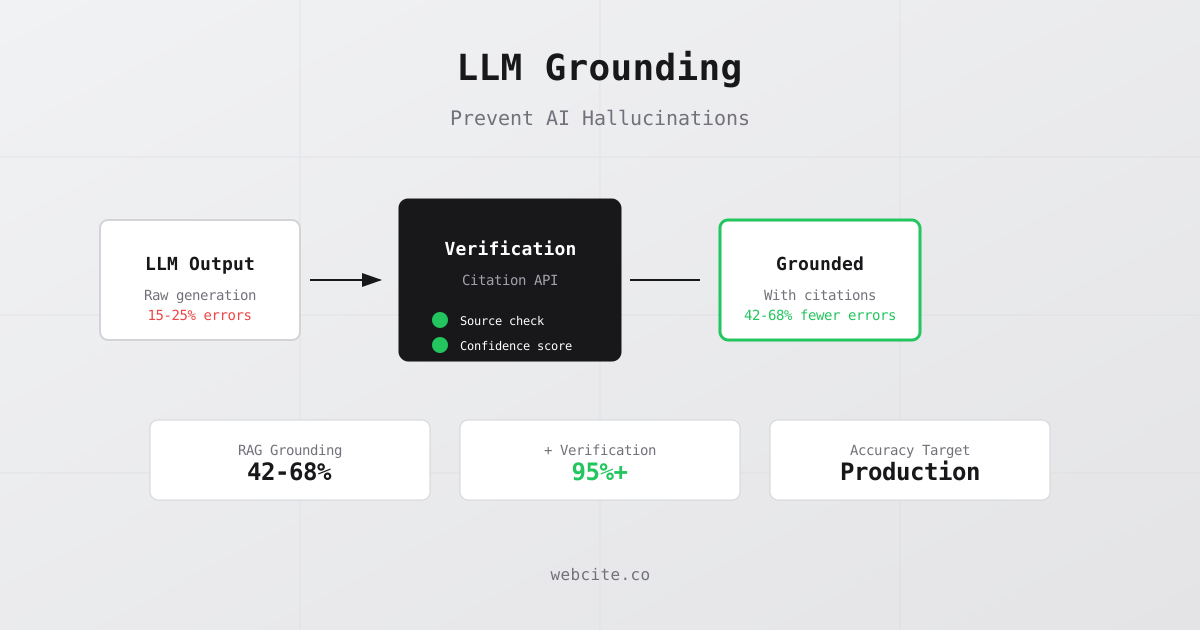
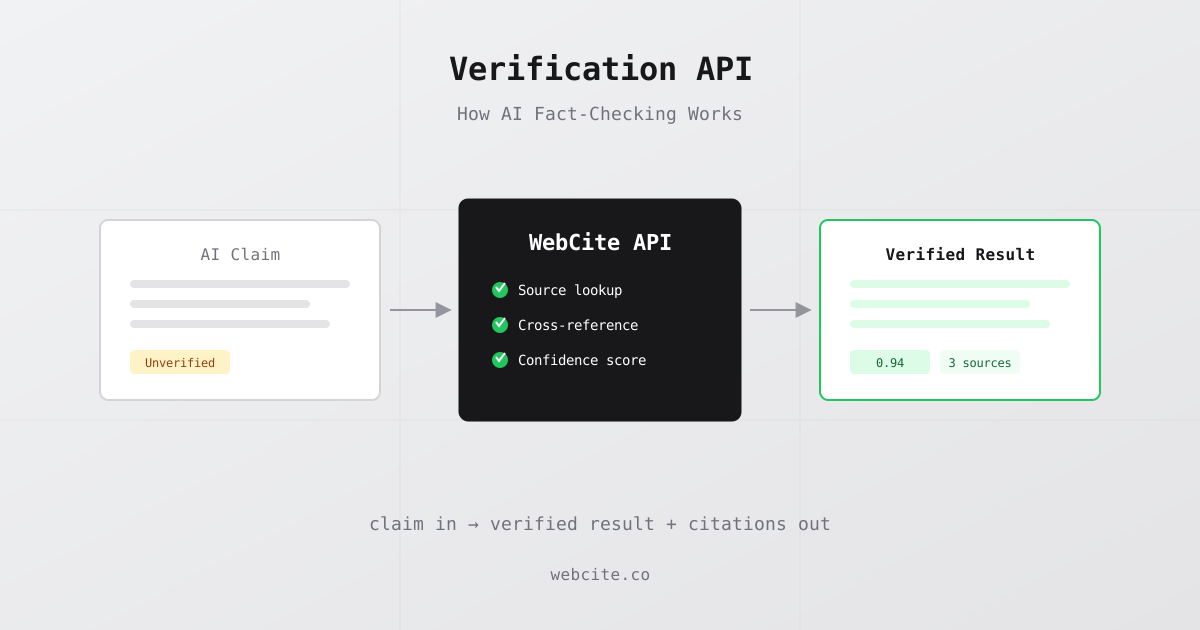
Source verification checks each claim in an AI output against real-world evidence. Instead of asking “does this look normal?”, it asks “is this true?” A verification API retrieves relevant sources, evaluates whether those sources support or contradict the claim, and returns a confidence-scored verdict.
Webcite provides end-to-end verification in a single REST API call: claim extraction, source retrieval, stance detection, and verdict generation. Amazon Bedrock Guardrails uses contextual grounding checks and automated reasoning to verify outputs against provided reference material, claiming up to 99% accuracy on grounded content, according to AWS, 2025.
The difference matters for your architecture. Observability catches patterns. Verification catches facts. The best systems use both.
What It Takes to Build In-House
Building a hallucination detection system from scratch requires three core components: labeled training data, a detection model, and production infrastructure. Enterprise AI spending will reach $2.5 trillion in 2026, according to Gartner, 2026, but the majority of that spending flows to infrastructure, not custom ML projects.
Team Requirements
A minimum viable hallucination detection team needs 3 to 5 engineers:
| Role | Count | Average Salary (US) | Annual Cost |
|---|---|---|---|
| ML Engineer | 2 | $186,000 | $372,000 |
| Data Engineer | 1 | $155,000 | $155,000 |
| MLOps / Infrastructure | 1 | $165,000 | $165,000 |
| Total personnel | 4 | $692,000 |
Machine learning engineers in the United States earn an average of $186,000 per year, according to Glassdoor, 2026. Senior ML engineers at major technology companies earn $300,000 to $500,000 in total compensation when including equity. These are competitive roles with 6-month average time-to-hire.
Infrastructure Costs
GPU compute for training and inference adds $100,000 to $300,000 annually. NVIDIA A100 and H100 GPUs cost $25,000 to $40,000 each, and clusters scale into the millions for large workloads, according to Future Processing, 2026. Even cloud-based GPU instances on AWS, Google Cloud, or Azure run $2 to $4 per hour per GPU, which compounds quickly during training runs that last days or weeks.
Labeled Data
The hardest part is not the model. It is the training data. Hallucination detection requires thousands of labeled examples: AI-generated claims paired with human judgments of whether each claim is accurate, fabricated, or misleading. Creating this dataset takes domain experts, not crowdsourced labelers, because identifying factual errors in legal, medical, or financial content requires specialized knowledge.
Expect 3 to 6 months and $50,000 to $150,000 for an initial labeled dataset of 10,000 to 50,000 examples, depending on domain complexity.
Timeline
| Phase | Duration | Cost Range |
|---|---|---|
| Team hiring | 2-4 months | Recruiting costs |
| Data collection and labeling | 3-6 months | $50,000-$150,000 |
| Model development and training | 3-6 months | GPU + personnel time |
| Integration and testing | 1-2 months | Personnel time |
| Production deployment | 1-2 months | Infrastructure setup |
| Total | 6-12 months | $500,000-$1,200,000 |
The total first-year cost for a custom build ranges from $500,000 to $1.2 million. Annual maintenance adds 20 to 30 percent, or $150,000 to $300,000, according to TRooTech, 2026. That maintenance covers model retraining, data pipeline updates, infrastructure scaling, and adapting to new LLM versions.
What It Costs to Buy
The buy side of the equation is straightforward. You pay per API call or per seat, with no infrastructure to manage and no ML team to hire.
API-Based Verification: Webcite
Webcite offers three plans for claim verification:
| Plan | Monthly Cost | Credits | Verifications | Cost per Verification |
|---|---|---|---|---|
| Free | $0 | 50 | 12 | $0.00 |
| Builder | $20 | 500 | 125 | $0.16 |
| Enterprise | Custom | 10,000+ | 2,500+ | Less than $0.02 |
Each verification uses 4 credits: 2 for citation retrieval, 1 for stance detection, and 1 for the verdict. For detailed pricing breakdowns, see the Webcite API pricing guide.
Integration takes hours, not months. Here is a working verification call:
const response = await fetch("https://api.webcite.co/api/v1/verify", {
  method: "POST",
  headers: {
    "x-api-key": process.env.WEBCITE_API_KEY,
    "Content-Type": "application/json"
  },
  body: JSON.stringify({
    claim: "GPT-4o has a hallucination rate of 0.7%",
    include_stance: true,
    include_verdict: true
  })
})

const result = await response.json()
// result.verdict.result: "supported"
// result.verdict.confidence: 92
// result.citations: [{ title: "...", url: "...", stance: "for" }]
Observability Platforms
Galileo AI, which raised $45 million in Series B funding and serves six Fortune 50 companies, provides LLM evaluation and hallucination scoring through its Luna models, according to DataPhoenix, 2025. Pricing is typically per-seat or per-evaluation, starting in the hundreds of dollars per month for team plans.
Arize AI offers embedding-based observability with drift detection for production LLM monitoring. Fiddler AI provides real-time trust scoring with low-latency guardrails. Both platforms focus on statistical anomaly detection rather than factual verification.
Amazon Bedrock Guardrails bundles hallucination detection into the broader Bedrock ecosystem. It charges per validation request and integrates natively with AWS infrastructure, according to AWS Bedrock, 2025. The automated reasoning feature uses formal logic for verification, but it requires a reference document, making it best suited for RAG applications where you control the source material.
Annual Cost Comparison
| Approach | Year 1 Cost | Annual Maintenance | Time to Production |
|---|---|---|---|
| Custom build | $500K-$1.2M | $150K-$300K/year | 6-12 months |
| Webcite Free | $0 | $0 | 1 day |
| Webcite Builder | $240/year | $0 | 1 day |
| Webcite Enterprise | Custom | $0 | 1 week |
| Galileo AI (team) | $5K-$50K/year | Included | 1-2 weeks |
| Bedrock Guardrails | Per-request | Included | 1-2 weeks |
The cost differential is not marginal. It is orders of magnitude. A custom build costs 2,000x more than a Webcite Builder plan in year one.
Build vs Buy: Side-by-Side Comparison
The following table compares the two approaches across the dimensions that matter most to enterprise decision-makers.
| Dimension | Build In-House | Buy API/Platform |
|---|---|---|
| Time to production | 6-12 months | 1 day to 2 weeks |
| First-year cost | $500K-$1.2M | $0-$50K |
| Ongoing maintenance | $150K-$300K/year | $0 (vendor-managed) |
| Accuracy control | Full (you own the model) | Vendor-dependent |
| Domain customization | Unlimited | Limited to vendor capabilities |
| Data privacy | On-premise possible | Data leaves your infrastructure |
| Scalability | You manage capacity | Vendor manages capacity |
| Team required | 3-5 ML engineers | 1 developer |
| Regulatory compliance | You own compliance | Shared responsibility |
| Vendor lock-in risk | None | Moderate |
The numbers favor buying for the vast majority of use cases. Menlo Ventures found that 76% of enterprise AI use cases are now purchased rather than built, up from 53% in 2024, according to Menlo Ventures, 2025. The shift reflects a market learning that custom AI infrastructure is expensive, slow, and often unnecessary.
When to Build
Building makes strategic sense in a narrow set of circumstances. If more than two of these conditions apply, a custom build may be justified.
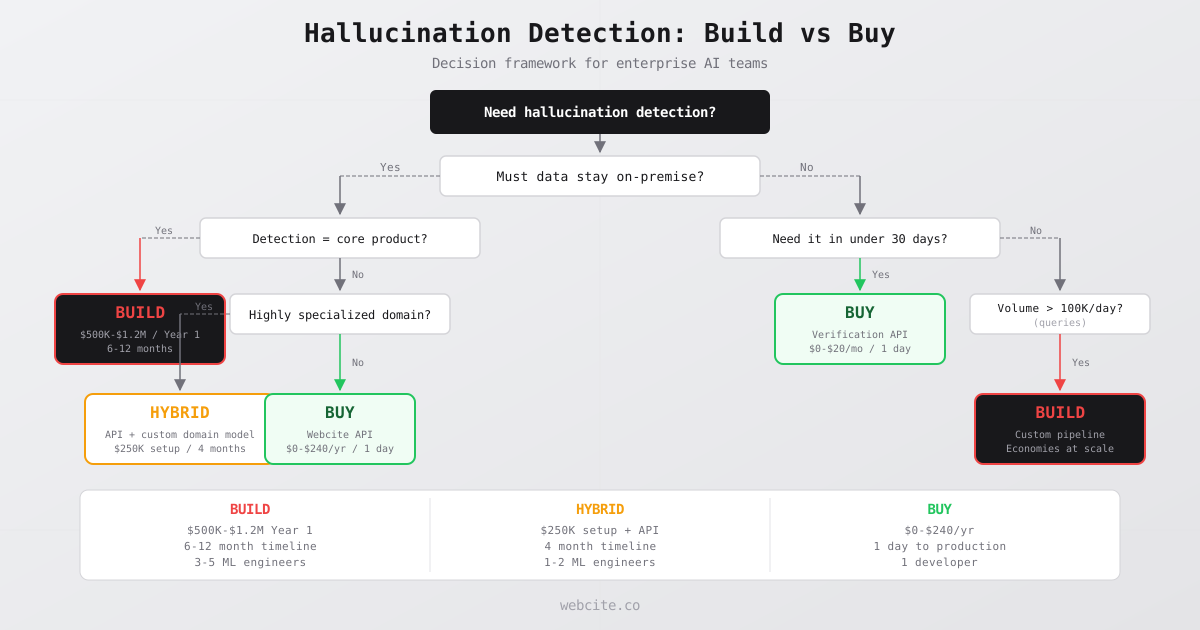
Your data is proprietary and cannot leave your infrastructure. Regulated industries like healthcare (HIPAA), defense (ITAR), and certain financial services require that data never touches third-party APIs. If your verification data contains protected health information, classified material, or restricted financial records, an on-premise solution is not optional.
Hallucination detection is your core product. If you are building a competing observability or verification platform, outsourcing your core capability to a vendor makes no sense. Galileo AI built its own Luna evaluation models because hallucination detection is their product, not a feature.
Your domain is highly specialized with no existing training data. If you are detecting hallucinations in quantum computing research papers, niche regulatory filings, or proprietary internal documents that have no external sources to verify against, off-the-shelf tools will underperform. You need custom models trained on your specific domain.
Your volume exceeds 100,000 verifications per day. At extreme scale, the economics of API pricing invert. At Webcite Enterprise rates (less than $0.02 per verification), 100,000 daily verifications cost approximately $2,000 per day, or $730,000 annually. A custom system may be cheaper at that volume if you already have the team.
When to Buy
Buying is the right default for most enterprises. The Andreessen Horowitz enterprise AI survey of 100 CIOs found that organizations are adopting AI through product-led growth at a scale rarely seen in enterprise software, according to a16z, 2025.
You need detection in production within weeks, not months. A verification API integration takes a single developer one to three days. A custom build takes 6 to 12 months. Gartner predicts that 40% of enterprise applications will include AI agents by 2026, according to Gartner, 2025. If your competitors are shipping AI features now, you cannot afford to wait.
Your use case is general-purpose fact-checking. If you are verifying claims about public knowledge (news, science, business, geography, history), external source verification APIs already have coverage. You do not need a custom model.
Your team does not include ML engineers. Hiring and retaining ML talent is the bottleneck for most enterprise AI projects. ML engineers earn $186,000 or more, demand is high, and time-to-hire averages 6 months. If you do not already have ML expertise, buying removes the hardest constraint.
You want to validate before committing. Webcite’s free tier lets you test verification on real data with zero cost and zero commitment. Start with 50 credits, evaluate the results, and scale only if the accuracy meets your requirements. Our hallucination statistics overview shows the baseline rates you should expect to catch.
The Hybrid Approach: Best of Both
The most sophisticated enterprises do not choose strictly between build and buy. They combine API-based verification for general claims with custom models for domain-specific checks.
Here is how a hybrid architecture works:
AI generates response
    |
    v
[Claim extraction]
    |
    +---> General claims ---> Verification API ---> Verdict + citations
    |
    +---> Domain claims ---> Custom model ---> Domain-specific score
    |
    v
[Merge results] ---> Final verified response
Step 1: Extract claims. Parse the AI output into individual factual statements. Classify each claim as general knowledge or domain specific.
Step 2: Route general claims to a verification API. Claims about public figures, dates, statistics, scientific facts, and current events go to Webcite for external source verification. This catches the majority of hallucinations without any custom ML work.
Step 3: Route domain claims to your custom model. Claims about your proprietary data, internal processes, or niche domain knowledge go to a model you trained on your own labeled data. This handles the long tail of specialized errors that no external API can catch.
Step 4: Merge results. Combine the API verdicts and custom model scores into a unified confidence assessment for the full response.
This approach reduces the custom build scope by 60 to 80 percent. Instead of building a full detection pipeline, you only build the vertical specific layer. The general-purpose verification, which accounts for the majority of claims, is handled by an API that costs a fraction of a custom system.
Total Cost of Ownership: 3-Year Analysis
The following TCO analysis compares three strategies over a 3-year horizon for an enterprise processing 1,000 verifications per day.
| Cost Category | Full Custom Build | Full API (Webcite Enterprise) | Hybrid |
|---|---|---|---|
| Year 1 setup | $800,000 | $0 | $250,000 |
| Year 1 operations | $200,000 | $87,600 | $87,600 |
| Year 2 operations | $250,000 | $87,600 | $117,600 |
| Year 3 operations | $250,000 | $87,600 | $117,600 |
| 3-year total | $1,500,000 | $262,800 | $572,800 |
| Accuracy (general claims) | 85-92% | 90-95% | 90-95% |
| Accuracy (domain claims) | 90-95% | 70-80% | 90-95% |
| Time to production | 9 months | 1 week | 4 months |
The API cost assumes Webcite Enterprise at approximately $0.008 per verification (1,000/day x 365 days x $0.008 = $2,920/month, or roughly $35,040/year for the verification component, plus platform fees). The hybrid approach allocates 70% of claims to the API and 30% to the custom model.
For enterprises where domain accuracy is critical and general purpose verification is table stakes, the hybrid model delivers the best risk-adjusted return. You get production-grade general verification immediately while building domain expertise incrementally.
Decision Framework
Use this framework to determine your approach. Score each criterion, and the column with the highest total points to your recommended strategy.
| Criterion | Build (score 1 if true) | Buy (score 1 if true) | Hybrid (score 1 if true) |
|---|---|---|---|
| Data must stay on-premise | Yes | No | Partially |
| Detection is core product | Yes | No | No |
| Need production in under 30 days | No | Yes | No |
| Have 3+ ML engineers on staff | Yes | No | Yes |
| Domain is highly specialized | Yes | No | Yes |
| Volume exceeds 100K/day | Yes | No | No |
| Budget under $50K/year | No | Yes | No |
| Need both general and domain accuracy | No | No | Yes |
3+ Build points: Invest in a custom system. Budget $800K+ for year one and plan for a 9-month timeline.
3+ Buy points: Start with Webcite Free, validate on real data, and upgrade to Builder or Enterprise as volume grows.
3+ Hybrid points: Deploy Webcite for general verification immediately and begin building your domain specific model in parallel.
Implementation Checklist
Regardless of your chosen approach, these steps apply to every hallucination detection deployment:
- Baseline your current hallucination rate. Run 500 to 1,000 AI outputs through manual review to establish your starting point. Without a baseline, you cannot measure improvement. Our AI hallucination statistics article provides industry benchmarks for comparison.
- Define your accuracy threshold. What hallucination rate is acceptable for your use case? Legal and medical applications typically require under 2%. Customer support may tolerate 5%. Marketing content may accept 10%.
- Start with the buy option to validate. Even if you plan to build, start with a verification API to establish what detection looks like in your pipeline. Webcite’s free tier costs nothing and provides real data for your build-vs-buy analysis.
- Measure cost per prevented hallucination. Track how many hallucinations each approach catches and divide by cost. A verification that prevents one legal liability incident has an ROI that dwarfs the API cost.
- Reassess quarterly. The AI tooling market is evolving rapidly. Solutions that did not exist six months ago may outperform your current approach. Enterprise tech spending will cross $6 trillion in 2026, according to Computerworld, 2025, driving rapid innovation across the verification stack.
Frequently Asked Questions
How long does it take to build an in-house hallucination detection system?
Building a production-grade hallucination detection system typically takes 6 to 12 months. That timeline includes data collection and labeling, model training, infrastructure setup, and ongoing calibration. Most enterprises underestimate the maintenance burden, which adds 20 to 30 percent of the initial build cost annually.
What is the cheapest way to add hallucination detection to an AI application?
The cheapest starting point is a verification API like Webcite, which offers 50 free credits per month. That covers 12 full verifications at zero cost. The Builder plan at $20 per month handles 125 verifications, enough for most early-stage production applications.
Should I use an observability platform or a verification API for hallucination detection?
They serve different purposes and work best together. Observability platforms like Galileo AI and Arize detect statistical anomalies in model behavior. Verification APIs like Webcite check specific claims against external sources. Observability catches patterns; verification catches individual factual errors.
When does it make sense to build hallucination detection in-house?
Building makes sense when your domain data is proprietary and cannot leave your infrastructure, when hallucination detection is a core competitive differentiator, or when your query volume exceeds 100,000 verifications per day. For most other cases, buying is faster and cheaper.
What is the total cost of ownership for a custom hallucination detection system?
A custom system costs between $500,000 and $1.2 million in the first year, including ML engineer salaries, GPU infrastructure, labeled training data, and ongoing maintenance. Annual maintenance adds $150,000 to $300,000. By comparison, an API-based approach costs $240 to $12,000 per year depending on volume.