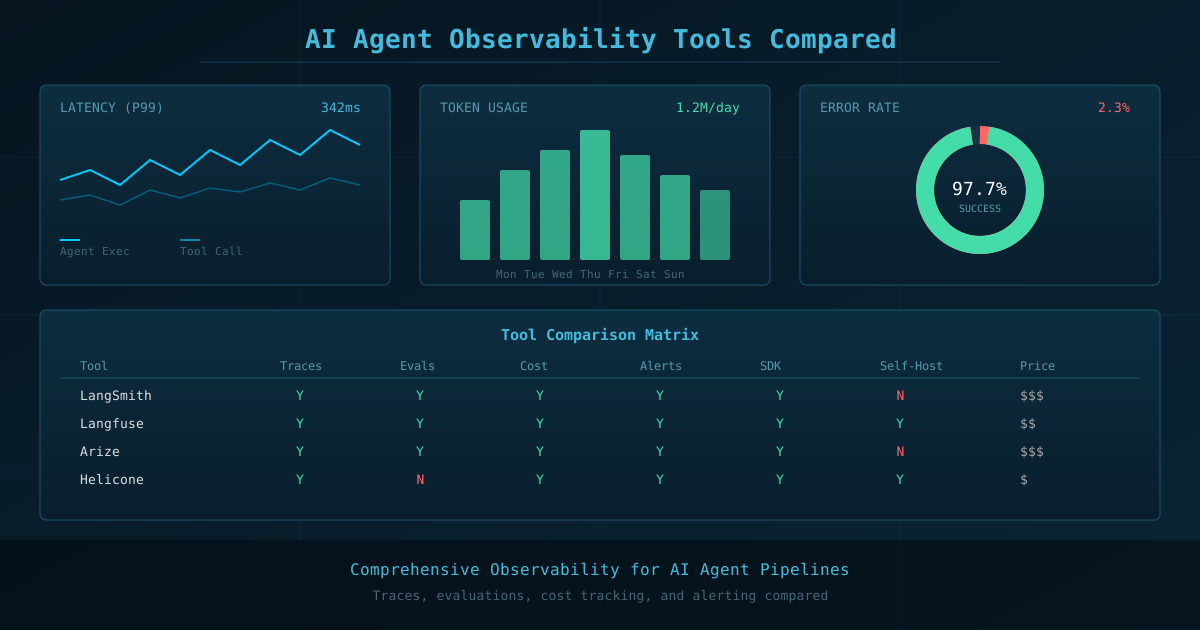
Gartner projects that 33% of enterprise software will incorporate agentic AI by 2028, according to Gartner, 2024. LangChain reported 600 to 800 companies running agents in production by mid-2025, according to the LangChain State of Agent Engineering Survey, 2025. As agents move from prototypes to production, observability has shifted from optional to essential. This article compares 6 leading AI agent observability tools across tracing, evaluation, pricing, and debugging capabilities so you can pick the right platform for your stack.
- Langfuse is the best free, open-source option with self-hosting, tracing, and evaluation built in.
- Braintrust leads on evaluation workflows with built-in scoring, A/B testing, and dataset management.
- Arize excels at production monitoring with drift detection, embedding analysis, and real-time alerting.
- LangSmith integrates tightly with LangChain and LangGraph but has limited value outside that ecosystem.
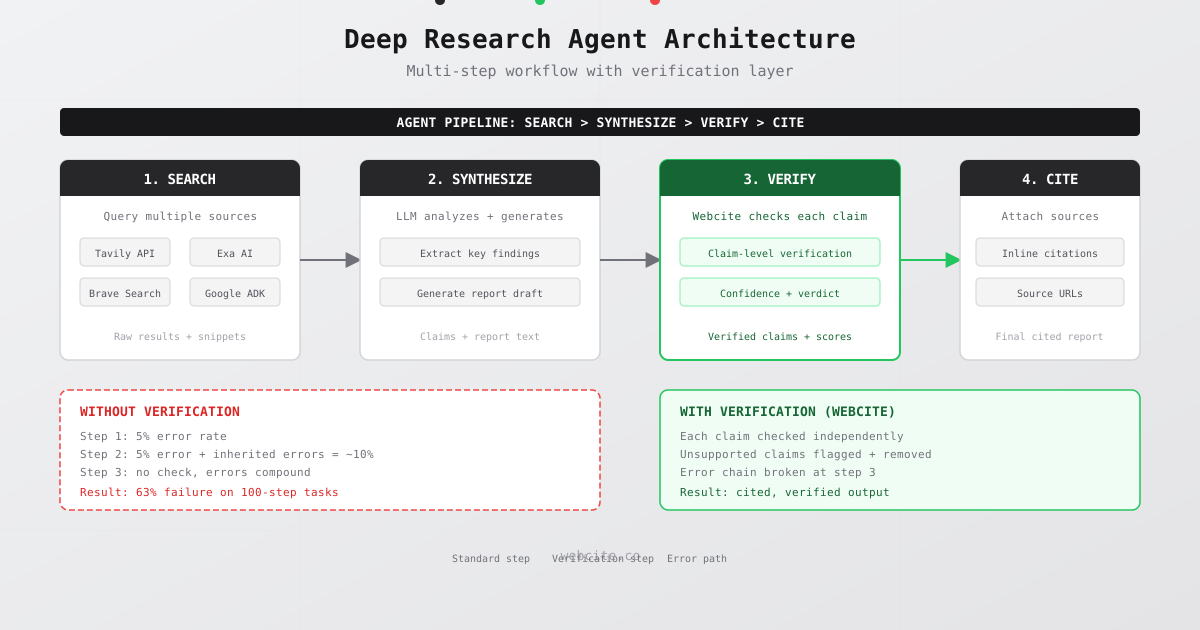
- Observability tools track agent behavior; verification tools like Webcite check whether agent outputs are factually correct. Both are needed.
Comparison Table: 6 Tools at a Glance
| Feature | Langfuse | Braintrust | Arize | Maxim AI | LangSmith | Webcite |
|---|---|---|---|---|---|---|
| Primary focus | Tracing + Eval | Evaluation + Datasets | Production monitoring | Testing + Eval | LangChain tracing | Output verification |
| Open source | Yes (MIT) | Partial (SDK) | No | No | No | No |
| Self-hosting | Yes | No | No | No | No | No |
| Distributed tracing | Yes | Yes | Yes | Yes | Yes | N/A |
| LLM evaluation | Yes | Yes (advanced) | Yes | Yes | Yes | Factual only |
| Custom evaluators | Yes | Yes | Yes | Yes | Yes | N/A |
| Prompt management | Yes | Yes | No | Yes | Yes | N/A |
| Real-time alerting | Basic | No | Yes (advanced) | Yes | Basic | N/A |
| Framework support | All major | All major | All major | All major | LangChain/LangGraph | REST API |
| Free tier | Yes | Yes (1K evals) | Community edition | Limited | Yes (5K traces) | 50 credits/mo |
| Paid starting price | Self-host free | $250/mo | $500/mo | Custom | $39/mo | $20/mo |
What to Look for in Agent Observability
Agent observability differs from traditional application performance monitoring (APM) in several critical ways. Standard tools like Datadog, New Relic, and Grafana track request latency, error rates, and throughput. They are designed for deterministic systems where the same input produces the same output.
AI agents are non-deterministic. The same input can produce different outputs across runs. A single agent task may involve dozens of LLM calls, multiple tool invocations, and branching decision logic. Traditional APM captures none of this.
Effective agent observability requires five capabilities:
-
Distributed tracing across agent steps. Each LLM call, tool invocation, and decision point must be captured as a span in a trace. Multi-agent systems need cross-agent trace propagation, similar to how microservices use distributed tracing with OpenTelemetry.
-
LLM-specific metrics. Token usage, prompt/completion latency, model version, and temperature settings need to be captured per call. These metrics do not exist in traditional APM.
-
Evaluation scoring. Output quality, including correctness, faithfulness, relevance, and safety, must be measured programmatically. Manual review does not scale. Organizations that rely solely on human review spend an average of 4.3 hours per employee per week verifying AI outputs, according to Korra, 2024.
-
Prompt versioning and management. As prompts change, evaluation scores shift. Linking prompt versions to quality metrics enables data-driven prompt engineering.
-
Cost tracking. LLM API costs accumulate quickly in agentic systems. Per-trace cost attribution helps teams identify expensive agent paths and optimize them.
Langfuse: Open-Source Tracing and Evaluation
Langfuse is an open-source LLM observability platform released under the MIT license. It provides tracing, evaluation, prompt management, and cost tracking. The self-hosted option makes it the go-to choice for teams with data residency requirements or budget constraints.
Tracing. Langfuse captures hierarchical traces with spans for each LLM call, tool invocation, and custom event. Traces can be nested to represent complex agent workflows. The SDK integrates with LangChain, LlamaIndex, OpenAI, Anthropic, and other frameworks through decorators and callbacks, according to Langfuse docs, 2025.
Evaluation. Langfuse supports both automated and human evaluation workflows. You can define custom scoring functions, run LLM-as-judge evaluations, or attach human annotations to traces. Evaluation scores are linked to traces, enabling filtering and analysis by quality level.
Prompt management. Prompts are versioned and tracked alongside traces. When a prompt change causes quality regression, the connection is visible in the dashboard.
Pricing. Self-hosting is free. The hosted Langfuse Cloud offers a free tier for individual developers, with paid plans starting based on trace volume. The open-source codebase has over 7,500 GitHub stars, according to Langfuse GitHub, 2025.
Limitations. Langfuse is strong on tracing and basic evaluation but lacks the advanced drift detection, embedding analysis, and real-time alerting that production-heavy teams need. Self-hosting requires maintaining infrastructure.
Braintrust: Evaluation-First Platform
Braintrust positions itself as an evaluation and experiment management platform for AI. Its core strength is structured evaluation workflows: defining datasets, running experiments, scoring outputs, and comparing results across model versions.
Evaluation. Braintrust provides built-in scoring functions for common metrics (factuality, relevance, coherence) and supports custom evaluators. The experiment framework lets you run the same dataset against different models, prompts, or configurations and compare results in a structured table, according to Braintrust docs, 2025.
Datasets. Braintrust includes dataset management for golden test sets. You can create, version, and share evaluation datasets across your team. This is a significant differentiator; most observability tools treat evaluation data as an afterthought.
Tracing. Full distributed tracing is supported with nested spans for agent workflows. Traces link to evaluation scores, making it easy to identify which agent paths produce low-quality outputs.
Pricing. Free tier includes 1,000 evaluations per month. Paid plans start at $250 per month for teams, according to Braintrust pricing, 2025.
Limitations. Braintrust is weaker on production monitoring and alerting compared to Arize. It excels in the development and evaluation phase but is less focused on real-time production observability.
Arize AI: Production Monitoring and Drift Detection
Arize AI is a machine learning observability platform that expanded into LLM monitoring. Its strength is production-grade monitoring with drift detection, embedding analysis, and automated alerting.
Monitoring. Arize tracks LLM performance in production with dashboards for latency, token usage, error rates, and quality scores. The platform automatically detects performance degradation and sends alerts, according to Arize AI, 2025.
Embedding analysis. Arize visualizes embedding distributions to detect data drift. When the distribution of input embeddings shifts, indicating that the model is seeing different types of queries, Arize flags it before quality degrades.
Tracing. Arize Phoenix, the open-source component, provides LLM tracing compatible with OpenTelemetry. The commercial platform adds production monitoring, alerting, and team collaboration features on top.
Evaluation. Arize includes LLM evaluation with custom scoring functions and human annotation workflows. Evaluations can be triggered automatically on production traffic.
Pricing. Arize Phoenix is open source. The commercial platform starts at $500 per month for teams, with enterprise pricing for larger deployments, according to Arize pricing, 2025.
Limitations. Arize is the most expensive option on this list for small teams. The platform is optimized for large-scale production deployments, which makes it overkill for early-stage projects or individual developers.
Maxim AI: Testing and Quality Assurance
Maxim AI focuses on AI testing and quality assurance, positioning itself as a QA platform for LLM applications. It emphasizes pre-deployment testing, regression detection, and quality gates.
Testing workflows. Maxim provides structured test suites that evaluate LLM outputs against defined criteria before deployment. Tests can be configured for correctness, safety, brand alignment, and custom quality dimensions, according to Maxim AI, 2025.
Simulation. Maxim generates synthetic test inputs to stress-test agents against edge cases, adversarial inputs, and unusual scenarios. This complements real-world evaluation data with broader coverage.
Evaluation. Custom evaluation pipelines support multi-metric scoring with configurable thresholds. Results feed into quality gates that block deployment when scores drop below acceptable levels.
Pricing. Custom pricing based on usage and team size. No public pricing page as of February 2026.
Limitations. Maxim AI is focused on release gate testing rather than production monitoring. Teams need a separate tool for real-time observability in production. The platform is newer and has a smaller community than Langfuse or LangSmith.
LangSmith: LangChain Ecosystem Integration
LangSmith is LangChain’s official observability and evaluation platform. It provides deep integration with the LangChain and LangGraph frameworks, making it the natural choice for teams already in that ecosystem.
Tracing. LangSmith captures every LangChain and LangGraph execution step with detailed traces. The integration is automatic: adding LangSmith to a LangChain project requires setting environment variables, not code changes, according to LangSmith docs, 2025.
Hub. The LangChain Hub provides a shared repository of prompts and chains. LangSmith links Hub prompts to traces and evaluation scores, enabling community-driven prompt improvement.
Evaluation. LangSmith supports automated evaluation with built-in and custom metrics. Datasets can be uploaded for offline evaluation, and production traces can be sampled for online evaluation.
Pricing. Free tier includes 5,000 traces per month. Developer plan at $39 per month provides additional traces and features. Enterprise pricing is custom, according to LangSmith pricing, 2025.
Limitations. LangSmith’s value proposition is tightly coupled to the LangChain ecosystem. If you use a different framework, such as CrewAI, Haystack, or custom orchestration, the integration benefits disappear. The platform also lacks the advanced production monitoring and drift detection that Arize provides.
Where Output Verification Fits In
Observability platforms monitor agent behavior and detect when something goes wrong. They answer questions like “Is the agent slower than usual?” and “Are error rates increasing?” and “Which agent step failed?”
They do not answer the question “Is this specific claim in the agent’s output factually correct?” That requires output verification, a fundamentally different capability.
The Webcite verification API checks individual claims against external sources and returns a structured verdict with confidence scores and citations. It fits into the agent pipeline after the agent generates output and before that output reaches the user.
Observability and verification are complementary:
| Capability | Observability (Langfuse, Arize, etc.) | Verification (Webcite) |
|---|---|---|
| Detects latency issues | Yes | No |
| Tracks token costs | Yes | No |
| Identifies drift | Yes | No |
| Checks factual accuracy | No | Yes |
| Provides source citations | No | Yes |
| Catches hallucinations | Statistical patterns only | Per-claim verification |
For production agents where factual accuracy matters, using both layers provides the most complete picture. For more on how automated verification compares to manual review, see the linked guide.
The Webcite free tier provides 50 credits per month ($0), enough for 12 full verifications. The Builder plan at $20 per month offers 500 credits for 125 verifications. Enterprise plans start at 10,000 credits with custom pricing.
How to Choose the Right Tool
The right observability tool depends on your stack, team size, and priorities.
Choose Langfuse if you need an open-source, self-hostable solution. It is the best free option with comprehensive tracing and evaluation. Ideal for startups, privacy-sensitive applications, and teams that want full control over their data.
Choose Braintrust if evaluation and experiment management are your primary needs. The dataset management and structured evaluation workflows are the best in class. Best for teams spending most of their time optimizing prompt quality and comparing model versions.
Choose Arize if you are running agents at scale in production and need advanced monitoring, drift detection, and automated alerting. Best for enterprise teams with mature AI infrastructure that need production-grade observability.
Choose Maxim AI if release gate testing and quality assurance are your priority. Best for teams with established CI/CD pipelines that want to integrate AI quality checks into their release process.
Choose LangSmith if your stack is built on LangChain and LangGraph. The seamless integration and LangChain Hub access make it the natural choice for that ecosystem.
Add Webcite if factual accuracy of agent outputs matters to your users. Observability catches systemic problems. Verification catches factual errors on individual outputs. For agents generating research, recommendations, or claims that users rely on, both layers are necessary. For a detailed comparison of fact-checking tools, see the best AI fact-checking tools guide.
Frequently Asked Questions
What is AI agent observability?
AI agent observability is the practice of monitoring, tracing, and evaluating AI agent behavior across multi-step workflows. It extends traditional application monitoring to cover LLM interactions, tool calls, reasoning chains, and outcome quality. The goal is to understand not just whether an agent ran, but whether it produced correct, safe, and useful results.
What is the best free AI agent observability tool?
Langfuse is the strongest free option. It is open source under the MIT license, can be deployed on your own infrastructure, and provides tracing, prompt management, and evaluation. The hosted version includes a free tier for individual developers. Braintrust also offers a free tier with 1,000 evaluations per month, making it a solid alternative for evaluation-focused workflows.
What is the difference between observability and evaluation for AI agents?
Observability tracks runtime behavior: latency, token usage, error rates, and execution traces. Evaluation measures output quality: correctness, relevance, faithfulness, and safety. Most modern platforms combine both capabilities, but some specialize. Arize focuses on observability and drift detection. Braintrust and Maxim AI emphasize evaluation workflows.
Do I need a separate tool for AI agent observability?
Generic APM tools like Datadog and New Relic can track latency and errors, but they miss LLM-specific signals like hallucination rates, prompt quality, and reasoning chain failures. Dedicated AI observability tools add LLM tracing, evaluation scoring, and prompt versioning that general-purpose tools cannot provide.
How does Webcite differ from observability platforms?
Observability platforms monitor and trace agent behavior to detect anomalies and quality degradation. Webcite verifies the factual accuracy of agent outputs by checking claims against external sources and returning structured verdicts with citations. They serve complementary roles: observability catches systemic issues, verification catches individual factual errors.
How much do AI agent observability tools cost?
Pricing varies widely. Langfuse is free and open source with on-premises deployment available. Braintrust starts free with paid tiers from $250 per month. Arize starts at $500 per month for teams. LangSmith offers a free tier with paid plans from $39 per month. Maxim AI uses custom pricing. Webcite starts at $0 with 50 credits per month and scales to $20 per month on the Builder plan.