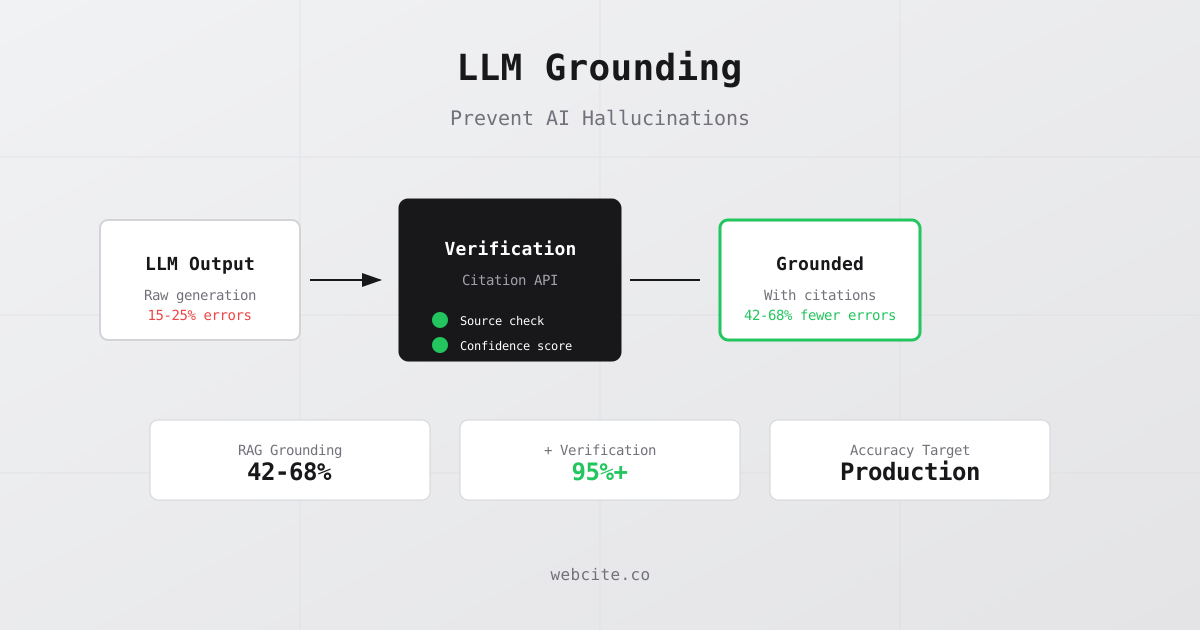
RAG (Retrieval-Augmented Generation) reduces large language model hallucinations by 71 percent, according to AllAboutAI, 2026. That still leaves a substantial residual error rate. A Stanford Law study found that RAG-powered legal AI tools from LexisNexis and Thomson Reuters hallucinate in 17 to 33 percent of queries, according to Magesh et al., Stanford Law School, 2024. This article explains why RAG alone is insufficient, how verification APIs close the accuracy gap, and how to integrate both into a single pipeline.
- RAG cuts hallucinations by 71%, but residual rates of 17-33% persist in production systems.
- RAG has three blind spots: outdated documents, retrieval failures, and unfaithful generation.
- Verification APIs independently check each claim against external sources after RAG generates a response.
- Enterprises lost an estimated $67.4 billion to AI hallucinations in 2024.
- Adding verification to a RAG pipeline requires fewer than 40 lines of code.
- RAG plus verification catches errors that neither approach catches alone.
How RAG Works and Where It Falls Short
Retrieval-Augmented Generation combines two steps: a retrieval step that fetches relevant documents from a knowledge base, and a generation step where a large language model produces a response grounded in those documents. The approach was popularized by Meta AI researchers in 2020 and has since become the default architecture for enterprise AI applications built on platforms like LangChain, LlamaIndex, and Microsoft Azure AI Search.
The theory is sound. By injecting retrieved context into the prompt, the model should stick to verified information instead of generating from parametric memory alone. In practice, RAG reduces hallucinations significantly. Google research shows that properly implemented RAG cuts hallucination rates by 71 percent compared to vanilla LLM generation, according to AllAboutAI, 2026.
But 71 percent is not 100 percent. The remaining 29 percent of hallucinations still reach users, and in some domains, the residual rate is far worse. Stanford HAI researchers found that AI hallucination rates vary from 3 to 20 percent depending on the domain, according to Stanford HAI, 2025. In legal applications specifically, that rate climbs to 17 to 33 percent even with RAG enabled, according to Magesh et al., Stanford Law School, 2024.
RAG fails for three specific reasons that no amount of prompt engineering can fix.
Outdated documents. Vector stores contain documents from when they were last indexed. If a regulation changed, a price updated, or a statistic was revised, the RAG system retrieves stale information and the model presents it as current. The system has no mechanism to detect that its own knowledge base is wrong.
Retrieval failures. Embedding-based retrieval is probabilistic. A query about “carbon emissions standards for 2026” might retrieve documents about general environmental policy instead of the specific regulatory text. The model then generates a plausible-sounding answer grounded in the wrong context, and it looks exactly like a correct answer.
Unfaithful generation. Even when retrieval is perfect, the language model can misinterpret the context. It might combine facts from two different retrieved passages in a way that neither passage supports. It might round a number, swap a date, or attribute a quote to the wrong person. The Stanford Law study documented all of these patterns in production RAG systems from Lexis+ AI and Westlaw AI-Assisted Research.
These are not edge cases. They are structural limitations of the RAG architecture.
Categories of RAG Hallucination
Understanding the taxonomy of RAG hallucinations helps you build targeted defenses. Researchers classify RAG hallucinations into two primary categories: intrinsic and extrinsic.
Intrinsic hallucinations contradict the retrieved source material. The model reads a passage that says “revenue grew 12 percent” and generates “revenue grew 20 percent.” The information is in the context; the model just gets it wrong. Intrinsic hallucinations account for roughly 40 percent of RAG errors, according to the Vectara Hallucination Leaderboard, 2024.
Extrinsic hallucinations introduce information that is absent from the retrieved documents entirely. The model generates a claim, a statistic, or a citation that exists nowhere in the provided context. It draws from its parametric memory (training data) instead of the retrieved documents, producing outputs that sound grounded but are not.
Within these two categories, hallucinations originate at different stages of the RAG pipeline:
Retrieval-stage hallucinations happen before the model even sees the context. The retriever fetches irrelevant documents, low-quality passages, or outdated content. The model then faithfully summarizes bad inputs, producing outputs that are “grounded” in the wrong material.
Generation-stage hallucinations happen after retrieval. The model receives correct context but produces unfaithful output. This includes misattribution (correct fact, wrong source), confabulation (plausible but fabricated details), and numerical errors (rounding, swapping, or inventing figures).
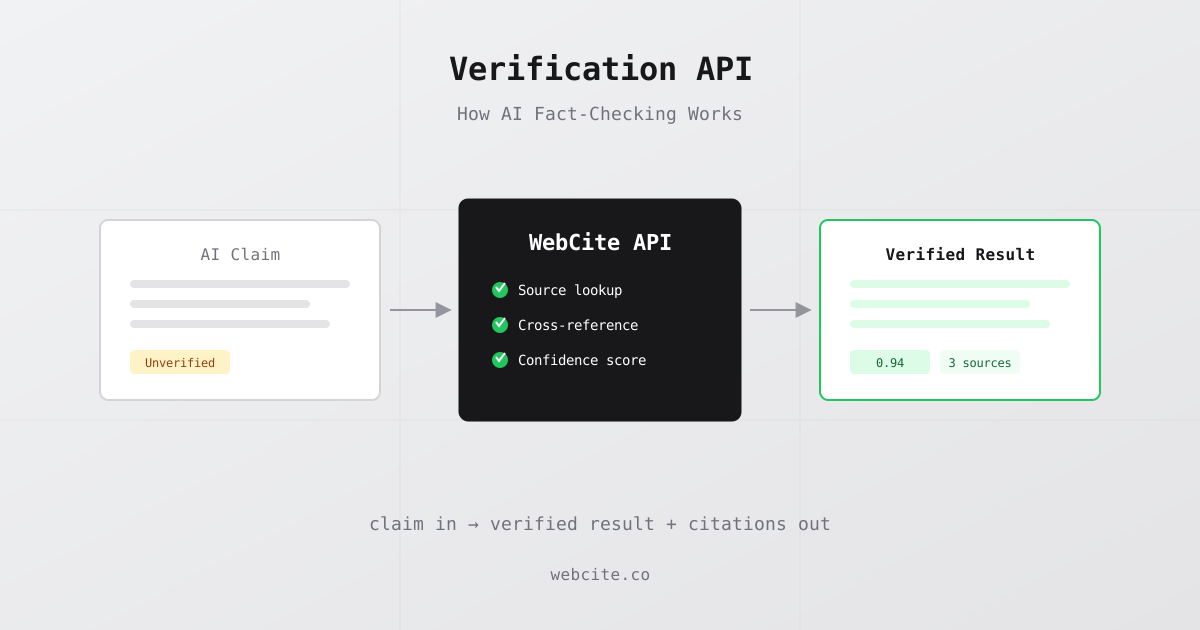
A verification API catches both categories because it checks the final output against independent external sources. It does not care whether the error originated in retrieval or generation. If the claim is not supported by real-world evidence, the API flags it.
Why Verification APIs Solve What RAG Cannot
RAG grounds the model in your documents. A verification API grounds the output in reality. These are fundamentally different operations.
RAG answers the question: “What do my documents say about this topic?” A verification API answers the question: “Is this specific claim supported by real-world sources?” The first is a retrieval problem. The second is a verification problem. They complement each other.
The cost of not verifying is substantial. Enterprises lost an estimated $67.4 billion to AI hallucinations in 2024, including costs from incorrect decisions, customer service errors, legal liability, and reputational damage, according to Korra, 2024.
A verification API provides three capabilities that RAG does not:
Independent source checking. RAG checks against your own document store. A verification API checks against the open web, news archives, and academic databases. If your documents are wrong, RAG will confidently repeat the error. A verification API will catch it because external sources disagree.
Stance detection. RAG returns documents. It does not tell you whether those documents support or contradict the generated claim. A verification API explicitly evaluates stance: does this source support, contradict, or say nothing about the claim?
Confidence scoring. RAG provides retrieval similarity scores (how close is this document to the query). A verification API provides claim-level confidence scores (how likely is this claim to be true based on available evidence). These are different measurements that serve different purposes.
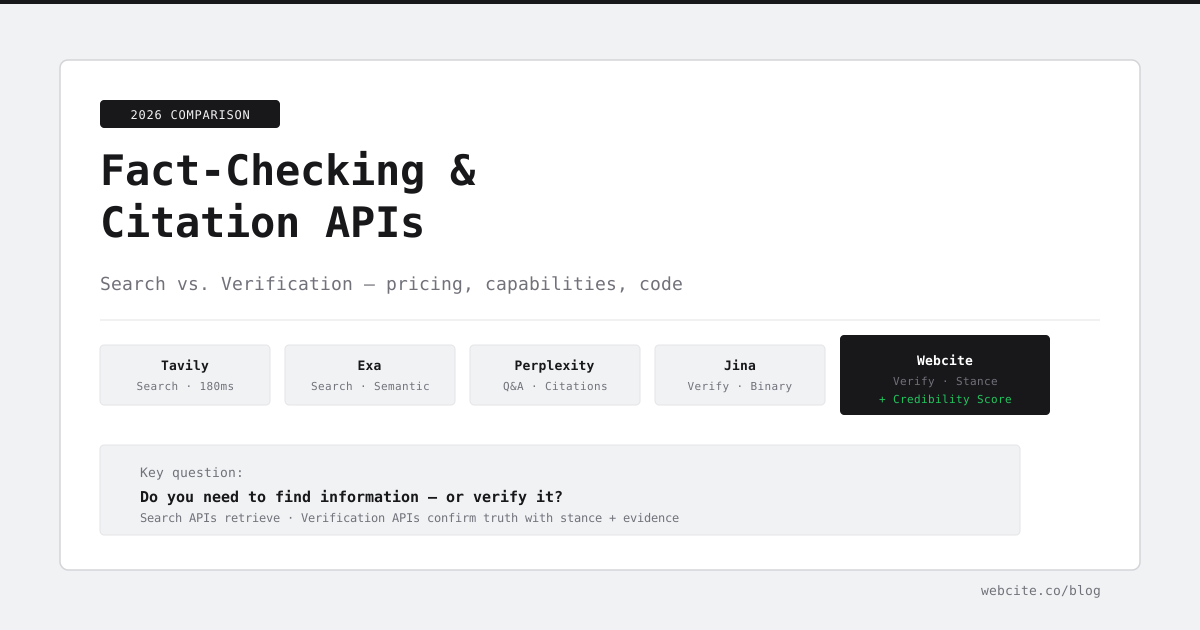
For a detailed comparison of how Webcite handles verification compared to search-only APIs, see our fact-checking API comparison guide.
RAG Alone vs RAG Plus Verification
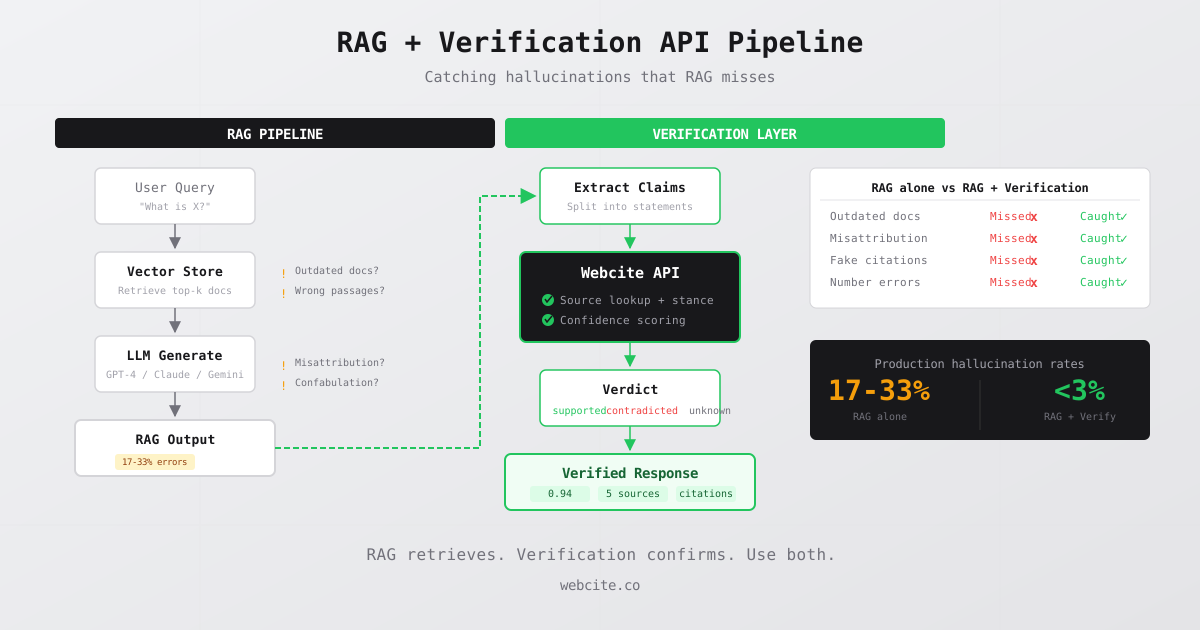
The following table summarizes what each approach catches and misses.
| Failure Mode | RAG Alone | RAG + Verification API |
|---|---|---|
| Model ignores context | Not detected | Caught by external source check |
| Retrieved documents are outdated | Not detected | Caught if external sources have current data |
| Model misattributes a statistic | Not detected | Caught by cross-referencing original source |
| Model fabricates a citation | Not detected | Caught; fake citation has no matching source |
| Claim contradicts retrieved context | Sometimes detected with faithfulness checks | Caught independently of retrieval |
| Numerical rounding or swapping | Not detected | Caught if specific number is verifiable |
| Generated response is fully supported | Assumed (no check) | Confirmed with evidence and confidence score |
The pattern is clear. RAG assumes accuracy when the right documents are retrieved. Verification confirms accuracy by checking the generated output against independent evidence. Running both layers gives you defense in depth.
Air Canada’s chatbot hallucinated a bereavement fare policy that did not exist, leading to a tribunal ruling that forced the airline to honor the fabricated discount, according to CBC News, 2024. A post-generation verification check would have flagged the nonexistent policy before it reached the customer.
Architecture: RAG Pipeline Plus Verification API
The integration architecture adds a verification layer after the RAG pipeline’s generation step. Here is the flow:
User query
    │
    ▼
┌─────────────────────┐
│  1. Retrieve docs    │  ← Vector store (Pinecone, Weaviate, Chroma)
│     from knowledge   │
│     base             │
└─────────┬───────────┘
          │
          ▼
┌─────────────────────┐
│  2. Generate response│  ← LLM (GPT-4, Claude, Gemini, Llama)
│     grounded in      │
│     retrieved context│
└─────────┬───────────┘
          │
          ▼
┌─────────────────────┐
│  3. Extract claims   │  ← Split response into verifiable statements
└─────────┬───────────┘
          │
          ▼
┌─────────────────────┐
│  4. Verify each      │  ← Verification API (external source check)
│     claim against    │
│     real sources     │
└─────────┬───────────┘
          │
          ▼
┌─────────────────────┐
│  5. Compose final    │  ← Merge RAG response + verification results
│     response with    │
│     citations        │
└─────────────────────┘
Steps 1 and 2 are your existing RAG pipeline. Steps 3, 4, and 5 are the verification layer. The verification layer is additive; it does not modify your retrieval or generation logic.
This is the same pattern described in our tutorial on adding fact-checking to an AI chatbot, applied specifically to RAG architectures.
Working Code: Verifying RAG Output with Webcite
Here is a complete implementation that takes RAG output and verifies each claim before returning it to the user. This example uses JavaScript with the Webcite REST API.
Step 1: Extract Verifiable Claims
function extractClaims(ragResponse) {
  const sentences = ragResponse
    .split(/[.!?]+/)
    .map(s => s.trim())
    .filter(s => s.length > 20)

  // Keep sentences with numbers, dates, or proper nouns (factual claims)
  return sentences.filter(s =>
    /\d/.test(s) || /[A-Z][a-z]{2,}/.test(s.slice(1))
  )
}
Step 2: Verify Each Claim via Webcite API
async function verifyClaim(claim) {
  const response = await fetch("https://api.webcite.co/api/v1/verify", {
    method: "POST",
    headers: {
      "x-api-key": process.env.WEBCITE_API_KEY,
      "Content-Type": "application/json"
    },
    body: JSON.stringify({
      claim: claim,
      include_stance: true,
      include_verdict: true
    })
  })
  return response.json()
}
Step 3: Build the Verified Response
async function verifyRagOutput(ragResponse) {
  const claims = extractClaims(ragResponse)
  const verifications = await Promise.all(claims.map(verifyClaim))

  const verified = []
  const flagged = []
  const allCitations = []

  verifications.forEach((result, index) => {
    const claim = claims[index]
    const verdict = result.verdict?.result

    if (verdict === "supported") {
      verified.push(claim)
      allCitations.push(...(result.citations || []))
    } else if (verdict === "contradicted") {
      flagged.push({
        claim,
        reason: result.verdict?.summary || "Contradicted by sources",
        confidence: result.verdict?.confidence
      })
    } else {
      // Insufficient evidence: include with disclaimer
      verified.push(claim)
    }
  })

  return {
    response: verified.join(". ") + ".",
    flagged_claims: flagged,
    citations: allCitations.map(c => ({
      title: c.title,
      url: c.url,
      stance: c.stance
    })),
    verification_stats: {
      total_claims: claims.length,
      supported: verified.length,
      contradicted: flagged.length
    }
  }
}
Step 4: Integrate into Your RAG Endpoint
app.post("/api/ask", async (req, res) => {
  const { question } = req.body

  // Step 1-2: Existing RAG pipeline
  const retrievedDocs = await vectorStore.similaritySearch(question, 5)
  const ragResponse = await llm.generate(question, retrievedDocs)

  // Step 3-5: Verification layer
  const verifiedResult = await verifyRagOutput(ragResponse)

  res.json({
    answer: verifiedResult.response,
    sources: verifiedResult.citations,
    flagged: verifiedResult.flagged_claims,
    stats: verifiedResult.verification_stats
  })
})
Each verification call consumes 4 credits (2 for citation retrieval, 1 for stance detection, 1 for the verdict). Webcite’s free tier includes 50 credits per month, enough for 12 full verifications during development and testing. The Builder plan at $20/month provides 500 credits for 125 verifications.
Optimizing Verification in Production
Running every claim through a verification API works for development. In production, you want to optimize for cost and latency.
Selective verification only checks claims that carry the highest hallucination risk. Claims containing numbers, dates, statistics, proper nouns, or regulatory references are far more likely to be hallucinated than general statements. Filtering for these patterns can reduce API calls by 60 to 80 percent.
Parallel verification sends all claims to the API simultaneously rather than sequentially. The code example above uses Promise.all for this. Five claims verified in parallel take the same time as one claim verified alone, typically 1 to 3 seconds.
Caching stores verification results for identical or near-identical claims. If your RAG system generates the same factual statement across multiple user queries, you only need to verify it once. A Redis or Memcached layer with a 24-hour TTL catches most repeated claims.
Asynchronous verification returns the RAG response immediately and appends verification results after they arrive. This eliminates the latency penalty entirely. The user sees the response in real time, and citation badges appear a few seconds later.
A survey of enterprise AI teams found that 76 percent now include human-in-the-loop verification to catch hallucinations before deployment, according to AllAboutAI, 2026. Verification APIs automate that manual step while providing consistent, auditable results.
The Regulatory Dimension
Verification is not just a quality concern. The EU AI Act Article 50, taking effect 2 August 2026, mandates that AI providers disclose AI interactions and label AI-generated content in machine-readable format, according to the official EU AI Act text, 2024. Applications that generate content for European users need auditable evidence of source attribution and accuracy checks.
In the United States, the Colorado AI Act and California transparency requirements also take effect in 2026, creating overlapping regulations that require provable AI accuracy, according to Wilson Sonsini, 2026. Every verification API call produces a timestamped record of what was checked, against which sources, and what verdict was returned. That audit trail is exactly what regulators require.
A Deloitte report on Australian welfare reform contained AI hallucinations that led to a $290,000 refund, according to Fortune, 2025. For organizations operating in regulated industries, the cost of verification is trivial compared to the liability of unverified outputs.
Getting Started
Adding verification to your RAG pipeline takes three steps:
-
Sign up at webcite.co and get a free API key. The free tier includes 50 credits per month for testing.
-
Add the verification layer after your RAG generation step using the code examples above. No changes to your existing retrieval or generation logic are needed.
-
Choose your verification strategy: synchronous for high-stakes domains (legal, healthcare, finance), asynchronous for general-purpose applications where latency matters more than pre-delivery accuracy.
The Builder plan at $20 per month with 500 credits is the most common starting point for production RAG applications. Enterprise plans with 10,000+ credits per month support high-volume pipelines with dedicated support.
For a deeper look at how verification APIs work under the hood, see our guide on what a verification API is and how it works. For step-by-step chatbot integration, see our tutorial on adding fact-checking to your AI chatbot.
Frequently Asked Questions
How often do RAG systems hallucinate?
RAG reduces hallucinations compared to vanilla LLMs, but it does not eliminate them. A Stanford Law study found that RAG-based legal AI tools from LexisNexis and Thomson Reuters hallucinate in 17 to 33 percent of queries. The residual rate depends on domain complexity, retrieval quality, and document freshness.
What is the difference between retrieval hallucination and generation hallucination?
Retrieval hallucination occurs when the RAG system fetches irrelevant, outdated, or incorrect documents from the vector store. Generation hallucination occurs when the LLM misinterprets, misattributes, or fabricates information despite receiving correct retrieved context. Both types produce inaccurate outputs, but they require different mitigation strategies.
Can a verification API work alongside an existing RAG pipeline?
Yes. A verification API plugs in as a post-processing step after the RAG pipeline generates a response. The pipeline produces an answer grounded in retrieved documents, and the verification API independently checks each claim against external web sources. No changes to your existing retrieval or generation logic are required.
How much latency does verification add to a RAG pipeline?
A verification API call typically adds 1 to 3 seconds per claim. You can verify claims in parallel to reduce total latency to the time of a single verification, or use asynchronous verification to show the RAG response immediately and append citation badges after verification completes.
What does RAG plus verification cost compared to RAG alone?
Webcite offers a free tier with 50 credits per month. Each verification uses 4 credits. The Builder plan at $20/month provides 500 credits, enough for 125 verifications. Compare that to the $67.4 billion in annual enterprise costs attributed to AI hallucinations, and the per-query cost is negligible.