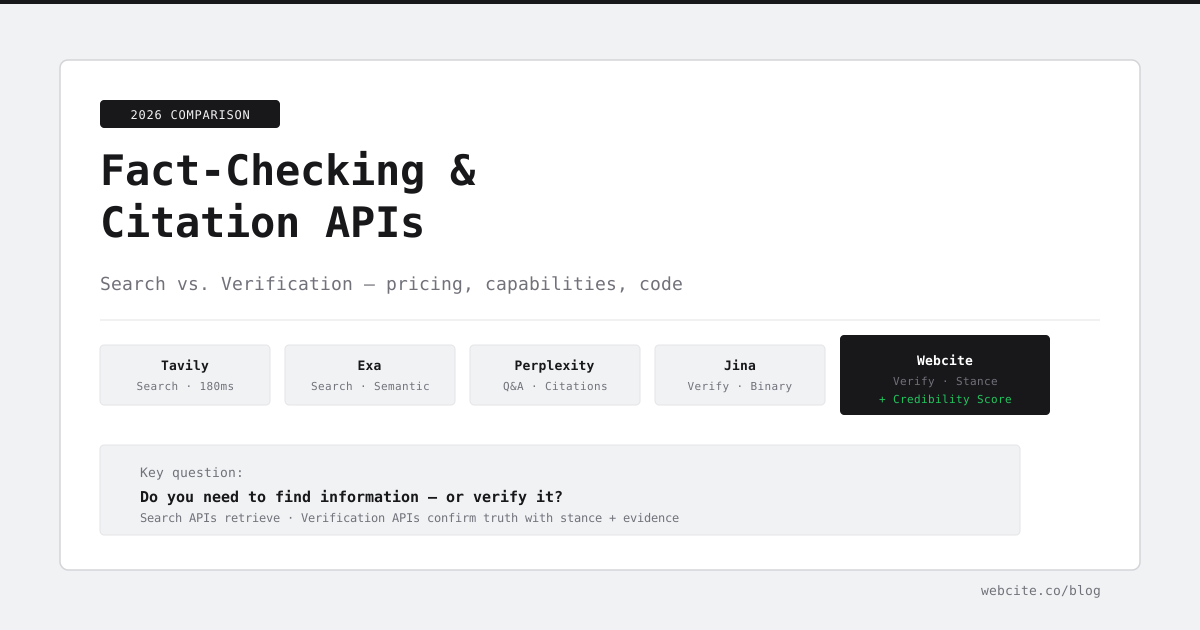
Five APIs dominate the citation and fact-checking space in 2026, according to G2 enterprise software reviews, 2026. Search APIs (Tavily, Exa, Perplexity) find information. Verification APIs (Jina, Webcite) confirm whether claims are true. This guide compares all five with real pricing, capabilities, and code examples.
- Tavily leads AI agent search with 180ms latency and $0.005/query pricing
- Exa excels at semantic discovery with 62% accuracy on company search benchmarks
- Jina offers cheap verifications at $0.006/statement but only binary true/false
- Webcite provides stance analysis and credibility scoring for $0.08-0.12/verification
Why This Comparison Matters
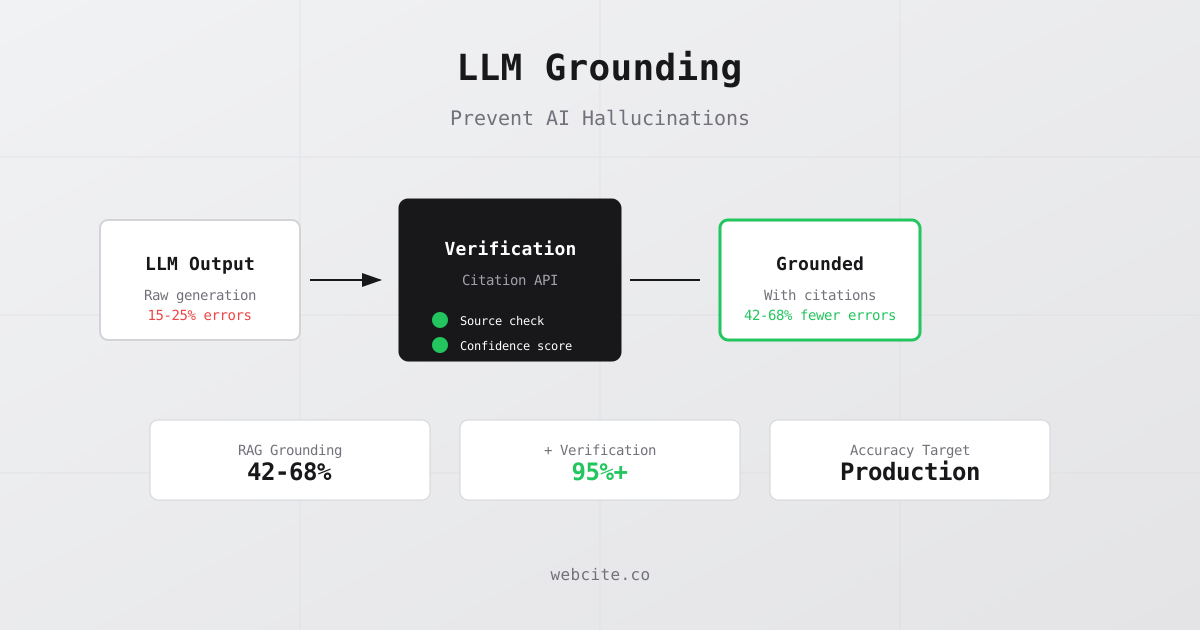
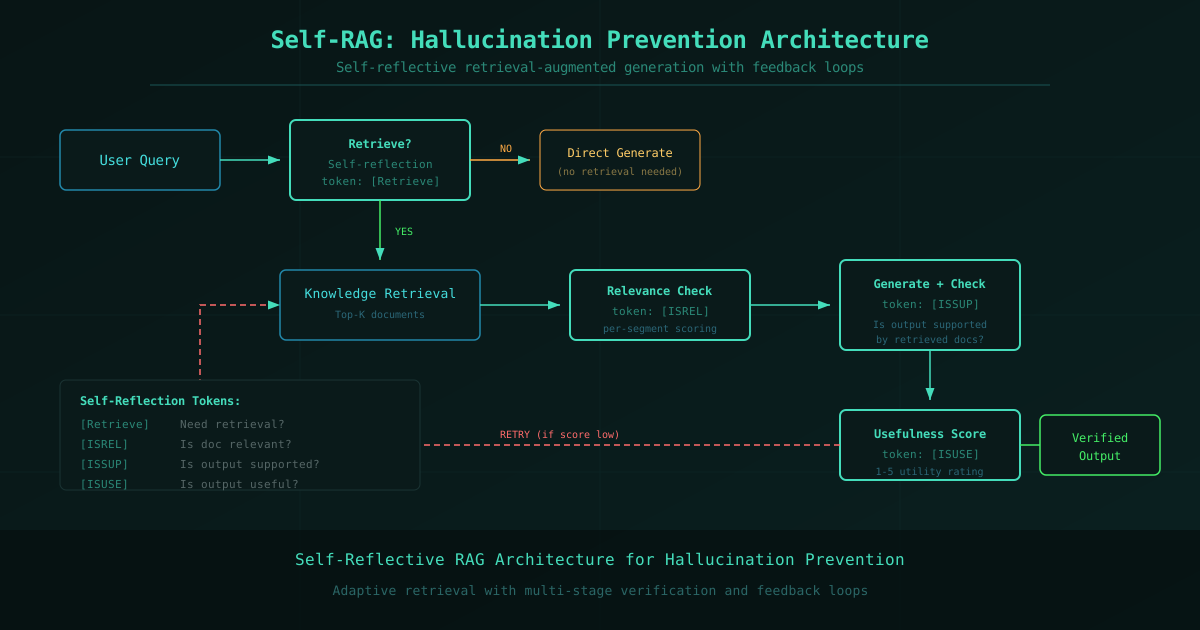
AI-generated content reached 90% of online content by 2025, according to Europol’s AI Threat Landscape Report, 2024. Most “grounded” or “fact-checked” AI products use search APIs and hope their LLM figures out the rest.
The fundamental difference:
- Search: “Find me sources about X”
- Verification: “Is this specific claim true, and what’s the evidence?”
LLMs hallucinate 3-27% of responses depending on domain, according to MIT CSAIL research, 2023. Citation APIs address this, but capabilities vary dramatically.
Overview Comparison
| Tavily | Exa | Perplexity | Jina | Webcite | |
|---|---|---|---|---|---|
| Category | Search | Search | Search + Q&A | Verification | Verification |
| Primary Use | AI Agents | Research | Conversational | Quick Checks | Deep Verification |
| Response Time | 180ms | 400ms | 500ms | 600ms | 800ms |
| Stance Analysis | No | No | No | No | Yes |
| Credibility Scoring | No | No | No | No | Yes |
| Verdict Generation | No | No | No | Binary | Nuanced |
| Free Tier | 1,000/mo | $10 credit | Limited | 1M tokens | 50 credits |
Search APIs
Search APIs excel at finding and retrieving information. Your application decides what to do with it.
Tavily
Website - Documentation - Pricing
The standard for AI agent search. Backed by a $25M Series A, according to TechCrunch, 2025. Tavily powers search for thousands of production AI applications including integrations with Databricks, IBM WatsonX, and JetBrains. They report 100M+ requests handled monthly, according to Tavily’s homepage, 2026.
Key Strengths
| Capability | Detail |
|---|---|
| Speed | 180ms p50 latency, fastest in market |
| Reliability | 99.99% uptime SLA |
| Scale | 100M+ requests handled monthly |
| Integrations | Native support for LangChain, LlamaIndex, and OpenAI function calling |
Pricing
| Plan | Credits/Month | Cost | Per Credit |
|---|---|---|---|
| Researcher | 1,000 | Free | N/A |
| Project | 4,000 | $30 | $0.0075 |
| Bootstrap | 15,000 | $100 | $0.0067 |
| Startup | 38,000 | $220 | $0.0058 |
| Growth | 100,000 | $500 | $0.005 |
Basic search = 1 credit. Advanced search = 2 credits. Research = 15-250 credits.
Implementation
from tavily import TavilyClient

client = TavilyClient(api_key="tvly-...")

results = client.search("transformer architecture improvements 2026")  # Basic search, 1 credit

results = client.search(
    "transformer architecture improvements 2026",
    search_depth="advanced",  # Advanced search with content extraction, 2 credits
    include_raw_content=True
)
What Tavily Returns
- Ranked search results
- Content snippets
- Relevance scores
What Tavily Does Not Do
- No stance classification (does this source support or contradict?)
- No credibility scoring (is this source trustworthy?)
- No verification verdict (is the claim true or false?)
- Your LLM must interpret and synthesize results
Ideal Use Cases
| Recommended | Not Recommended |
|---|---|
| AI agents with web access | Verifying specific claims |
| Sub-200ms response requirements | Stance classification needs |
| Production systems needing 99.99% uptime | Source credibility assessment |
| LangChain/LlamaIndex workflows | N/A |
Exa
Website - Documentation - Pricing
Neural search that understands meaning. Exa uses embeddings to find conceptually relevant content that keyword search misses.
Key Strengths
| Capability | Detail |
|---|---|
| Semantic Search | Embeddings-based, finds meaning not just keywords |
| Discovery | Surfaces niche sources invisible to traditional search |
| Enterprise | SOC 2 Type II, Zero Data Retention, SSO |
| Research API | Automated multi-step research workflows |
Benchmark Performance
Exa’s published benchmarks show significant accuracy advantages, according to Exa’s benchmark page, 2026:
| Task | Exa | Competitors |
|---|---|---|
| Company Search | 62% accuracy | 36-37% |
| People Search | 63% accuracy | 27-30% |
| Code Search | 73% accuracy | 65% |
Pricing
| Operation | Price per 1,000 |
|---|---|
| Search (1-25 results) | $5 |
| Search (26-100 results) | $25 |
| Deep Search | $15 |
| Contents (text extraction) | $1 |
| Answer | $5 |
$10 free credits to start. Enterprise discounts available.
Implementation
from exa_py import Exa

exa = Exa(api_key="...")

results = exa.search(  # Neural semantic search
    "companies building AI code review tools",
    type="neural",
    num_results=10
)

results = exa.search_and_contents(  # With content extraction
    "companies building AI code review tools",
    type="neural",
    text=True,
    highlights=True
)
What Exa Returns
- Semantically relevant results
- Full page content extraction
- Metadata (date, author, domain)
What Exa Does Not Do
- No fact-checking capability
- No stance analysis
- No credibility scoring
- Designed for discovery, not verification
Ideal Use Cases
| Recommended | Not Recommended |
|---|---|
| Company and people research | Verifying factual claims |
| Semantic understanding requirements | Stance classification |
| Enterprise compliance (SOC 2, SSO) | N/A |
| Finding sources that keyword search misses | N/A |
Perplexity
Website - Documentation - Pricing
Conversational search with citations. OpenAI-compatible API that answers questions with sources.
Key Strengths
| Capability | Detail |
|---|---|
| Conversational | Natural language in, structured answers out |
| Citations | Every response includes sources |
| OpenAI Compatible | Drop-in replacement for many use cases |
| Deep Research | Multi-step research with Sonar models |
Pricing
| API | Price |
|---|---|
| Search API | $5 per 1,000 requests |
| Sonar (input tokens) | $1-3 per 1M tokens |
| Sonar (output tokens) | $1-15 per 1M tokens |
| Web search tool | $0.005 per invocation |
| URL fetch tool | $0.0005 per invocation |
Additional context-size fees: $5-14 per 1,000 requests depending on search depth.
Implementation
from openai import OpenAI

client = OpenAI(  # OpenAI SDK works directly
    api_key="pplx-...",
    base_url="https://api.perplexity.ai"
)

response = client.chat.completions.create(
    model="sonar",
    messages=[{
        "role": "user",
        "content": "What are the key differences between GPT-4 and Claude 3?"
    }]
)

print(response.choices[0].message.content)  # Response includes inline citations
What Perplexity Returns
- Synthesized answers
- Source citations
- Conversational context
What Perplexity Does Not Do
- Generates answers, does not verify external claims
- Sources support the answer, do not validate user-submitted claims
- No stance analysis (support vs contradict)
- Designed for Q&A, not fact-checking
Ideal Use Cases
| Recommended | Not Recommended |
|---|---|
| Conversational interfaces | Verifying user-submitted claims |
| Research assistants with citations | Stance classification |
| OpenAI API compatibility requirements | N/A |
| Synthesized answers over raw results | N/A |
Verification APIs
Verification APIs analyze whether claims are true, with evidence.
Jina Grounding
Website - Grounding API - DeepSearch
Quick factuality checks. Takes a statement, returns true/false with references.
Key Strengths
| Capability | Detail |
|---|---|
| Factuality Score | 0-1 confidence rating per statement |
| Reference Quotes | Direct quotes from supporting sources |
| Accuracy | Higher F1 score than GPT-4 on fact-checking benchmarks |
| Price | Approximately $0.006 per statement |
Benchmark Performance
Jina’s grounding API outperforms major LLMs on fact-checking, according to Jina Research, 2024:
| Model | F1 Score |
|---|---|
| Jina Grounding | Highest |
| GPT-4 | Lower |
| Gemini 1.5 | Lower |
| o1-mini | Lower |
Implementation
curl -X POST https://g.jina.ai \
  -H "Authorization: Bearer jina_..." \
  -H "Content-Type: application/json" \
  -d '{"statement": "The Eiffel Tower was completed in 1889"}'
Response:
{
  "factuality": 0.95,
  "result": true,
  "reason": "Multiple authoritative sources confirm construction completed March 31, 1889",
  "references": [
    {
      "url": "https://toureiffel.paris/en/the-monument/history",
      "keyQuote": "The tower was completed on March 31, 1889",
      "isSupportive": true
    }
  ]
}
What Jina Returns
- Factuality score (0-1)
- Boolean result (true/false/unknown)
- Reference URLs with quotes
Limitations
| Limitation | Impact |
|---|---|
| Binary output only | No “partially true” or “mixed evidence” verdicts |
| No stance breakdown | Cannot see which sources disagree |
| No credibility scoring | All sources weighted equally |
| Single statements | Not designed for document-level verification |
Ideal Use Cases
| Recommended | Not Recommended |
|---|---|
| High-volume simple verifications | Claims with conflicting evidence |
| Content moderation flags | Understanding source reliability |
| Budget-conscious verification | Nuanced verdicts required |
| True/false is sufficient | Document-level verification |
Webcite
Website - API Documentation - Pricing
Deep verification with evidence analysis. Does not just check if claims are true, but explains why with stance classification and credibility scoring.
Capability Comparison
| Capability | Search APIs | Jina | Webcite |
|---|---|---|---|
| Find sources | Yes | Yes | Yes |
| Extract content | Yes | Yes | Yes |
| Stance per source | No | No | Yes |
| Credibility scores | No | No | Yes |
| Conflict handling | No | No | Yes |
| Nuanced verdicts | No | Binary | Yes |
| Methodology transparency | No | No | Yes |
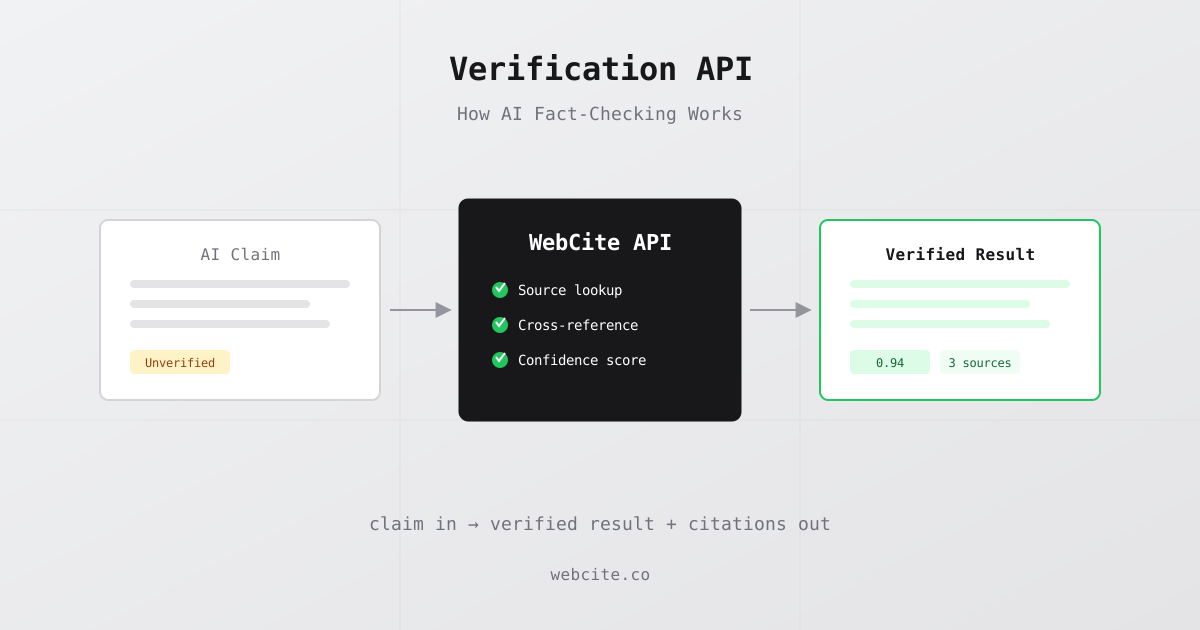
The Verification Pipeline
Step 1: Citation Search (2 credits)
- Search journals, news, government records
- Return sources with credibility scores
- Filter by relevance and authority
Step 2: Stance Analysis (1 credit)
- Classify each source: SUPPORTS or CONTRADICTS
- Extract relevant quotes
- Handle nuance (partial support, conditional claims)
Step 3: Verdict Generation (1 credit)
- Weigh evidence by source credibility
- Generate verdict: SUPPORTED / CONTRADICTED / MIXED / UNVERIFIABLE
- Provide methodology transparency
Pricing
| Plan | Credits | Price | Per Credit |
|---|---|---|---|
| Free | 50 | $0 | N/A |
| Builder | 500 | $20/mo | $0.04 |
| Builder overage | N/A | N/A | $0.05 |
| Enterprise | 10,000+ | Custom | Volume discount |
Credit costs:
- Citation search: 2 credits
- Stance analysis: 1 credit
- Verdict generation: 1 credit
- Full verification: 4 credits (approximately $0.08-0.12)
Skip steps you don’t need. Citations only? 2 credits.
Implementation
curl -X POST https://api.webcite.co/api/v1/verify \
  -H "x-api-key: webcite_..." \
  -H "Content-Type: application/json" \
  -d '{
    "claim": "Remote workers are more productive than office workers",
    "includeStance": true,
    "includeVerdict": true
  }'
Response:
{
  "claim": "Remote workers are more productive than office workers",
  "verdict": "mixed",
  "confidence": 0.58,
  "summary": "Evidence is divided. Stanford studies support the claim for certain roles; Microsoft data shows reduced collaboration.",
  "citations": [
    {
      "source": "Stanford Graduate School of Business",
      "url": "https://gsb.stanford.edu/faculty-research/...",
      "stance": "supports",
      "credibility": 0.94,
      "quote": "Work-from-home employees showed 13% performance increase..."
    },
    {
      "source": "Microsoft Research",
      "url": "https://microsoft.com/research/...",
      "stance": "contradicts",
      "credibility": 0.91,
      "quote": "Remote work led to more siloed collaboration networks..."
    }
  ],
  "methodology": {
    "sources_searched": 47,
    "sources_analyzed": 12,
    "supporting": 5,
    "contradicting": 4,
    "inconclusive": 3
  }
}
Enterprise Features
| Feature | Detail |
|---|---|
| Custom data sources | Google Drive, SharePoint, S3 integration |
| SSO/SAML | Enterprise authentication |
| Custom citation logic | Industry-specific verification rules |
| SLA | Dedicated support and uptime guarantees |
Ideal Use Cases
| Recommended | Not Recommended |
|---|---|
| Verifying citations in AI-generated content | Sub-200ms response requirements |
| Stance classification requirements | Simple true/false sufficient |
| Source credibility assessment | N/A |
| Claims with conflicting evidence | N/A |
| Audit trail requirements | N/A |
| Nuanced verdicts (mixed/unverifiable) | N/A |
Decision Framework
Do you need to find information or verify it?
If finding information:
- Speed critical? Use Tavily
- Semantic understanding? Use Exa
- Synthesized answers? Use Perplexity
If verifying information:
- Simple true/false sufficient? Use Jina
- Need stance analysis or credibility scoring? Use Webcite
- Evidence conflicts? Use Webcite
Practical Applications
AI Content Verification
Challenge: AI generates articles with citations. LLMs hallucinate 3-27% of responses, according to MIT CSAIL, 2023. Some citations are fabricated or misrepresented.
| Approach | Tool | Outcome |
|---|---|---|
| Search | Tavily, Exa | Find sources; LLM interprets |
| Basic verification | Jina | True/false per citation |
| Deep verification | Webcite | Stance classification, flag misrepresentations |
Content Moderation
Challenge: Flag potentially false claims at scale.
| Approach | Tool | Outcome |
|---|---|---|
| First pass | Jina | High-volume, low-cost screening |
| Deep review | Webcite | Detailed verification when flagged |
Enterprise Fact-Checking
Challenge: Verify claims in reports with audit trails.
| Approach | Tool | Outcome |
|---|---|---|
| Verification | Webcite | Stance analysis, credibility scores, methodology |
| Internal data | Webcite Enterprise | Custom data source integration |
Getting Started
| API | Best For | Free Tier |
|---|---|---|
| Tavily | Speed + AI agents | Researcher plan, free |
| Exa | Semantic discovery | $10 free credit |
| Perplexity | Conversational Q&A | API access |
| Jina | Quick fact-checks | 1M free tokens |
| Webcite | Deep verification | 50 free credits |
Frequently Asked Questions
What is the difference between search APIs and verification APIs?
Search APIs like Tavily and Exa find and retrieve information based on queries. They return relevant sources but do not determine whether claims are true or false. Verification APIs like Webcite and Jina analyze specific claims against evidence and return verdicts with supporting citations.
Which API is fastest for AI agent search?
Tavily leads with 180ms p50 latency and 99.99% uptime SLA. This makes it the standard choice for production AI agents that need real-time web access without slowing down response times.
What is stance analysis in fact-checking?
Stance analysis classifies whether each source supports or contradicts a specific claim. Webcite is the only API in this comparison that provides per-source stance classification. Other APIs return sources without indicating agreement or disagreement.
How much does citation verification cost?
Costs vary significantly. Jina offers the cheapest per-statement checks at approximately $0.006. Webcite’s full verification pipeline (search, stance, verdict) costs $0.08-0.12 per claim. Search APIs like Tavily range from $0.005-0.0075 per query depending on plan.
Building something that requires verified facts? Start with 50 free credits, no credit card required. Questions about your specific use case? Contact us.