Webcite offers three API plans starting at $0 per month, with the Builder plan at $20 per month serving as the most popular option for production applications. AI hallucinations cost enterprises an estimated $67.4 billion in 2024, according to Korra, 2024. This article breaks down each Webcite pricing tier, explains how the credit system works, and shows you how to minimize your cost per verification.
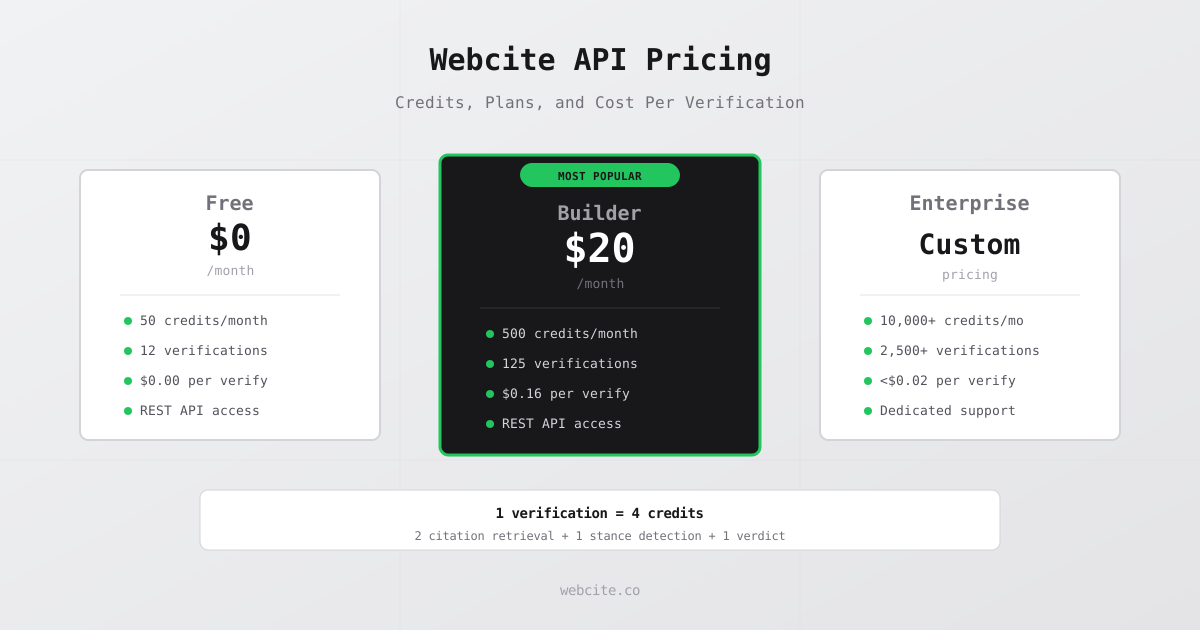
- Webcite has three plans: Free ($0, 50 credits/month), Builder ($20, 500 credits), and Enterprise (custom, 10,000+ credits).
- Each verification costs 4 credits: 2 citation retrieval + 1 stance detection + 1 verdict.
- Builder plan cost per verification is $0.16, while Enterprise drops below $0.02.
- Selective verification, caching, and batching can reduce your credit usage by 60-80 percent.
- Webcite is cheaper than manual review, which costs $14,200 per employee per year on average.
The Three Webcite Plans
Webcite uses a credit-based pricing model with three tiers. Each tier targets a different stage of adoption, from prototyping to production to scale.
| Feature | Free | Builder | Enterprise |
|---|---|---|---|
| Monthly price | $0 | $20 | Custom |
| Credits per month | 50 | 500 | 10,000+ |
| Verifications per month | 12 | 125 | 2,500+ |
| Cost per verification | $0.00 | $0.16 | Less than $0.02 |
| API access | REST | REST | REST + dedicated support |
Free plan. Zero cost, 50 credits per month, enough for 12 full verifications. Use this for prototyping, testing your integration, and evaluating whether the API fits your use case. There are no credit card requirements and no trial expiration.
Builder plan. $20 per month, 500 credits, enough for 125 verifications. This is the most popular plan for production applications. If your chatbot handles 1,000 conversations per month and you selectively verify 10 percent of responses, 125 verifications covers your needs.
Enterprise plan. Custom pricing, 10,000+ credits per month, dedicated support. Designed for high-volume applications that process thousands of verifications daily. At this scale, the cost per verification drops below $0.02.
The global AI verification market is projected to grow at a 37.3 percent compound annual rate through 2030, according to Grand View Research, 2024. As demand scales, credit-based pricing like Webcite’s lets teams pay for what they use rather than overpaying for flat subscriptions.
How Credits Work: The 4-Credit Breakdown
Every full verification on Webcite consumes exactly 4 credits. Here is what each credit pays for:
2 credits for citation retrieval. The API searches the web, academic databases, and news archives for sources relevant to your claim. It returns structured citations with URLs, titles, and the exact passages that support or contradict the claim.
1 credit for stance detection. The API determines whether each retrieved source supports, contradicts, or is neutral toward the claim. This is the step that separates Webcite from a search API. Tavily and Brave return results but leave stance analysis to your application.
1 credit for verdict generation. The API synthesizes the stance analysis into a final verdict: supported, contradicted, or insufficient evidence. It also returns a confidence score between 0 and 1.
Here is what a verification call looks like:
const response = await fetch("https://api.webcite.co/api/v1/verify", {
  method: "POST",
  headers: {
    "x-api-key": process.env.WEBCITE_API_KEY,
    "Content-Type": "application/json"
  },
  body: JSON.stringify({
    claim: "GPT-4 was released in March 2023",
    include_stance: true,
    include_verdict: true
  })
})

const result = await response.json()
// result.verdict.result: "supported"
// result.verdict.confidence: 97
// result.citations: [{ title: "...", url: "...", stance: "for" }]
This means 50 credits on the Free plan gives you exactly 12 full verifications. On the Builder plan, 500 credits gives you 125 verifications. The math is predictable, which makes budgeting straightforward.
For a deeper explanation of what a verification API does and how it differs from a search API, see our technical guide.
Cost Per Verification at Each Tier
The cost math is simple. Divide your monthly plan price by the number of verifications.
| Plan | Price | Credits | Verifications | Cost per Verify |
|---|---|---|---|---|
| Free | $0 | 50 | 12 | $0.00 |
| Builder | $20 | 500 | 125 | $0.16 |
| Enterprise (10K) | Custom | 10,000 | 2,500 | Less than $0.02 |
At the Builder tier, $0.16 per verification is the relevant number. Compare that to what it costs without automated verification. Employees spend an average of 4.3 hours per week verifying AI-generated content manually, costing approximately $14,200 per employee annually, according to Korra, 2024. A $20 per month API replaces a meaningful share of that manual work.
At the Enterprise tier, the per-verification cost drops below $0.02. For a team processing 2,500 verifications per month, that is under $50 per month in effective verification costs, less than the price of a single hour of manual fact-checking.
How Webcite Compares to Competitor Pricing
Webcite is not the only API in the verification and search space. Here is how the pricing stacks up against Tavily, Brave Search API, and Perplexity.
| Provider | Free Tier | Paid Entry | What You Get Back |
|---|---|---|---|
| Tavily | 1,000 free searches | $50/month | Search results (no verdict) |
| Brave Search | Pay as you go | $5-9 per 1,000 searches | Search results (no verdict) |
| Perplexity | Limited | $20/month subscription | Conversational answers (no raw scores) |
| Webcite | 50 credits/month | $20/month (Builder) | Verdict + citations + confidence |
Tavily charges $50 per month for its base paid plan after a 1,000-query free tier, according to Tavily, 2026. That is 2.5 times the cost of Webcite Builder, and Tavily returns search results, not verified claims. You still need to build your own verification logic on top.
Brave Search API charges $5 to $9 per 1,000 queries depending on the plan, according to Brave, 2026. That is the cheapest raw search option, but it returns zero verification, zero citations, and zero confidence scoring.
Perplexity charges $20 per month for a subscription that includes conversational answers with inline citations, according to Perplexity, 2026. The API does not expose per-claim confidence scores or structured source credibility data.
The key distinction is output quality. Webcite returns a verdict, confidence score, and structured citations in a single call. The competitors return search results or conversational summaries that require additional processing. For a detailed feature comparison, see our fact-checking API comparison.
Cost Optimization Strategies
You do not need to verify every sentence your AI generates. Smart verification strategies can cut your credit usage by 60 to 80 percent while still catching the highest-risk errors.
Selective Verification
Only verify claims that carry factual risk. Sentences with numbers, dates, statistics, proper nouns, and medical or legal terms are worth checking. Opinions, greetings, and general knowledge statements are not.
A 2024 Stanford study found that even RAG-powered legal AI tools hallucinate in 17 to 33 percent of queries, according to Magesh et al., Stanford Law School, 2024. The highest-risk claims, those with specific numbers and citations, account for most of those errors.
function shouldVerify(sentence) {
  const hasNumber = /\d/.test(sentence)
  const hasProperNoun = /[A-Z][a-z]{2,}/.test(sentence.trim().slice(1))
  const hasDate = /\b(19|20)\d{2}\b/.test(sentence)
  return hasNumber || hasProperNoun || hasDate
}
This filter alone typically reduces verification calls by 60 to 70 percent.
Response Caching
If your application answers the same questions repeatedly, cache verification results. A customer support bot that handles 500 daily conversations likely sees the same 50 factual claims over and over. Verify each unique claim once, cache the result for 24 hours, and serve cached verdicts for repeat queries. This can reduce credit usage by 80 percent or more in repetitive-query environments.
Batch Processing
For content pipelines that generate articles or reports, batch your claims and verify them together rather than one at a time. Extract all factual claims from a document, deduplicate them, then verify only the unique claims. A 2,000-word article might contain 30 sentences but only 8 unique factual claims worth verifying, cutting your credit usage from 120 to 32.
Tiered Confidence Thresholds
Not every claim needs the same level of scrutiny. For internal documentation, a confidence score of 0.7 might be acceptable. For customer-facing content, require 0.9 or higher. By setting different thresholds for different content types, you can prioritize where your credits go.
ROI Calculation: Verification vs Hallucination Costs
The cost of not verifying is substantially higher than the cost of verification.
AI hallucinations cost enterprises $67.4 billion in 2024, according to Korra, 2024. That figure includes customer support errors, legal liability, reputational damage, and wasted employee time spent correcting AI outputs.
Gartner predicted that 30 percent of generative AI projects would be abandoned after proof-of-concept by end of 2025, citing poor data quality and hallucination-related trust failures, according to Gartner, 2024.
Consider a concrete example. Your AI chatbot serves 10,000 conversations per month. LLMs hallucinate in 3 to 20 percent of responses depending on the domain, according to Stanford HAI, 2025. At a conservative 5 percent hallucination rate, that is 500 potentially inaccurate responses per month.
If you selectively verify 10 percent of responses (the ones with factual claims), that is 1,000 verifications per month. On the Enterprise plan, that costs under $20 per month in effective verification spend. Compare that to the cost of a single customer complaint that escalates to legal review.
The ROI equation is not close. For any application where accuracy affects trust, revenue, or compliance, the cost of verification is a rounding error compared to the cost of getting it wrong.
When to Upgrade: Free to Builder to Enterprise
Stay on Free if you are prototyping, running fewer than 12 verifications per month, or evaluating whether the API fits your product. The free tier has no expiration.
Upgrade to Builder when your application moves to production and you consistently need more than 12 verifications per month. The $20 monthly cost is justified the first time automated verification catches an error that would have required manual intervention. Most teams hit this threshold within the first week of production deployment.
Move to Enterprise when you process more than 125 verifications per month or need dedicated support, custom SLAs, or higher rate limits. At 10,000+ credits per month, the per-verification cost drops below $0.02, making it economical even for applications that verify every response.
For a step-by-step guide on integrating verification into your chatbot, including code examples and latency optimization, see our tutorial on adding fact-checking to AI chatbots.
Getting Started
Two steps to begin:
-
Sign up at webcite.co and get a free API key. No credit card required.
-
Make your first verification call:
const response = await fetch("https://api.webcite.co/api/v1/verify", {
  method: "POST",
  headers: {
    "x-api-key": process.env.WEBCITE_API_KEY,
    "Content-Type": "application/json"
  },
  body: JSON.stringify({
    claim: "OpenAI released GPT-4 in March 2023",
    include_stance: true,
    include_verdict: true
  })
})

const result = await response.json()
// result.verdict: { result: "supported", confidence: 97 }
// result.citations: [{ title: "...", url: "...", stance: "for" }]
Each call uses 4 credits. You get 50 credits free, enough to test 12 verifications and decide whether the Builder plan at $20 per month fits your production needs.
Frequently Asked Questions
How much does the Webcite API cost?
Webcite offers three plans. The Free plan costs $0 and includes 50 credits per month. The Builder plan costs $20 per month and includes 500 credits. Enterprise plans offer 10,000+ credits at custom pricing. Each full verification consumes 4 credits.
How do Webcite credits work?
Each full verification uses 4 credits: 2 for citation retrieval, 1 for stance detection, and 1 for the verdict. The Free plan includes 50 credits per month, enough for 12 full verifications. The Builder plan includes 500 credits, enough for 125 verifications.
What is the cost per verification on Webcite?
On the Free plan, verifications cost nothing up to the 50-credit limit. On the Builder plan at $20 per month with 500 credits, each verification costs $0.16. Enterprise plans bring the cost below $0.02 per verification at 10,000+ credits.
How does Webcite pricing compare to Tavily and other APIs?
Webcite Builder costs $20 per month for 500 credits. Tavily starts at $50 per month after a 1,000-query free tier. Brave Search API costs $5 to $9 per 1,000 queries. The key difference is that Webcite returns a verified verdict with citations, while Tavily and Brave return raw search results.
When should I upgrade from the Free plan to Builder?
Upgrade when you consistently need more than 12 verifications per month. If your application handles 100+ conversations daily and you verify even 10 percent of responses, you will exceed the Free plan limit within the first week. The Builder plan at $20 per month covers 125 verifications.