Only 13% of enterprises have achieved company-wide AI impact, according to BCG, 2025. That leaves 87% of organizations spending more on AI every year while struggling to prove returns. The gap between investment and impact is not a technology problem; it is a reliability problem. This article examines why AI output reliability is the single largest determinant of enterprise ROI, what the numbers actually show, and how verification layers close the gap between pilot success and production value.
- Only 13% of enterprises achieve full-scale AI impact; the rest stall at pilot or limited deployment stages.
- 72% of enterprises plan bigger AI budgets in 2026, yet just 5% of GenAI initiatives deliver measurable financial returns.
- 35% of executives cite reliability and inaccurate output as their primary concern with generative AI.
- GenAI delivers a 3.7x average ROI, but the median company captures far less due to scaling failures.
- Verification layers that check AI output against external sources reduce error rates and rebuild the trust required for scaling.
How Much Are Enterprises Spending on AI in 2026?
The spending numbers are staggering. Worldwide AI spending is projected to total $2.5 trillion in 2026, according to Gartner, 2026. The AI software market alone is racing toward $71 billion, according to IDC, 2025. Enterprise AI budgets grew 72% year-over-year in 2025, and 78% of organizations now use generative AI in at least one business function, up from 65% just twelve months earlier, according to McKinsey, 2025.
The investment acceleration is rational. AI automates knowledge work, accelerates decision-making, and creates new product capabilities. Microsoft reported that GitHub Copilot users complete tasks 55% faster, according to Microsoft Research, 2024. McKinsey estimates that generative AI could add $2.6 to $4.4 trillion in annual value across industries.
But spending is not the same as returns. The uncomfortable reality is that most of this money is not generating proportional value, and the reason traces back to one root cause.
Why Only 13% of Companies See Enterprise-Wide AI Impact
BCG surveyed over 1,800 executives across 19 industries and 100 countries in 2025. The findings revealed a stark divide. Only 13% of companies have deployed AI initiatives that deliver impact across the entire organization, according to BCG, 2025. Another 53% are stuck in “pilot purgatory,” running small experiments that never scale. The remaining 34% have limited deployments that generate value in isolated pockets but fail to transform operations.
The pattern repeats across every major survey. Rand Corporation found that fewer than 5% of generative AI initiatives deliver measurable financial returns, according to RAND, 2025. Gartner predicted that over 40% of agentic AI projects will be canceled by end of 2027 if governance and ROI clarity are not established, according to Gartner, 2025.
What separates the 13% from the 87%? Three factors appear consistently:
- The successful companies treat AI reliability as a first-class engineering concern, not an afterthought.
- They invest in output validation infrastructure before scaling beyond pilots.
- They measure and report AI accuracy metrics alongside productivity metrics.
The common thread is trust. Executives, employees, and customers need to trust that AI output is accurate before they will rely on it for consequential decisions. Without trust, adoption stalls. Without adoption, ROI never materializes.
What Does 35% Citing Reliability as the Primary Concern Actually Mean?
Reliability is the most cited barrier to enterprise AI adoption. In the BCG survey, 35% of executives named reliability and inaccurate output as their primary concern with generative AI, ahead of data privacy (28%), security (22%), and cost (15%), according to BCG, 2025.
This concern is grounded in measurable failure rates. General-purpose LLMs exhibit hallucination rates ranging from 0.7% for GPT-4o to 8.4% for older models on general knowledge tasks, according to Visual Capitalist, 2025. Those rates seem small in isolation. At enterprise scale, they are devastating.
Consider a company using AI to generate 2,000 customer-facing responses per day. Even at a 2% hallucination rate, that produces 40 factually incorrect responses daily, 1,200 per month, 14,600 per year. Each incorrect response risks customer complaints, support escalations, brand damage, and in regulated industries, legal liability. Air Canada’s chatbot invented a bereavement fare policy that the airline was forced to honor by a Canadian tribunal, according to CBC News, 2024.
The financial cost of AI hallucinations across enterprises reached an estimated $67.4 billion in 2024, according to Korra, 2024. That figure includes direct error correction, customer compensation, legal exposure, and the productivity lost when employees spend time verifying AI output instead of using it.
Employees already feel the burden. Workers spend an average of 4.3 hours per week manually verifying AI-generated content, costing approximately $14,200 per employee annually, according to Korra, 2024. When the cost of verifying AI output approaches or exceeds the cost savings the AI delivers, ROI collapses.
How Does the 3.7x ROI Figure Break Down?
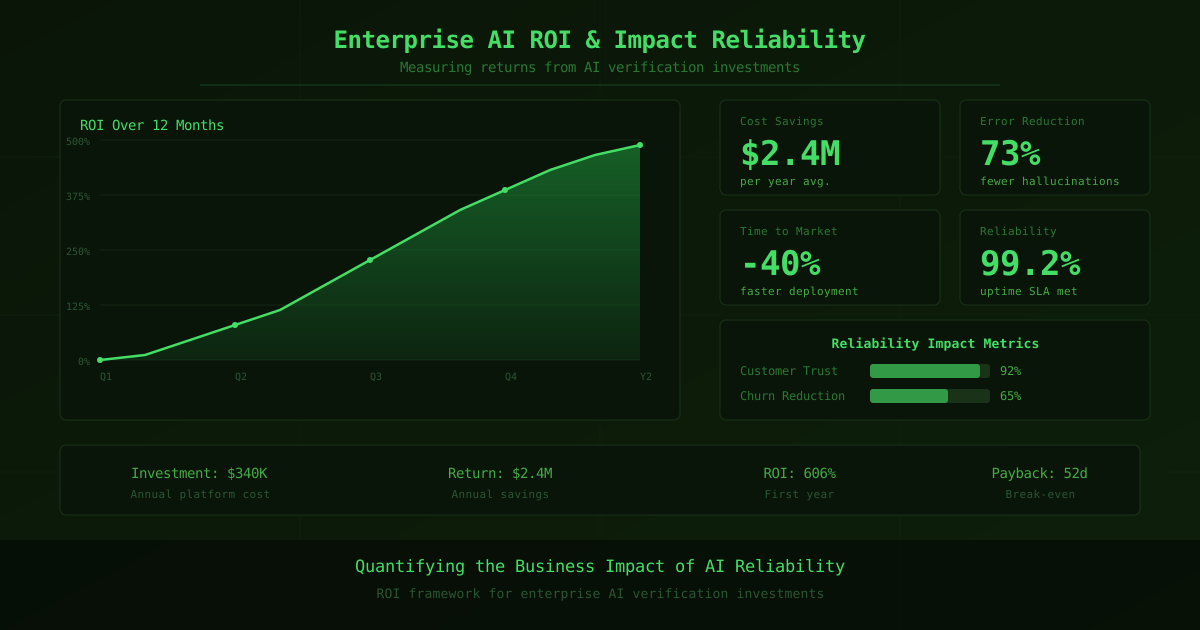
BCG reported that generative AI delivers a 3.7x ROI on average, according to BCG, 2025. That headline number requires context. It is a mean, not a median. The distribution is heavily skewed: a small number of high-performing companies pull the average up while the majority see far lower returns.
The 13% of companies achieving company-wide impact report ROI multiples of 5x to 10x. They deploy AI across customer service, content generation, code development, data analysis, and internal operations. Their AI systems handle high-volume, high-frequency tasks with output validation built into the pipeline.
The remaining 87% cluster around 1x to 2x returns, and many report negative ROI when fully accounting for infrastructure costs, talent, and the hidden labor of error correction. The RAND analysis found that most GenAI initiatives “consume more resources in overhead, management, and error correction than they save in productivity,” according to RAND, 2025.
The gap is not about which model companies use. OpenAI GPT-4o, Anthropic Claude 3.5 Sonnet, Google Gemini 1.5 Pro, and Meta Llama 3.1 all achieve similar accuracy on standardized benchmarks. The gap is about what happens after the model generates output: whether that output passes through validation, verification, and quality control before it reaches production.
What Is the Reliability Gap and Why Does It Destroy ROI?
The reliability gap is the distance between what an AI model can produce in a controlled demo and what it consistently produces at scale in production. Every enterprise AI team has experienced this gap. The demo works perfectly. The pilot shows promising results. Then production traffic exposes edge cases, ambiguous inputs, domain-specific queries, and temporal knowledge gaps that the model handles inconsistently.
Three mechanisms cause the reliability gap to destroy ROI:
First, error correction costs scale linearly with output volume. If 3% of outputs require human review and correction, scaling from 100 outputs per day to 10,000 outputs per day means scaling the review team from 3 corrections to 300 corrections daily. The human labor cost rises proportionally, but the AI cost savings were supposed to be the opposite: more output with the same team.
Second, trust erosion is nonlinear. One high-profile error, a wrong financial figure in a client report, an incorrect medical claim in a patient-facing system, a fabricated legal citation in a compliance document, can destroy months of accumulated trust. Stanford researchers found that AI legal tools hallucinate in 17% to 33% of queries, according to Magesh et al., Stanford Law School, 2024. After a trust-breaking incident, users revert to manual processes and the AI investment sits idle.
Third, pilot-to-production failure creates organizational skepticism. When the first two AI projects fail to deliver promised ROI, securing budget and executive support for the third becomes exponentially harder. Gartner’s prediction that 50% of GenAI projects would be abandoned after proof of concept by end of 2025 reflects this pattern, according to Gartner, 2024.
The reliability gap is not an inherent limitation of AI models. It is an infrastructure gap. Organizations that close it, with verification layers, confidence thresholds, and automated quality control, are the ones that reach the 13%.
How Do Verification Layers Bridge the Reliability Gap?
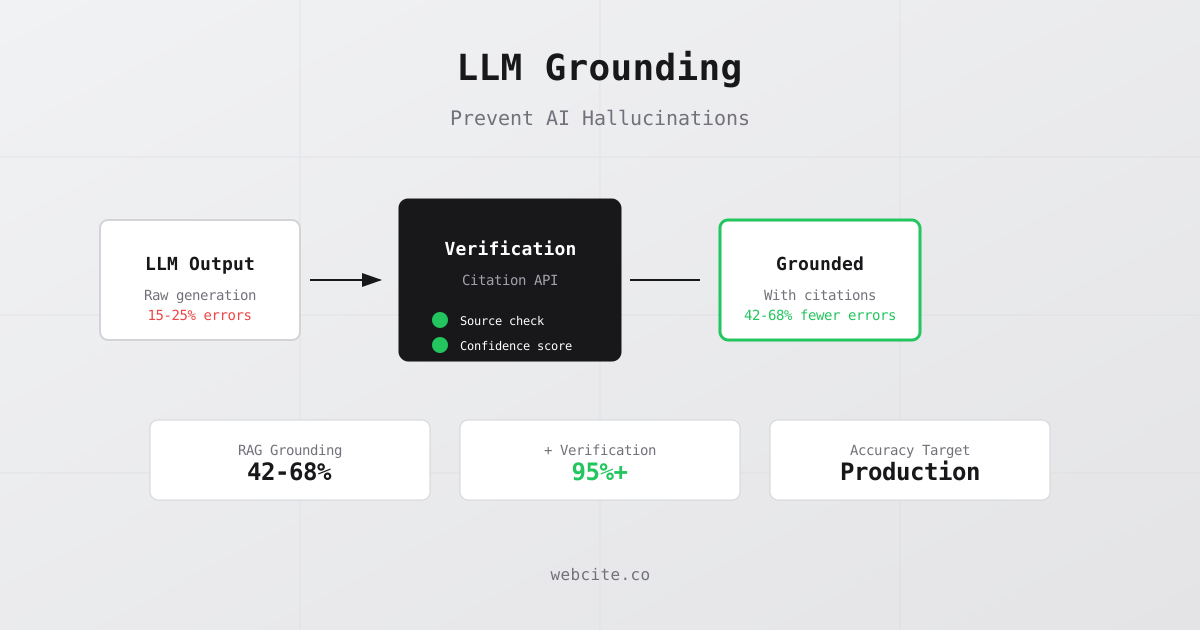
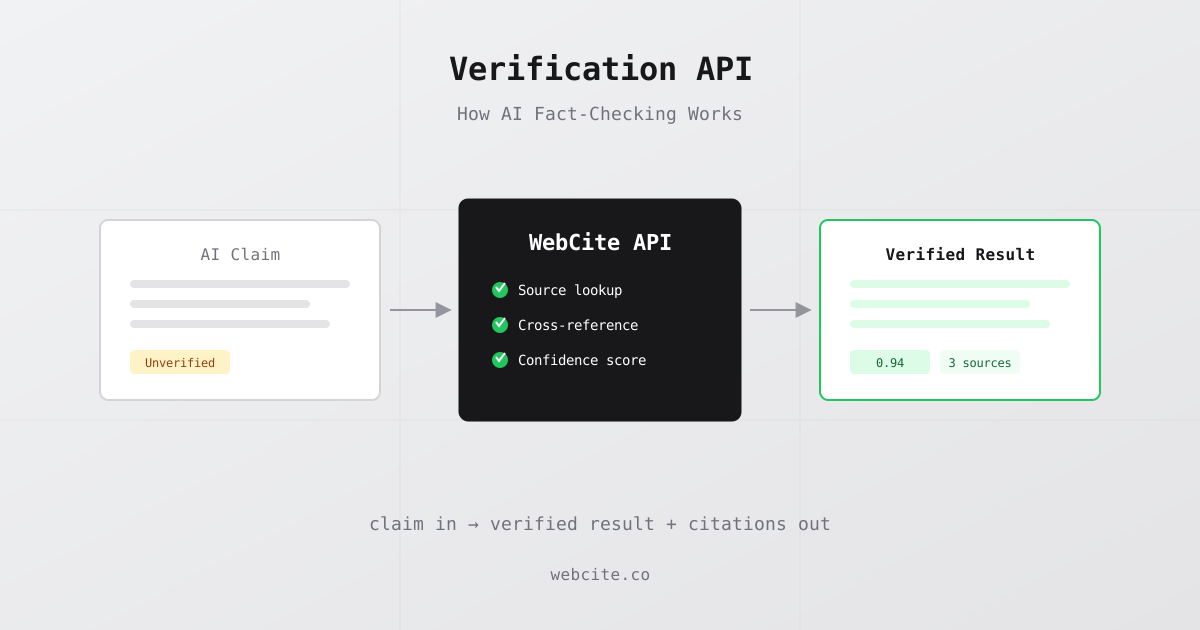
A verification layer sits between AI output generation and production delivery. It checks each factual claim in the AI-generated content against external sources and returns a verdict (supported, refuted, or insufficient evidence), a confidence score, and citations. Claims below a configurable confidence threshold are flagged for human review or automatically removed.
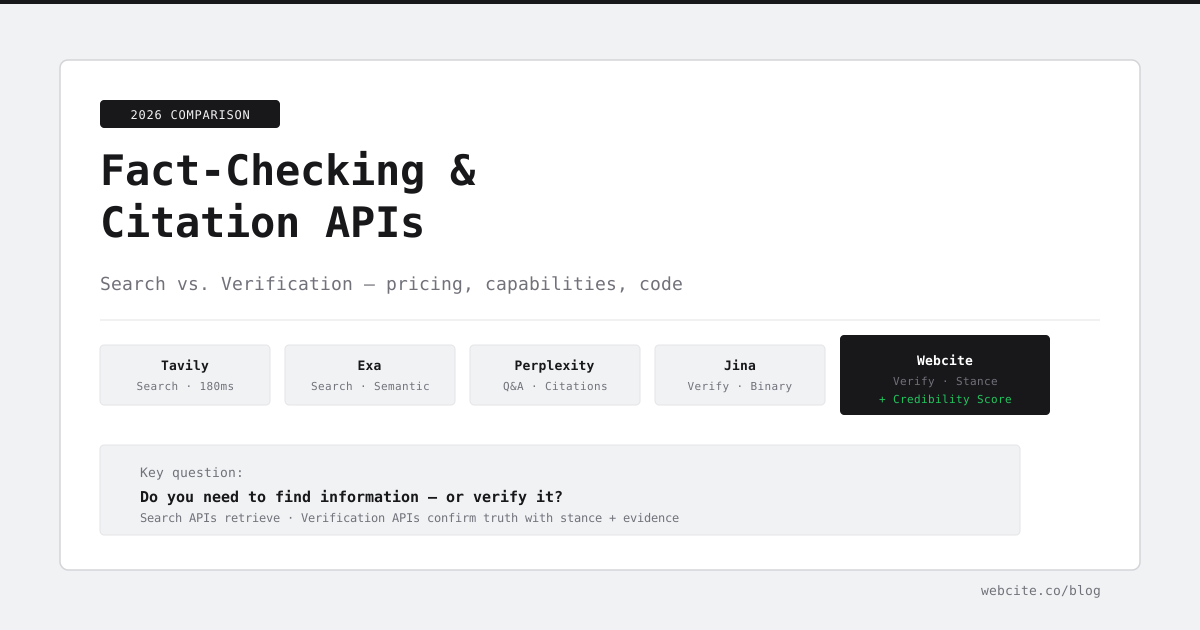
This is different from prompt engineering, which tries to prevent errors at generation time. It is different from guardrails, which filter for safety and toxicity. It is different from observability, which monitors model behavior patterns. Verification answers a specific question: “Is this claim factually accurate?”
Here is how a verification call works with the Webcite API:
import requests

def verify_claim(claim):
    response = requests.post(
        "https://api.webcite.co/api/v1/verify",
        headers={
            "x-api-key": "your-api-key",
            "Content-Type": "application/json"
        },
        json={
            "claim": claim,
            "include_stance": True,
            "include_verdict": True
        }
    )
    return response.json()

result = verify_claim("Global AI spending will reach $2.5 trillion in 2026")
print(result["verdict"]["result"])    # "supported"
print(result["verdict"]["confidence"])  # 94
print(result["citations"])  # [{"title": "Gartner, 2026", "url": "...", "snippet": "..."}]
The ROI impact of verification is straightforward to calculate. If your AI system produces 2,000 outputs per day with a 3% error rate, that is 60 errors daily. If each error costs $50 in correction labor and risk exposure, the daily cost of unreliable output is $3,000, or $1.1 million annually. A verification layer that catches 80% of those errors reduces the annual cost to $219,000, saving $876,000. At Webcite Builder pricing ($20/month for 500 credits), the verification cost is negligible compared to the savings.
For a deeper look at how verification fits into enterprise AI pipelines, see our guide on building a citation pipeline for AI-generated content.
What Separates the 13% from the 87%?
The companies achieving organization-wide AI impact share five operational patterns that the remaining 87% lack:
-
They validate before they scale. Every AI output pipeline includes automated accuracy checks before reaching production. They treat verification as infrastructure, not as an optional quality step.
-
They measure accuracy alongside productivity. Dashboards track not just “how many outputs did AI generate” but “how many of those outputs were accurate.” This prevents the trap of celebrating volume while ignoring quality.
-
They set explicit confidence thresholds by use case. Customer-facing financial content might require 95% confidence. Internal summaries might accept 80%. These thresholds are configured, not assumed.
-
They build feedback loops. When verification catches an error, the error type, context, and model input are logged and fed back into prompt refinement and system improvement cycles.
-
They invest in AI infrastructure teams. The 13% have dedicated teams responsible for AI reliability, distinct from the data science teams that build models. Menlo Ventures found that 76% of enterprise AI use cases are now purchased rather than built, according to Menlo Ventures, 2025. Even companies that buy AI tools need internal teams to validate outputs.
The common denominator is treating reliability as a first-class concern with dedicated tooling, measurement, and accountability. Our overview of AI trust frameworks covers the governance structures that support this approach.
How to Start Closing the Reliability Gap
The path from the 87% to the 13% does not require a massive infrastructure overhaul. It starts with three concrete steps.
First, baseline your current error rate. Run 500 to 1,000 AI outputs through manual review. Categorize errors by type (factual hallucination, outdated information, unsupported claim, logical error). This gives you a number to improve against. Our AI hallucination statistics article provides industry benchmarks for comparison.
Second, add a verification layer to your highest-value AI pipeline. Pick the one use case where AI errors cost the most, whether that is customer communications, research reports, or content generation, and integrate a verification API. Webcite’s free tier includes 50 credits per month ($0), enough for testing. The Builder plan at $20 per month provides 500 credits for 125 verifications. Enterprise plans start at 10,000+ credits with custom pricing.
Third, measure the ROI delta. Compare error rates, correction costs, and user trust metrics before and after adding verification. The 13% of successful companies did not get there by hoping AI would be accurate; they got there by measuring and proving it.
const response = await fetch("https://api.webcite.co/api/v1/verify", {
  method: "POST",
  headers: {
    "x-api-key": process.env.WEBCITE_API_KEY,
    "Content-Type": "application/json"
  },
  body: JSON.stringify({
    claim: "Only 13% of enterprises achieve enterprise-wide AI impact",
    include_stance: true,
    include_verdict: true
  })
})

const result = await response.json()
// result.verdict.result: "supported"
// result.verdict.confidence: 91
// result.citations: [{ title: "BCG, 2025", url: "...", snippet: "..." }]
The math is clear: $2.5 trillion in global AI spending, $67.4 billion in hallucination costs, and only 13% of companies seeing broad organizational returns. The difference between the companies that capture AI ROI and those that don’t is not the model they chose. It is whether they verified the output.
Frequently Asked Questions
What percentage of enterprises achieve full AI ROI?
Only 13% of enterprises have achieved enterprise-wide AI impact, according to BCG, 2025. The remaining 87% are stuck in pilot programs, limited deployments, or abandoned projects, largely because output reliability issues erode trust before scaling can begin.
Why does AI reliability affect ROI more than model capability?
A model that is 95% accurate still produces errors in 1 out of every 20 outputs. At enterprise scale, thousands of daily outputs generate hundreds of errors that require human review, correction, and rework. The labor cost of managing unreliable output often exceeds the productivity gains the AI was supposed to deliver.
How much are enterprises spending on AI in 2026?
Global AI spending is projected to reach $2.5 trillion in 2026, according to Gartner, 2026. Enterprise AI budgets are growing 72% year-over-year, with the majority allocated to generative AI initiatives, infrastructure, and talent.
What is a verification layer in enterprise AI?
A verification layer is a post-generation step that checks AI outputs against external sources before they reach end users. It returns a verdict (supported, refuted, or insufficient evidence), a confidence score, and citations. This catches factual errors that internal guardrails and prompt engineering cannot detect.
How does Webcite help improve enterprise AI ROI?
Webcite provides a REST API that verifies factual claims in AI-generated content against real-world sources. Each verification returns a confidence score and citations. By catching errors before they reach production, it reduces rework costs and builds the trust needed to scale AI from pilot to full organizational deployment.
What is the average ROI multiplier for generative AI projects?
BCG found that generative AI delivers a 3.7x ROI on average across surveyed enterprises. However, that average masks extreme variance: the top 13% of companies capture most of the value, while the majority see returns well below the mean due to scaling and reliability challenges.