NIST published its AI Risk Management Framework in January 2023, and within 18 months over 600 organizations had adopted some version of structured AI governance, according to NIST, 2024. The reason is simple: enterprises deploying AI at scale need a systematic way to validate outputs, manage risk, and prove compliance. This article explains what an AI trust framework is, how the major standards (NIST AI RMF, ISO/IEC 42001, EU AI Act) intersect, and how verification APIs fit into the enterprise validation stack.
- An AI trust framework combines governance, monitoring, guardrails, and output verification into a single validation stack.
- NIST AI RMF organizes risk management into 4 functions: Govern, Map, Measure, and Manage.
- The EU AI Act's full risk classification and transparency requirements take effect on 2 August 2026.
- 85% of enterprise AI projects fail to move from pilot to production, often due to trust and governance gaps.
- Verification APIs provide the output validation layer that closes the gap between governance policy and provable accuracy.
What Is an AI Trust Framework?
An AI trust framework is an organization’s end-to-end system for ensuring AI outputs are accurate, safe, and compliant with internal policies and external regulations. It is not a single tool or standard. It is a layered architecture where each layer addresses a different category of AI risk.
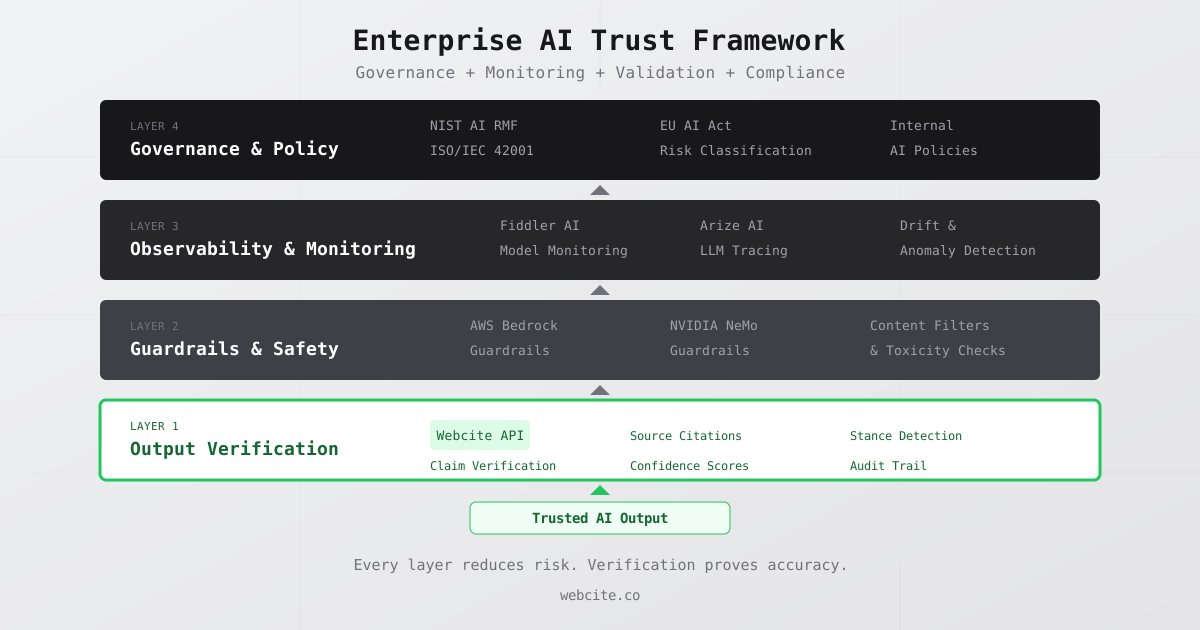
The four layers work together:
Layer 1: Governance and Policy. This is where the rules are set. Which AI models can be used? What data can they access? Who approves new AI deployments? Standards like the NIST AI Risk Management Framework and ISO/IEC 42001 define how to structure these policies. McKinsey’s 2024 Global AI Survey found that only 21 percent of organizations have established AI governance policies covering all relevant risk dimensions, according to McKinsey, 2024.
Layer 2: Observability and Monitoring. Once AI is deployed, you need to watch it. Platforms like Fiddler AI and Arize AI track model performance, detect data drift, and flag anomalies in real time. IBM Watson OpenScale provides similar capabilities within the IBM ecosystem. The global AI market reached $254 billion in 2025, according to Statista, 2025, and monitoring that growing footprint is non-negotiable.
Layer 3: Guardrails and Safety. Guardrails filter AI inputs and outputs for safety concerns. AWS Bedrock Guardrails blocks toxic content, prompt injection, and off-topic responses. NVIDIA NeMo Guardrails provides programmable safety rails for LLM applications. A 2024 Stanford Law study found that even RAG-based legal AI tools hallucinate in 17 to 33 percent of queries, according to Magesh et al., Stanford Law School, 2024. Guardrails prevent harmful outputs, but they do not catch these factual errors.
Layer 4: Output Verification. This is the layer most enterprises are missing. Guardrails check if output is safe, but not whether it is true. A verification API checks each factual claim against real-world sources and returns a verdict with citations and confidence scores. This layer provides the auditable proof of accuracy that governance policies require but rarely enforce.
The gap between Layer 1 (policy says “outputs must be accurate”) and Layer 4 (technical control that proves accuracy) is where most enterprise AI trust failures occur. Gartner predicted that at least 30 percent of generative AI projects would be abandoned after the proof-of-concept stage by end of 2025, citing poor data quality and inadequate risk controls, according to Gartner, 2024.
NIST AI Risk Management Framework
The National Institute of Standards and Technology published AI RMF 1.0 in January 2023. Over 240 organizations from industry, academia, and government contributed to its development. It is the most widely adopted AI governance standard in the United States, and it provides the structural foundation for most enterprise AI trust frameworks.
The global AI governance market was valued at $164 million in 2023 and is projected to reach $3.9 billion by 2034, according to Precedence Research, 2024. This growth reflects how seriously enterprises are taking structured AI risk management.
NIST AI RMF organizes AI risk management into four core functions:
Govern. Establish organizational policies, roles, and accountability structures for AI risk. This includes designating responsible AI officers, defining acceptable use policies, and creating escalation procedures for high-risk AI decisions. Google, Microsoft, and IBM all publish responsible AI principles that map to this function.
Map. Identify and categorize AI risks specific to your use cases. Risk mapping involves classifying AI applications by their potential impact: low risk (content suggestions), medium risk (customer service automation), and high risk (medical diagnosis, legal analysis, financial decisions). This classification directly parallels the EU AI Act’s risk tiers.
Measure. Quantify AI risks using metrics, benchmarks, and testing. This is where hallucination rates become critical. Stanford HAI researchers found that AI hallucination rates vary from 3 to 20 percent depending on the domain, according to Stanford HAI, 2025. If you cannot measure your hallucination rate, you cannot manage it. Verification APIs provide per-claim accuracy metrics that feed directly into the Measure function.
Manage. Implement controls to mitigate identified risks. This includes technical controls (guardrails, verification APIs, monitoring dashboards), process controls (human-in-the-loop review, incident response), and organizational controls (training, audits, third-party assessments). Google research shows that properly implemented RAG reduces hallucinations by 71 percent but does not eliminate them, according to AllAboutAI, 2026. Technical controls beyond RAG are essential for the Manage function.
The framework is voluntary, but it has become the de facto standard for U.S. enterprises. The White House Executive Order on AI Safety (October 2023) explicitly references NIST AI RMF, and federal procurement increasingly requires alignment with it. Deloitte, PwC, and Accenture all structure their AI governance consulting practices around the NIST framework.
For the Measure function specifically, verification APIs provide exactly the kind of per-claim, per-source accuracy data that NIST requires. Each API call produces a timestamped record of the claim checked, the sources consulted, the confidence score, and the verdict returned. That granularity is what distinguishes a real measurement program from a checkbox exercise. For technical details on how verification APIs produce this data, see our guide on how AI hallucination rates are measured.
ISO/IEC 42001: The AI Management System Standard
ISO/IEC 42001 was published in December 2023 as the first international management system standard for artificial intelligence. Where NIST AI RMF provides a risk framework, ISO 42001 specifies the management system requirements for organizations that develop, deploy, or use AI. It follows the same structure as ISO 27001 (information security) and ISO 9001 (quality management), making it familiar to enterprises already certified under those standards.
The standard requires organizations to:
- Establish an AI management system (AIMS) with defined scope and objectives
- Conduct systematic AI risk assessments and implement controls
- Maintain documentation of AI system design, data sources, and decision-making processes
- Perform regular internal audits of AI operations
- Demonstrate continual improvement in AI risk management
ISO 42001 is particularly relevant because it is certifiable. Unlike NIST AI RMF, which is a voluntary framework, ISO 42001 allows organizations to undergo third-party audits and receive formal certification. Microsoft Azure, Google Cloud, and Amazon Web Services have all begun pursuing ISO 42001 alignment for their AI services. A PwC survey found that 52 percent of companies experienced an increase in the frequency of a single type of crisis over the previous five years, with AI-related incidents growing fastest, according to PwC Global Crisis and Resilience Survey, 2023. Certifiable frameworks give enterprises a structured defense against these risks.
The standard’s control framework includes specific requirements for AI output quality. Control A.6.2.6 (“Data quality for AI systems”) and A.8.4 (“Documentation of AI system operations”) require organizations to demonstrate that AI outputs meet defined quality thresholds and that verification processes are documented. A verification API that logs every claim, source, and confidence score satisfies both requirements with a single integration.
EU AI Act: Risk Classification and Compliance Deadlines
The EU AI Act is the world’s first comprehensive AI regulation. It was signed into law in 2024 and is being implemented in phases. The regulation classifies AI systems into four risk tiers and mandates different levels of oversight for each.
The regulation affects a substantial market. The European AI market reached $33 billion in 2024, according to Statista European AI Market Forecast, 2024. Every organization serving that market must comply.
Prohibited AI practices (enforcement began February 2025): Social scoring systems, real-time biometric identification in public spaces (with limited exceptions), and AI systems that exploit vulnerabilities of specific groups.
High-risk AI systems (compliance required by August 2026): AI used in critical infrastructure, education, employment, essential services, law enforcement, migration, and administration of justice. These systems must undergo conformity assessments, maintain technical documentation, implement human oversight, and demonstrate accuracy and robustness.
General-purpose AI models (compliance required by August 2025): Providers of foundation models must publish training data summaries, comply with EU copyright law, and implement safety evaluations. Models with systemic risk face additional requirements including adversarial testing and incident reporting.
Limited-risk and minimal-risk AI (transparency requirements by August 2026): AI systems that interact with humans must disclose that the user is interacting with AI. AI-generated content must be labeled in machine-readable format under Article 50. This applies to chatbots, content generators, and any system whose output could be mistaken for human-generated.
The August 2026 deadline for Article 50 transparency requirements is the most broadly applicable provision, according to SecurePrivacy, 2026. Any organization deploying AI that generates content for EU users needs to demonstrate source attribution and content labeling. Fines for non-compliance reach up to 35 million euros or 7 percent of global annual turnover, whichever is higher.
For enterprises building AI applications, the EU AI Act means verification is no longer optional for European markets. Every claim needs a traceable source. Every AI-generated output needs a label. A verification API that produces structured citations with confidence scores generates the compliance evidence that Article 50 requires.
The Enterprise AI Validation Stack
A production AI trust framework is not built from a single vendor or standard. It combines multiple tools across the four layers. Here is how the components map:
| Layer | Function | Tools/Standards | What It Catches |
|---|---|---|---|
| Governance | Policy and risk classification | NIST AI RMF, ISO 42001, EU AI Act | Organizational risk gaps |
| Observability | Performance monitoring | Fiddler AI, Arize AI, IBM OpenScale | Model drift, anomalies, degradation |
| Guardrails | Safety filtering | AWS Bedrock Guardrails, NeMo Guardrails | Toxicity, bias, prompt injection |
| Verification | Factual accuracy | Webcite API | Hallucinations, unsupported claims |
Most enterprises have invested in the first three layers. The verification layer is where the gap exists. A survey by AllAboutAI found that 76 percent of enterprise AI teams include human-in-the-loop verification, but manual review does not scale, according to AllAboutAI, 2026. At 100 claims per day, human reviewers can keep up. At 10,000 claims per day, they cannot.
The cost of that gap is measurable. Enterprises lost an estimated $67.4 billion to AI hallucinations in 2024, including costs from incorrect decisions, customer service errors, legal liability, and reputational damage, according to Korra, 2024. A Deloitte report on Australian welfare reform contained AI hallucinations that led to a $290,000 government refund. Air Canada’s chatbot hallucinated a bereavement fare policy that a tribunal forced the airline to honor.
The Vectara Hallucination Leaderboard found that intrinsic hallucinations (where the model contradicts its own source material) account for roughly 40 percent of all RAG errors, according to the Vectara Hallucination Leaderboard, 2024. Automated verification APIs close this gap by checking every factual claim against real-world sources before it reaches users. They produce the same structured evidence (source, citation, confidence score, verdict) that a human fact-checker would, but at API speed.
How Verification APIs Fit Into Trust Frameworks
A verification API is the technical control that operationalizes the accuracy requirements defined in governance frameworks. Here is how it maps to each standard:
NIST AI RMF alignment. The Measure function requires organizations to “use metrics, benchmarks, and testing to assess AI system performance.” A verification API provides per claim accuracy metrics: which claims were supported, which were contradicted, what confidence level, and which sources were consulted. The Manage function requires controls to mitigate identified risks. Automated verification that blocks or flags unsupported claims before they reach users is exactly that control.
ISO 42001 alignment. Control A.6.2.6 requires data quality documentation. Control A.8.4 requires operational documentation of AI systems. Each verification API call produces a structured log entry that satisfies both: input claim, output verdict, sources consulted, confidence score, timestamp. ISO auditors can review these logs the same way they review security event logs for ISO 27001.
EU AI Act alignment. Article 50 requires AI content labeling and source transparency. A verification API generates machine-readable citation data for every verified claim: source URL, passage, stance (supports/contradicts), and credibility score. This data can be embedded in AI-generated content as the transparency metadata that Article 50 mandates.
Here is what a verification API call looks like in the context of a trust framework:
import requests

response = requests.post(
    "https://api.webcite.co/api/v1/verify",
    headers={"x-api-key": "your-api-key", "Content-Type": "application/json"},
    json={
        "claim": "The EU AI Act imposes fines up to 35 million euros.",
        "include_stance": True,
        "include_verdict": True,
    },
)

result = response.json()
## result["verdict"]["result"]: "supported"
## result["verdict"]["confidence"]: 95
## result["citations"]: [{ "title": "EU AI Act...", "url": "...", "stance": "for" }]
Each call returns structured data that serves three purposes simultaneously: the application gets a verdict for the user, the monitoring system gets a quality metric, and the compliance team gets an audit log entry.
Building Your Trust Framework: A Practical Roadmap
Implementing a full AI trust framework does not require a multi-year initiative. Here is a phased approach based on what enterprises like JPMorgan Chase, Siemens, and Unilever have adopted:
Phase 1: Classify your AI use cases (Week 1-2). Map every AI application to a risk tier using the EU AI Act classification as your baseline. Customer-facing chatbots, content generators, and decision-support tools are typically medium to high risk. Internal productivity tools are typically low risk. Air Canada’s chatbot hallucinated a bereavement fare policy, leading to a tribunal ruling that forced the airline to honor the fabricated discount, according to CBC News, 2024. Risk classification determines which controls apply and which use cases need verification first.
Phase 2: Implement monitoring (Week 2-4). Deploy observability tools (Fiddler AI, Arize AI, or similar) on your highest-risk applications first. Track hallucination rates, response latency, and user feedback. A Deloitte report on Australian welfare reform contained AI hallucinations that led to a $290,000 government refund, according to Fortune, 2025. You cannot manage what you do not measure.
Phase 3: Add guardrails (Week 3-5). Implement safety guardrails on all customer-facing AI applications. AWS Bedrock Guardrails and NVIDIA NeMo Guardrails are the most common choices. These block toxic, biased, or off-topic outputs.
Phase 4: Add verification (Week 4-6). Integrate a verification API for factual accuracy checking on medium and high risk applications. Start with post-generation verification on your highest-volume use case.
const response = await fetch("https://api.webcite.co/api/v1/verify", {
  method: "POST",
  headers: {
    "x-api-key": process.env.WEBCITE_API_KEY,
    "Content-Type": "application/json"
  },
  body: JSON.stringify({
    claim: "NIST published the AI RMF in January 2023",
    include_stance: true,
    include_verdict: true
  })
})

const result = await response.json()
// Log for compliance audit trail
console.log(result.verdict.result)     // "supported"
console.log(result.verdict.confidence) // 97
Phase 5: Document and audit (Ongoing). Compile verification logs, monitoring dashboards, and guardrail reports into a compliance package. In the United States, the Colorado AI Act and California transparency requirements also take effect in 2026, creating overlapping regulations that require provable AI accuracy, according to Wilson Sonsini, 2026. This documentation satisfies ISO 42001 audit requirements, EU AI Act transparency obligations, and emerging U.S. state-level requirements.
Webcite’s free tier includes 50 credits per month (approximately 12 full verifications), enough to validate the approach on your most critical use case. The Builder plan at $20 per month provides 500 credits for production workloads. Enterprise plans start at 10,000+ credits per month with custom pricing and dedicated support.
Trust Framework Components Compared
Different frameworks emphasize different aspects of AI governance. Here is how they compare:
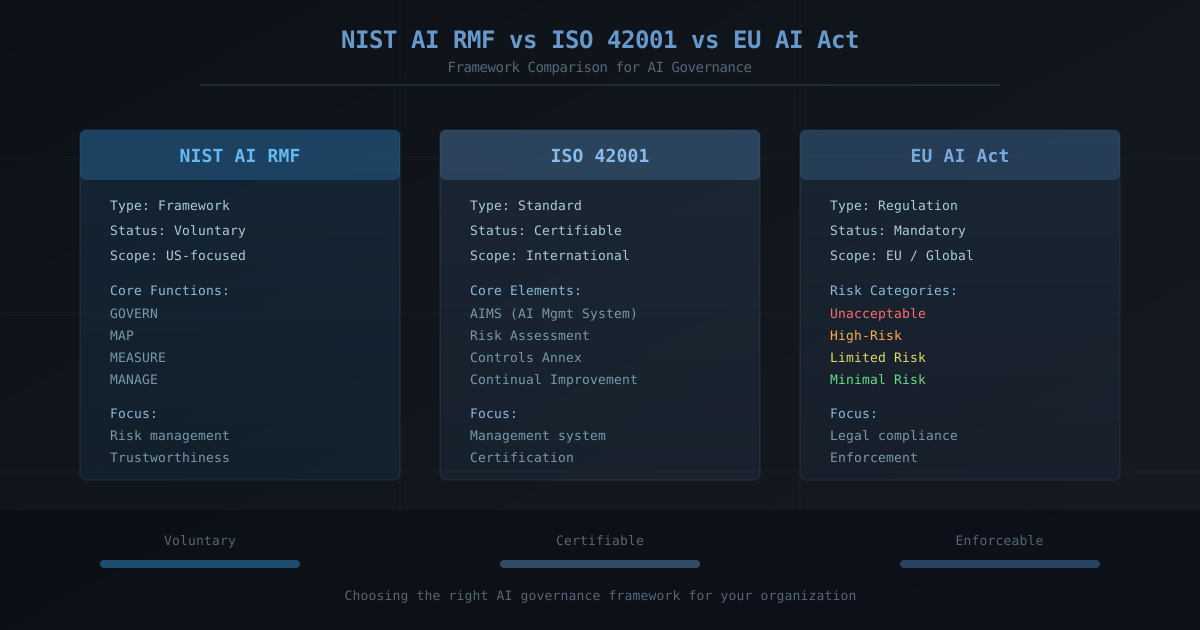
| Component | NIST AI RMF | ISO/IEC 42001 | EU AI Act |
|---|---|---|---|
| Scope | Voluntary, U.S.-focused | Certifiable, international | Mandatory, EU-wide |
| Risk classification | Four functions (Govern, Map, Measure, Manage) | Management system controls | Four risk tiers (Prohibited to Minimal) |
| Accuracy requirements | Measure function metrics | Control A.6.2.6 data quality | Article 50 transparency |
| Audit requirements | Self-assessment recommended | Third-party certification | Conformity assessment for elevated risk |
| Enforcement | No penalties | Market credibility | Up to 35M euros or 7% revenue |
| Timeline | Active since Jan 2023 | Active since Dec 2023 | Full enforcement Aug 2026 |
| Verification API role | Provides Measure/Manage metrics | Satisfies output quality controls | Generates Article 50 compliance data |
The practical approach is to use all three. NIST AI RMF provides the risk management structure. ISO 42001 provides the certifiable management system. EU AI Act compliance is mandatory for any organization serving European users. Even frontier models still hallucinate: the Vectara Hallucination Leaderboard measured hallucination rates of 0.7 to 2.5 percent for the best general purpose LLMs in 2024, according to the Vectara Hallucination Leaderboard, 2024. A verification API provides the technical evidence layer that satisfies the accuracy and transparency requirements across all three frameworks.
For a deeper look at how verification APIs work and how they differ from search-based approaches, see our guide on what a verification API is. For current data on AI hallucination rates across different models and domains, see our AI hallucination statistics roundup.
Frequently Asked Questions
What is an AI trust framework?
An AI trust framework is a structured set of policies, processes, and technical controls that govern how an organization develops, deploys, and monitors AI systems. It typically includes governance policies, risk classification, output monitoring, guardrails, and verification layers that work together to ensure AI outputs are accurate, safe, and compliant.
What is the NIST AI Risk Management Framework?
The NIST AI Risk Management Framework (AI RMF 1.0) is a voluntary standard published by the National Institute of Standards and Technology in January 2023. It organizes AI risk management into four functions: Govern, Map, Measure, and Manage. Over 240 organizations contributed to its development, and it serves as the foundation for most enterprise AI governance programs in the United States.
When does the EU AI Act take effect?
The EU AI Act entered into force on 1 August 2024 and is being implemented in phases. Prohibited AI practices became enforceable in February 2025. Multipurpose AI model obligations apply from August 2025. The full risk-based classification system and transparency requirements under Article 50 take effect on 2 August 2026.
How do verification APIs fit into an AI trust framework?
Verification APIs serve as the output validation layer of an AI trust framework. After governance sets policies and guardrails filter unsafe content, a verification API checks each factual claim against real-world sources and returns a verdict with citations and confidence scores. This provides the auditable evidence of accuracy that frameworks like NIST AI RMF and ISO 42001 require.
What is the difference between AI guardrails and AI verification?
AI guardrails filter inputs and outputs for safety concerns like toxicity, bias, and prompt injection. They block harmful content but do not check factual accuracy. AI verification checks whether specific claims are supported by real-world sources. Guardrails prevent unsafe outputs; verification prevents inaccurate outputs. Enterprise trust frameworks need both.