The AI governance market was valued at $164 million in 2023 and is projected to reach $3.9 billion by 2034, according to Precedence Research, 2024. That 24x growth reflects a straightforward reality: enterprises deploying AI at scale can no longer manage risk and compliance using spreadsheets. The EU AI Act reaches full enforcement on August 2, 2026. NIST AI RMF adoption is accelerating. This article compares 6 leading AI governance platforms, explains the core capabilities to evaluate, and shows where output verification fits.
- The AI governance market is growing from $164M (2023) to a projected $3.9B (2034), driven by EU AI Act, NIST, and ISO 42001 requirements.
- Core capabilities to evaluate: model registry, risk assessment, impact assessment, compliance reporting, and audit trail generation.
- OneTrust, Credo AI, IBM OpenPages, ServiceNow, Securiti.ai, and Holistic AI lead the enterprise segment.
- Governance tools manage policy and process; verification tools manage output accuracy. Enterprises need both.
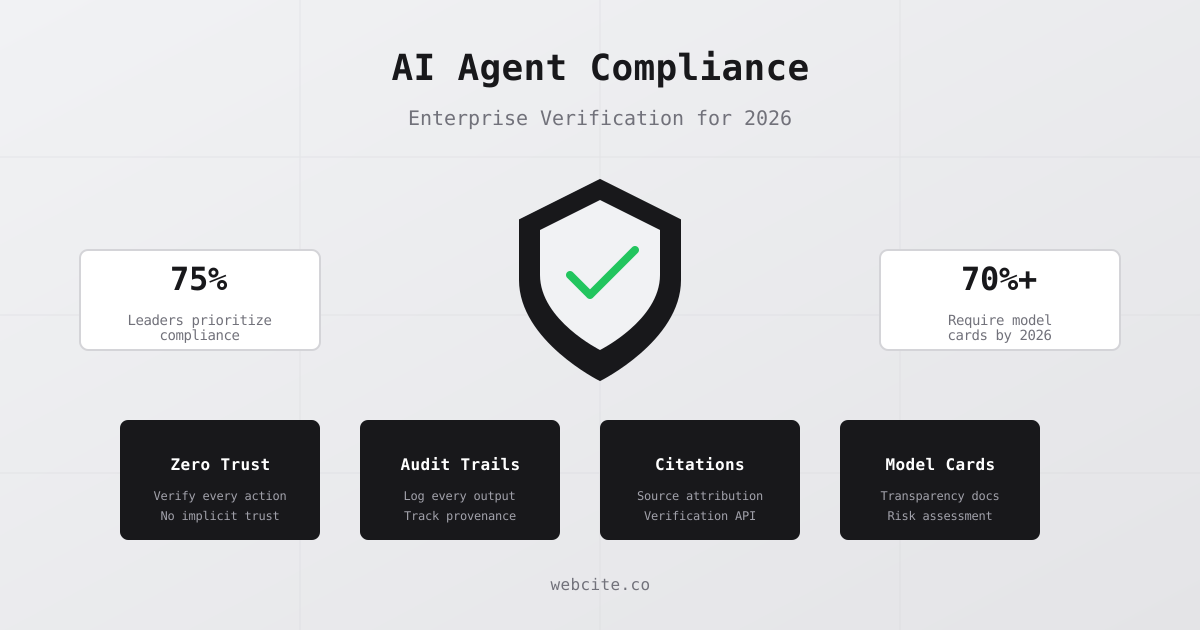
- EU AI Act enforcement in August 2026 is the primary purchase driver for 70%+ of enterprise buyers.
Why Enterprises Need Dedicated AI Governance Tools
Three converging forces are driving enterprise adoption of AI governance platforms.
Regulatory deadlines. The EU AI Act’s broadest provisions take full effect on August 2, 2026, covering high-risk AI systems and Article 50 transparency requirements, according to Secure Privacy, 2026. The Colorado AI Act takes effect June 30, 2026. Over 1,100 state-level AI bills were introduced in the U.S. in 2025, according to the Brennan Center for Justice, 2025. Organizations can’t track compliance obligations across multiple jurisdictions manually.
Scale of AI deployment. McKinsey’s 2025 survey found that 72% of enterprises now use generative AI in at least one business function, according to McKinsey, 2025. An enterprise running 50 AI models across 8 departments needs a centralized system to track what’s deployed, where, by whom, and under what risk classification. Spreadsheets break at this scale.
Audit and certification requirements. ISO 42001 certification requires documented evidence of AI risk management processes, including model inventories, risk assessments, and performance monitoring. Third-party auditors need structured, queryable records, not folder trees of PDFs. Governance tools produce the audit-ready documentation that certification demands.
The cost of not governing AI is quantifiable. Gartner predicts that over 40% of agentic AI projects will be canceled by end of 2027 if governance, observability, and ROI clarity are not established, according to Gartner, 2025. Enterprises lost an estimated $67.4 billion to AI hallucinations in 2024, including costs from incorrect decisions, customer service errors, and legal liability, according to Korra, 2024. Governance tools reduce both regulatory risk and operational loss.
Core Capabilities to Evaluate
Before comparing vendors, understand the 6 core capabilities that differentiate AI governance platforms:
1. Model registry. A centralized catalog of all AI models deployed across the organization. Each entry includes the model’s purpose, training data sources, deployment environment, responsible team, risk classification, and version history. The registry answers the fundamental governance question: what AI do we have, and where is it running?
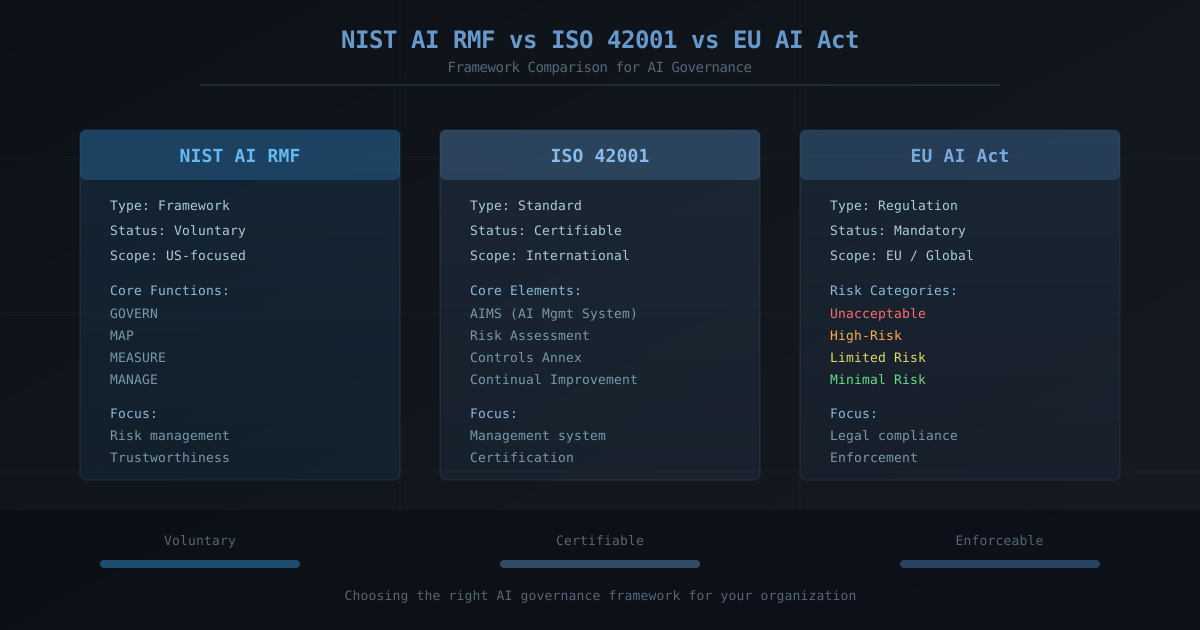
2. Risk assessment and classification. Automated or guided workflows for classifying AI systems by risk level. The best tools map to multiple frameworks simultaneously: EU AI Act risk tiers, NIST AI RMF risk categories, and ISO 42001 control requirements. Classification drives which compliance obligations apply.
3. Impact assessment. Templates and workflows for completing AI impact assessments, including the Colorado AI Act’s required assessments, the EU AI Act’s conformity assessments, and voluntary NIST AI RMF assessments. Automated data gathering reduces the manual effort of compiling assessment inputs.
4. Compliance reporting. Dashboards that show compliance posture across multiple frameworks and jurisdictions. Reports should be exportable for regulators, auditors, and board presentations. The best tools generate framework-specific reports (EU AI Act readiness, NIST alignment, ISO 42001 gaps) from a single data source.
5. Audit trail and evidence management. Structured, timestamped records of governance activities: who approved a model for deployment, when a risk assessment was completed, what changes were made to a model’s data pipeline, and what monitoring results showed. These records form the evidence base for regulatory audits and ISO certification.
6. Monitoring and alerting. Ongoing tracking of AI system performance, data drift, bias indicators, and accuracy metrics. Alerts trigger when performance drops below defined thresholds. This capability connects governance to operations by flagging issues before they become compliance violations.
Platform Comparison: 6 Leading AI Governance Tools
OneTrust AI Governance
OneTrust, headquartered in Atlanta, expanded from privacy compliance (GDPR, CCPA) into AI governance. The platform offers pre-built assessment templates for the EU AI Act, ISO 42001, and NIST AI RMF, according to OneTrust.
Strengths:
- Pre-built regulatory templates covering EU AI Act, NIST AI RMF, and ISO 42001
- Integration with existing OneTrust privacy and data governance modules
- Automated risk classification mapped to multiple frameworks
- Strong data mapping capabilities inherited from privacy compliance
Considerations:
- Enterprise pricing; typically requires annual contract
- Most valuable for organizations already using OneTrust for privacy
- AI governance module is newer than core privacy product
Best for: Organizations that already use OneTrust for privacy compliance and want a unified governance platform.
Credo AI
Credo AI, based in San Francisco, focuses on responsible AI governance and was founded in 2020, according to Credo AI.
Strengths:
- AI governance platform with policy-to-practice workflow automation
- Model cards and risk assessment documentation
- Stakeholder collaboration features for cross-functional governance teams
- Focus on responsible AI principles alongside regulatory compliance
Considerations:
- Smaller company; may lack the integration breadth of OneTrust or IBM
- More focused on responsible AI than pure regulatory compliance
- Enterprise-only pricing
Best for: Organizations prioritizing responsible AI governance and ethical AI principles alongside compliance.
IBM OpenPages with Watson
IBM OpenPages is an established governance, risk, and compliance (GRC) platform that added AI-specific capabilities, according to IBM.
Strengths:
- Mature GRC platform with decades of regulatory compliance experience
- AI model risk management integrated with broader risk management
- Watson AI-powered insights for risk identification
- Integration with IBM Cloud Pak for Data and Watson Studio
Considerations:
- Can be complex to deploy; enterprise implementation typically takes 3-6 months
- Pricing reflects IBM enterprise model
- Deepest value within IBM ecosystem
Best for: Large enterprises with existing IBM infrastructure and complex multi-framework compliance requirements.
ServiceNow AI Governance
ServiceNow extended its IT service management platform to include AI governance capabilities, according to ServiceNow.
Strengths:
- Integration with existing ITSM and workflow automation
- AI model lifecycle management within ServiceNow workflows
- Change management and approval workflows for AI deployments
- Familiar interface for organizations already using ServiceNow
Considerations:
- AI governance is newer capability; less mature than dedicated platforms
- Strongest for IT-centric governance; may lack depth for data science teams
- Requires ServiceNow platform license
Best for: Organizations using ServiceNow for ITSM that want AI governance within their existing workflow platform.
Securiti.ai
Securiti.ai provides a unified data intelligence platform that combines data privacy, security, and AI governance, according to Securiti.ai.
Strengths:
- Unified data + AI governance approach
- Strong EU AI Act compliance features including data lineage tracking
- Automated data discovery and classification for AI training data
- Cloud-native architecture with multi-cloud support
Considerations:
- Relatively newer entrant in AI governance
- Strongest value when both data governance and AI governance are needed
- Enterprise pricing with modular capability licensing
Best for: Organizations that need integrated data privacy, data security, and AI governance in a single platform.
Holistic AI
Holistic AI, headquartered in London, provides AI risk management and compliance auditing, according to Holistic AI.
Strengths:
- Dedicated AI auditing and compliance platform
- Bias auditing and algorithmic fairness assessment tools
- EU AI Act compliance mapping and gap analysis
- NYC Local Law 144 bias audit compliance (proven track record)
Considerations:
- More focused on audit/compliance than model lifecycle management
- Smaller vendor compared to OneTrust or IBM
- Best suited for compliance-first organizations
Best for: Organizations that need specialized AI auditing capabilities and algorithmic fairness assessments.
Comparison Table
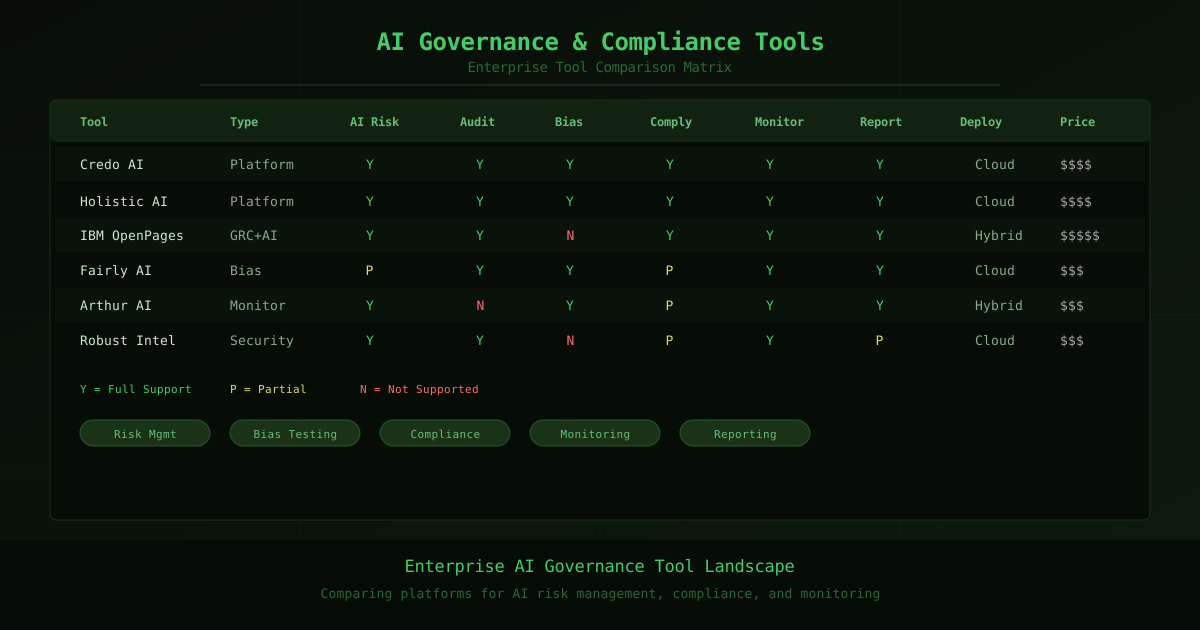
| Capability | OneTrust | Credo AI | IBM OpenPages | ServiceNow | Securiti.ai | Holistic AI |
|---|---|---|---|---|---|---|
| Model registry | Yes | Yes | Yes | Yes | Yes | Partial |
| EU AI Act templates | Yes | Yes | Partial | Partial | Yes | Yes |
| NIST AI RMF mapping | Yes | Yes | Yes | Partial | Yes | Yes |
| ISO 42001 support | Yes | Partial | Yes | Partial | Partial | Partial |
| Impact assessment | Yes | Yes | Yes | Yes | Yes | Yes |
| Bias auditing | Partial | Yes | Partial | Partial | Partial | Yes |
| Data lineage | Yes | Partial | Yes | Partial | Yes | Partial |
| Pricing model | Enterprise | Enterprise | Enterprise | Platform + module | Modular | Enterprise |
| Deployment | Cloud | Cloud | Cloud/On-prem | Cloud | Cloud | Cloud |
| Best fit | Privacy + AI | Responsible AI | Large enterprise | ITSM-centric | Data + AI | Audit-first |
Where Output Verification Fits in the Governance Stack
AI governance tools manage process and policy. They track which models are deployed, classify their risk, and generate compliance reports. They do not check whether specific AI outputs are factually accurate. That’s the function of output verification.
Consider the governance stack as three layers:
| Layer | Function | Tools |
|---|---|---|
| Policy and process | Risk classification, model registration, impact assessment | OneTrust, Credo AI, IBM OpenPages, etc. |
| Safety and guardrails | Block toxic, biased, or unsafe outputs | AWS Bedrock Guardrails, NVIDIA NeMo Guardrails |
| Output accuracy | Verify factual claims against real-world sources | Webcite verification API |
Governance tools answer: “Are we following the rules?” Verification APIs answer: “Is this output true?” Both questions must be answered for full compliance.
The EU AI Act’s Article 50 requires transparency about how AI outputs are generated and what sources support them, according to the EU AI Act text. A governance tool documents that you have a verification process. A verification API executes that process and generates the source attribution evidence.
Here is how verification integrates with a governance workflow:
import requests

def verify_ai_output(claim):
    response = requests.post(
        "https://api.webcite.co/api/v1/verify",
        headers={
            "x-api-key": "your-api-key",
            "Content-Type": "application/json"
        },
        json={
            "claim": claim,
            "include_stance": True,
            "include_verdict": True
        }
    )
    result = response.json()
    # Log this result in your governance platform
    # as evidence for compliance audits
    return {
        "claim": claim,
        "verdict": result.get("verdict", {}),
        "citations": result.get("citations", []),
        "audit_timestamp": "2026-02-19T10:00:00Z"
    }
For a deeper analysis of how verification APIs map to specific compliance requirements across NIST, ISO, and the EU AI Act, see our framework comparison guide.
How to Choose the Right Governance Platform
Selection depends on 4 factors:
1. Your existing tech stack. If you already use OneTrust for privacy, extending to AI governance is the lowest-friction path. If you run IBM infrastructure, OpenPages integrates naturally. ServiceNow users benefit from workflow continuity. Minimize new vendor introductions.
2. Your regulatory exposure. Companies serving EU customers need strong EU AI Act templates. Companies in U.S. regulated industries (finance, healthcare) need NIST AI RMF and ISO 42001 support. Companies operating in Colorado need impact assessment capabilities aligned with SB 24-205. Match the platform’s framework coverage to your jurisdictional requirements.
3. Your AI maturity. Organizations with 5 or fewer AI models may not need a dedicated governance platform; NIST AI RMF self-assessment in a structured document can suffice. Organizations with 20+ models across multiple teams need centralized model registration, automated risk classification, and compliance dashboards. Match the tool’s complexity to your scale.
4. Your budget and timeline. Enterprise governance platforms typically start at $50,000 to $150,000 annually. Implementation takes 2 to 6 months depending on complexity. With the EU AI Act deadline 166 days away (as of this writing), platforms that offer rapid deployment and pre-built regulatory templates have a practical advantage.
A PwC survey found that 52% of companies experienced an increase in crisis frequency over the prior five years, with AI-related incidents growing fastest, according to PwC, 2023. Investing in governance infrastructure now is cheaper than managing crises later.
Getting Started with Governance and Verification
Two parallel workstreams get you to compliance fastest:
Workstream 1: Governance platform. Evaluate the platforms above against your requirements. Request demos from your top 2 to 3 choices. Prioritize time-to-value: which platform gets you to a functional model registry and risk classification in under 30 days?
Workstream 2: Output verification. While governance platform procurement runs its course (typically 4 to 8 weeks), you can deploy output verification immediately. Sign up at webcite.co for a free API key. The free tier includes 50 credits per month (approximately 12 full verifications) for testing. Each verification uses 4 credits. The Builder plan at $20 per month provides 500 credits for production. Enterprise plans offer 10,000+ credits with custom pricing. Authentication uses the x-api-key header.
const response = await fetch("https://api.webcite.co/api/v1/verify", {
  method: "POST",
  headers: {
    "x-api-key": process.env.WEBCITE_API_KEY,
    "Content-Type": "application/json"
  },
  body: JSON.stringify({
    claim: "The AI governance market will reach $3.9 billion by 2034",
    include_stance: true,
    include_verdict: true
  })
})

const result = await response.json()
// result.verdict.result: "supported"
// result.verdict.confidence: 92
// Feed this into your governance platform's audit trail
The governance platform manages policy. The verification API provides evidence. Together, they close the gap between “we have a policy that says outputs must be accurate” and “here is the proof that they are.” For more on building this integrated compliance stack, see our guide on AI hallucination detection: build vs. buy.
Frequently Asked Questions
What is an AI governance tool?
An AI governance tool is enterprise software that helps organizations manage AI risk, track compliance with regulations like the EU AI Act and NIST AI RMF, maintain model registries, conduct impact assessments, generate audit trails, and monitor AI system performance. These tools operationalize governance policies into measurable, auditable workflows.
Which AI governance tool is best for EU AI Act compliance?
OneTrust and Securiti.ai offer the most comprehensive EU AI Act compliance features, including risk classification wizards, Article 50 transparency templates, and automated reporting. Credo AI focuses on responsible AI governance and model cards. The best choice depends on whether your organization prioritizes regulatory compliance (OneTrust), responsible AI practices (Credo AI), or data security integration (Securiti.ai).
How much do AI governance tools cost?
Enterprise AI governance platforms typically start at $50,000 to $150,000 annually for mid-market organizations. Enterprise pricing scales based on the number of AI models registered, users, and compliance frameworks supported. OneTrust, IBM, and ServiceNow use custom enterprise pricing. Some vendors offer modular pricing where you pay only for the capabilities you need.
Do I need an AI governance tool if I already use NIST AI RMF?
NIST AI RMF provides the risk management methodology, but a governance tool automates the execution. Without a tool, teams manage risk assessments in spreadsheets, track models in documents, and compile audit evidence manually. A governance platform automates model registration, risk scoring, assessment workflows, and compliance reporting, reducing manual effort by 60% or more.
What is the difference between AI governance and AI verification?
AI governance manages the organizational policies, risk classifications, and compliance workflows around AI systems. AI verification checks whether specific AI outputs are factually accurate by comparing claims against real-world sources. Governance answers “are we following the rules?” while verification answers “is this output true?” Enterprise AI programs need both.
How fast is the AI governance market growing?
The AI governance market was valued at $164 million in 2023 and is projected to reach $3.9 billion by 2034, representing a compound annual growth rate of over 35%, according to Precedence Research, 2024. The EU AI Act’s August 2026 enforcement deadline, NIST AI RMF adoption, and ISO 42001 certification demand are the primary growth drivers.