NewsGuard identified over 2,089 undisclosed AI-generated news websites across 16 languages by October 2025, according to NewsGuard, 2025. That number has grown every quarter since tracking began. AI-generated misinformation is no longer a theoretical risk. It is a measurable, accelerating problem that spans deepfakes, synthetic news, chatbot hallucinations, and automated disinformation campaigns. This article compiles the data on where AI misinformation stands in 2026 and what organizations can do about it.
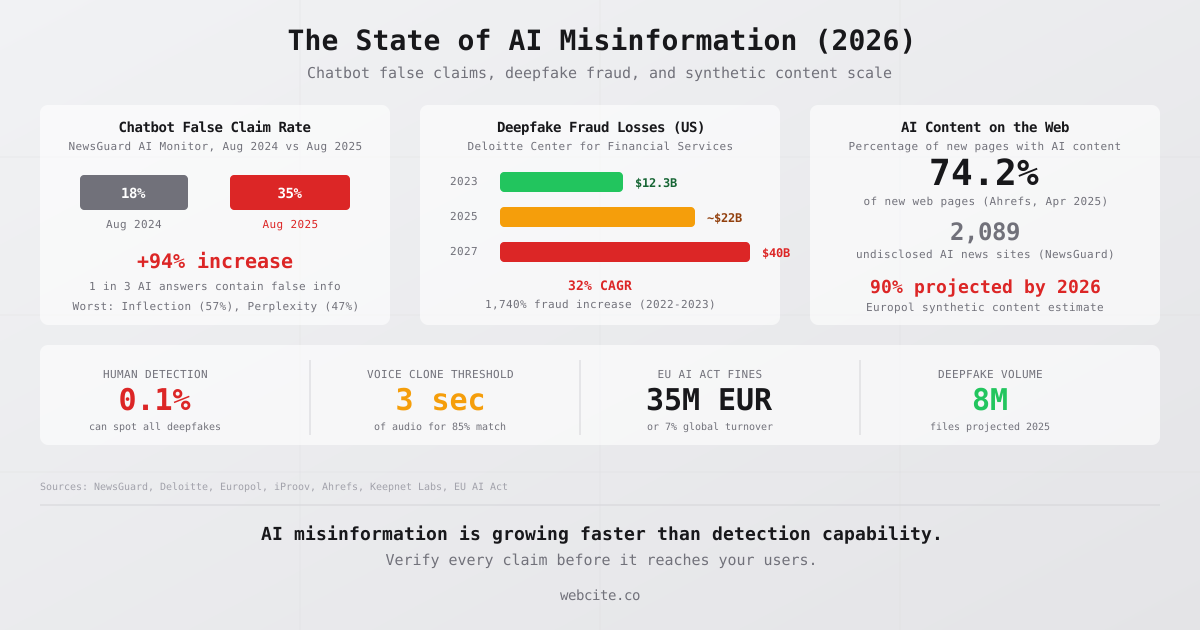
- AI chatbots repeated false claims 35% of the time in August 2025, nearly double the 18% rate from a year earlier.
- Deepfake fraud could drive US losses to $40 billion by 2027 (Deloitte, 2024).
- Only 0.1% of consumers correctly identified all deepfake and real media in an iProov study of 2,000 people.
- The EU AI Act mandates deepfake labeling and AI content disclosure by August 2026, with fines up to 35 million EUR.
- Verification APIs provide automated claim-checking against real sources before AI-generated content reaches users.
The Scale of AI-Generated Content Online
The volume of AI-generated content on the internet has crossed a threshold that makes manual detection impossible. Ahrefs analyzed nearly one million new web pages published in April 2025 and found that 74.2% contained detectable AI-generated content, according to Ahrefs, 2025. A separate analysis by Graphite found that 50.3% of new web articles were generated primarily by AI as of November 2024, according to eWeek, 2025.
Europol projected in its deepfake threat assessment that as much as 90% of online content could be synthetically generated by 2026, according to Europol, 2022. While that projection has drawn scrutiny for its aggressiveness, the direction of the trend is clear. The internet is shifting from a primarily human-authored medium to one where AI-generated content is the majority.
This shift matters for misinformation because AI content generation operates at a scale no human editorial team can match. A single operator can publish thousands of articles per day across dozens of domains. NewsGuard documented that the number of undisclosed AI-generated news sites grew from 713 in February 2024 to over 2,089 by October 2025, according to NewsGuard, 2025. These sites mimic legitimate news outlets, publish AI-generated articles without editorial oversight, and attract real traffic through search engines and social media.
The content itself is not always false. Much of it is low-quality but technically accurate. The problem is the subset that contains fabricated claims, hallucinated statistics, or deliberately misleading narratives that spread at machine speed through an information ecosystem built for human-paced publishing.
Chatbot Misinformation: The 35% Problem
Large language models are the most direct pipeline for AI misinformation reaching consumers. NewsGuard’s August 2025 AI False Claim Monitor tested the 10 most popular AI chatbots against known false narratives and found that they repeated false claims 35% of the time, according to NewsGuard, 2025. That figure nearly doubled from the 18% false claim rate measured in August 2024.
The failure rate is not uniform across chatbots. Inflection produced false claims 57% of the time. Perplexity followed at 47%. Anthropic’s Claude and Google’s Gemini performed best but still failed on a meaningful percentage of queries, according to Axios, 2025.
A key driver of this worsening performance is the integration of real-time web search into chatbots. As models gained the ability to pull live information from the web, their non-response rate dropped from 31% to near zero. But the web they search is polluted. Malign actors seed low-quality websites, social media posts, and AI-generated content farms with false narratives that chatbots then treat as credible sources, according to NewsGuard, 2025.
This creates a feedback loop. AI-generated content containing errors gets published to the web. Other AI systems retrieve that content and treat it as evidence. The misinformation compounds with each cycle, a pattern researchers call AI hallucination propagation.
A February 2025 example illustrates the mechanism: Google’s AI Overview cited an April Fools’ satire article about “microscopic bees powering computers” as factual information in search results, according to Harvard Kennedy School Misinformation Review, 2025. The system did not intend to mislead, but the output was a confident falsehood served to millions of searchers.
Deepfakes: Scale, Sophistication, and Financial Damage
Deepfake content has moved from a novelty to a measurable financial threat. The volume of deepfake files surged from 500,000 in 2023 to a projected 8 million in 2025, with content volume increasing by approximately 900% annually, according to Keepnet Labs, 2026.
The financial consequences are severe. Deloitte’s Center for Financial Services projects that generative AI-enabled fraud losses will reach $40 billion in the United States by 2027, up from $12.3 billion in 2023, representing a compound annual growth rate of 32%, according to Deloitte, 2024. In 2024, businesses lost an average of nearly $500,000 per deepfake-related incident, according to Keepnet Labs, 2026.
The most striking data point comes from human detection capability. An iProov study of 2,000 UK and US consumers found that only 0.1% of participants correctly identified all deepfake and real content shown to them, according to iProov, 2025. Participants were 36% less likely to correctly identify a synthetic video compared to a synthetic image, and 22% of respondents had never even heard of deepfakes.
Voice cloning has crossed what Fortune described as the “indistinguishable threshold.” Scammers need as little as three seconds of audio to create a voice clone with an 85% match to the original speaker, according to Fortune, 2025. This has enabled new categories of fraud including real-time video call impersonation. In January 2024, a Hong Kong finance worker transferred $25 million after a video call with what appeared to be the company’s CFO and several colleagues, all of whom were deepfakes, according to Deloitte, 2024.
North America witnessed a 1,740% increase in deepfake fraud between 2022 and 2023, according to Keepnet Labs, 2026. The trajectory suggests the problem is compounding, not stabilizing.
Hallucination Propagation: How AI Errors Spread
AI hallucinations become misinformation when they escape the original conversation and enter the broader information ecosystem. This propagation follows a predictable pattern.
First, an LLM generates a plausible but false claim. A 2025 VKTR analysis found that hallucination rates for news-related queries nearly doubled, with OpenAI’s o3 model hallucinating 33% of the time and o4-mini reaching 48%, according to VKTR, 2025.
Second, the hallucinated claim gets published. Users copy chatbot outputs into blog posts, social media updates, and even academic papers. The Ipsos 2025 survey found that at least 46% of Americans use AI tools for information seeking, according to drainpipe.io, 2025.
Third, other AI systems retrieve the published hallucination and treat it as evidence. Search engines index the content. RAG pipelines retrieve it. New AI-generated content cites the hallucinated claim, giving it a veneer of multi-source corroboration.
The healthcare domain shows how dangerous this cycle can be. AI chatbots hallucinated fabricated diseases, lab values, and clinical signs in up to 83% of simulated medical cases when safety measures were absent, according to Medical Economics, 2025. More than one in five Americans reported following AI health advice that was later proven wrong.
This is distinct from traditional misinformation. Human-created misinformation requires human effort to produce and spread. AI-generated misinformation is produced at machine speed, indexed by search engines automatically, and amplified by the same AI systems that created it. Breaking this cycle requires intervention at the verification layer, not just at the generation layer. A verification API checks each claim against real sources before it reaches users, interrupting the propagation chain at its most critical point.
Regulatory Responses: The EU AI Act and Beyond
Governments are responding to the AI misinformation crisis with legislation that creates real financial consequences for non-compliance.
The EU AI Act is the most comprehensive regulatory framework. Its penalty structure, which took effect on August 2, 2025, imposes fines of up to 35 million EUR or 7% of global annual turnover for prohibited AI practices, up to 15 million EUR or 3% for violations of other obligations, and up to 7.5 million EUR or 1% for providing incorrect information to authorities, according to EU AI Act Article 99.
Article 50 transparency obligations become enforceable in August 2026. These require providers to disclose AI interactions, label AI-generated content in machine-readable format, and identify deepfakes, according to DLA Piper, 2025. The European Commission published a first draft Code of Practice for marking and labeling AI-generated content in December 2025, establishing technical standards for watermarking and detecting synthetic media.
The full compliance framework for high-risk AI systems takes effect on August 2, 2026, according to Axis Intelligence, 2026. General-purpose AI model providers must publish summaries of training datasets to help users distinguish between human and synthetic content.
The EU is not acting alone. The Colorado AI Act and California transparency requirements also take effect in 2026, according to Wilson Sonsini, 2026. These overlapping regulations create a global compliance landscape where AI applications serving multiple markets must meet the strictest standard.
For organizations deploying AI, this means verification is no longer a quality feature. It is a compliance requirement. Every claim, source, and confidence score must be auditable. The cost of non-compliance, up to 7% of global revenue under the EU AI Act, dwarfs the cost of implementing verification infrastructure.
The Role of Verification APIs in Combating AI Misinformation
Verification APIs address the AI misinformation problem at the point where it matters most: before false claims reach users. Unlike content moderation, which reacts after content is published, verification APIs check claims against real sources in real time.
The mechanism is straightforward. An AI system generates content. Before that content is displayed, served, or published, a verification API checks each factual claim against multiple real-world sources, evaluates source credibility, and returns a verdict: supported, contradicted, or insufficient evidence. Claims that fail verification get flagged, removed, or regenerated.
This approach is particularly effective against hallucination propagation. When an LLM generates a hallucinated statistic, the verification API checks it against actual sources and returns a “contradicted” or “insufficient evidence” verdict. The hallucination is caught before it enters the information ecosystem.
Webcite provides this verification in a single REST API call:
const response = await fetch("https://api.webcite.co/api/v1/verify", {
  method: "POST",
  headers: {
    "x-api-key": process.env.WEBCITE_API_KEY,
    "Content-Type": "application/json"
  },
  body: JSON.stringify({
    claim: "Deepfake fraud losses reached $40 billion in the US in 2025",
    include_stance: true,
    include_verdict: true
  })
})

const result = await response.json()
// result.verdict.result: "contradicted"
// result.verdict.confidence: 87
// result.citations: [{ title: "Deloitte Financial Services", url: "...",
//   snippet: "$40 billion projected by 2027, not 2025" }]
The API handles the entire pipeline: claim extraction, source retrieval, credibility scoring, and verdict generation. Developers do not need to build source-ranking heuristics, citation extraction, or credibility databases.
For organizations subject to EU AI Act compliance, verification API call logs serve as auditable documentation. Each call produces a record of what was checked, which sources were consulted, and what verdict was returned. This audit trail is precisely what regulators require under Article 50’s transparency obligations.
Webcite offers a free tier with 50 credits per month ($0), a Builder plan at $20 per month with 500 credits, and Enterprise plans starting at 10,000+ credits with custom pricing. Each full verification consumes 4 credits: 2 for citation retrieval, 1 for stance detection, and 1 for the final verdict.
What Comes Next: Projections for 2026 and Beyond
The data points to three developments that will define AI misinformation through 2026 and beyond.
First, the EU AI Act’s August 2026 enforcement deadline will force organizations to implement verification infrastructure or face penalties. Companies that have not started building compliance systems by mid-2026 will scramble to meet the deadline, creating a surge in demand for verification tools.
Second, the feedback loop between AI-generated content and AI retrieval systems will intensify. As more AI-generated content enters the web, AI systems that search the web for evidence will increasingly retrieve AI-generated content. Without verification at the retrieval layer, the quality of AI-grounded responses will degrade further.
Third, deepfake sophistication will continue outpacing human detection capability. The 0.1% detection rate from the iProov study will likely drop as generation technology improves faster than human perceptual ability. Automated detection and verification systems will become the primary defense, not human judgment.
Organizations that treat verification as an afterthought will face compounding costs: regulatory fines under the EU AI Act, reputational damage from publishing hallucinated content, and financial losses from deepfake-enabled fraud. Organizations that build verification into their AI pipelines now will have a structural advantage in accuracy, compliance, and user trust.
Frequently Asked Questions
How much AI-generated misinformation is online in 2026?
Europol projected that up to 90% of online content could be synthetically generated by 2026. NewsGuard has identified over 2,089 undisclosed AI-generated news websites across 16 languages, and Ahrefs found that 74.2% of new web pages published in April 2025 contained detectable AI-generated content. The volume of synthetic content is growing faster than the ability to moderate it.
What percentage of AI chatbot responses contain false claims?
NewsGuard found that AI chatbots repeated false claims 35% of the time in August 2025, nearly double the 18% rate recorded in August 2024. When non-responses are included, the overall failure rate reached 41.5% across the 10 most popular chatbots. Inflection performed worst at 57%, while Anthropic’s Claude and Google’s Gemini had the lowest false claim rates.
What are the EU AI Act penalties for AI misinformation?
The EU AI Act imposes fines of up to 35 million EUR or 7% of global annual turnover for prohibited AI practices. Article 50 transparency obligations, including mandatory deepfake labeling and AI content disclosure, become enforceable in August 2026. The full compliance framework for high-risk AI systems also takes effect on that date.
How much financial damage do deepfakes cause?
Deloitte projects that AI-enabled fraud losses will reach $40 billion in the United States by 2027, up from $12.3 billion in 2023. In 2024, businesses lost an average of nearly $500,000 per deepfake-related incident. North America saw a 1,740% increase in deepfake fraud between 2022 and 2023.
Can people detect AI-generated deepfakes?
An iProov study of 2,000 consumers found that only 0.1% could correctly identify all deepfake and real media shown to them. Participants were 36% less likely to detect a synthetic video than a synthetic image, and 22% of respondents had never heard of deepfakes before the study.