The European Parliament’s AI Act imposes fines up to 35 million EUR or 7% of global annual revenue for non-compliance. The broadest provisions take effect on August 2, 2026, according to the EU AI Act high-level summary. Over 80% of organizations using AI in the European market are not yet fully prepared for the compliance deadline, according to Secure Privacy, 2026. This article explains the Act’s key deadlines, risk classifications, and transparency requirements, and shows how verification APIs provide the audit infrastructure enterprises need to comply.
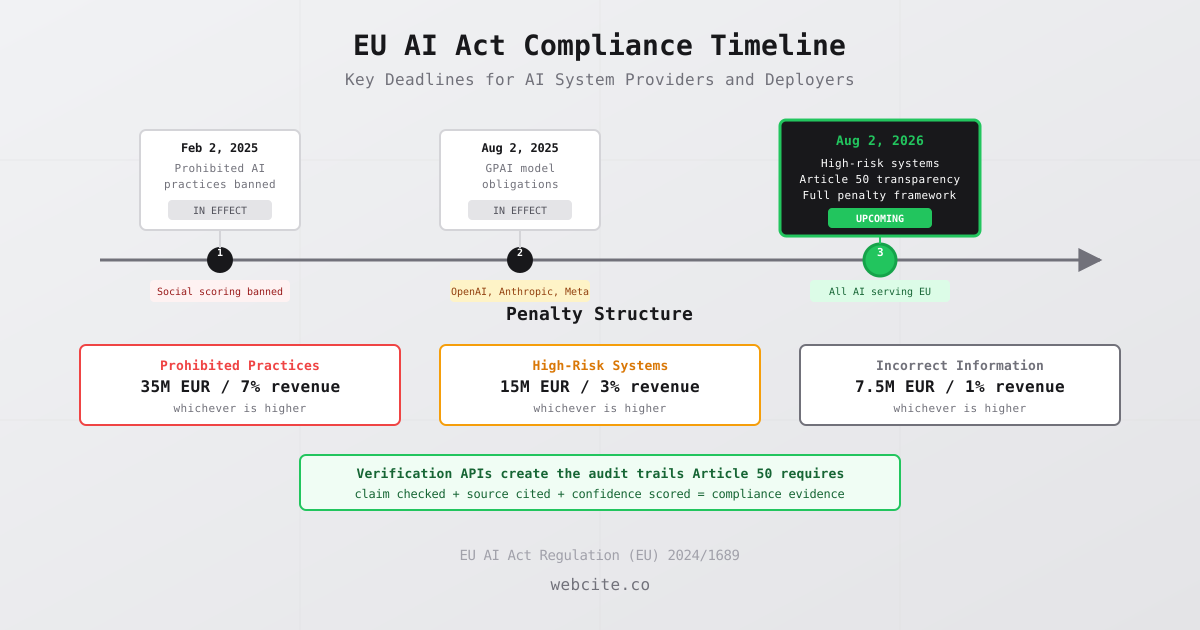
- The EU AI Act rolls out in 3 phases: prohibited practices (Feb 2025), GPAI rules (Aug 2025), and high-risk systems plus Article 50 transparency (Aug 2026).
- Any company serving EU users falls under the regulation, regardless of where it is headquartered.
- Penalties reach 35 million EUR or 7% of global annual revenue for the most serious violations.
- Article 50 requires AI-generated content disclosure, machine-readable labeling, and auditable documentation of outputs.
- Verification APIs create the audit trails, citation logs, and confidence scores that regulators require as compliance evidence.
EU AI Act Deadlines: Three Phases of Enforcement
The EU AI Act does not arrive all at once. The European Commission structured enforcement in three phases, each targeting a different category of AI systems. Understanding the timeline is essential because the compliance work differs at each stage.
Phase 1: February 2, 2025 (already in effect). Prohibited AI practices became enforceable. This phase bans AI systems that use subliminal manipulation, exploit vulnerable groups, perform social scoring by public authorities, or conduct real-time biometric identification in public spaces (with narrow law enforcement exceptions). The European AI Office, established under the European Commission, oversees enforcement at the EU level. The global AI market reached $254 billion in 2025, according to Statista, 2025, making the scale of regulation proportional to the scale of the technology.
Phase 2: August 2, 2025 (already in effect). General-purpose AI model (GPAI) obligations took effect. Providers of foundation models like OpenAI, Anthropic, Google DeepMind, Meta, and Mistral AI must publish technical documentation, comply with EU copyright law, and provide summaries of training data. Models classified as posing “systemic risk” face additional requirements including adversarial testing and incident reporting.
Phase 3: August 2, 2026 (166 days away). The broadest and most consequential provisions take effect. High-risk AI system requirements, Article 50 transparency obligations, and the full penalty framework all become enforceable. This is the deadline that affects the majority of enterprises deploying AI in the European market.
The European Commission published its first draft Code of Practice for general-purpose AI models in November 2025, with the final version expected by mid-2026, according to Secure Privacy, 2026. Organizations waiting for final guidance before starting compliance work risk missing the August deadline.
Risk Classification: Where Your AI System Falls
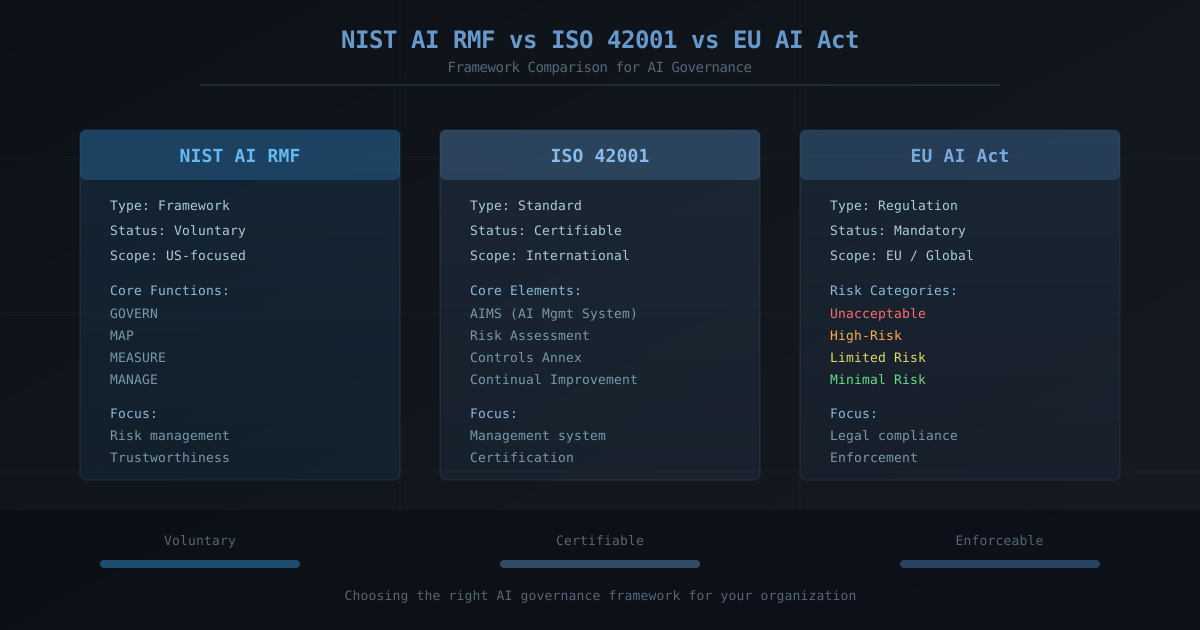
The EU AI Act organizes all AI systems into four risk tiers. Your compliance obligations depend entirely on which tier your system occupies.
Unacceptable Risk (Banned)
These AI applications are prohibited outright since February 2, 2025:
- Cognitive behavioral manipulation targeting vulnerable groups (children, elderly, disabled individuals)
- Social scoring systems operated by or for public authorities
- Real-time remote biometric identification in public spaces for law enforcement (with narrow exceptions)
- Emotion recognition in workplaces and educational institutions
- Untargeted facial image scraping from the internet or CCTV for database creation
Violations carry the maximum penalty: 35 million EUR or 7% of worldwide annual turnover, whichever is higher. For a company like Microsoft (2024 revenue: $245 billion), that ceiling reaches $17.15 billion. AI hallucinations cost enterprises an estimated $67.4 billion in 2024, according to Korra, 2024, which means the penalties are calibrated against real financial damage that uncontrolled AI outputs already cause.
High Risk
High-risk AI systems face the most extensive compliance requirements under the Act. These include systems used in:
- Critical infrastructure management (energy, transport, water, digital networks)
- Education and vocational training (admissions, assessment, learning allocation)
- Employment (recruitment, selection, task allocation, performance evaluation, termination)
- Essential services (credit scoring, insurance pricing, emergency response dispatch)
- Law enforcement (risk assessment, polygraph, evidence evaluation)
- Migration and border control (visa processing, residence permits, asylum applications)
- Justice and democratic processes (judicial decision assistance, dispute resolution)
Providers of these systems must maintain technical documentation, implement quality management systems, conduct conformity assessments, register in the EU database, and ensure human oversight capabilities. Failure to meet these obligations carries penalties up to 15 million EUR or 3% of global annual turnover.
The Stanford Institute for Human-Centered AI estimates that compliance costs for these AI systems range from $150,000 to $400,000 per system for initial certification, according to Stanford HAI, 2025.
Limited Risk
Limited-risk AI systems must comply with Article 50 transparency obligations. This tier includes:
- Chatbots and conversational AI (users must know they are interacting with AI)
- AI-generated text, audio, image, and video content (must be labeled as AI-generated)
- Emotion recognition and biometric categorization systems (users must be informed)
- Deep fakes and synthetic media (must carry machine-readable labels)
This is the tier that affects the broadest range of AI applications. If your product generates text for EU users, Article 50 applies to you. Even the best current LLMs hallucinate in 0.7% to 3.1% of general-knowledge queries, according to Visual Capitalist, 2025, and domain-specific rates run far higher, which is precisely why regulators require transparency mechanisms.
Minimal Risk
AI systems that pose minimal risk, such as spam filters, AI-enabled video games, and inventory management tools, face no specific obligations under the Act. However, providers are encouraged to voluntarily adopt codes of conduct.
Article 50: The Transparency Requirement That Changes Everything
Article 50 is the provision with the widest blast radius. It imposes transparency obligations on virtually every AI system that generates or manipulates content for end users.
The core requirements under Article 50 include:
1. AI interaction disclosure. Users must be informed when they are interacting with an AI system, unless this is obvious from the circumstances. Chatbots, virtual assistants, and automated customer service systems all fall under this requirement.
2. AI-generated content labeling. Text, images, audio, and video generated or substantially modified by AI must be labeled as such. The labels must be in a machine-readable format that survives downstream distribution. The European Commission is working with standards bodies like CEN and CENELEC to define the technical specifications. A December 2025 McKinsey survey found that 72% of enterprises now use generative AI in at least one business function, according to McKinsey, 2025, which means the labeling requirement touches a majority of large organizations.
3. Deep fake disclosure. Synthetic audio, video, or images that depict real people must be clearly labeled as artificially generated or manipulated. Broadcasting, journalism, and political advertising face additional requirements.
4. Provider documentation. AI system providers must maintain documentation showing how outputs are generated, what data sources are used, and what measures are in place to ensure output accuracy.
For developers building AI applications, requirement number 4 is where verification APIs become operationally critical. Stanford researchers found that even RAG-based legal AI tools hallucinate in 17% to 33% of queries, according to Magesh et al., Stanford Law School, 2024, underscoring that documentation of verification steps is not optional. A verification API that logs every claim, every source, every confidence score, and every verdict creates exactly the documentation trail that Article 50 demands.
Penalties: The Cost of Falling Short
The EU AI Act establishes a three-tier penalty structure that scales with the severity of the violation:
| Violation Type | Maximum Fine | Revenue Percentage |
|---|---|---|
| Prohibited AI practices | 35 million EUR | 7% of global annual turnover |
| Covered system violations | 15 million EUR | 3% of global annual turnover |
| Incorrect information to authorities | 7.5 million EUR | 1% of global annual turnover |
For SMEs and startups, lower caps apply to avoid disproportionate impact. But for enterprises, the fines are modeled on the GDPR enforcement pattern: the higher of the fixed amount or the revenue percentage.
The GDPR precedent is instructive. Since GDPR enforcement began in 2018, the European Data Protection Board has issued over 2,000 fines totaling more than 4.5 billion EUR, according to GDPR Enforcement Tracker. Amazon alone received a 746 million EUR fine in 2021. Meta has been fined over 2.5 billion EUR across multiple decisions. The EU AI Act uses an identical enforcement mechanism, administered by national market surveillance authorities in each member state.
Organizations that treat EU AI Act compliance as optional are making the same miscalculation that companies made with GDPR in 2017. The regulatory infrastructure is built, the penalties are defined, and enforcement will follow the established pattern.
Who Is Affected: Extraterritorial Scope
The EU AI Act applies to:
- Providers who develop or place AI systems on the EU market, regardless of whether they are established in the EU
- Deployers who use AI systems within the EU
- Importers and distributors who bring non-EU AI systems into the European market
- Any organization whose AI system output is used within the EU
This extraterritorial scope mirrors GDPR’s reach. A SaaS company headquartered in San Francisco whose chatbot serves customers in Berlin falls under the regulation. An AI content platform based in Singapore that generates articles read by users in Paris is subject to Article 50 transparency requirements. Gartner predicted that 30% of generative AI projects would be abandoned after proof-of-concept by end of 2025 due to poor data quality and inadequate risk controls, according to Gartner, 2024. Regulatory compliance pressure only accelerates that attrition for teams without verification infrastructure.
The International Association of Privacy Professionals (IAPP) estimates that over 300,000 organizations worldwide will need to evaluate their AI systems for EU AI Act compliance, according to IAPP, 2025. The count includes any company that uses third-party AI tools (like ChatGPT, Claude, or Gemini) in products or services available to EU residents.
How Verification APIs Meet Compliance Requirements
A verification API addresses multiple EU AI Act requirements through a single integration point. Here is how each compliance obligation maps to verification API capabilities:
Audit Trail Generation
Every verification API call produces a structured record containing the input claim, retrieved sources, stance analysis, confidence score, and final verdict. This record satisfies Article 50’s documentation requirement by proving what was checked and what evidence supported the output.
const response = await fetch("https://api.webcite.co/api/v1/verify", {
  method: "POST",
  headers: {
    "x-api-key": process.env.WEBCITE_API_KEY,
    "Content-Type": "application/json"
  },
  body: JSON.stringify({
    claim: "The EU AI Act imposes fines up to 35 million EUR",
    include_stance: true,
    include_verdict: true
  })
})

const result = await response.json()
// result.verdict: { result: "supported", confidence: 96 }
// result.citations: [{ title: "EU AI Act", url: "...", stance: "for" }]
// Each call creates an auditable compliance record
Source Attribution and Citation Trails
Article 50 requires providers to demonstrate transparency in how AI outputs are generated. Verification APIs return structured citations with source URLs, relevant passages, and credibility scores. These citations form a provenance chain from output to source that regulators can audit.
Webcite returns citations in a structured JSON format that includes the source title, URL, relevant passage, stance (for, against, neutral), and a credibility score. This is the machine-readable attribution format that Article 50’s technical specifications are converging toward. Research from Princeton and Georgia Tech found that content with citations is 30% more likely to be surfaced by AI search engines, according to GEO study, 2024, which means citation infrastructure serves both compliance and visibility goals.
Output Verification and Accuracy Documentation
High-risk AI systems must demonstrate that outputs meet accuracy standards. A verification API provides per-claim confidence scores that quantify output reliability. An enterprise can set minimum confidence thresholds (such as 0.85 for customer-facing content) and log every verification result as evidence that accuracy standards are enforced. 47% of enterprise AI users reported making at least one business decision based on hallucinated information, according to AllAboutAI, 2026, which is exactly the outcome that accuracy documentation requirements are designed to prevent.
Continuous Monitoring
The EU AI Act requires post-market monitoring for covered systems. Verification API logs provide ongoing evidence that an AI system’s outputs remain accurate over time. Declining confidence scores or increasing contradiction rates signal model degradation before it becomes a compliance issue. Employees spend an average of 4.3 hours per week verifying AI-generated content manually, costing approximately $14,200 per employee annually, according to Korra, 2024. Automated verification via API replaces that manual overhead while producing the audit records compliance requires.
Enterprise Compliance Checklist
Use this checklist to assess your organization’s readiness for the August 2, 2026 deadline:
Classification and Assessment
- Identify all AI systems deployed in your organization
- Classify each system by EU AI Act risk tier (unacceptable, high, limited, minimal)
- Determine which systems generate content visible to EU users
- Map each system to its applicable obligations under the Act
Technical Infrastructure
- Implement AI interaction disclosure (inform users when they engage with AI)
- Add machine-readable labels to AI-generated content
- Integrate a verification API to create audit trails for AI outputs
- Set up logging infrastructure to retain verification records
- Establish confidence score thresholds for different content categories
Documentation and Governance
- Prepare technical documentation for each covered AI system
- Implement a quality management system covering data, training, and monitoring
- Appoint a compliance officer or team responsible for AI governance
- Conduct a conformity assessment for each covered system
- Register applicable systems in the EU database
Ongoing Operations
- Establish post-market monitoring procedures
- Define incident reporting workflows for serious AI incidents
- Schedule regular compliance audits using verification API logs
- Train development and operations teams on EU AI Act obligations
Organizations that complete this checklist before August 2026 avoid the dual risk of regulatory penalties and the operational disruption of retrofitting compliance into production systems under time pressure. Air Canada’s chatbot invented a bereavement fare policy that a tribunal later forced the airline to honor, according to CBC News, 2024. Under the EU AI Act, similar incidents would trigger both the fine and the remediation obligation.
Verification API Integration for Compliance
Integrating a verification API for compliance requires a systematic approach. Here is the implementation pattern used by enterprises preparing for the August deadline:
Step 1: Identify verifiable outputs. Map every point in your application where AI-generated content reaches an end user. This includes chatbot responses, generated reports, automated summaries, and AI-assisted content creation.
Step 2: Add post-generation verification. Route AI outputs through a verification API before they reach the user. Each claim is checked against external sources and receives a verdict with a confidence score.
import requests

def verify_ai_output(claims):
    results = []
    for claim in claims:
        response = requests.post(
            "https://api.webcite.co/api/v1/verify",
            headers={
                "x-api-key": "your-api-key",
                "Content-Type": "application/json"
            },
            json={
                "claim": claim,
                "include_stance": True,
                "include_verdict": True,
            },
        )
        results.append(response.json())
    return results
Step 3: Store audit records. Persist every verification result with timestamp, input claim, output verdict, confidence score, and citations. These records form your compliance evidence base. Retain records for at least the duration required by your applicable member state’s supplementary legislation. The AI verification market is projected to grow at a 37.3% compound annual rate through 2030, according to Grand View Research, 2024, driven in large part by regulatory compliance demand.
Step 4: Set enforcement thresholds. Define minimum confidence scores for different content categories. Customer-facing claims in critical domains might require 0.90 or higher. Internal documentation might accept 0.75. Claims below the threshold are flagged for human review.
Webcite offers three pricing tiers for this workflow. The Free plan at $0 per month includes 50 credits for testing. The Builder plan at $20 per month provides 500 credits for production use. Enterprise plans start at 10,000+ credits with custom pricing and dedicated compliance support.
For organizations building AI trust frameworks, the verification API serves as the technical foundation that turns policy commitments into measurable, auditable outcomes.
The Compliance Timeline: What to Do Now
With 166 days until the August 2, 2026 deadline (as of this writing), organizations should prioritize actions by urgency:
Immediate (this month). Complete your AI system inventory and risk classification. Identify which systems fall under Article 50 transparency obligations. This assessment requires no technical changes and can be done in parallel with development work. The FDA has cleared over 950 AI-enabled medical devices as of 2025, according to the FDA AI/ML Device Database, illustrating how many AI deployments require classification across jurisdictions.
Short-term (March to April 2026). Integrate verification API infrastructure into your CI/CD pipeline. Start generating audit trails for AI outputs in staging environments. Test confidence thresholds against your specific content types.
Medium-term (May to June 2026). Deploy verification to production. Validate that audit trails are complete and that logging infrastructure handles your output volume. Conduct internal compliance audits using real verification data.
Pre-deadline (July 2026). Complete conformity assessments for covered systems. Register in the EU database. Brief leadership on compliance posture. Prepare incident response procedures for AI-related events.
The Colorado AI Act and California’s AB 2885 also introduce AI transparency requirements in 2026, according to Wilson Sonsini, 2026. Organizations that build compliance infrastructure for the EU AI Act will find much of it directly applicable to these US state-level regulations.
Getting Started
Two steps to begin building your compliance infrastructure:
-
Sign up at webcite.co and get a free API key. The free tier includes 50 credits per month, enough for 12 full verifications while you test your integration.
-
Make your first verification call and examine the audit trail it produces:
const response = await fetch("https://api.webcite.co/api/v1/verify", {
  method: "POST",
  headers: {
    "x-api-key": process.env.WEBCITE_API_KEY,
    "Content-Type": "application/json"
  },
  body: JSON.stringify({
    claim: "The EU AI Act takes full effect on August 2, 2026",
    include_stance: true,
    include_verdict: true
  })
})

const result = await response.json()
// result.verdict: { result: "supported", confidence: 97 }
// result.citations: [{ title: "EU AI Act", url: "...", stance: "for" }]
// This response is your first compliance audit record
The Builder plan at $20 per month provides 500 credits for production applications. Enterprise plans at 10,000+ credits include dedicated compliance support and custom SLAs. For a full breakdown of credits and cost per verification, see our pricing guide.
Frequently Asked Questions
When does the EU AI Act take full effect?
The EU AI Act enforcement rolls out in phases. Prohibited AI practices became enforceable on February 2, 2025. General-purpose AI model rules took effect August 2, 2025. The broadest provisions, covering high-risk AI systems and Article 50 transparency requirements, take full effect on August 2, 2026.
Does the EU AI Act apply to companies outside Europe?
Yes. The EU AI Act applies to any organization that deploys AI systems or places AI-generated output on the EU market, regardless of where the company is headquartered. A SaaS company in the United States whose product serves customers in Germany falls under the regulation’s scope.
What are the penalties for non-compliance with the EU AI Act?
Penalties vary by violation severity. Prohibited AI practices carry fines up to 35 million EUR or 7% of global annual revenue. High-risk system violations reach 15 million EUR or 3% of revenue. Providing incorrect information to authorities costs up to 7.5 million EUR or 1% of revenue. These penalties mirror the GDPR enforcement model.
How does a verification API help with EU AI Act compliance?
A verification API creates machine-readable audit trails by logging every claim checked, every source consulted, and every confidence score returned. This documentation directly satisfies Article 50 transparency requirements and provides the evidence regulators need during compliance audits.
What is Article 50 of the EU AI Act?
Article 50 establishes transparency obligations for AI system providers. It requires that AI-generated content be disclosed to users, that synthetic media be labeled in machine-readable format, and that providers maintain documentation showing how outputs were generated and verified. The compliance deadline is August 2, 2026.