Researchers at the University of Washington and IBM Research published the SELF-RAG paper in October 2023, demonstrating that a 7-billion-parameter model with self-reflective retrieval outperformed GPT-4 on factuality benchmarks, according to Asai et al., 2023. The core insight is counterintuitive: instead of always retrieving and always trusting the retrieved context, the model learns when retrieval helps, whether the passages are relevant, and whether its own response is actually supported by evidence. This article explains the SELF-RAG architecture, its three reflection mechanisms, how it compares to standard RAG, and where external verification APIs complement its reflection capabilities.
- SELF-RAG trains models to decide when to retrieve, evaluate passage relevance, and verify their own output, using 3 types of reflection tokens.
- A 7B SELF-RAG model outperformed GPT-4 on factuality benchmarks while using 25x fewer parameters.
- Standard RAG always retrieves, which introduces noise; SELF-RAG retrieves selectively, improving both accuracy and efficiency.
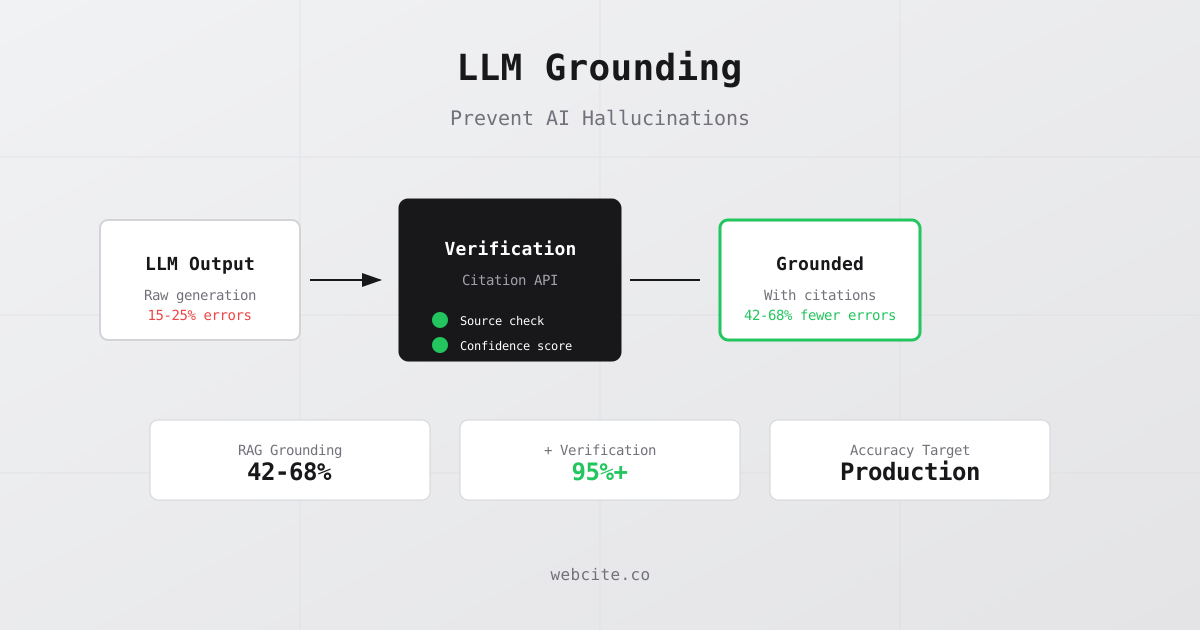
- The architecture reduces hallucination but does not eliminate it; external verification via APIs like Webcite provides an independent second check.
- The SELF-RAG framework has been cited over 700 times and influenced production RAG systems at Google, Meta, and Microsoft.
What Problem Does SELF-RAG Solve?
Standard Retrieval-Augmented Generation (RAG) has a structural limitation. It retrieves passages for every query, feeds them to the model, and hopes the model uses them correctly. This creates three failure modes that SELF-RAG addresses.
First, unnecessary retrieval. Not every query benefits from retrieval. If someone asks “What is 2 + 2?” or “Write a poem about rain,” retrieving web documents adds noise without improving the answer. Standard RAG retrieves anyway, sometimes causing the model to generate worse responses than it would have without retrieval. A 2024 study from Microsoft Research found that indiscriminate retrieval degrades output quality on 15% to 20% of queries, according to Shi et al., Microsoft Research, 2024.
Second, irrelevant passages. Even when retrieval is appropriate, the retrieved passages may not be relevant to the specific question. Standard RAG systems rely on embedding similarity to find passages, but semantic similarity does not guarantee factual relevance. A LangChain survey of 1,340 AI practitioners found that retrieval quality is the top challenge in production RAG systems, with 45% of teams reporting issues with irrelevant context, according to LangChain, 2025. A passage about “enterprise AI spending” might be retrieved for a query about “enterprise AI ROI” even though it contains no specific ROI data.
Third, unsupported generation. The most dangerous failure mode occurs when the model generates text that contradicts or is not supported by the retrieved passages. The model has the right context but produces the wrong answer. This is where standard RAG hallucination originates: the model “knows” what the passages say but generates something different. General-purpose LLMs exhibit hallucination rates of 3% to 27% even with RAG, according to Galileo AI, 2025.
SELF-RAG attacks all three failure modes by teaching the model to reflect at each stage.
How Does the SELF-RAG Architecture Work?
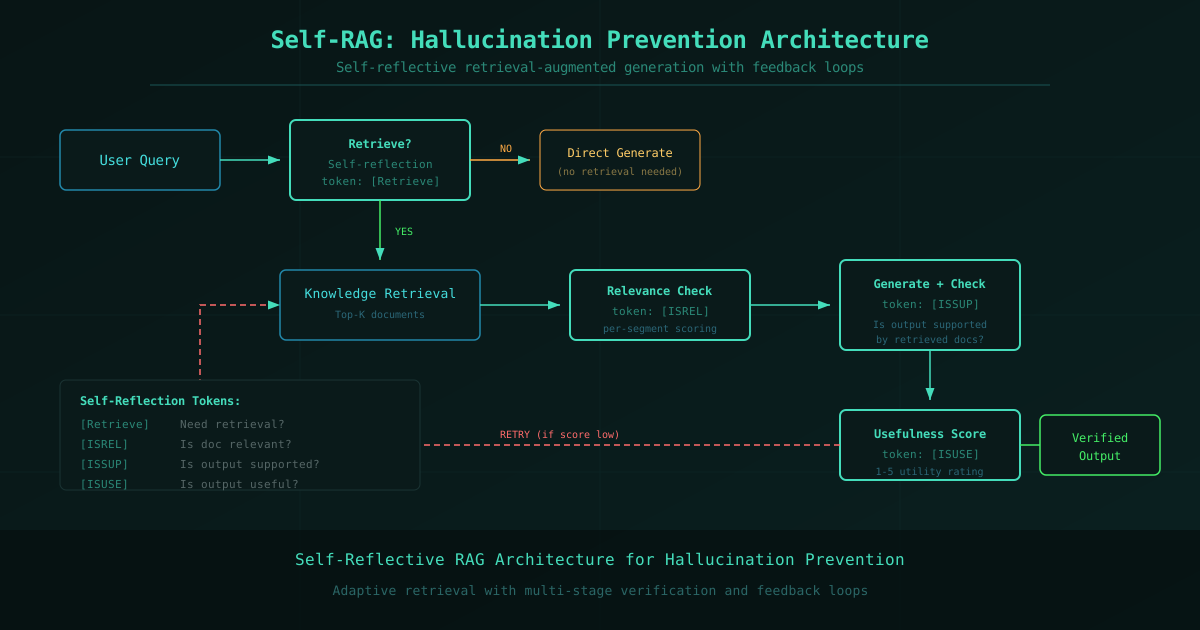
SELF-RAG introduces three types of reflection tokens that the model generates alongside its regular text output. These tokens act as decision points that control the generation process.
Reflection Token 1: Retrieve
Before generating each segment of text, the model outputs a Retrieve token that is either “yes” or “no.” This token represents the model’s judgment about whether external information would improve the current response. If the model is confident in its knowledge (simple factual recall, creative tasks, logical reasoning), it generates “no” and proceeds without retrieval. If it detects uncertainty, it generates “yes” and triggers a retrieval step.
This is fundamentally different from standard RAG, where retrieval is a fixed step that occurs for every query regardless of need.
Reflection Token 2: ISREL (Passage Relevance)
After retrieval, the model evaluates each retrieved passage and generates an ISREL token: “relevant” or “irrelevant.” Passages marked irrelevant are discarded before they can influence generation. This filtering step prevents the model from being misled by passages that are semantically similar but factually unrelated.
The ISREL evaluation uses the model’s own understanding of the query and the passage content. It is not a separate retrieval model; it is the same language model applying its comprehension abilities to judge relevance.
Reflection Token 3: ISSUP (Response Support)
After generating a response segment, the model produces an ISSUP token that evaluates whether the generated text is “fully supported,” “partially supported,” or “not supported” by the retrieved passages. This is the internal evaluation step. The model examines its own output against the evidence and flags unsupported claims.
If the ISSUP token indicates “not supported,” the model can regenerate the segment with a different approach or explicitly qualify the claim as uncertain.
The training process for these reflection tokens uses a two-stage approach. First, a critic model (GPT-4 in the original paper) generates ground-truth reflection labels for a large training dataset. Then, the target model (Llama 2, 7B or 13B) is trained to predict both the regular text tokens and the reflection tokens simultaneously, according to Asai et al., 2023.
How Does SELF-RAG Compare to Standard RAG on Benchmarks?
The original SELF-RAG paper evaluated performance on six benchmarks spanning open-domain question answering, reasoning, and fact verification. The results showed consistent improvements.
On PopQA (open-domain questions about less popular entities), SELF-RAG with Llama 2 13B scored 55.8% accuracy compared to 45.7% for standard RAG with the same model and 51.3% for ChatGPT, according to Asai et al., 2023. On biography generation (FactScore benchmark), SELF-RAG achieved 81.2% factual precision compared to 71.4% for standard RAG.
The most striking result was on the ALCE citation accuracy benchmark. SELF-RAG generated responses with correct citations 78% of the time compared to 55% for standard RAG. The model’s ability to evaluate its own output quality directly translated to better source attribution, a capability that connects to real-world needs for source attribution in AI systems.
On PubHealth (public health claim verification), SELF-RAG achieved 72.4% accuracy compared to 69.2% for GPT-4 with RAG. This benchmark is particularly relevant because it tests the model’s ability to assess factual claims against evidence, which is exactly the task where self-reflection adds the most value.
The SELF-RAG paper has accumulated over 700 citations since October 2023, making it one of the most referenced RAG architecture papers in the field, according to Semantic Scholar, 2026.
The efficiency gains matter too. Because SELF-RAG skips retrieval when it is not needed, it makes 40% to 60% fewer retrieval calls than standard RAG on mixed-query workloads. Fewer retrieval calls mean lower latency and lower cost in production systems.
What Are the Limitations of Self-Critique?
SELF-RAG’s reflective approach significantly improves over standard RAG, but it has inherent limitations that practitioners must understand.
The model’s critique is bounded by its training data. SELF-RAG learns to generate reflection tokens from a critic model (GPT-4) that itself has limitations. If the critic model cannot detect a particular type of error during training data generation, the target model will not learn to detect it either. The internal evaluation is a learned skill, not a logical proof of correctness.
Temporal knowledge gaps persist. SELF-RAG can evaluate whether its response is supported by retrieved passages, but if the passages themselves contain outdated information, the model has no way to detect the staleness. A passage from 2023 stating “GPT-4 is the most capable model” would pass the ISSUP check even though the claim is outdated in 2026. The retrieval system’s index freshness limits the model’s factual accuracy.
Domain transfer is imperfect. The original SELF-RAG model was trained on a general-purpose corpus. When applied to specialized domains like medicine, law, or finance, the reflection tokens may not capture domain-specific error patterns. Stanford researchers demonstrated that even RAG-augmented legal AI tools hallucinate in 17% to 33% of queries, according to Magesh et al., Stanford Law School, 2024. Domain-specific training of both the retrieval system and the reflection mechanism is needed for high-stakes applications.
Calibration drift occurs over time. As the knowledge landscape changes, the model’s internal calibration of “what requires retrieval” and “what counts as supported” can become misaligned. Vectara’s hallucination leaderboard shows that even the best LLMs hallucinate 3% to 5% of the time on straightforward factual questions, according to Vectara, 2025. A claim that was common knowledge in 2024 may be contested in 2026, but the model’s reflection tokens still judge it as needing no retrieval.
These limitations define where external verification becomes essential.
How Does External Verification Complement SELF-RAG?
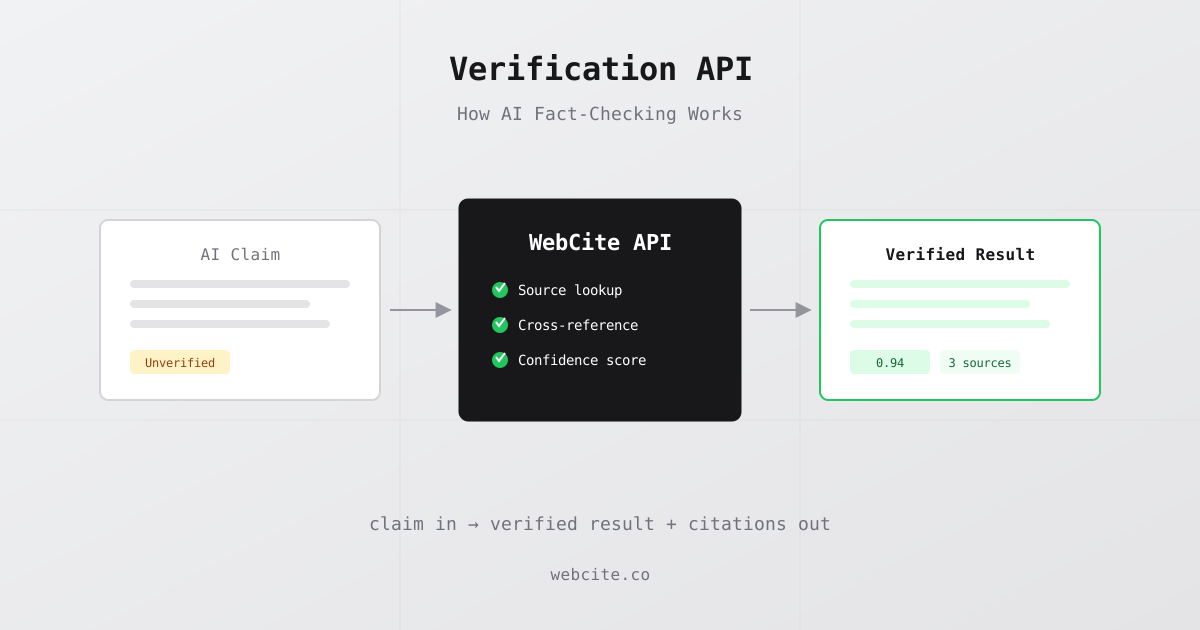
SELF-RAG provides internal reflection: the model evaluating its own output against its own retrieved evidence. External verification provides an independent check: a separate system evaluating the model’s claims against real-world sources that the model never accessed.
The two approaches catch different types of errors.
SELF-RAG catches: responses that contradict retrieved passages, answers generated without sufficient evidence, irrelevant retrieval results that would mislead generation, and queries where retrieval is unnecessary.
External verification catches: claims supported by retrieved passages that are themselves incorrect or outdated, factual statements the model generated confidently but that are wrong, claims about recent events that occurred after the model’s training cutoff, and domain-specific errors that the model’s reflection mechanism was not trained to detect.
The combination creates two layers of defense. SELF-RAG reduces the hallucination rate at generation time. A verification API catches the remaining errors before output reaches production. The result is a lower error rate than either approach achieves alone.
Here is how an external verification step integrates after a SELF-RAG pipeline:
import requests

def verify_with_webcite(claims):
    results = []
    for claim in claims:
        response = requests.post(
            "https://api.webcite.co/api/v1/verify",
            headers={
                "x-api-key": "your-api-key",
                "Content-Type": "application/json"
            },
            json={
                "claim": claim,
                "include_stance": True,
                "include_verdict": True
            }
        )
        result = response.json()
        results.append({
            "claim": claim,
            "verdict": result.get("verdict", {}).get("result"),
            "confidence": result.get("verdict", {}).get("confidence"),
            "sources": result.get("citations", [])
        })
    return results

self_rag_output = "SELF-RAG was published by University of Washington researchers in 2023..."
claims = extract_claims(self_rag_output)  # Your claim extraction logic
verified = verify_with_webcite(claims)
This pattern works with any RAG variant: standard RAG, SELF-RAG, CRAG (Corrective RAG from Anthropic), or custom implementations. The verification step is model-agnostic because it checks claims against external sources, not against the model’s internal state. For a deeper look at detecting hallucinations across different RAG architectures, see our guide on RAG hallucination detection.
What Variants of SELF-RAG Have Emerged?
The SELF-RAG paper catalyzed a wave of research into reflective and adaptive retrieval architectures. Several notable variants have emerged since the original publication.
CRAG (Corrective RAG), published by researchers from Rutgers and Baidu in January 2024, adds a lightweight retrieval evaluator that grades retrieved documents as correct, incorrect, or ambiguous. Documents graded as incorrect trigger web search as a fallback, and all documents pass through a knowledge refinement step before generation, according to Yan et al., 2024. CRAG focuses on correcting bad retrieval, while SELF-RAG focuses on deciding whether to retrieve at all.
Adaptive-RAG, published by researchers from KAIST in March 2024, uses a classifier to dynamically select between no retrieval, single-step retrieval, and multi-step retrieval based on query complexity. Simple queries skip retrieval entirely; complex queries trigger iterative retrieval and reasoning, according to Jeong et al., 2024. This approach automates the retrieval strategy selection that SELF-RAG’s Retrieve token handles.
Self-Reflective RAG with Re-ranking, explored by multiple research groups in 2024 and 2025, combines SELF-RAG’s reflection tokens with learned re-ranking models that reorder retrieved passages before the model processes them. Google’s Gemini and Anthropic’s Claude have both incorporated elements of adaptive retrieval into their production RAG pipelines. Enterprise adoption of advanced RAG architectures grew 89% in 2025, according to Menlo Ventures, 2025.
The trend across all variants is the same: static “retrieve everything” RAG is being replaced by dynamic, self-evaluating architectures that make context-dependent decisions about when and what to retrieve. Gartner predicts that by 2027, over 50% of enterprise RAG deployments will use adaptive retrieval strategies rather than fixed retrieval pipelines, according to Gartner, 2025.
How to Apply SELF-RAG Principles Without Fine-Tuning
Not every team can fine-tune a model to generate reflection tokens. The good news is that SELF-RAG’s core principles can be approximated through prompt engineering and multistep workflows with any model, including closed-source ones like GPT-4o, Claude 3.5 Sonnet, or Gemini 1.5 Pro.
The first principle, selective retrieval, can be implemented by asking the model whether retrieval would help before triggering it. A system prompt that instructs the model to respond with “[NEEDS_RETRIEVAL]” or “[NO_RETRIEVAL]” before answering achieves a similar effect to the Retrieve token.
The second principle, passage relevance filtering, can be implemented as a separate LLM call that evaluates each retrieved passage against the query and returns a relevance score. Passages below a threshold are dropped before the main generation step.
The third principle, output support verification, maps directly to a verification API call. Instead of relying on the model’s internal ISSUP assessment, send each generated claim to Webcite for independent evaluation:
const response = await fetch("https://api.webcite.co/api/v1/verify", {
  method: "POST",
  headers: {
    "x-api-key": process.env.WEBCITE_API_KEY,
    "Content-Type": "application/json"
  },
  body: JSON.stringify({
    claim: "SELF-RAG outperformed GPT-4 on factuality benchmarks",
    include_stance: true,
    include_verdict: true
  })
})

const result = await response.json()
// External verification replaces the ISSUP reflection token
// with an independent source-backed assessment
Webcite’s free tier includes 50 credits per month ($0) for testing this integration. The Builder plan at $20 per month provides 500 credits for 125 verifications. Enterprise plans start at 10,000+ credits with custom pricing for production RAG pipelines.
The combination of prompt-based selective retrieval, LLM-as-judge relevance filtering, and API-based output verification approximates the full SELF-RAG pipeline without requiring any model training. It is not as efficient as native reflection tokens, which add minimal overhead during inference, but it achieves the same goal: reducing hallucination through systematic self-evaluation and verification.
Frequently Asked Questions
What does SELF-RAG stand for?
SELF-RAG stands for Self-Reflective Retrieval-Augmented Generation. It is a framework developed by researchers at the University of Washington and IBM Research that trains language models to adaptively retrieve passages, generate text, and critique their own output using special reflection tokens.
How is SELF-RAG different from standard RAG?
Standard RAG always retrieves passages for every query, regardless of whether retrieval is needed, and never evaluates whether the retrieved passages actually support the generated response. SELF-RAG adds three reflection steps: it decides whether to retrieve, evaluates passage relevance, and checks whether the response is supported by the passages. This selective, self-critical approach reduces hallucination and improves factual accuracy.
Does SELF-RAG eliminate hallucinations completely?
No. SELF-RAG significantly reduces hallucination rates compared to standard RAG and non-retrieval baselines, but it does not eliminate them entirely. The model’s internal evaluation is learned during training and can still miss errors, especially on out-of-distribution queries. External verification through an API like Webcite provides an independent check that catches errors the model’s own reflection misses.
What are SELF-RAG reflection tokens?
Reflection tokens are special tokens the model generates during inference that control its behavior. The three main types are: Retrieve (should I look up information?), ISREL (is this passage relevant?), and ISSUP (does the passage support my response?). These tokens are trained through supervised learning on a critic model’s judgments.
Can I use SELF-RAG with any LLM?
The original SELF-RAG paper fine-tuned Llama 2 models (7B and 13B parameters). The framework requires training the model to generate reflection tokens, which means it cannot be applied to closed-source models like GPT-4 or Claude without fine-tuning access. However, the principles of selective retrieval and self-assessment can be approximated through prompt engineering and multistep workflows with any model.
How does Webcite complement SELF-RAG?
SELF-RAG provides internal reflection during generation. Webcite provides external verification after generation. SELF-RAG catches errors the model can detect about its own output. Webcite catches errors by checking claims against independent real-world sources. Using both creates two layers of verification: one at generation time and one before the output reaches production.