Reuters employs over 2,500 journalists across 200 locations to verify information before publication, according to Reuters, 2024. That operation costs millions annually. Meanwhile, 47 percent of enterprise AI users have made business decisions based on hallucinated content, according to Korra, 2024. The gap between the volume of AI content that needs checking and the capacity of human reviewers to check it is widening every quarter.
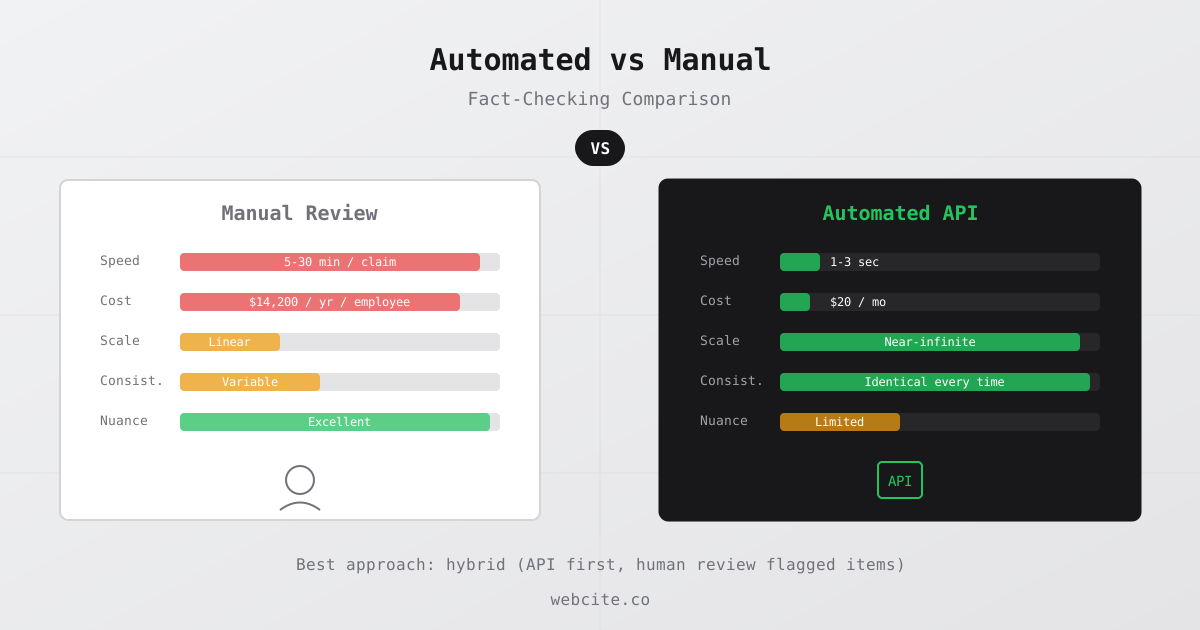
- Manual fact-checking costs approximately $14,200 per employee per year in lost productivity, while automated API checking starts at $20 per month.
- Automated verification returns results in 1-3 seconds per claim versus 5-30 minutes for manual review.
- Human reviewers still outperform automation on nuanced, context-dependent claims requiring editorial judgment.
- A hybrid workflow (API first, human review for flagged items) reduces manual review volume by 60-80 percent.
- Organizations like the Associated Press and Agence France-Presse now use automated tools alongside human fact-checkers.
The Scale Problem: Why Manual Fact-Checking Cannot Keep Up
The volume of content that needs verification has outgrown the capacity of human reviewers. Employees spend an average of 4.3 hours per week verifying AI-generated content, costing approximately $14,200 per employee annually, according to Korra, 2024. For a team of 10 content producers, that is $142,000 per year spent on manual verification alone.
The problem compounds as AI content generation scales. A single GPT-4 instance can produce 50,000 words per hour. A human fact-checker handles roughly 1,000 words per hour when doing thorough verification. That is a 50-to-1 mismatch between generation speed and verification capacity.
News organizations understood this mismatch early. The Associated Press adopted automated reporting tools in 2014 for corporate earnings stories, increasing their quarterly earnings coverage from 300 to 4,400 stories, according to AP News, 2024. But each automated story still required some form of verification. Without automated checking, that 15x increase in output would have required a 15x increase in editorial staff.
Stanford HAI researchers found that even RAG-powered legal AI tools hallucinate in 1 out of 6 or more benchmarking queries, according to Stanford HAI, 2025. Manual verification of every AI output at that error rate is not sustainable for any team producing content at scale.
Head-to-Head: Automated vs Manual Fact-Checking
The comparison breaks down across five dimensions. Each has a clear winner depending on the use case.
| Dimension | Manual Fact-Checking | Automated API Fact-Checking |
|---|---|---|
| Speed | 5-30 minutes per claim | 1-3 seconds per claim |
| Cost | $14,200/employee/year | $20/month (Webcite Builder) |
| Consistency | Varies by reviewer | Identical every time |
| Scalability | Linear (more staff = more checks) | Near-infinite (API scales horizontally) |
| Nuance | Excellent (context, sarcasm, intent) | Limited (relies on published sources) |
| Coverage | Limited by reviewer expertise | Limited by source database |
Speed. A verification API processes a claim in 1 to 3 seconds. A human fact-checker at a major newsroom takes 5 to 30 minutes per claim depending on complexity, according to the Duke Reporters Lab. For a 10-claim article, automated checking completes in under 30 seconds. Manual checking takes 1 to 5 hours.
Cost. The Webcite Builder plan costs $20 per month for 500 credits, enough for 125 full verifications. Each verification uses 4 credits: 2 for citation retrieval, 1 for stance detection, 1 for the verdict. At enterprise scale with 10,000+ credits, the cost per verification drops below $0.02. Compare that to the $14,200 annual per-employee cost of manual verification, and the ROI becomes immediate.
Consistency. Human reviewers have good days and bad days. A reviewer checking their 50th claim at 4 PM on Friday will miss things they would have caught at 9 AM on Monday. An API returns the same result for the same claim every time. Google DeepMind found that AI consistency eliminates the 15-20 percent variance typically seen in human annotation tasks, according to AllAboutAI, 2026.
Scalability. Manual fact-checking scales linearly. Doubling your throughput requires doubling your staff. Automated checking scales horizontally with infrastructure. A verification API can process 1,000 claims per hour as easily as 10.
Nuance. This is where manual fact-checking wins. Consider the claim “Apple is the most innovative company in the world.” A human understands this is a subjective opinion, not a verifiable fact. An API might search for supporting sources and return “insufficient evidence” without recognizing the claim is not the type that can be verified. Manual reviewers bring editorial judgment that algorithms lack.
When Manual Fact-Checking Is the Better Choice
Automated tools have clear limitations. Understanding these helps you design the right workflow.
Context-dependent claims. “The economy improved under President Johnson” requires knowing which President Johnson, which economy metric, and which time period. Human reviewers parse context naturally. APIs need explicit disambiguation.
Emerging topics. When a story breaks, published sources lag behind reality by hours or days. A claim about a developing situation may have no indexed sources yet. Manual reviewers can make phone calls, consult primary witnesses, and apply firsthand reporting. APIs are limited to what has been published and indexed.
Satirical and rhetorical content. Agence France-Presse runs one of the largest fact-checking operations globally with dedicated desks in over 80 countries, according to AFP Fact Check, 2024. Their human reviewers routinely encounter satire, parody, and rhetorical claims that automated systems would misclassify as genuine factual assertions.
Cultural and regional nuance. A claim that is true in one jurisdiction may be false in another. Tax rates, legal precedents, and medical guidelines differ by country. A human reviewer with regional expertise catches these distinctions. An API checking against global sources may conflate jurisdictions.
Editorial judgment calls. Some claims are technically true but misleading. “Crime rates dropped 50 percent” is verifiable, but without the context that the comparison period was an unusual spike year, it is misleading. Human reviewers exercise judgment about whether a technically accurate claim is fair. PolitiFact, the Pulitzer Prize-winning fact-checking organization, uses a six-level “Truth-O-Meter” that captures this nuance, according to PolitiFact, 2024.
When Automated Fact-Checking Is the Better Choice
Automated verification excels in scenarios where speed, volume, and consistency matter more than nuanced judgment.
High-volume content pipelines. If your platform generates hundreds of articles per day, manual review of every claim is not feasible. An API like Webcite can check every factual claim in every article before publication, flagging only the ones that need human review. This is the pattern used by AI writing tools like Jasper and Writer.
Real-time applications. Chatbots that need fact-checking cannot wait 30 minutes for a human reviewer. An API call that returns in 2 seconds fits within the user experience. Customer support bots, research assistants, and conversational AI all require this real-time verification capability.
Consistent baselines. Regulatory compliance requires consistent, auditable verification. The EU AI Act Article 50 mandates AI output transparency by August 2026, according to the official EU AI Act text, 2024. An API that logs every claim, source, verdict, and confidence score creates the audit trail that regulators require. Human reviewers do not naturally produce this structured data.
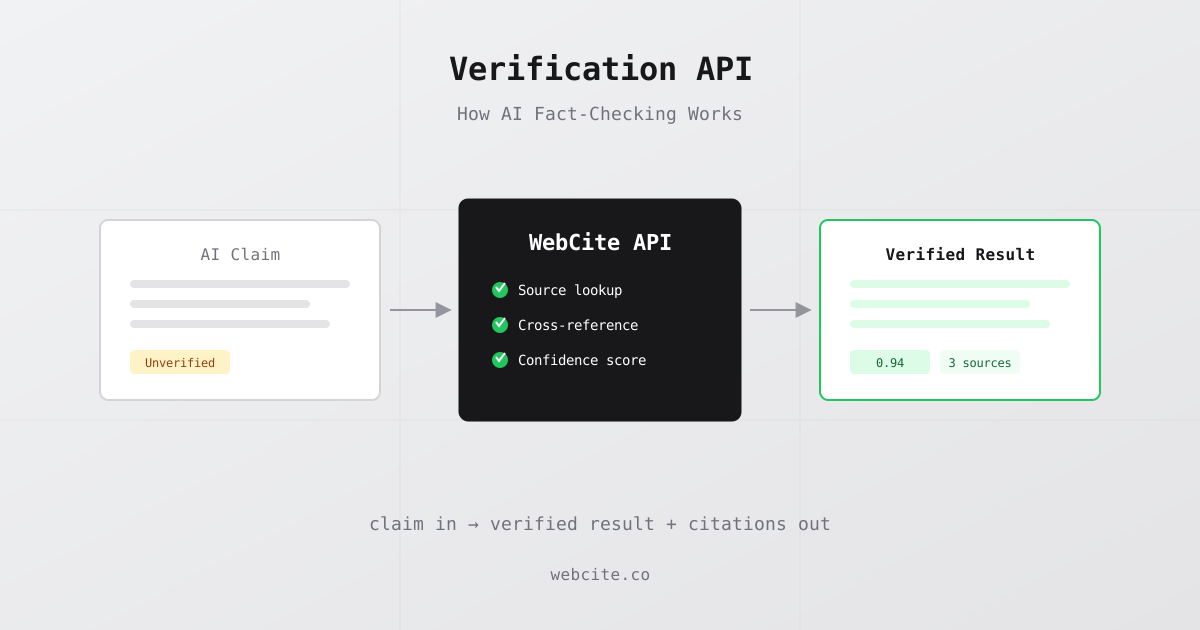
Repetitive claim types. Financial data, sports statistics, product specifications, and geographic facts are all well-suited to automated checking. These claims have clear right-or-wrong answers in published sources. The Webcite API handles these in a single call:
const response = await fetch("https://api.webcite.co/api/v1/verify", {
  method: "POST",
  headers: {
    "x-api-key": process.env.WEBCITE_API_KEY,
    "Content-Type": "application/json"
  },
  body: JSON.stringify({
    claim: "Tesla delivered 1.81 million vehicles in 2023",
    include_stance: true,
    include_verdict: true
  })
})

const result = await response.json()
// result.verdict.result: "supported"
// result.verdict.confidence: 96
// result.citations: [{ title: "Tesla IR", url: "...", stance: "for" }]
Cost-sensitive operations. A startup with a $500 monthly content budget cannot hire a full-time fact-checker at $60,000 per year. The Webcite free tier provides 50 credits per month at $0, and the Builder plan at $20 per month covers most small-team needs. Enterprise plans start at 10,000+ credits for organizations operating at scale.
The Hybrid Approach: API First, Human Review Second
The most effective fact-checking workflow is neither purely automated nor purely manual. It is a hybrid that uses each approach where it performs best.
The pattern works in three stages:
Stage 1: Automated first pass. Every claim goes through the verification API. Claims that return “supported” with high confidence (above 0.85) pass through. Claims that return “contradicted” get flagged for removal or correction. This stage handles 60 to 80 percent of all claims without human involvement.
Stage 2: Human review of flagged items. Claims that return “insufficient evidence” or confidence scores below 0.85 get routed to a human reviewer. This is a much smaller queue, typically 20 to 40 percent of the original volume. The reviewer sees the API results as a starting point, not a blank slate. They know what sources were checked and what the initial verdict was.
Stage 3: Feedback loop. When human reviewers override an API verdict, that decision feeds back into the system. Over time, the team builds a knowledge base of edge cases and exceptions that improves both the automated and manual processes.
Here is what this looks like in practice:
async function hybridFactCheck(claims) {
  const results = await Promise.all(
    claims.map(claim =>
      fetch("https://api.webcite.co/api/v1/verify", {
        method: "POST",
        headers: {
          "x-api-key": process.env.WEBCITE_API_KEY,
          "Content-Type": "application/json"
        },
        body: JSON.stringify({
          claim,
          include_stance: true,
          include_verdict: true
        })
      }).then(r => r.json())
    )
  )

  const approved = []
  const flagged = []

  results.forEach((result, i) => {
    const confidence = result.verdict?.confidence || 0
    const verdict = result.verdict?.result

    if (verdict === "supported" && confidence >= 85) {
      approved.push({ claim: claims[i], sources: result.citations })
    } else {
      flagged.push({ claim: claims[i], verdict, confidence, sources: result.citations })
    }
  })

  return { approved, flagged }
}
The Associated Press uses a similar hybrid model. Their automated tools handle routine earnings reports and sports scores. Human editors review any output that falls outside established templates, according to AP News, 2024. This approach lets them publish 4,400 quarterly earnings stories without a proportional increase in editorial staff.
Real-World Cost Comparison
The economics favor automation for all but the smallest operations.
Manual-only workflow. A mid-size content team of 5 people spending 4.3 hours per week each on verification costs $71,000 per year. That covers roughly 250 claims per week at 5-30 minutes each, or about 13,000 claims per year.
Automated-only workflow. The Webcite Builder plan at $20 per month provides 500 credits, enough for 125 verifications per month or 1,500 per year. Annual cost: $240. For higher volume, enterprise plans at custom pricing handle 10,000+ credits per month. Even at the enterprise tier, the annual cost is a fraction of a single employee’s verification time.
Hybrid workflow. Using automated checking for the first pass and human review for 20-30 percent of flagged claims cuts manual verification time by 70-80 percent. That same 5-person team now spends 1.1 hours per week on verification instead of 4.3 hours. Annual savings: approximately $50,000.
The productivity data supports this approach. According to research from Korra, AI hallucinations cost enterprises an estimated $67.4 billion in 2024, according to Korra, 2024. That figure includes not just direct errors but lost productivity from manual verification workflows that could be automated.
How to Implement a Hybrid Workflow with Webcite
Getting started requires minimal setup. Webcite operates as a REST API with x-api-key authentication and returns structured JSON.
Step 1: Set your confidence threshold. Decide which confidence level triggers human review. Most teams start at 0.80 and adjust upward as they build trust in the system. Higher thresholds mean more claims go to human review but fewer errors slip through.
Step 2: Route claims by type. Not every claim needs the same treatment. Numerical claims (dates, prices, statistics) are well-suited to automated checking. Subjective assessments, predictions, and opinion-adjacent claims should default to human review regardless of API confidence.
Step 3: Build the review queue. When the API flags a claim, present the reviewer with the claim text, the API verdict, the confidence score, and the sources that were checked. This context cuts review time from 15 minutes per claim to 3-5 minutes because the reviewer is not starting from scratch.
Step 4: Track and measure. Log every API call and every human override. After 30 days, analyze how often humans agree with the API verdict. If agreement exceeds 90 percent at your confidence threshold, consider raising the threshold to reduce the review queue further.
Webcite pricing supports this iterative approach. The free tier at 50 credits per month lets you test the workflow on a sample of your content. The Builder plan at $20 per month handles production workloads for most teams. Enterprise plans with 10,000+ credits support high-volume pipelines with dedicated assistance.
Frequently Asked Questions
Is automated fact-checking more accurate than manual?
Automated fact-checking is more consistent but not always more accurate. APIs check claims against the same source database every time, eliminating human variability. Manual reviewers still outperform automation on nuanced claims requiring cultural context, sarcasm detection, or domain expertise that is not well-represented in published sources.
How much does automated fact-checking cost compared to manual?
Manual fact-checking costs approximately $14,200 per employee per year in lost productivity alone, according to Korra, 2024. Automated API fact-checking starts at $0 with free tiers and scales to $20 per month for 500 credits on platforms like Webcite. At enterprise scale, the cost per automated check drops below $0.02.
Can automated fact-checking fully replace human reviewers?
Not entirely. Automated systems excel at high-volume, real-time verification of straightforward factual claims. Human reviewers remain essential for context-dependent claims, emerging topics with limited source coverage, and editorial judgment calls. The most effective approach is a hybrid workflow where APIs handle the first pass and humans review flagged items.
How fast is automated fact-checking compared to manual?
Automated verification APIs return results in 1 to 3 seconds per claim. Manual fact-checking takes 5 to 30 minutes per claim depending on complexity, according to the Duke Reporters Lab. For a 10-claim article, automated checking takes under 30 seconds versus 1 to 5 hours manually.
What is a hybrid fact-checking workflow?
A hybrid workflow routes all claims through an automated API first. Claims that return a clear supported or contradicted verdict pass through without human review. Claims flagged as insufficient evidence or low confidence get escalated to a human reviewer. This approach reduces manual review volume by 60 to 80 percent while maintaining editorial quality.