The global AI market reached $184 billion in 2024 and is projected to exceed $826 billion by 2030, according to Statista. As AI applications scale, the need for reliable fact-checking and citation APIs has grown from a nice-to-have to a hard requirement. Models generate fluent text, but they hallucinate, and studies estimate that large language models produce factual errors in 15 to 25 percent of their outputs (source: Vectara Hallucination Index, 2024).
Whether you are building a research assistant, a content verification tool, or an AI-powered writing platform, choosing the right fact-checking API determines whether your users can trust what your product tells them. This article provides a data-backed comparison of the leading options.
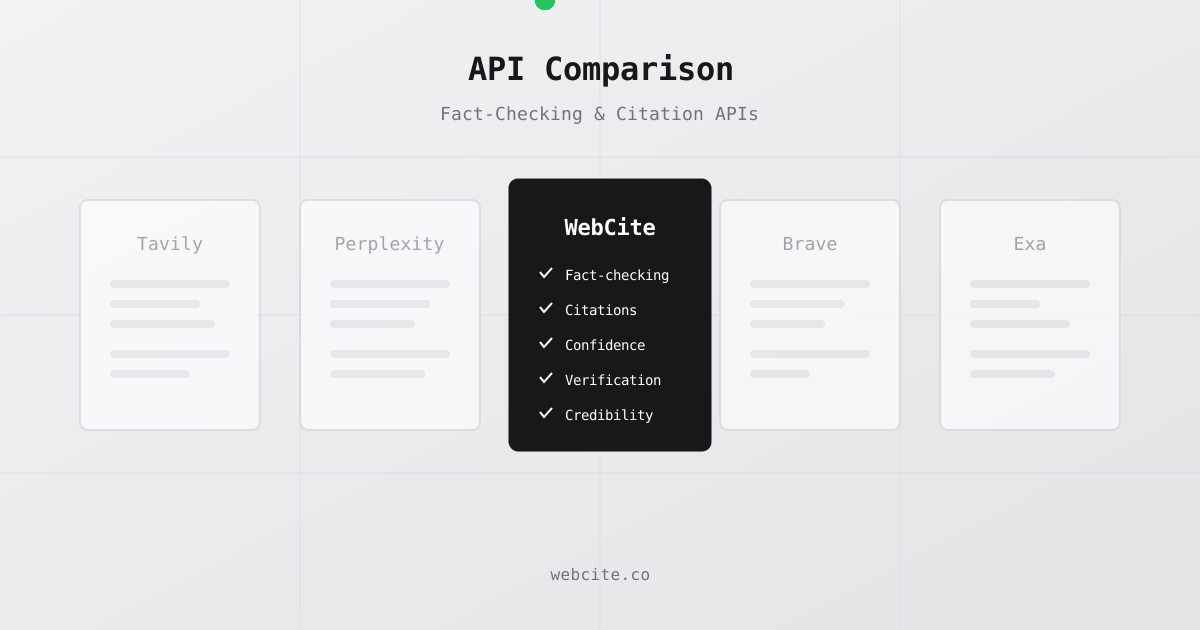
- Webcite is the only API here that verifies claims, scores source credibility, and returns structured citations in one call. The others return search results and leave accuracy up to you.
- Tavily and Brave Search are search tools. They find pages; they don't check whether those pages support or contradict a claim.
- Perplexity adds inline citations to a chat interface, but its API doesn't give you raw confidence scores or source quality data you'd need to build your own trust layer.
- Webcite starts free (50 credits/month) and scales to $20/month for 500 credits on the Builder plan.
- Enterprise adoption of AI verification tools grew 340% from 2023 to 2025 (CB Insights), which tells you where the market is heading.
The Contenders at a Glance
| Feature | Webcite | Tavily | Perplexity | Exa | Brave Search |
|---|---|---|---|---|---|
| Real-time fact checking | Yes | Limited | Yes | No | No |
| Structured citation extraction | Yes | No | Limited | Yes | No |
| Source verification & credibility scoring | Yes | No | No | No | No |
| Per-claim confidence scores | Yes | No | No | No | No |
| API response time | <2s | 3-5s | 2-4s | 1-3s | 1-2s |
| Pricing model | Credit-based | Per query | Subscription | Per query | Per query |
Why Fact-Checking APIs Matter Now
Fact-checking APIs are critical because LLM hallucinations make AI outputs unreliable without external verification. According to a 2024 Gartner report, more than 30% of generative AI projects will be abandoned by 2026 due to issues including poor data quality and hallucinated outputs. The enterprise demand for verifiable AI is accelerating.
Enterprise losses from AI hallucinations reached $67.4 billion in 2024, according to Korra, 2024. A good verification API does not just search the web. It evaluates source credibility, extracts relevant passages, and returns structured citations your application can render inline. The difference between a search API and a fact-checking API is the difference between giving users a list of links and giving them verified, citable evidence.
“The most dangerous misinformation is not the kind that is obviously false. It is the kind that is almost true, mixed with just enough real data to be convincing.”
Webcite’s Approach
Integrated Fact-Checking Pipeline
Webcite is the only API in this comparison that provides an end-to-end fact-checking pipeline in a single call. Unlike competitors that offer search-only capabilities, every Webcite API call returns verified, structured data rather than raw search results that your application has to parse and evaluate.
Here’s what happens when you make an API call:
- Webcite searches the web for sources relevant to your specific claim.
- It checks whether those sources actually support, contradict, or say nothing about the claim.
- You get back structured citations with a confidence score for each claim, not a generic relevance ranking.
- This works across 40+ languages, so the same call handles English, Spanish, Arabic, or Mandarin content.
Here is what a typical API call looks like:
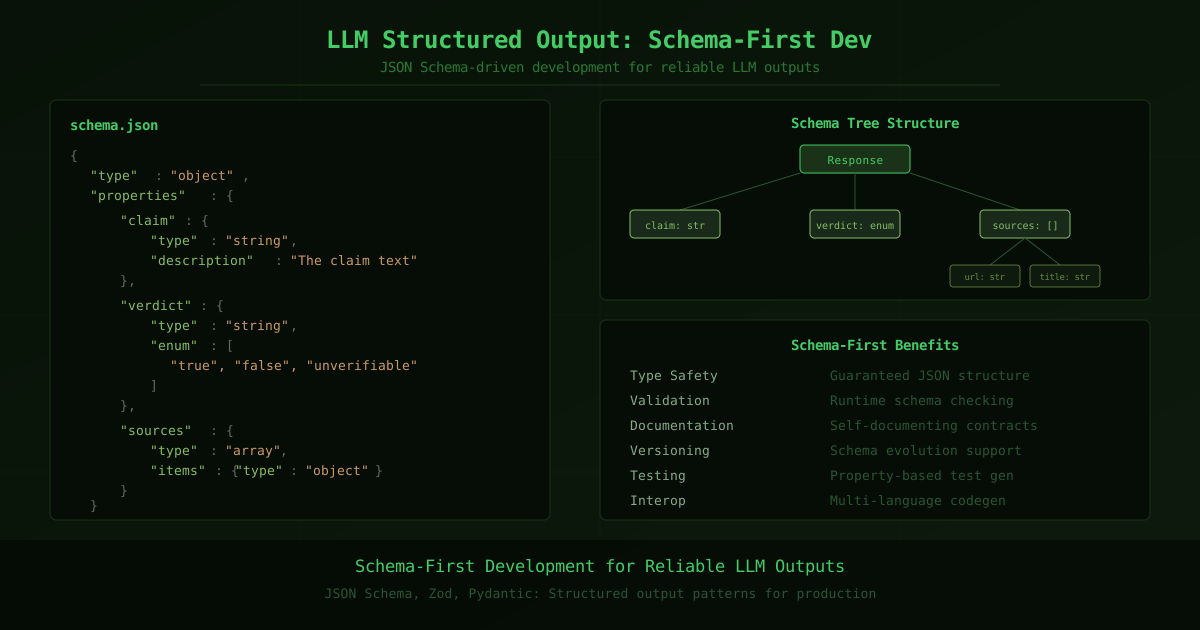
const response = await fetch("https://api.webcite.co/api/v1/verify", {
  method: "POST",
  headers: {
    "x-api-key": "your-api-key",
    "Content-Type": "application/json"
  },
  body: JSON.stringify({
    claim: "The global AI market is worth $184 billion",
    include_stance: true,
    include_verdict: true
  })
})

const result = await response.json()
The response includes each source’s credibility score, the exact passage that supports or refutes the claim, and a direct citation link, all in a single API call.
Citation Quality
Most APIs just hand you a URL. Webcite goes further: it pulls the actual passage that matters, tells you how confident it is about each individual claim, and flags whether you’re looking at an original study or someone’s summary of it.
What does that look like in practice?
- You get the exact quote from a source, not just a link to the homepage. If a statistic lives on page 14 of a PDF, the citation points there.
- Each claim gets its own confidence score. One sentence in your text might be well supported while the next has thin evidence, and the API tells you which is which.
- The response labels each source as academic, news, government, or blog, so your app can weight them differently or display them accordingly.
Developer Experience
According to Deloitte, 2024, 68% of enterprises increased their AI budgets in 2024, with accuracy and trust cited as the top barrier to wider deployment. On the practical side: the API is RESTful with full OpenAPI docs, so you can use fetch, curl, or whatever HTTP client you already have. There’s webhook support if you need to verify large batches asynchronously. The free tier gives you 50 credits a month to test with.
Detailed Competitor Comparison
Tavily
Tavily is a search API, not a fact-checking API. It excels at returning clean, structured search results quickly for LLM integration. However, Tavily does not verify claims against sources or provide confidence scoring. It returns search results and leaves verification to your application logic. Stanford researchers found that even RAG-powered legal AI tools hallucinate in 17 to 33 percent of queries, according to Stanford Law, 2025, which illustrates why search alone is insufficient.
Best for: Quick prototyping, basic search integration, RAG pipelines where source verification is handled downstream.
Limitation: No built-in fact-checking. You get search results, not verified citations.
Perplexity
A 2024 NewsGuard audit found that leading chatbots generated misinformation in 32% of test prompts. Perplexity is the closest competitor to Webcite for end-user citation experience, but it lacks granular confidence data. It offers a conversational search API that returns natural-language answers with inline citations, but its API is subscription-based and does not expose per-claim confidence scores or source credibility data.
Best for: Consumer-facing applications where a conversational search experience is the primary use case.
Limitation: Subscription pricing (not per-query), limited citation structure, no granular confidence data.
Exa
Exa is a semantic search engine, not a fact-checker. You describe what you are looking for in natural language, and Exa returns matching content. It is strong at content discovery but does not perform claim verification or return confidence scores.
According to McKinsey, 2024, 72% of organizations now use AI in at least one business function, which means the demand for reliable source retrieval is growing fast. Exa fits the discovery layer but leaves the verification step to other tools.
Best for: Research-focused applications, content discovery, finding similar documents at scale.
Limitation: No fact-checking pipeline. Higher price point ($99/month minimum).
Brave Search
Brave Search API is the cheapest option for high-volume web search, but it offers zero verification capabilities. It provides privacy-focused search results at low cost. It does not offer fact-checking, citation extraction, or any verification layer.
Best for: Privacy-focused applications, high-volume search at the lowest cost per query.
Limitation: Search results only, with no verification, no citations, and no structured data.
When to Choose Each API
Here’s how to think about the decision:
If your app needs to tell users “this fact is verified and here’s where it came from,” Webcite is the only option that handles the full pipeline. Research tools, AI writing platforms, and compliance systems all fall in this bucket.
Tavily works well as a search layer inside a RAG pipeline, especially for prototyping. Just know that you’ll be writing your own verification logic on top of it.
Perplexity is a solid fit for consumer apps that want a chatbot-style search experience with inline citations, though you won’t get confidence data you can act on programmatically.
Exa shines at finding semantically similar documents across large corpora. Great for research, but it doesn’t check whether the content is actually true.
Brave Search is the budget option. The global fact-checking market is projected to reach $9.6 billion by 2028, according to Markets and Markets, 2024. High volume, low cost, privacy first, but no verification of any kind.
Pricing Comparison
These APIs use different pricing models, so a direct apples-to-apples comparison is not straightforward. Webcite uses a credit-based model where each full verification (citation retrieval, stance detection, verdict) costs 4 credits. The other providers charge per query or per subscription.
| Provider | Free Tier | Entry Paid Plan | Model |
|---|---|---|---|
| Webcite | 50 credits/mo (~12 verifications) | $20/mo (Builder, 500 credits) | Credit-based |
| Tavily | 1,000 queries/mo | $50/mo | Per query |
| Perplexity | Limited | $20/mo | Subscription |
| Exa | 100 queries/mo | $99/mo | Per query |
A 2025 Stack Overflow Developer Survey found that 76% of developers are using or planning to use AI tools in their development workflow, up from 44% in 2023. The key difference is what you get back for each call. A Webcite verification returns sourced citations with confidence scores and a verdict. A Tavily or Brave query returns search results that your application still needs to process. Perplexity returns a conversational answer but does not expose granular confidence data. The right choice depends on how much verification work you want to handle yourself.
Conclusion
Each API serves different needs, but for applications requiring verified facts and reliable citations, Webcite offers the most comprehensive solution. The integrated pipeline eliminates the need to chain multiple services together, reducing complexity and improving accuracy.
The right API depends on your use case. If you are building anything where trust and accuracy matter, and given that enterprise adoption of AI verification tools grew 340% between 2023 and 2025 according to CB Insights State of AI, 2025, it is worth evaluating Webcite’s approach to structured, verifiable citations.
Frequently Asked Questions
What is a fact-checking API?
A fact-checking API lets you send a claim and get back an answer: is this supported by real sources? Instead of returning a list of links, it evaluates whether those sources actually back up the claim and gives you structured citations you can show to users. It closes the loop that search APIs leave open.
How does Webcite compare to Tavily for fact-checking?
Webcite verifies claims and returns a verdict with scored citations. Tavily returns search results and leaves the verification to you. If you need to tell users “this fact is confirmed by these sources,” Webcite handles that out of the box. If you just need search results for a RAG pipeline, Tavily is simpler to start with.
Can I use a fact-checking API to reduce LLM hallucinations?
Yes. You run the LLM output through the API before showing it to users. The API checks each claim against real sources, flags anything unsupported, and attaches citations to the claims that hold up. Stanford researchers found RAG tools still hallucinate 17 to 33 percent of the time, so this extra step catches errors that retrieval alone misses.
What is the best API for AI citation generation?
Depends on what you need. Webcite gives you the full pipeline: verification, source scoring, and structured citations in one call. Exa is strong for semantic search and content discovery. Perplexity works well for conversational search with inline citations but doesn’t expose the raw data for programmatic use.
How much does a fact-checking API cost?
Pricing varies by provider. Webcite offers a free tier with 50 credits per month and a Builder plan at $20/month with 500 credits. Each full verification costs 4 credits. Tavily offers 1,000 free queries but starts at $50/month for paid plans. Perplexity charges $20/month (subscription-based), and Exa starts at $99/month.
How does Webcite’s credit system work?
Webcite uses a credit-based pricing model. Each full verification consumes 4 credits: 2 for citation retrieval, 1 for stance detection, and 1 for the final verdict. The free plan includes 50 credits per month, the Builder plan includes 500, and Enterprise plans start at 10,000+.