Google’s Grounding with Google Search reduced hallucinations by 65% for Gemini models in 2025, according to Google DeepMind. Anthropic launched a Citations API for Claude. Microsoft added Bing Grounding to Azure AI Foundry. Each of these provider-specific grounding features shares one critical limitation: they only work with that provider’s own models. This article compares Google, Anthropic, and Microsoft grounding APIs with independent, model-agnostic verification APIs and explains when to use each.
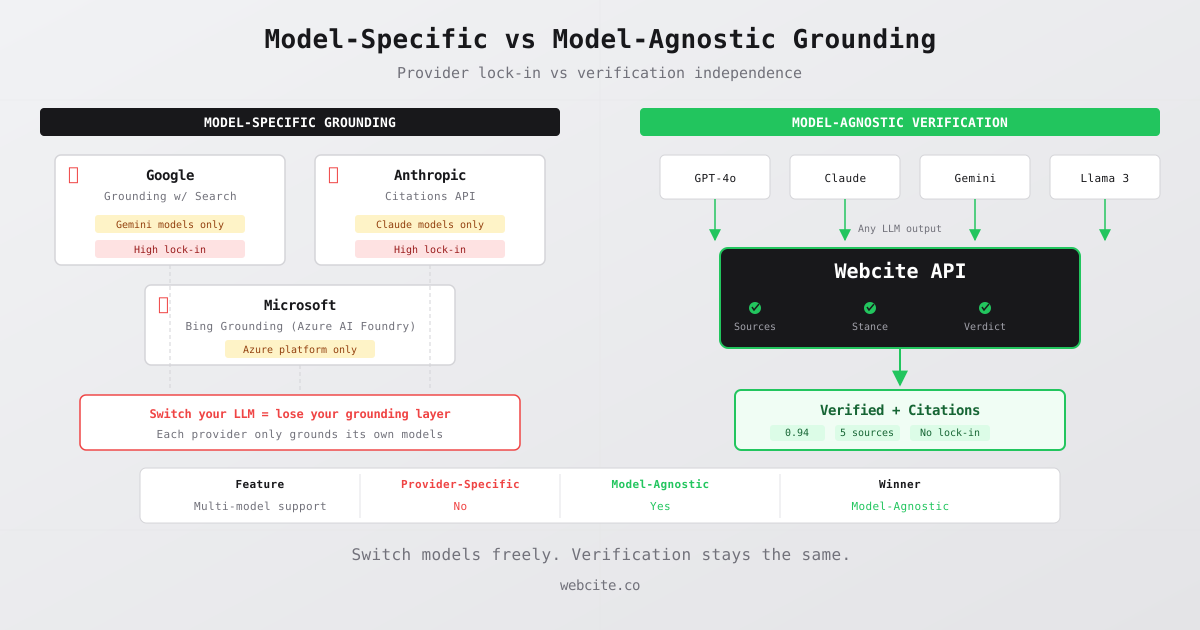
- Google, Anthropic, and Microsoft each offer grounding APIs that only work with their own model families.
- Google's Grounding with Google Search reduces Gemini hallucinations by 65%, but that benefit disappears if you switch to Claude or GPT-4o.
- Universal verification APIs like Webcite check claims from any LLM and return verdicts with citations in a single REST call.
- Stanford researchers found that even grounded RAG systems hallucinate in 17-33% of queries, making post-generation verification essential.
- Teams using multiple models need verification that follows the output, not the provider.
How Provider-Specific Grounding APIs Work
Enterprises lost an estimated $67.4 billion to AI hallucinations in 2024, according to Korra, 2024. Each major AI provider has built grounding into their platform to address this, but the implementations differ in scope, method, and limitations.
Google Grounding with Google Search
Google offers the most mature search-based grounding. Available through the Gemini API and Vertex AI, Grounding with Google Search lets Gemini models query Google Search in real time during response generation. The model identifies claims that need external support, runs search queries, and cites the results inline.
Google reports that their reasoning models with search grounding achieve a 65% reduction in hallucinations, according to Google DeepMind, 2025. The feature also includes a grounding confidence score that tells developers how well-supported each response is.
Google also provides a Check Grounding API through Vertex AI Discovery Engine, which takes a claim and a set of facts, then returns a support score indicating how well the facts support the claim. This is useful for validating responses against known data, but it requires you to supply the grounding facts yourself.
The limitation is absolute: Grounding with Google Search works exclusively with Gemini models. The global AI market reached $254 billion in 2025, according to Statista, 2025, and companies across that market use multiple model providers. If your application uses GPT-4o for code generation, Claude for analysis, and Gemini for search tasks, only the Gemini leg gets grounded. The other two models operate without any grounding from Google’s system.
Anthropic Citations API
Anthropic took a different approach with the Citations API, launched in early 2025. Instead of searching the web, Citations API maps Claude’s responses to specific passages in documents you provide. Each claim in Claude’s response includes character-level spans pointing to the exact text in the source material.
This makes Citations API exceptionally strong for document-grounded workflows: legal contract analysis, compliance review, medical literature synthesis, and research summarization. The precision is unmatched. You know exactly which sentence in which document supports which claim. RAG reduces hallucinations by 71% when properly implemented, according to AllAboutAI, 2026, but that still leaves nearly a third of errors unaddressed without additional verification.
The tradeoff is twofold. First, Citations API only works with Claude models. Second, it only grounds responses in documents you supply. It does not search the web or verify claims against external sources. If Claude generates a factual claim that is not covered by your provided documents, Citations API has no mechanism to check it.
Microsoft Bing Grounding
Microsoft integrated Bing Grounding into Azure AI Foundry, making it available as a tool for agents running on the Azure platform. Bing Grounding connects models to Bing search results, providing web-sourced evidence during generation.
Microsoft’s approach is more flexible than Google’s in one respect: Bing Grounding works with multiple models hosted on Azure, not just Microsoft’s own models. However, it requires the Azure AI Foundry infrastructure. If your application runs on AWS, Google Cloud, or your own servers, Bing Grounding is not available.
Bing Grounding also carries a per-transaction cost through the Bing Search API pricing model. At scale, enterprises running thousands of grounded queries per day face significant search API bills in addition to their model inference costs. Even frontier models with retrieval hallucinate in over 15% of outputs, according to the Vectara Hallucination Leaderboard, 2024, so grounding alone does not eliminate the problem regardless of which provider supplies it.
The Lock-In Problem
The pattern across all three providers is consistent: grounding is a feature of the platform, not a standalone service. This creates vendor lock-in at the accuracy layer.
Consider a team that builds a production application using Gemini with Google Grounding. Six months later, Claude 4 launches with superior reasoning for their use case. Switching to Claude means losing their entire grounding infrastructure. They must either rebuild with Anthropic’s Citations API (which works differently), find an alternative, or accept ungrounded output.
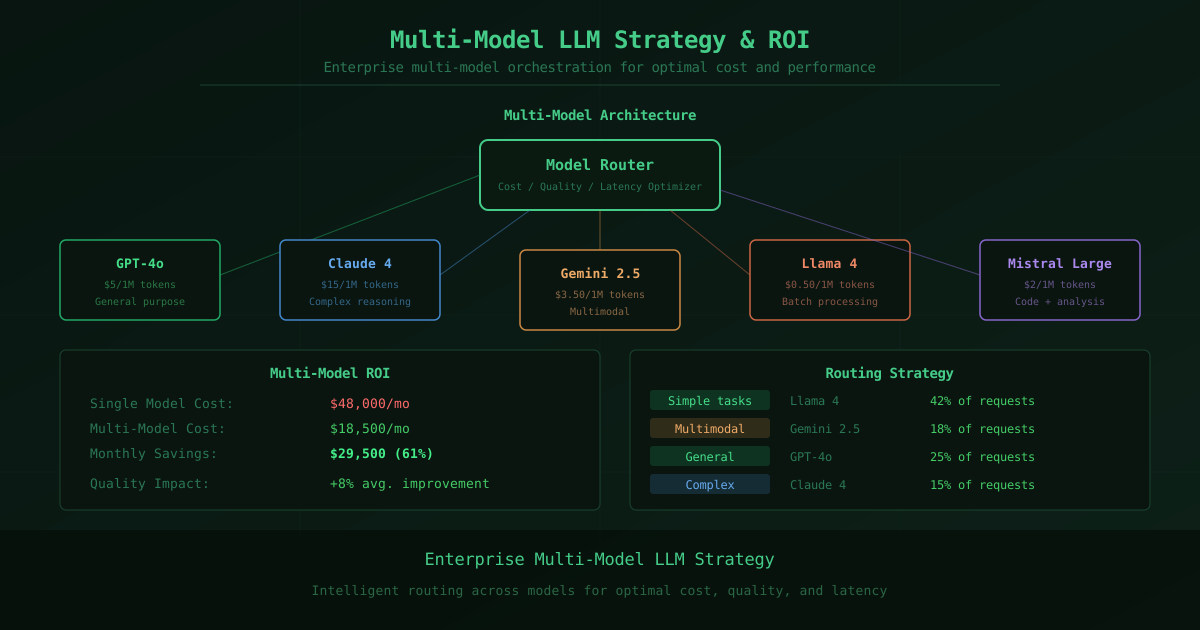
This dependency compounds with multi-model architectures. A growing number of production systems use different models for different tasks. Patronus AI reported that 83% of enterprise teams plan to use multiple LLM providers, according to Patronus AI, 2024. A routing layer might send creative tasks to Claude, analytical tasks to GPT-4o, and search-heavy tasks to Gemini. Provider-specific grounding only covers the slice that matches its model.
The cost of switching also extends to monitoring and evaluation. Each provider’s grounding returns data in different formats with different confidence metrics. Engineering teams must build separate parsing, logging, and alerting for each provider’s grounding output. Gartner predicted that at least 30% of generative AI projects would be abandoned after proof-of-concept by end of 2025, citing poor data quality and inadequate risk controls, according to Gartner, 2024. Fragmented grounding infrastructure contributes to these abandonments. An independent verification layer standardizes accuracy checks across all models.
How Universal Verification APIs Work
A universal verification API operates at a fundamentally different layer. Instead of grounding during generation, it verifies after generation. The input is text, not a model-specific API call. Any text from any model goes through the same verification pipeline.
The process works in four steps:
- Claim extraction: The API identifies individual factual claims in the generated text.
- Evidence retrieval: Each claim is searched against web sources, academic databases, and news archives.
- Source credibility scoring: Retrieved sources are scored based on domain authority, publication recency, and cross-referencing.
- Verdict generation: Each claim receives a verdict (supported, contradicted, or insufficient evidence) with a confidence score and citations.
This architecture is deliberately decoupled from the generation step. A survey of enterprise AI teams found that 76% now include human-in-the-loop processes to catch hallucinations, according to AllAboutAI, 2026. A verification API automates that human review step. Whether the text came from GPT-4o, Claude 3.5, Gemini 1.5, Llama 3, Mistral Large, or a fine-tuned open-source model, the verification process is identical.
Here is what this looks like with Webcite’s REST API:
const response = await fetch("https://api.webcite.co/api/v1/verify", {
  method: "POST",
  headers: {
    "x-api-key": process.env.WEBCITE_API_KEY,
    "Content-Type": "application/json"
  },
  body: JSON.stringify({
    claim: "Google's Gemini models reduce hallucinations by 65% with search grounding",
    include_stance: true,
    include_verdict: true
  })
})

const result = await response.json()
// result.verdict.result: "supported"
// result.verdict.confidence: 91
// result.citations: [{ title: "Google AI...", url: "...", snippet: "..." }]
The same call works for a claim generated by Claude, GPT-4o, or Llama 3. The API does not need to know which model produced the text. It checks the claim on its merits.
Head-to-Head Comparison
The following table compares proprietary grounding with universal verification across the dimensions that matter most in production.
| Feature | Google Grounding | Anthropic Citations | Microsoft Bing | Webcite Verification |
|---|---|---|---|---|
| Models supported | Gemini only | Claude only | Azure-hosted | Any LLM |
| Grounding method | Web search | Document mapping | Bing search | Post-generation check |
| Works with GPT-4o | No | No | Yes (on Azure) | Yes |
| Works with Claude | No | Yes | Yes (on Azure) | Yes |
| Works with Gemini | Yes | No | Yes (on Azure) | Yes |
| Works with Llama/Mistral | No | No | Yes (on Azure) | Yes |
| Platform required | Vertex AI / Gemini API | Anthropic API | Azure AI Foundry | Any (REST API) |
| Web source verification | Yes | No (docs only) | Yes | Yes |
| Confidence scoring | Yes | No | Limited | Yes |
| Source credibility scoring | No | No | No | Yes |
| Structured verdict | No | No | No | Yes |
| Vendor lock-in | High | High | Medium | None |
| Pricing model | Per-query + model cost | Per-token | Per-search transaction | Credit-based |
The table reveals a structural divide. Proprietary grounding is tightly integrated but narrowly applicable. Universal verification is loosely coupled but broadly applicable.
When to Use Provider-Specific Grounding
Provider-specific grounding is the right choice in three scenarios.
Single-model, single-provider architecture. If your entire stack runs on Gemini through Vertex AI, Google’s Grounding with Google Search is the fastest path to reduced hallucinations. Google Search processes over 8.5 billion queries per day, according to Internet Live Stats, 2025. That search infrastructure advantage translates to high-quality grounding with minimal latency overhead.
Document-grounded workflows with Claude. If your application processes legal documents, medical records, or compliance filings and you need character-level source attribution, Anthropic’s Citations API is purpose-built for this. No other grounding tool provides passage-level precision for document QA.
Azure-native enterprise environments. If your organization runs on Azure and your models are deployed through Azure AI Foundry, Bing Grounding adds web search capability without leaving the Microsoft ecosystem. The operational simplicity matters for enterprises with strict platform governance.
When to Use Independent Verification
Independent verification is the right choice in four scenarios.
Multi-model architectures. The moment your application uses more than one LLM provider, native grounding cannot cover every response. RAG alone still leaves a 17 to 33 percent hallucination rate in production legal AI tools, according to Magesh et al., Stanford Law School, 2024. A universal verification API gives you consistent accuracy checks across all models and catches errors that grounding misses.
Model migration and A/B testing. Teams that A/B test model providers or plan to switch models in the future need verification that survives the migration. Moving from Gemini to Claude should not require rebuilding your accuracy layer.
External fact verification. Anthropic’s Citations API only checks against documents you provide. Google’s Grounding with Google Search only works with Gemini. If you need to verify factual claims about the real world from any model, a verification API is the only option that covers all cases.
Compliance and audit requirements. EU AI Act Article 50 takes effect in August 2026, mandating transparency in AI-generated content, according to the official EU AI Act text, 2024. The Colorado AI Act and California transparency requirements also take effect in 2026, creating overlapping regulations, according to Wilson Sonsini, 2026. A verification API that logs every claim, source, confidence score, and verdict provides a standardized audit trail regardless of which model generated the content.
Architecture: Using Both Together
The strongest production systems use native grounding and independent verification together. They are complementary, not competing.
Here is a practical architecture for a multi-model system:
User query
  -> Router selects best model for task
    -> Gemini (with Google Grounding) for search-heavy queries
    -> Claude (with Citations API) for document analysis
    -> GPT-4o for code and reasoning tasks
      -> ALL responses pass through verification API
        -> Verified response with standardized citations
Each model benefits from its provider’s native grounding where available. Then every response, regardless of source, passes through the same verification layer. This catches errors that native grounding misses.
Stanford researchers found that even RAG-grounded legal AI tools hallucinate in 17 to 33 percent of queries, according to Magesh et al., Stanford Law School, 2024. Provider-specific grounding reduces that rate but does not eliminate it. The verification layer is the final safety net.
Here is how the verification step integrates in Python:
import requests

def verify_any_llm_output(claim: str) -> dict:
    response = requests.post(
        "https://api.webcite.co/api/v1/verify",
        headers={
            "x-api-key": "your-api-key",
            "Content-Type": "application/json"
        },
        json={
            "claim": claim,
            "include_stance": True,
            "include_verdict": True,
        },
    )
    return response.json()

## Works identically for any model's output
gemini_result = verify_any_llm_output("Claim from Gemini")
claude_result = verify_any_llm_output("Claim from Claude")
gpt4_result = verify_any_llm_output("Claim from GPT-4o")
The function does not care which model generated the claim. That is the operational advantage of universal verification.
Pricing Comparison
Cost structure varies significantly across grounding approaches.
Google Grounding with Google Search is included in Gemini API pricing for standard queries. Dynamic retrieval mode lets you set a threshold so the model only searches when needed, reducing unnecessary grounding costs. However, you pay Gemini model inference costs regardless.
Anthropic Citations API adds token overhead because source documents must be included in the context window. Longer documents mean more input tokens and higher per-request costs. There is no separate citations charge, but your effective cost rises with document length.
Microsoft Bing Grounding uses the Bing Search API pricing model. The base pricing level costs $7 per 1,000 transactions at the time of writing, plus Azure AI model inference costs.
Webcite uses a credit-based model. The Free plan includes 50 credits per month at $0. The Builder plan provides 500 credits for $20 per month. Enterprise plans start at 10,000+ credits with custom pricing. Each full verification uses 4 credits: 2 for citation retrieval, 1 for stance detection, and 1 for the verdict. On the Builder plan, that works out to $0.16 per verification.
For teams running multiple models, Webcite’s single verification layer replaces the need to pay for grounding on each individual provider, potentially reducing total accuracy costs while covering more of the output. A Deloitte report on Australian welfare reform contained AI hallucinations that led to a $290,000 refund, according to Fortune, 2025. At $0.16 per verification on the Builder plan, the cost of checking claims is negligible compared to the cost of getting them wrong.
The Grounding Landscape Is Fragmenting
The market trend is clear. Every major AI provider is investing in grounding, but each implementation is designed to keep developers within that provider’s ecosystem.
Google invested heavily in grounding as a Gemini differentiator. The Gemini 2.0 family includes enhanced search grounding with Google Maps integration and multi-modal grounding capabilities. Anthropic expanded Citations API with support for PDF ingestion and multi-document referencing. Microsoft positioned Bing Grounding as a core Azure AI Foundry capability.
This fragmentation creates a problem for developers. The MCP ecosystem grew 407% in its first three months, reaching nearly 2,000 servers by November 2025, according to the Model Context Protocol blog. Every new agent that connects to multiple models needs a unified accuracy layer. A unified grounding strategy requires either committing to a single provider or building abstraction layers across multiple grounding APIs. The first option creates dependency. The second creates engineering complexity.
Universal verification sidesteps both problems. By operating at the output layer rather than the generation layer, it provides a single integration point that works regardless of how the upstream architecture evolves.
For a deeper explanation of how grounding in AI works across all these approaches, including RAG, search grounding, citations, and post-generation verification, see our comprehensive guide.
Getting Started
If you are evaluating grounding options for a production application, start by answering two questions:
-
Do you use a single LLM provider exclusively? If yes, start with that provider’s native grounding. Add independent verification as a safety net.
-
Do you use or plan to use multiple LLM providers? If yes, start with universal verification. Add native grounding where it adds value.
Webcite’s free tier includes 50 credits per month, enough for approximately 12 full verifications. Sign up at webcite.co, get an API key, and test it against your own model outputs in under five minutes.
For a detailed walkthrough of integrating verification into an existing chatbot, see our step-by-step integration tutorial.
Frequently Asked Questions
What is Google’s Grounding with Google Search?
Google’s Grounding with Google Search is a feature in the Gemini API and Vertex AI that lets Gemini models query Google Search during generation and cite web sources inline. It reduces hallucinations by up to 65% for Gemini models but does not work with GPT-4o, Claude, Llama, or any non-Google model.
Can I use Google’s grounding API with non-Gemini models?
No. Google’s Grounding with Google Search only works with Gemini models through the Gemini API or Vertex AI. If your application uses GPT-4o, Claude, Llama 3, or Mistral, you need a model-agnostic verification API like Webcite that checks claims from any LLM.
What is the difference between grounding and verification?
Grounding connects an LLM to external sources during generation, typically through search or document retrieval. Verification checks claims after generation against independent evidence and returns a verdict with confidence scores. Grounding prevents some errors; verification catches the ones that slip through.
How does a universal verification API work?
A universal verification API accepts text output from any LLM, extracts individual claims, searches for supporting or contradicting evidence across the web, scores source credibility, and returns a structured verdict with citations. Webcite does this in a single REST call using an x-api-key header.
Should I use Google grounding or an independent verification API?
Use both if you run Gemini. Google grounding reduces errors during generation, and a verification API catches what grounding misses. If you use multiple models or any non-Google model, an independent verification API is required because Google grounding will not work with your stack.