Three AI governance frameworks are converging in 2026. American state legislators introduced over 1,100 AI-related bills in 2025, according to the Brennan Center for Justice, 2025. The EU AI Act reaches full enforcement on August 2, 2026. Penalties reach up to 35 million EUR or 7% of global annual revenue, according to the EU AI Act text. This article compares NIST AI RMF, ISO/IEC 42001, and the EU AI Act across 12 dimensions to help compliance, legal, and engineering teams choose the right combination.
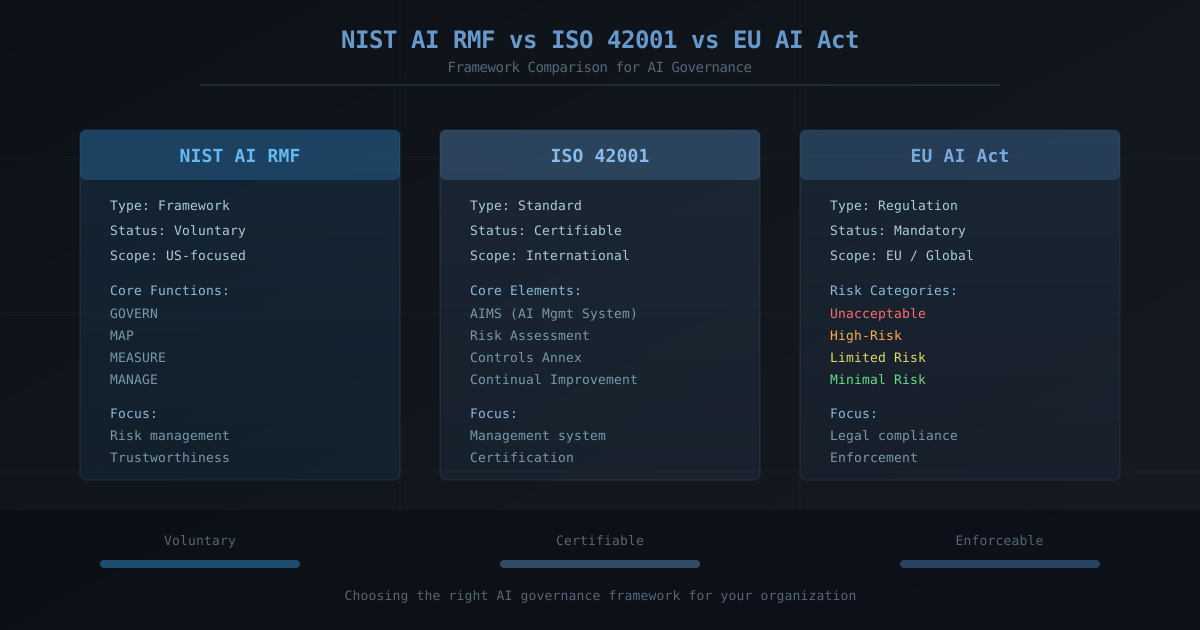
- NIST AI RMF is voluntary and U.S.-focused. ISO 42001 is certifiable and international. The EU AI Act is mandatory with fines up to 35M EUR or 7% revenue.
- All three frameworks require some form of AI output accuracy measurement, but only the EU AI Act carries enforcement penalties.
- American state legislators introduced 1,100+ AI bills in 2025, signaling that mandatory federal regulation is approaching.
- Enterprises serving global markets should adopt all three: NIST for risk methodology, ISO for certification, EU AI Act for legal compliance.
- Verification APIs satisfy accuracy and transparency requirements across all three frameworks through a single integration.
Framework Overview: Scope, Origin, and Legal Status
Each framework emerged from a different institution with a different mandate, and understanding those origins clarifies their scope.
NIST AI RMF 1.0. Published in January 2023 by the U.S. National Institute of Standards and Technology, this framework organizes AI risk management into four core functions: Govern, Map, Measure, and Manage. Over 240 organizations from industry, academia, and government contributed to its development, according to NIST, 2023. It is voluntary; no organization is legally required to adopt it. However, the White House Executive Order on AI Safety (October 2023) references NIST AI RMF directly, and federal procurement increasingly favors vendors aligned with the framework.
ISO/IEC 42001:2023. Published in December 2023 by the International Organization for Standardization and the International Electrotechnical Commission, ISO 42001 is the first international management system standard for AI. It follows the Annex SL structure used by ISO 27001 (information security) and ISO 9001 (quality management). It is certifiable: organizations can undergo third-party audits and receive formal certification. Microsoft Azure, Google Cloud, and Amazon Web Services have all pursued ISO 42001 alignment for their AI services.
EU AI Act (Regulation 2024/1689). Adopted by the European Parliament in March 2024 and signed into law in 2024, this is the world’s first comprehensive AI regulation. It classifies AI systems into four risk tiers (unacceptable, high, limited, minimal) and imposes corresponding obligations. It is mandatory for any organization deploying AI on the EU market, regardless of where the organization is headquartered. Full enforcement of elevated-risk system requirements and Article 50 transparency obligations begins August 2, 2026, according to Secure Privacy, 2026.
Complete Comparison Table
| Dimension | NIST AI RMF 1.0 | ISO/IEC 42001:2023 | EU AI Act |
|---|---|---|---|
| Issuing body | U.S. NIST | ISO/IEC (international) | European Parliament |
| Date published | January 2023 | December 2023 | March 2024 (law); phased enforcement |
| Legal status | Voluntary | Voluntary (certifiable) | Mandatory |
| Geographic scope | U.S.-focused, globally referenced | International | EU market (extraterritorial) |
| Certification | No | Yes (independent audit) | Conformity assessment for high-risk |
| Risk classification | Govern, Map, Measure, Manage | Management system controls | 4 tiers: Unacceptable, High, Limited, Minimal |
| Accuracy requirements | Measure function metrics | Control A.6.2.6 (data quality) | Article 50 (transparency) |
| Audit requirements | Self-assessment | Third-party certification audits | Regulatory conformity assessment |
| Penalties | None | None (market credibility) | Up to 35M EUR or 7% global revenue |
| Output verification | Recommended under Measure | Required under data quality controls | Required under Article 50 |
| Human oversight | Recommended | Required in management system | Mandatory for critical-risk systems |
| Incident reporting | Encouraged | Required in management system | Mandatory for serious incidents |
The frameworks aren’t competitors. They serve different functions in an enterprise governance stack. NIST provides the risk methodology. ISO provides the certifiable management system. The EU AI Act provides the legal baseline. Most multinational enterprises will need all three.
NIST AI RMF: Structure and Practical Application
NIST AI RMF organizes AI risk management into four functions, each with subcategories and suggested practices.
Govern establishes the organizational context. It requires defining AI risk tolerance, establishing accountability structures, assigning roles and responsibilities, and creating policies for AI development and deployment. Google, Microsoft, IBM, and Salesforce all publish responsible AI principles that map to this function. In practice, Govern means having a documented AI policy that answers: who can deploy AI, what approvals are needed, and who is accountable when something goes wrong.
Map identifies and contextualizes AI risks. This involves cataloging all AI systems in the organization, classifying them by risk level, identifying stakeholders affected by AI decisions, and documenting intended versus potential misuse scenarios. The AI governance market was valued at $164 million in 2023 and is projected to reach $3.9 billion by 2034, according to Precedence Research, 2024. Organizations that skip the Map function often discover risks only after incidents occur.
Measure quantifies AI performance and risk. This is where verification becomes critical. NIST requires organizations to define metrics, run benchmarks, and test AI systems for accuracy, fairness, and robustness. Verification APIs directly serve the Measure function by providing per-claim accuracy scores. Stanford HAI researchers found that AI hallucination rates vary from 3% to 20% depending on the domain, according to Stanford HAI, 2025. If you don’t measure your hallucination rate, you can’t demonstrate compliance with NIST Measure requirements.
Manage implements controls to address identified risks. This includes deploying guardrails, integrating verification APIs, establishing human-in-the-loop review for critical decisions, and creating incident response procedures. The Manage function is where policy translates into engineering. For implementation details on the verification layer, see our guide on AI trust frameworks.
NIST also published a companion Generative AI Profile (NIST AI 600-1) in July 2024 that maps the unique risks of generative AI, including hallucination, confabulation, and training data issues, to the four core functions, according to NIST, 2024. This profile is particularly relevant for organizations deploying LLM-powered applications.
ISO 42001: Certification and Management System Requirements
Over 50 countries have now adopted or are developing AI governance legislation, according to the OECD AI Policy Observatory, 2025. ISO 42001 differs from NIST AI RMF in a fundamental way: it specifies mandatory requirements for an AI management system (AIMS) rather than suggested practices. Organizations can be audited against ISO 42001 and receive formal certification, just as they can be certified under ISO 27001 for information security.
The standard requires:
Context of the organization. Define the scope of your AI management system, identify interested parties (regulators, customers, employees, affected individuals), and determine internal and external factors that affect AI governance.
Leadership commitment. Top management must demonstrate commitment to the AIMS, establish an AI policy, assign organizational roles and responsibilities, and ensure adequate resources for AI governance.
Planning. Identify risks and opportunities related to AI, set measurable AI objectives, and plan actions to address them. This is where ISO 42001 and NIST AI RMF’s Map function converge.
Support. Provide resources, ensure competence of personnel involved in AI operations, maintain documented information, and establish internal and external communication channels for AI governance.
Operation. Implement operational planning and control for AI systems. This includes Annex A controls that map to specific AI risk categories:
- Control A.6.2.6 requires data quality documentation
- Control A.8.4 requires documentation of AI system operations
- Control A.9.3 addresses AI system performance monitoring
Performance evaluation. Monitor, measure, analyze, and evaluate AI system performance. Conduct internal audits. Perform management reviews. A PwC survey found that 52% of companies experienced an increase in crisis frequency over the prior five years, with AI-related incidents growing fastest, according to PwC, 2023. ISO 42001’s evaluation requirements help organizations detect and respond to AI issues before they become crises.
Improvement. Address nonconformities, take corrective actions, and pursue continual improvement of the AI management system.
For organizations already certified under ISO 27001 or ISO 9001, the ISO 42001 implementation path is familiar. The Annex SL structure means your existing management system can be extended rather than rebuilt. Deloitte, PwC, KPMG, and EY all offer ISO 42001 readiness assessments and audit support.
A verification API generates the operational documentation that ISO 42001 auditors look for. Each API call produces a timestamped record with the input claim, sources consulted, confidence score, and verdict. These logs satisfy Control A.6.2.6 (data quality) and A.8.4 (operational documentation) with structured, machine-readable evidence.
EU AI Act: Obligations, Penalties, and Extraterritorial Reach
The EU AI Act is the only framework of the three that carries legal enforcement. Understanding its penalty structure, extraterritorial scope, and specific obligations is essential for any organization serving EU users.
Risk tiers and obligations. The EU AI Act classifies AI systems into four categories:
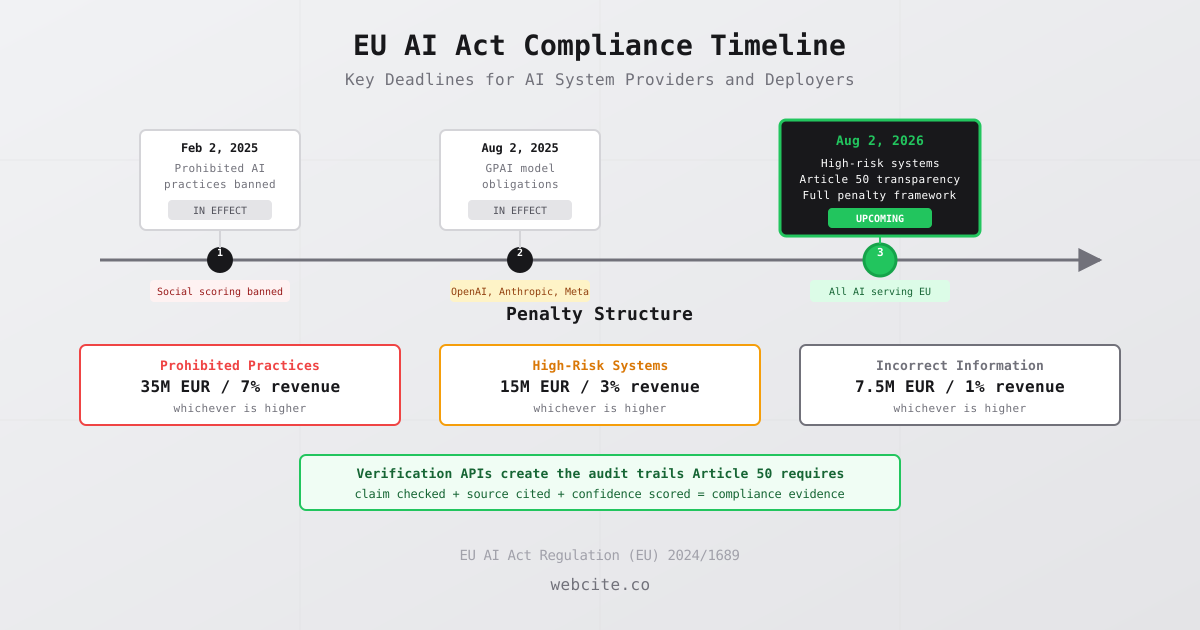
- Unacceptable risk: Banned outright (social scoring, manipulative AI, most real-time biometric identification). Enforcement began February 2025.
- High risk: Extensive compliance requirements including conformity assessments, technical documentation, human oversight, and accuracy demonstrations. Applies to AI in critical infrastructure, education, employment, law enforcement, and essential services. Full enforcement August 2026.
- Limited risk: Article 50 transparency obligations. AI-generated content must be labeled. Users must be informed they are interacting with AI. Full enforcement August 2026.
- Minimal risk: No specific obligations, but voluntary codes of conduct are encouraged.
Penalty structure. Fines scale with violation severity:
| Violation | Maximum Fine | Revenue Cap |
|---|---|---|
| Prohibited AI practices | 35 million EUR | 7% global annual revenue |
| High-risk system violations | 15 million EUR | 3% global annual revenue |
| Incorrect information to authorities | 7.5 million EUR | 1% global annual revenue |
The GDPR enforcement precedent is instructive. Since 2018, EU data protection authorities have issued over 2,000 fines totaling more than 4.5 billion EUR, according to GDPR Enforcement Tracker. Meta alone has been fined over 2.5 billion EUR across multiple decisions. Deloitte reported that 62% of organizations expect to increase their AI compliance budgets in 2026, according to Deloitte, 2025. The EU AI Act uses the same enforcement infrastructure and a similar penalty methodology.
Extraterritorial scope. The EU AI Act applies to any organization that places AI systems on the EU market or whose AI output is used within the EU, regardless of where the organization is headquartered. A SaaS company in San Francisco whose chatbot serves customers in Berlin falls under the regulation. This mirrors GDPR’s extraterritorial reach, which forced global compliance despite being an EU regulation.
For a deeper analysis of EU AI Act compliance requirements and timelines, see our EU AI Act compliance guide.
Where the Three Frameworks Converge
Despite their different origins and legal statuses, all three frameworks converge on several core requirements:
AI output accuracy. NIST AI RMF’s Measure function requires accuracy metrics. ISO 42001’s Control A.6.2.6 requires data quality documentation. The EU AI Act’s Article 50 requires transparency about AI output generation and accuracy. All three demand some mechanism for proving that AI outputs are correct.
Documentation and auditability. NIST recommends self-assessment documentation. ISO 42001 requires documented information for external audits. The EU AI Act requires technical documentation for conformity assessments. The common thread: you need records.
Risk-based approach. All three frameworks apply different levels of scrutiny based on risk. NIST’s Map function classifies AI applications by impact. ISO 42001 requires risk assessments. The EU AI Act’s four-tier classification system determines which obligations apply. Higher-risk AI requires more rigorous controls.
Human oversight. NIST recommends human involvement in critical AI decisions. ISO 42001 requires human oversight capabilities in the management system. The EU AI Act mandates human oversight for elevated-risk AI systems. McKinsey’s 2025 survey found that 72% of enterprises now use generative AI in at least one business function, according to McKinsey, 2025. As adoption broadens, the human oversight requirement affects more applications.
Continuous monitoring. NIST’s Manage function includes ongoing monitoring. ISO 42001’s performance evaluation clause requires regular measurement and review. The EU AI Act mandates post-market monitoring for regulated AI systems. AI governance is not a one-time compliance exercise; it’s an ongoing operational function.
This convergence means that organizations building compliance infrastructure for one framework can extend it to cover the other two. A verification API that logs every claim, source, and confidence score satisfies all three simultaneously: NIST Measure, ISO A.6.2.6/A.8.4, and EU AI Act Article 50.
Choosing a Framework: Decision Matrix
Your framework selection depends on where you operate, who your customers are, and what level of validation you need. A World Economic Forum survey found that 75% of companies plan to adopt AI governance frameworks by 2027, according to WEF, 2025.
U.S.-only companies with no EU customers: Start with NIST AI RMF. It aligns with federal procurement requirements and provides the most practical risk management guidance. Add ISO 42001 if you need external certification for enterprise sales.
Companies serving EU customers: EU AI Act compliance is mandatory. Start there. Layer NIST AI RMF underneath for risk management methodology. Pursue ISO 42001 for competitive differentiation.
Regulated industries (finance, healthcare, legal): Adopt all three. Regulated sectors face industry-specific AI requirements in addition to general frameworks. The OCC requires model risk management for banking AI (SR 11-7). The FDA regulates AI-based medical devices. ISO 42001 certification provides the independent validation that regulators and auditors expect.
Startups and early-stage companies: Start with NIST AI RMF as a lightweight governance foundation. It’s free, voluntary, and doesn’t require certification audits. Revisit ISO 42001 and EU AI Act compliance as you scale into regulated markets or EU geographies.
Gartner predicts that over 40% of agentic AI projects will be canceled by end of 2027 if governance, observability, and ROI clarity are not established, according to Gartner, 2025. Choosing and implementing the right framework combination now prevents that outcome.
Implementing Compliance with Verification APIs
Regardless of which frameworks you adopt, all three require mechanisms for measuring and documenting AI output accuracy. A verification API provides that mechanism through a single integration point.
Here’s how verification maps to each framework’s requirements:
import requests

def verify_claim(claim):
    response = requests.post(
        "https://api.webcite.co/api/v1/verify",
        headers={
            "x-api-key": "your-api-key",
            "Content-Type": "application/json"
        },
        json={
            "claim": claim,
            "include_stance": True,
            "include_verdict": True
        }
    )
    return response.json()

result = verify_claim("NIST published the AI RMF in January 2023")
print(result["verdict"]["result"])   #=> "supported"
print(result["verdict"]["confidence"])  #=> 97
print(result["citations"])  #=> [{"title": "NIST AI RMF", ...}]
#=> Satisfies: NIST Measure, ISO 42001 A.6.2.6, EU AI Act Article 50
Each verification call produces a structured audit record. Over time, these records create a compliance evidence base that spans all three frameworks. Auditors, regulators, and internal governance teams can review the same dataset for different purposes.
Webcite’s free tier at $0 per month includes 50 credits for testing. Each verification uses 4 credits. The Builder plan at $20 per month provides 500 credits for production workflows. Enterprise plans at 10,000+ credits per month include custom pricing and dedicated compliance support. Authentication uses the x-api-key header.
For more on how verification APIs integrate with broader AI trust frameworks, including guardrails, monitoring, and governance layers, see our enterprise validation guide. For current AI hallucination statistics that quantify the accuracy risks these frameworks address, see our data roundup.
Frequently Asked Questions
What is the difference between NIST AI RMF and ISO 42001?
NIST AI RMF is a voluntary risk management framework published by the U.S. National Institute of Standards and Technology. It provides guidance for identifying and managing AI risks through four functions: Govern, Map, Measure, and Manage. ISO 42001 is an international certifiable management system standard that specifies requirements for establishing and maintaining an AI management system. NIST provides the risk framework; ISO provides the auditable management system.
Is the EU AI Act mandatory?
Yes. The EU AI Act is legally binding for any organization that develops, deploys, or distributes AI systems on the EU market, regardless of where the organization is headquartered. Full enforcement begins August 2, 2026, with penalties reaching 35 million EUR or 7% of global annual revenue for the most serious violations.
Can you be certified under NIST AI RMF?
No. NIST AI RMF is a voluntary framework without a formal certification program. Organizations can self-assess their alignment with the framework, and many use it as the basis for internal governance programs. For independent certification, ISO 42001 is the appropriate standard.
Do these three frameworks conflict with each other?
No. The three frameworks are complementary. NIST AI RMF provides the risk management methodology. ISO 42001 provides the certifiable management system. The EU AI Act provides the legal obligations. Many enterprises adopt all three, using NIST for risk assessment, ISO for certification, and EU AI Act compliance as the regulatory baseline.
Which framework should a U.S. company adopt first?
Start with NIST AI RMF because it provides the most practical risk management guidance and aligns with federal procurement requirements. If your company serves EU customers, add EU AI Act compliance planning immediately given the August 2026 deadline. Pursue ISO 42001 certification when you need independent validation for enterprise sales or regulated industries.
How do verification APIs help with AI framework compliance?
Verification APIs create auditable records of AI output accuracy by checking each claim against real-world sources and returning verdicts with confidence scores and citations. This documentation satisfies NIST AI RMF Measure function requirements, ISO 42001 data quality controls, and EU AI Act Article 50 transparency obligations through a single API integration.