Samsung banned ChatGPT company-wide after engineers pasted proprietary semiconductor source code into the tool three separate times within 20 days, according to The Economist, 2023. That was 2023. By early 2026, ChatGPT has reached 800 million weekly active users, according to OpenAI, 2025, and the shadow AI problem has grown from isolated incidents into a systemic enterprise risk. This guide covers what shadow AI is, why it threatens compliance and data security, how regulators are responding, and the five-layer mitigation strategy that enterprises are deploying to regain control.
- Shadow AI, unauthorized use of AI tools by employees, affects an estimated 50% to 78% of enterprise AI usage.
- OWASP added AI-specific vulnerability categories in 2025, with shadow AI mapping to multiple risk vectors.
- The EU AI Act creates legal liability for deployers, including liability for AI tools adopted without formal procurement.
- Data leakage through unauthorized LLM usage is the top concern, with employees pasting source code, customer data, and strategy documents into public tools.
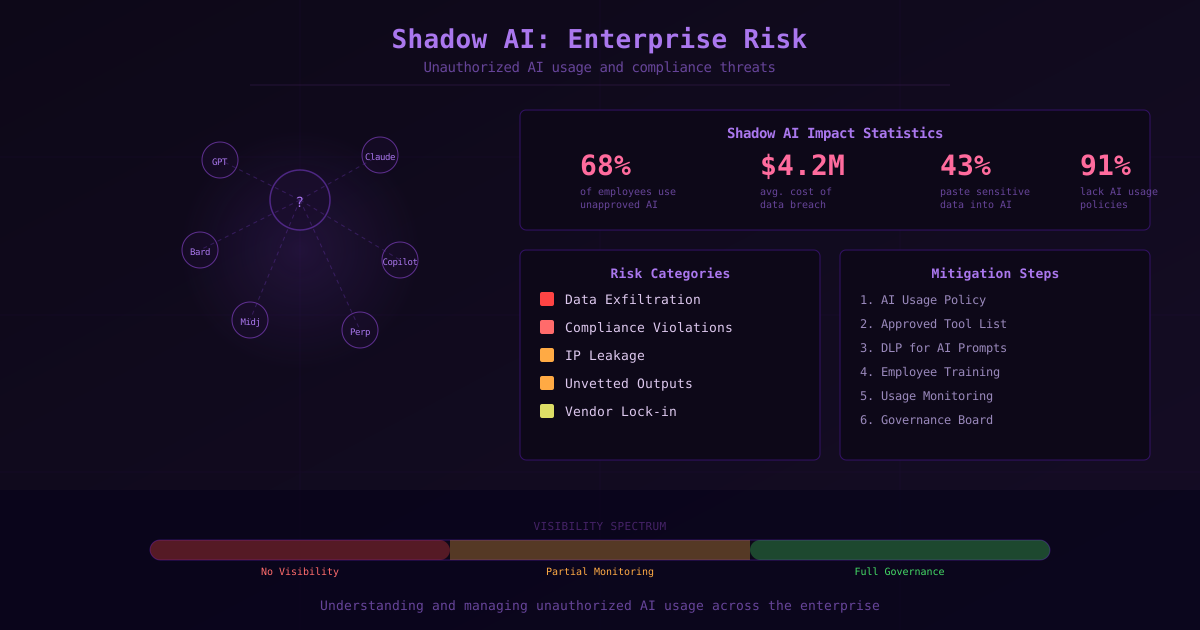
- Mitigation requires 5 layers: API gateways, approved tool lists, output verification, employee training, and regular audits.
What Is Shadow AI and Why Is It Spreading?
Shadow AI is not a fringe problem. It is the default state of AI adoption in most enterprises. Salesforce surveyed over 14,000 workers across 14 countries and found that 49% of generative AI users at work have never received formal training on the tools they use, according to Salesforce, 2024. A separate survey by the National Cybersecurity Alliance found that 38% of employees admit to sharing sensitive work data with AI tools without their employer’s knowledge, according to NCA, 2024.
The adoption curve is simple. An employee discovers that ChatGPT can draft emails, summarize documents, write code, or analyze data faster than traditional methods. They start using it. They never file a procurement request, never consult IT, never read a policy document. Within weeks, the tool is embedded in their daily workflow. Their team notices and follows suit. McKinsey found that 78% of employees using AI at work have adopted it on their own, without company-provided access, according to McKinsey, 2025.
The scale of consumer AI adoption makes this inevitable. ChatGPT alone reached 300 million weekly active users by late 2025, according to The Verge, 2025. Add Anthropic Claude, Google Gemini, Microsoft Copilot, Perplexity, and dozens of specialized AI tools, and the total number of knowledge workers using AI daily exceeds a billion. The enterprise perimeter cannot contain tools that employees carry in their browsers and phones.
How Does Shadow AI Create Data Leakage Risk?
Data leakage is the most immediate and consequential shadow AI risk. When employees paste information into a public AI tool, that data leaves the organization’s security boundary. The specific risks depend on what data is shared and with which provider.
The Samsung incident was not unique. Research from Cyberhaven analyzed millions of corporate data movements and found that 11% of data employees paste into ChatGPT is confidential, according to Cyberhaven, 2024. The categories include source code (31% of sensitive data shared), internal business documents (23%), client data (15%), regulated information including PII and PHI (12%), and security-related data like access keys and credentials (8%).
The destination matters. OpenAI, Anthropic, and Google all have data retention policies. OpenAI retains API inputs for 30 days for abuse monitoring by default, though enterprise API contracts offer zero-retention options, according to OpenAI Data Usage Policy, 2025. Consumer ChatGPT conversations may be used for model training unless users opt out. Anthropic’s consumer Claude retains conversation history unless users delete it. The distinction between API access (with contractual data protections) and consumer access (with standard terms of service) is critical, and shadow AI usage almost always occurs through consumer channels.
For organizations subject to GDPR, HIPAA, SOC 2, or PCI DSS, unauthorized data transfer to a third-party AI service can constitute a compliance violation. The EU AI Act compounds this risk by holding deployers responsible for the AI tools their organizations use, regardless of procurement status.
Why Did OWASP Flag Shadow AI as a Vulnerability?
OWASP, the Open Worldwide Application Security Project, released its Top 10 for Large Language Model Applications in 2025, establishing a standardized framework for LLM security risks, according to OWASP, 2025. Shadow AI maps directly to multiple categories in the OWASP LLM framework.
The most relevant categories include:
LLM06: Excessive Agency. When employees grant AI tools access to enterprise systems, email, calendars, documents, and code repositories through browser extensions and integrations, the AI gains capabilities beyond what any security team authorized. Microsoft Copilot’s integration with Microsoft 365, for example, can access every document a user has permission to view. If an employee activates Copilot without IT approval, the tool inherits that employee’s entire access scope.
LLM02: Sensitive Information Disclosure. Employees sharing proprietary data with external AI tools create a direct path for information disclosure. Unlike traditional data exfiltration, which requires malicious intent and technical skill, AI-driven data leakage happens through normal productivity workflows. The employee is not trying to steal data; they are trying to summarize a report.
LLM09: Misinformation. AI tools used without governance produce unverified output that enters business workflows. A marketing team using ChatGPT to generate product claims, a sales team using Claude to draft customer proposals, an analyst using Gemini to create market research, all of these produce content that may contain hallucinated facts, outdated statistics, or fabricated citations. Without a verification API checking those outputs, misinformation propagates through official business communications.
The OWASP framework also identifies supply chain vulnerabilities in LLM plugins and integrations, which shadow AI amplifies. Employees install browser extensions, Slack bots, and API connectors to AI tools without security review, creating unmonitored attack surfaces.
How Does the EU AI Act Create Liability for Shadow AI?
The EU AI Act creates legal accountability for AI usage that extends to tools adopted outside formal procurement. Article 4 of the regulation defines “deployer” as any natural or legal person that uses an AI system under its authority, according to the EU AI Act full text. An employee using ChatGPT on company time, on company devices, for company work constitutes deployment under the organization’s authority.
Three specific regulatory risks emerge from shadow AI:
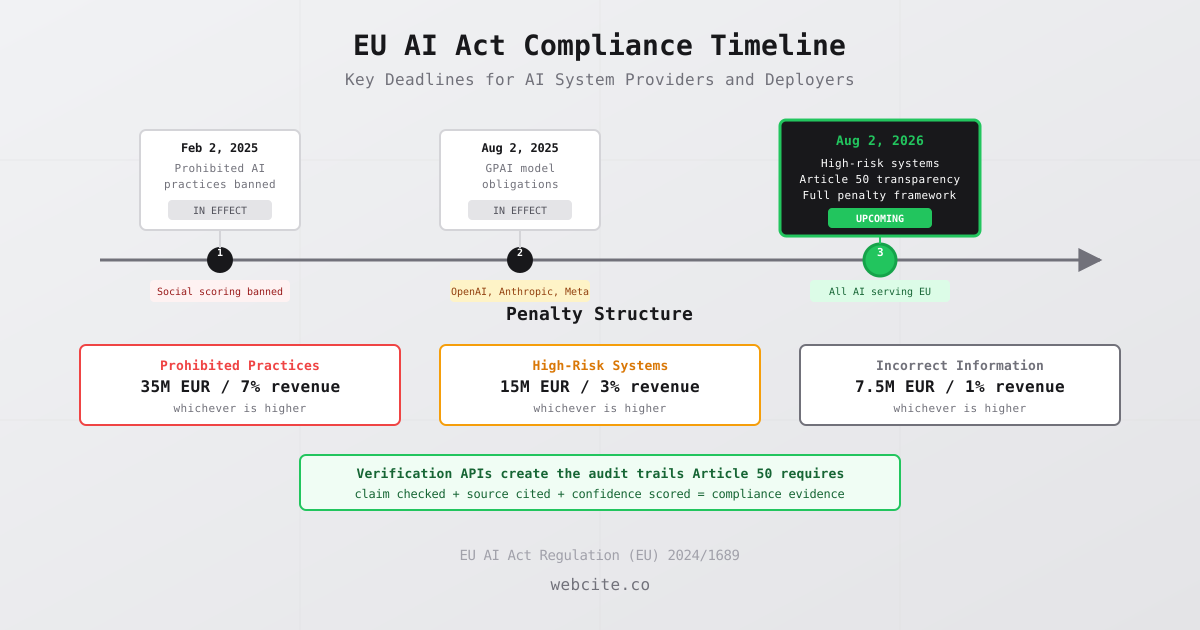
First, transparency violations under Article 50. If an employee uses AI to generate customer-facing content without disclosure, the organization violates the labeling requirement. The employee did not know they needed to disclose AI involvement. The organization did not know AI was being used. Neither ignorance is a legal defense. Penalties for transparency violations reach 7.5 million EUR or 1% of global annual turnover.
Second, high-risk system obligations. If an employee in HR uses an AI tool to screen resumes or evaluate candidates, that constitutes a high-risk AI deployment under the Act. The organization must maintain technical documentation, conduct a conformity assessment, and ensure human oversight. Shadow AI usage bypasses all of these requirements. Penalties reach 15 million EUR or 3% of global annual turnover. For more on these requirements, see our EU AI Act compliance guide.
Third, data protection violations. Shadow AI usage that transfers EU resident data to non-EU AI providers may violate GDPR data transfer restrictions, triggering a separate penalty framework. The GDPR has generated over 4.5 billion EUR in cumulative fines since 2018, according to GDPR Enforcement Tracker. AI-related data transfers are a growing focus for European Data Protection Authorities.
The regulatory trend extends beyond Europe. The Colorado AI Act requires disclosure of AI usage in consequential decisions, effective 2026, according to Wilson Sonsini, 2026. California’s AB 2885 introduces similar requirements. Organizations that allow unchecked shadow AI usage face multiplying compliance exposure across jurisdictions.
What Is the Five-Layer Shadow AI Mitigation Strategy?
Enterprises that have successfully managed shadow AI deploy five complementary layers. No single layer is sufficient; the combination creates defense in depth.
Layer 1: API Gateway Monitoring
An API gateway positioned at the network perimeter intercepts and logs all traffic to known AI service endpoints (api.openai.com, api.anthropic.com, generativelanguage.googleapis.com). This provides visibility into which teams are using which AI services, how frequently, and what volume of data is being transmitted.
Cloudflare, Zscaler, and Netskope all offer AI traffic classification in their gateway products. These tools do not necessarily block AI usage; they make it visible. Visibility is the prerequisite for governance.
The gateway also enables policy enforcement. Organizations can require that all AI API calls route through a corporate proxy that applies data loss prevention (DLP) rules, strips sensitive content, and logs interactions for audit purposes.
Layer 2: Approved Tool Lists
Instead of banning AI tools, which employees circumvent within days, successful organizations publish approved tool lists. These lists specify which AI services are authorized for which use cases, with what data classification levels.
A typical approved tool list looks like:
| Tool | Approved Use | Data Classification Limit | Access Channel |
|---|---|---|---|
| Microsoft Copilot | General productivity | Internal | Enterprise license |
| ChatGPT Enterprise | Research, drafting | Confidential with DLP | Enterprise API |
| Anthropic Claude | Code review, analysis | Internal | API with SSO |
| Open-source models | Sensitive data tasks | Restricted | On-premise only |
The key is providing alternatives, not just restrictions. Employees adopt shadow AI because it makes them more productive. If the approved tools offer comparable capability with better security controls, adoption naturally shifts from unauthorized to authorized channels.
Layer 3: Output Verification
Even authorized AI tools produce unreliable output. The third layer ensures that AI-generated content entering production workflows passes through automated verification.
A verification API checks factual claims against external sources before AI output reaches customers, partners, or official records. This layer catches hallucinations regardless of whether the content came from an approved or unauthorized tool.
import requests

def verify_ai_output(claims):
    verified_results = []
    for claim in claims:
        response = requests.post(
            "https://api.webcite.co/api/v1/verify",
            headers={
                "x-api-key": "your-api-key",
                "Content-Type": "application/json"
            },
            json={
                "claim": claim,
                "include_stance": True,
                "include_verdict": True
            }
        )
        result = response.json()
        verified_results.append({
            "claim": claim,
            "verdict": result.get("verdict", {}).get("result"),
            "confidence": result.get("verdict", {}).get("confidence"),
            "citations": result.get("citations", [])
        })
    return verified_results
Webcite’s free tier includes 50 credits per month ($0) for testing. The Builder plan at $20 per month provides 500 credits for 125 verifications. Enterprise plans start at 10,000+ credits with custom pricing. Each verification uses 4 credits.
Layer 4: Employee Training
Technical controls without education create friction without understanding. Training should cover three topics: what data can and cannot be shared with AI tools, how to use approved tools effectively, and how to identify AI-generated content that needs verification before use.
The most effective training programs are short (under 30 minutes), scenario-based (using real examples from the employee’s role), and repeated quarterly rather than delivered as a one-time onboarding module. Salesforce found that organizations with AI training programs saw 34% higher compliance with data handling policies, according to Salesforce, 2024.
Layer 5: Regular Audits
Quarterly audits combine gateway logs, approved tool usage data, and incident reports to measure shadow AI prevalence and policy effectiveness. The audit should answer three questions: What percentage of AI usage is through approved channels? What types of data are being shared with unauthorized tools? Are output verification rates meeting quality thresholds?
Organizations that measure shadow AI consistently find that the problem is larger than expected. The first audit is typically the most alarming; subsequent audits, with mitigation layers in place, show steady improvement.
How Does Output Verification Fit into Shadow AI Governance?
Output verification serves a unique function in the shadow AI mitigation stack. Gateway monitoring controls the input (what data goes to AI tools). Approved tool lists control the tools (which AI services are used). Training controls the behavior (how employees interact with AI). Audits measure compliance.
Output verification controls the output. It ensures that regardless of which tool generated the content, regardless of whether it was authorized or unauthorized, the factual claims in that content are checked before they enter production.
This is critical because shadow AI is a containment problem, not an elimination problem. Organizations cannot prevent every employee from using unauthorized AI tools. What they can do is ensure that AI-generated content, whatever its source, passes through verification before it affects customers, enters official records, or triggers compliance obligations.
For a broader look at how verification APIs work and why they complement guardrails and observability, see our verification API explainer.
Getting Started with Shadow AI Governance
Three immediate actions that any enterprise can take this week:
First, run a discovery scan. Use your network monitoring or proxy tools to identify traffic to known AI service domains. Count unique users, request volume, and data transfer sizes. This gives you a baseline measurement of shadow AI prevalence. Most organizations are surprised by the results.
Second, publish a simple AI usage policy. It does not need to be comprehensive. Start with three rules: do not paste confidential or restricted data into consumer AI tools, use approved tools listed on the internal wiki, and flag AI-generated content before including it in customer-facing communications.
Third, integrate output verification for your highest-risk AI use case. Identify the one workflow where AI-generated errors would cause the most damage, whether that is customer proposals, regulatory filings, or published content, and add a verification step. Sign up at webcite.co for the free tier to test the integration.
Shadow AI is not going away. The 800 million weekly ChatGPT users will become 2 billion within 18 months. The question is not whether your employees use AI; it is whether your organization governs that usage or ignores it until a data breach, compliance penalty, or public embarrassment forces action.
Frequently Asked Questions
What is shadow AI?
Shadow AI refers to the use of artificial intelligence tools, particularly large language models like ChatGPT, Claude, and Gemini, by employees without the knowledge, approval, or oversight of their organization’s IT or security teams. It is the AI equivalent of shadow IT, where consumer-grade tools enter the enterprise through individual adoption rather than formal procurement.
Why is shadow AI a security risk?
Employees paste proprietary data, source code, customer records, and strategic documents into public AI tools. That data enters the model provider’s infrastructure and may be used for training, logged in ways that violate data residency requirements, or exposed through prompt injection attacks. The organization has no visibility into what data left and no ability to audit or recall it.
Is shadow AI listed as an OWASP vulnerability?
Yes. OWASP added AI-specific categories to its Top 10 for LLM Applications in 2025. Shadow AI, where unauthorized AI tools consume enterprise data without governance controls, directly maps to multiple OWASP LLM risk categories including sensitive information disclosure, excessive agency, and misinformation.
How does the EU AI Act affect shadow AI?
The EU AI Act holds deployers legally responsible for AI systems they use, even if the AI tool was adopted by individual employees without formal approval. Organizations cannot claim ignorance of shadow AI usage as a defense against non-compliance. Article 50 transparency requirements apply regardless of whether the AI tool was officially procured.
What are the best ways to mitigate shadow AI risk?
Five proven strategies: deploy API gateways that monitor and log all AI traffic, maintain an approved tools list with pre-vetted options, implement output verification for AI-generated content entering production, train employees on data handling policies for AI tools, and conduct regular audits of AI usage across the organization.
How many people use ChatGPT without IT approval?
ChatGPT reached 800 million weekly active users by early 2026, according to OpenAI, 2025. Industry surveys consistently show that 50% to 78% of enterprise AI usage is employee-driven and occurs without formal IT approval, making unauthorized use the norm rather than the exception.