Tavily processes over 100 million API queries per month, according to Tavily, making it the most widely adopted search API for AI agents built on frameworks like LangChain and CrewAI. But search and verification are different problems. Tavily finds web results. A verification API checks whether a claim is true. This article compares Tavily against four alternatives across search, verification, and citation capabilities so you can pick the right tool for your use case.
- Tavily, Exa, and Brave Search are search APIs. They return results but do not verify whether those results support a specific claim.
- Webcite is the only API in this comparison that returns a verdict, confidence score, and structured citations in a single call.
- Tavily charges $0.008 per credit (1 credit per basic search). Webcite starts free at 50 credits/month.
- A search-then-verify pipeline using Tavily plus Webcite catches errors that either tool misses alone.
- Enterprises lost an estimated $67.4 billion to AI hallucinations in 2024, making verification a financial necessity.
What Tavily Does Well
Tavily is a search API purpose-built for AI agents. It was designed from the start to integrate with LangChain, Microsoft AutoGen, and CrewAI, providing LLM-optimized search results that agents can consume programmatically. According to Tavily’s documentation, the platform uses a credit-based model where basic search costs 1 credit and advanced search costs 2 credits, with pay-as-you-go pricing at $0.008 per credit.
Tavily’s strengths include:
Agent-native design. Tavily returns clean, structured JSON that language models can parse directly. There is no HTML scraping or result parsing required. This makes it a natural fit for agentic RAG pipelines where an AI agent needs to search the web as part of a multi-step reasoning process.
Research API. Tavily’s Research API handles multi-step research tasks, synthesizing information from multiple queries into a comprehensive report. This uses 4 to 250 credits per request depending on complexity, according to Tavily Docs.
LangChain integration. Tavily is the default web search tool in the LangChain ecosystem. If you are building with LangChain, LangGraph, or LlamaIndex, Tavily plugs in with minimal configuration.
Speed. Basic search queries return in 1 to 3 seconds. For AI agent workflows where multiple search steps happen sequentially, this speed matters.
But Tavily has a fundamental limitation: it tells you what the web says, not whether a specific claim is true. A Tavily search for “global AI market size 2025” returns pages that mention the topic. It does not evaluate whether a statement like “the global AI market reached $254 billion in 2025” is supported by credible sources. That distinction matters when accuracy is the requirement, not information retrieval.
When You Need Verification, Not Search
Search and verification solve different problems. Understanding the boundary between them determines whether Tavily alone is sufficient or whether you need a different tool.
Search answers: “What do web pages say about this topic?” You send a query, and the API returns ranked results. The quality of those results depends on keyword matching, semantic relevance, and the freshness of the index. Search is the right tool when your agent needs to gather information during reasoning.
Verification answers: “Is this specific claim true?” You send a claim, and the API checks it against multiple sources, evaluates source credibility, and returns a verdict. Verification is the right tool when you need to confirm the accuracy of output that an LLM has already generated.
Stanford researchers found that even RAG-based AI tools hallucinate in 17 to 33 percent of queries, according to Magesh et al., Stanford Law School, 2024. RAG uses search to ground generation, but search alone cannot catch errors in the final output. A model might retrieve the correct document and still misinterpret, misattribute, or fabricate details from it.
Consider this workflow: an AI writing assistant generates an article claiming “OpenAI’s revenue exceeded $5 billion in 2024.” A search API finds pages mentioning OpenAI revenue. A verification API checks whether those pages actually support the $5 billion figure, flags conflicting sources, and returns a confidence score. That is the gap between search and verification.
Enterprises lost an estimated $67.4 billion to AI hallucinations in 2024, according to Korra, 2024. The EU AI Act Article 50 mandates AI output transparency by August 2026, according to the European Parliament. These regulatory and financial pressures make verification a requirement, not an enhancement.
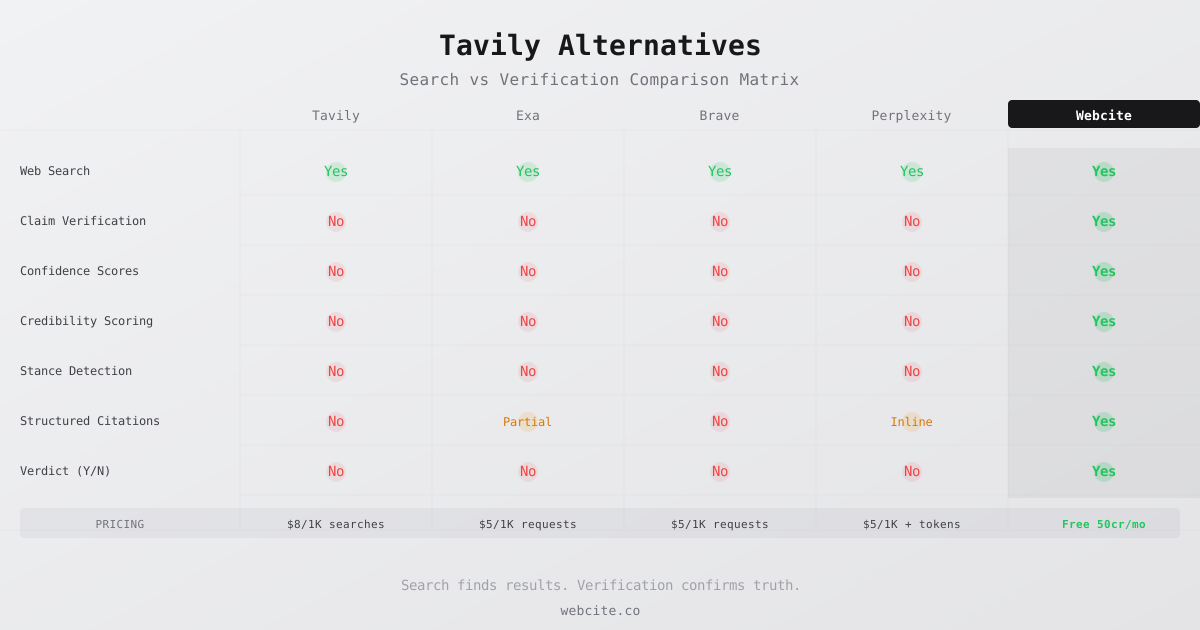
Comparison Table: Tavily vs Exa vs Brave Search vs Perplexity vs Webcite
| Capability | Tavily | Exa | Brave Search | Perplexity Sonar | Webcite |
|---|---|---|---|---|---|
| Web search | Yes | Yes (semantic) | Yes | Yes | Yes (claim-targeted) |
| Claim verification | No | No | No | No | Yes |
| Confidence scores | No | No | No | No | Yes |
| Source credibility scoring | No | No | No | No | Yes |
| Structured citations | No | Yes (content) | No | Limited (inline) | Yes (with stance) |
| Stance detection | No | No | No | No | Yes |
| Verdict (supported/refuted) | No | No | No | No | Yes |
| Agent framework support | LangChain, CrewAI | LangChain | General | General | REST API |
| Multi-language support | Limited | Limited | Yes | Yes | 40+ languages |
| Response time | 1-3s | Sub-200ms (Instant) | 1-2s | 2-4s | 1-3s |
The table clarifies the fundamental split: Tavily, Exa, Brave Search, and Perplexity are search tools. Webcite is a verification tool. If your application needs to confirm whether a claim is accurate, search APIs leave that responsibility to your code. As detailed in the Webcite vs Competitors comparison, Webcite is the only API that handles the full verification pipeline in a single call.
Pricing Comparison
| Provider | Free Tier | Paid Pricing | Cost per 1,000 Basic Operations | Credit Model |
|---|---|---|---|---|
| Tavily | 1,000 credits | From $0.008/credit | $8 (basic search) | Per credit |
| Exa | $10 free credit | $5/1,000 requests (Instant) | $5 (Instant search) | Per request |
| Brave Search | $5/month free | $5/1,000 requests | $5 | Per request |
| Perplexity Sonar | No free tier (API) | $1/$1 per M tokens + $5/1K searches | $5 (searches only) | Token + per search |
| Webcite | 50 credits/month | $20/month (Builder, 500 credits) | $16 (4 credits per verification) | Per credit |
Webcite pricing works differently because each API call does more. A single Webcite verification consumes 4 credits: 2 for citation retrieval, 1 for stance detection, and 1 for the verdict. That single call replaces what would take multiple calls to a search API plus custom verification logic on your end.
Webcite’s three tiers: Free at $0/month with 50 credits, Builder at $20/month with 500 credits, and Enterprise with custom pricing starting at 10,000+ credits. According to Brave’s updated pricing, Brave Search now offers $5 in free monthly credits (roughly 1,000 searches). Tavily provides 1,000 free credits to start and scales to $500/month for 100,000 credits, according to Tavily pricing.
Use Case Matrix: Search vs Verify vs Cite
Different use cases demand different capabilities. This matrix maps common AI application patterns to the tools that handle them:
RAG pipeline grounding. Your AI agent needs to search the web during generation to ground its responses in real data. Best tool: Tavily or Exa. These search APIs integrate natively with LangChain and return structured results that an LLM can reference during generation.
Post-generation fact-checking. Your application generates a response and needs to verify every claim before showing it to users. Best tool: Webcite. Search APIs cannot tell you whether a claim is supported or contradicted. Webcite’s verification API returns a verdict for each claim.
Research and content discovery. Your application needs to find relevant articles, papers, or data on a topic. Best tool: Exa (for semantic search) or Perplexity Sonar (for synthesized answers). Exa’s neural search engine returns semantically relevant results with sub-200ms latency on the Instant plan, according to MarkTechPost, 2026.
Citation generation. Your application needs to attach source citations to AI-generated claims. Best tool: Webcite. While Perplexity provides inline citations in its chat interface, its API does not expose raw confidence scores or source credibility data. Webcite returns each citation with a stance (supports, contradicts, neutral) and a credibility score.
Compliance and audit trails. Your enterprise application must demonstrate that AI outputs are verifiable per EU AI Act requirements. Best tool: Webcite. Audit compliance requires a record of what was checked, against which sources, and what the verdict was. Search results alone do not satisfy this requirement.
Code Comparison: Tavily Search vs Webcite Verification
Here is what a Tavily search call looks like:
// Tavily: Search for information
const tavilyResponse = await fetch("https://api.tavily.com/search", {
  method: "POST",
  headers: {
    "Content-Type": "application/json"
  },
  body: JSON.stringify({
    api_key: "tvly-your-api-key",
    query: "global AI market size 2025",
    search_depth: "advanced",
    max_results: 5
  })
})

const tavilyResult = await tavilyResponse.json()
// tavilyResult.results: [{ title, url, content, score }, ...]
// Returns: ranked search results
// Does NOT return: verdict, confidence, stance, credibility
Here is what a Webcite verification call looks like for the same topic:
// Webcite: Verify a specific claim
const webciteResponse = await fetch("https://api.webcite.co/api/v1/verify", {
  method: "POST",
  headers: {
    "x-api-key": "your-api-key",
    "Content-Type": "application/json"
  },
  body: JSON.stringify({
    claim: "The global AI market reached $254 billion in 2025",
    include_stance: true,
    include_verdict: true
  })
})

const webciteResult = await webciteResponse.json()
// webciteResult.verdict.result: "supported"
// webciteResult.verdict.confidence: 92
// webciteResult.citations: [
//   { title: "Statista (2025)", url: "...", stance: "supports", credibility: 94 },
//   { title: "IDC (2025)", url: "...", stance: "supports", credibility: 91 }
// ]
The difference is structural. Tavily returns a list of pages that mention AI market size. Webcite returns a verdict: the specific claim about $254 billion is supported with 92% confidence, and here are the sources that confirm it along with their credibility scores.
A Gartner report projected that more than 30% of generative AI projects will be abandoned by 2026 due to issues including hallucinated outputs, according to Gartner, 2024. Verification closes the accuracy gap that causes these project failures.
When to Use Both Together: The Search then verify Pipeline
The strongest approach combines search and verification in a pipeline. Tavily handles the search layer. Webcite handles the verification layer. Here is how that works:
// Step 1: AI agent uses Tavily to research during generation
async function researchAndGenerate(topic) {
  const searchResults = await fetch("https://api.tavily.com/search", {
    method: "POST",
    headers: { "Content-Type": "application/json" },
    body: JSON.stringify({
      api_key: "tvly-your-api-key",
      query: topic,
      search_depth: "advanced",
      max_results: 10
    })
  }).then(r => r.json())

  // Feed search results to LLM for generation
  const llmResponse = await generateWithContext(searchResults.results)
  return llmResponse
}

// Step 2: Verify each claim in the generated output
async function verifyOutput(generatedText) {
  const claims = extractClaims(generatedText)

  const verifications = await Promise.all(
    claims.map(claim =>
      fetch("https://api.webcite.co/api/v1/verify", {
        method: "POST",
        headers: {
          "x-api-key": "your-api-key",
          "Content-Type": "application/json"
        },
        body: JSON.stringify({
          claim: claim,
          include_stance: true,
          include_verdict: true
        })
      }).then(r => r.json())
    )
  )

  return verifications.map((v, i) => ({
    claim: claims[i],
    verdict: v.verdict.result,
    confidence: v.verdict.confidence,
    citations: v.citations
  }))
}

// Pipeline: Search -> Generate -> Verify
const article = await researchAndGenerate("AI market trends 2025")
const verified = await verifyOutput(article)
// Filter or flag claims where verdict !== "supported"
This pattern separates concerns. The search step ensures the LLM has access to relevant, current information. The verification step ensures the final output is accurate. Neither step alone is sufficient. According to the Vectara Hallucination Leaderboard, 2024, even the best LLMs produce factual errors in 3 to 15 percent of outputs when grounded with RAG. The verification step catches what search-grounded generation misses.
The cost of this pipeline is manageable. If your application generates 100 articles per day with an average of 10 claims each, that is 1,000 Tavily searches ($8 at basic rate) plus 1,000 Webcite verifications (4,000 credits, covered by two Builder plans at $40/month total). Compare that to the reputational and legal cost of publishing unverified AI-generated content.
How Each Alternative Compares to Tavily
Exa
Exa is a neural search engine built for AI applications. Its semantic search returns results based on meaning rather than keywords, and the new Exa Instant product delivers sub-200ms latency at $5 per 1,000 requests. Exa is a strong Tavily alternative for content discovery and semantic retrieval but, like Tavily, it does not verify claims. If your use case is finding relevant content for RAG pipelines, Exa competes directly with Tavily. If your use case is checking whether AI output is accurate, neither tool handles that.
Brave Search
Brave Search API offers web search with an independent index (not built on Google or Bing). As of February 2026, Brave charges $5 per 1,000 search requests with $5 in free monthly credits, according to Brave. Brave’s advantage is its independent crawl index and privacy focus. Its limitation for AI applications is the same as Tavily: it returns search results, not verdicts.
Perplexity Sonar
Perplexity Sonar provides AI-powered search with inline citations. The standard Sonar model charges $1 per million input tokens and $1 per million output tokens, plus $5 per 1,000 searches, according to Perplexity Docs. Sonar Pro uses more capable reasoning at $3/$15 per million tokens. Perplexity’s strength is synthesized answers with citations. Its limitation is that the API does not expose confidence scores, stance detection, or source credibility data that your application can use programmatically.
Firecrawl
Firecrawl is a web scraping and crawling API, not a search or verification tool. It converts web pages to clean markdown that LLMs can consume. Firecrawl starts free for 500 pages and scales from $16/month on the Hobby plan, according to Firecrawl. It complements Tavily by providing deeper content extraction from specific URLs, but it does not search the web or verify claims.
Webcite
Webcite occupies a different category. While every other tool in this list returns search results or scraped content, Webcite returns verification results. You send a claim, and Webcite checks it against real sources, evaluates credibility, detects stance, and returns a structured verdict. The free tier provides 50 credits per month. The Builder plan provides 500 credits at $20/month. Enterprise plans start at 10,000+ credits with custom pricing.
Decision Framework: Which Tool Do You Need?
Ask these three questions to determine the right tool:
1. Does your application need to search during generation or verify after generation?
If search during generation: Tavily, Exa, or Brave Search. These APIs integrate into RAG pipelines and provide the retrieval layer that grounds LLM output.
If verify after generation: Webcite. Once your LLM produces output, Webcite checks each claim against external sources and flags errors.
If both: Use the search and verify pipeline described above.
2. Does your application need structured citations with credibility data?
If you just need source URLs: Tavily or Brave Search return URLs with relevance scores.
If you need citations with stance and credibility: Webcite returns each citation with a stance (supports, contradicts, neutral), a credibility score, and the relevant passage.
3. Does your application face compliance or audit requirements?
If yes: Webcite provides the structured verification data needed for EU AI Act compliance and audit trails. Search results alone do not constitute verification evidence.
If no: Choose based on speed, price, and integration requirements.
The global AI verification market is projected to grow at a 28.4% compound annual growth rate through 2030, according to Grand View Research, 2024. As AI-generated content scales across every industry, the tools that verify accuracy will matter as much as the tools that generate content.
Frequently Asked Questions
What is the best Tavily alternative for fact-checking?
Webcite is the strongest Tavily alternative for fact-checking because it verifies claims against real sources and returns a structured verdict with confidence scores and citations. Tavily returns search results but does not evaluate whether those results support or contradict a specific claim.
Can I use Tavily and Webcite together?
Yes. A common pipeline uses Tavily for initial search and research, then passes the AI-generated output through Webcite for claim verification. Tavily finds relevant sources during generation, and Webcite confirms accuracy after generation. This search followed by verify pattern catches errors that search alone misses.
How does Tavily pricing compare to Webcite?
Tavily charges $0.008 per credit with basic search costing 1 credit and advanced search costing 2 credits. Webcite offers a free tier with 50 credits per month and a Builder plan at $20/month with 500 credits. Each Webcite verification uses 4 credits, covering citation retrieval, stance detection, and verdict generation.
Is Exa a good alternative to Tavily for verification?
Exa is a strong semantic search engine priced at $5 per 1,000 requests, but it does not verify claims. Like Tavily, Exa returns search results rather than verdicts. For verification, you need a tool like Webcite that evaluates whether sources support or contradict a specific claim.
What is the difference between a search API and a verification API?
A search API takes a query and returns ranked web results. A verification API takes a specific claim, checks it against multiple sources, scores source credibility, and returns a structured verdict with citations. Search finds information; verification confirms whether that information is true.