McKinsey’s 2025 State of AI report found that 72% of organizations now use generative AI in at least one business function, up from 65% the prior year, according to McKinsey, 2025. The ROI gap is significant. Organizations deploying diverse model environments report 67% higher ROI compared to single provider approaches, according to McKinsey, 2025. Nearly 40% of enterprises now spend over $250,000 annually on LLM infrastructure, according to a16z, 2025. This guide covers the architecture, routing strategies, cost analysis, and verification requirements for running a portfolio LLM stack in production.
- Diverse model LLM environments deliver 67% higher ROI than single provider deployments (McKinsey, 2025).
- Route 70% of routine tasks to cheaper models and reserve premium models for the 30% that require complex reasoning.
- DeepSeek-V3 uses Mixture of Experts (MoE) to activate only 37B of its 671B parameters per token, cutting inference costs by 70%.
- Over 60% of enterprises use models from two or more providers (a16z, 2025).
- A provider neutral verification layer ensures output quality across all models in the stack.
Why Single Provider LLM Strategies Fail at Scale
Most enterprises begin their AI journey with a single model provider. OpenAI’s GPT-4o is the most common starting point, followed by Anthropic’s Claude and Google’s Gemini. The sole provider approach works during prototyping but breaks down as production workloads grow and diversify.
The core problem is economic mismatch. Premium models like GPT-4o cost $2.50 per million input tokens and $10.00 per million output tokens, according to OpenAI Pricing, 2025. Using GPT-4o for every task, from simple classification to complex multi-step reasoning, means paying premium prices for work that cheaper models handle equally well. Anthropic’s Claude 3.5 Haiku processes tokens at $0.80 per million input and $4.00 per million output, roughly 3x cheaper, and handles 80% of routine tasks with comparable accuracy, according to Anthropic Pricing, 2025.
Vendor lock-in compounds the problem. When OpenAI experiences an outage, which happened 6 times in 2025 per their public status page, organizations relying on one provider go completely offline. Diverse model architectures fail over to alternative providers automatically. The Andreessen Horowitz enterprise AI survey of 100 CIOs found that over 60% of enterprises now use models from two or more providers, up from roughly 40% in 2024, according to a16z, 2025. The shift reflects hard lessons learned from production outages and price changes.
There is also the accuracy dimension. Different models excel at different tasks. Claude outperforms GPT-4o on long-context document analysis. GPT-4o leads on structured output generation and function calling. Google Gemini handles multimodal inputs (text plus images) more natively. Llama 3.1 provides strong performance for tasks that require on-premise deployment for data privacy. No single model is best at everything, and pretending otherwise wastes both money and quality.
The Multimodel Architecture
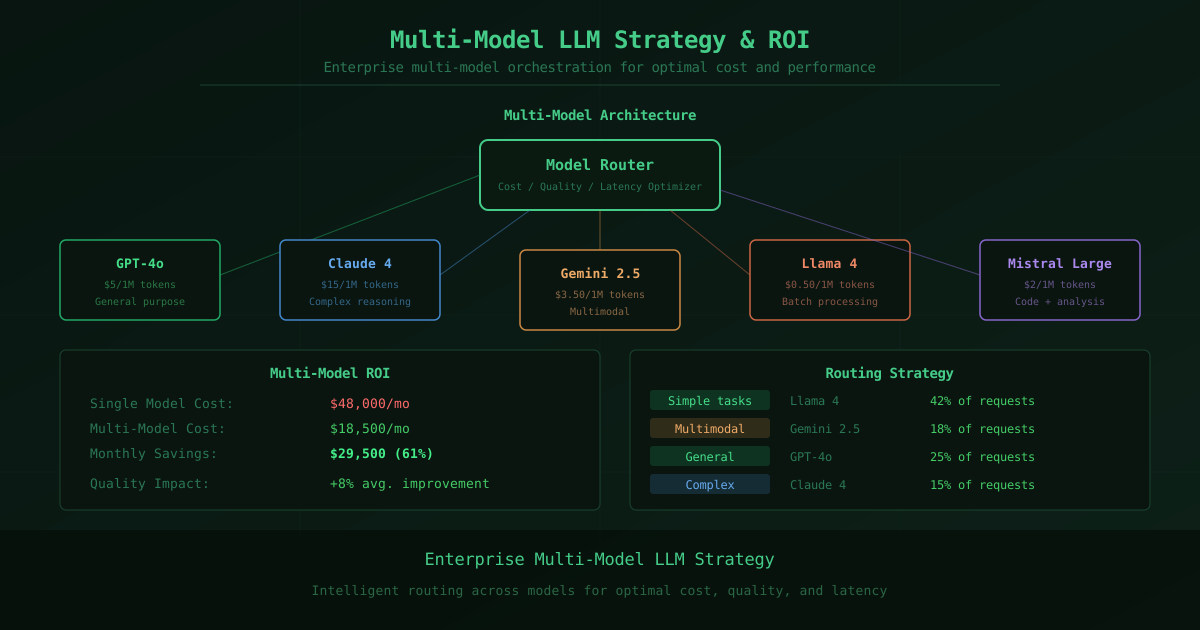
A production multimodel architecture has four layers: request classification, model routing, inference, and verification. Each layer has a clear responsibility.
The request classification layer analyzes each incoming request and assigns it a complexity score. Simple tasks like text classification, entity extraction, summarization of short documents, and template based generation score low. Complex tasks like multistep reasoning, creative writing, code generation, and analysis requiring domain expertise score high. Classification itself can be handled by a lightweight model or a rules-based system.
The model routing layer maps complexity scores to models. A typical enterprise routing table looks like this:
| Complexity Tier | Task Examples | Recommended Models | Cost per 1M Tokens (Input) |
|---|---|---|---|
| Tier 1: Simple | Classification, extraction, short summaries | GPT-4o-mini, Claude 3.5 Haiku, Llama 3.1 8B | $0.15 - $0.80 |
| Tier 2: Standard | Document analysis, Q&A, content generation | GPT-4o, Claude 3.5 Sonnet, Gemini 1.5 Pro | $2.50 - $3.00 |
| Tier 3: Complex | Multi-step reasoning, research, code review | Claude 3.5 Opus, GPT-o3, Gemini Ultra | $10.00 - $15.00 |
The inference layer calls the selected model and returns the response. This layer handles authentication, rate limiting, retries, and failover. If the primary model for a given tier is unavailable, the routing layer automatically redirects to an alternative.
The verification layer checks the factual accuracy of outputs before they reach users. This is where provider neutral verification becomes critical, and we’ll cover it in detail below.
Model Routing: The 70/30 Rule
Field data from enterprises running multimodel stacks reveals a consistent pattern: approximately 70% of production requests are routine tasks that cheaper models handle well, while 30% require premium model capabilities. This 70/30 split drives the ROI advantage of diverse model strategies.
Here is the math. Assume an enterprise processes 1 million requests per month:
| Scenario | Model | Requests | Cost per 1M Tokens | Monthly Token Cost |
|---|---|---|---|---|
| Single provider (all GPT-4o) | GPT-4o | 1,000,000 | $2.50 input / $10.00 output | ~$12,500 |
| Multimodel (70/30 split) | GPT-4o-mini (70%) | 700,000 | $0.15 input / $0.60 output | ~$525 |
| GPT-4o (30%) | 300,000 | $2.50 input / $10.00 output | ~$3,750 | |
| Multimodel total | 1,000,000 | ~$4,275 |
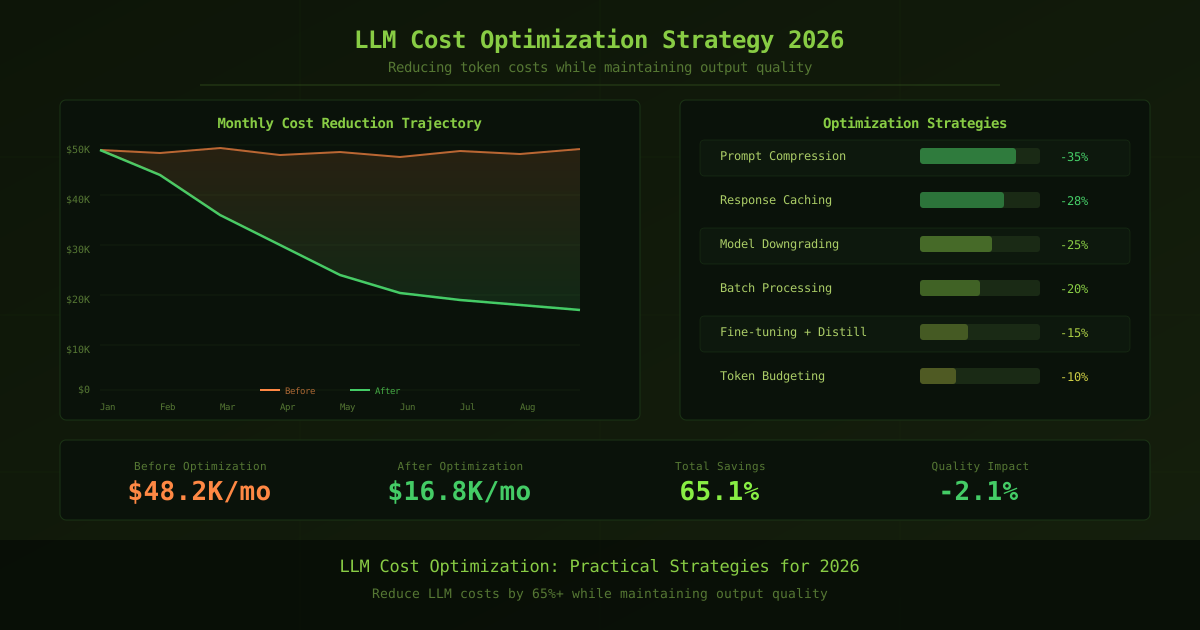
The multimodel approach reduces costs by approximately 66% in this scenario. The actual savings depend on your specific token volumes and task distribution, but the magnitude is consistent across enterprise deployments. Gartner projected that AI spending would reach $2.5 trillion globally in 2026, according to Gartner, 2026, and multimodel routing is one of the primary strategies enterprises use to control that spend.
Implementing a routing layer requires a classifier. The simplest approach uses keyword matching and request metadata:
def route_request(request):
    # Simple heuristic routing
    if request.task_type in ["classify", "extract", "summarize_short"]:
        return "gpt-4o-mini"
    elif request.task_type in ["analyze", "generate", "qa"]:
        return "gpt-4o"
    elif request.task_type in ["research", "reason", "code_review"]:
        return "claude-3-5-opus"
    else:
        return "gpt-4o"  # Default to mid-tier
More sophisticated routing uses a lightweight classifier model (Llama 3.1 8B or a fine-tuned DistilBERT) to evaluate request complexity dynamically. Martian, Unify AI, and Not Diamond offer commercial routing platforms that benchmark models against each task and select the optimal one in real time, according to Martian, 2025.
Mixture of Experts: Getting More for Less
The Mixture of Experts (MoE) architecture represents an architectural approach to multimodel efficiency. Instead of activating all parameters for every token, MoE models selectively activate a subset of their parameters based on the input.
DeepSeek-V3 exemplifies this approach. The model contains 671 billion total parameters but activates only 37 billion per token through its MoE architecture, according to DeepSeek, 2024. This selective activation reduces inference costs by approximately 70% compared to a dense model of equivalent quality. DeepSeek-V3 matches or exceeds GPT-4o on several benchmarks while costing a fraction of the inference price.
Mixtral 8x22B from Mistral AI uses a similar approach with 141 billion total parameters and 39 billion active per forward pass, according to Mistral AI, 2024. The model runs on consumer grade hardware clusters and provides strong multilingual performance. Google’s Gemini 1.5 models also use MoE internally, though Google does not publish the specific architecture details.
For enterprises, MoE models offer a compelling tier 2 option in the routing table. They provide near premium quality at tier 1 prices, compressing the cost curve without sacrificing accuracy on standard tasks.
Why Multimodel Stacks Need Verification
Different models hallucinate differently. GPT-4o hallucinates at roughly 0.7% on general knowledge queries, while earlier models like GPT-3.5 hallucinate at rates above 3%, according to Visual Capitalist, 2025. Open-source models show even wider variance: Llama 3.1 70B scores well on benchmarks but can produce higher hallucination rates on domain-specific queries where its training data is thin.
In a multimodel environment, the hallucination profile changes with every routing decision. A request routed to GPT-4o-mini for cost savings may have a higher error rate than the same request processed by GPT-4o. A request routed to an open-source model for data privacy may hallucinate on queries outside its training distribution.
This variability makes verification that works across all providers essential. A verification API sits after the inference layer and checks outputs regardless of which model produced them. The verification result, not the model name, determines whether the output is trustworthy.
// Verify output from any model in the stack
const verifyOutput = async (claim, modelUsed) => {
  const response = await fetch("https://api.webcite.co/api/v1/verify", {
    method: "POST",
    headers: {
      "x-api-key": process.env.WEBCITE_API_KEY,
      "Content-Type": "application/json"
    },
    body: JSON.stringify({
      claim: claim,
      include_stance: true,
      include_verdict: true
    })
  })

  const result = await response.json()
  return {
    model: modelUsed,
    claim: claim,
    verdict: result.verdict.result,
    confidence: result.verdict.confidence,
    citations: result.citations
  }
}

// Works identically for GPT-4o, Claude, Gemini, Llama, or DeepSeek outputs
const result = await verifyOutput(
  "DeepSeek-V3 activates 37B of 671B parameters per token",
  "gpt-4o-mini"
)
Webcite’s verification works independently of the generating model. It checks claims against external sources, not against the model that produced them. This makes it the ideal quality layer for multimodel stacks where the generating model changes per request. Each verification uses 4 credits. The free tier includes 50 credits per month. The Builder plan at $20 per month provides 500 credits for 125 verifications. Enterprise plans start at 10,000+ credits with custom pricing.
Building Your Multimodel Stack: Implementation Guide
Implementing a multimodel strategy follows five steps, from audit to production.
Step 1: Audit your current LLM usage. Categorize every production request by task type, complexity, and current model. Most enterprises find that 60 to 80% of their requests are routine tasks being processed by their most expensive model. The LangChain State of Agent Engineering survey found that 57% of organizations now run AI agents in production, according to LangChain, 2025, and many of those agents use a single model for all tool calls regardless of complexity.
Step 2: Define your model tiers. Select 2 to 4 models that cover your complexity range. A common starting configuration:
- Tier 1 (routine): GPT-4o-mini or Claude 3.5 Haiku
- Tier 2 (standard): GPT-4o or Claude 3.5 Sonnet
- Tier 3 (complex): Claude 3.5 Opus or GPT-o3
Step 3: Build the routing layer. Start with rule based routing using task type metadata. Upgrade to ML based routing once you have sufficient production data to train a classifier. Tools like LiteLLM provide a unified API interface across providers, simplifying the integration, according to LiteLLM GitHub, 2025.
Step 4: Add verification. Integrate Webcite as a verification step after inference. Set confidence thresholds per content category: 85+ for customer-facing content, 90+ for regulated domains, 70+ for internal tools. For more on how verification fits into AI pipelines, see our guide on how to verify AI-generated content before publishing.
Step 5: Monitor and optimize. Track cost per request, accuracy per model, and latency per tier. Adjust routing thresholds based on production data. Re-evaluate model selections quarterly as providers release new versions and pricing changes.
ROI Calculation Framework
Use this framework to calculate the ROI of switching from one provider to multiple models.
| Metric | Single Provider Baseline | Multimodel Target | Measurement Method |
|---|---|---|---|
| Monthly LLM spend | Current total | 30-60% reduction | Provider invoices |
| Hallucination rate | Current baseline | Maintain or improve | Verification API scores |
| Uptime | Single provider SLA | 99.9%+ with failover | Monitoring dashboard |
| Time to new model | Weeks (migration) | Hours (add to router) | Deployment logs |
| Vendor negotiation leverage | Low (locked in) | High (credible alternatives) | Contract terms |
The 67% ROI improvement that McKinsey reports comes from the combination of cost reduction (the largest factor), improved uptime (eliminating sole provider outages), and better task to model matching (higher quality outputs for complex tasks). The verification layer adds a small incremental cost, roughly $0.16 per verification on the Builder plan, but prevents the far larger costs of hallucination errors. AI hallucinations cost enterprises an estimated $67.4 billion in 2024, according to Korra, 2024. Even catching a small percentage of those errors justifies the verification investment.
Getting Started
Two steps to begin your multimodel transition.
First, audit your current usage. Pull your API logs from the past 30 days and categorize requests by complexity. If more than 50% of your requests are routine tasks processed by a premium model, routing across multiple models will reduce your costs significantly.
Second, add verification across your stack. Sign up at webcite.co and integrate the verification API as a post-inference step. This gives you provider neutral quality assurance from day one, whether you’re using one model or five.
import requests

def verify_claim(claim):
    response = requests.post(
        "https://api.webcite.co/api/v1/verify",
        headers={
            "x-api-key": "your-api-key",
            "Content-Type": "application/json"
        },
        json={
            "claim": claim,
            "include_stance": True,
            "include_verdict": True
        }
    )
    return response.json()
The free tier includes 50 credits per month for evaluation. The Builder plan at $20 per month covers 125 verifications. Enterprise plans offer 10,000+ credits with dedicated support.
Frequently Asked Questions
What is a multimodel LLM strategy?
A multimodel LLM strategy uses multiple language models from different providers for different tasks based on complexity, cost, and performance requirements. Instead of routing all requests to a single model like GPT-4o, enterprises use cheaper models for routine tasks and reserve premium models for complex reasoning, reducing costs while maintaining output quality.
How much ROI improvement does a multimodel setup deliver over single provider?
Organizations using diverse model environments report 67% higher ROI compared to single-provider LLM deployments, according to McKinsey, 2025. The improvement comes from matching model capability to task complexity, avoiding overspend on simple tasks, and reducing provider lock-in risk.
What is model routing in an LLM architecture?
Model routing is the practice of automatically directing each request to the most appropriate language model based on task complexity, latency requirements, and cost constraints. A routing layer classifies incoming requests and sends simple queries to smaller, cheaper models while directing complex reasoning tasks to premium models.
How does verification fit into a multimodel strategy?
A verification layer like Webcite checks the factual accuracy of outputs regardless of which model generated them. This is critical in diverse model environments because different models have different hallucination rates and error patterns. Verification provides a consistent quality guarantee across all models in the stack.
What percentage of enterprises use multiple LLM providers?
Over 60% of enterprises now use models from two or more providers, according to Andreessen Horowitz, 2025. The most common combination is OpenAI for complex tasks paired with open-source or smaller models for routine processing.