GPT-4o scores 88.7% on MMLU. Claude 3.5 Sonnet scores 88.7%. Gemini 1.5 Pro scores 85.9%. When the top models are separated by fewer than 3 percentage points on the most-cited LLM benchmark, that benchmark has stopped being useful, according to Vellum AI, 2025. Vellum AI excluded MMLU from their evaluations entirely because it no longer differentiates frontier models. This article covers the benchmarks that actually matter in 2026: MMLU-Pro, MixEval, LMSYS Chatbot Arena, and custom evaluation methods that measure what general benchmarks can’t.
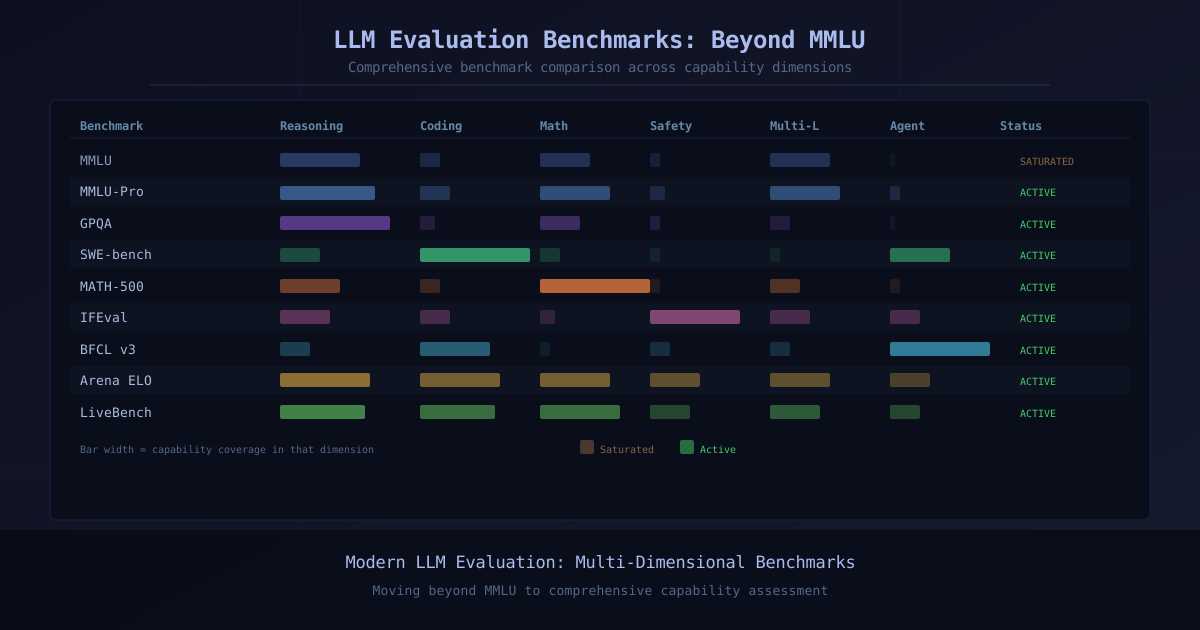
- MMLU is saturated; state-of-the-art models score above 85-90%, making it useless for differentiation.
- MMLU-Pro uses 10-option questions and chain-of-thought reasoning, producing a wider score distribution across models.
- LMSYS Chatbot Arena has collected over 2 million human preference votes and uses Elo ratings to rank models.
- For production decisions, evaluations on your own data outweigh any general benchmark.
- Factual accuracy requires verification against real sources, not just benchmark scoring.
Why MMLU No Longer Differentiates LLMs
MMLU (Massive Multitask Language Understanding) was introduced by researchers at UC Berkeley in 2020 as a 57-subject, 14,042-question multiple-choice test covering topics from abstract algebra to world religions, according to Hendrycks et al., 2020. When it launched, GPT-3 scored around 43%. The benchmark had headroom. Models could clearly improve.
By 2025, that headroom disappeared. Frontier models from OpenAI, Anthropic, Google, Meta, and Mistral AI all score above 85%. The differences between top models are within the margin of error for a 14,000-question test. MMLU has become a checkbox, not a discriminator.
Several structural issues compound the saturation problem:
- Four-option multiple choice gives models a 25% baseline through random guessing, compressing the effective scoring range.
- Many questions can be answered through pattern matching rather than genuine reasoning. Models trained on large internet corpora have likely seen similar or identical questions during training.
- The dataset is static. Once a model has been trained or fine-tuned on data that includes MMLU-style questions, its score reflects memorization as much as capability.
Vellum AI, an LLM evaluation platform that maintains one of the most comprehensive model leaderboards, dropped MMLU from their rankings because it adds noise rather than signal, according to Vellum AI, 2025. Their analysis found that MMLU scores correlate weakly with real-world performance on production tasks.
The broader lesson: any benchmark with a fixed dataset and simple format will eventually saturate as models improve. Evaluation must evolve faster than the models it measures.
MMLU-Pro: 10-Option Questions with Chain-of-Thought
MMLU-Pro addresses MMLU’s limitations by increasing difficulty and reducing the effectiveness of guessing. Published by researchers at Tiger Lab in 2024, MMLU-Pro makes three structural changes, according to Tiger Lab (MMLU-Pro), 2024:
-
Ten answer options instead of four. This reduces random guessing probability from 25% to 10%, widening the effective scoring range.
-
Chain-of-thought reasoning required. Many MMLU-Pro questions require multi-step reasoning to arrive at the correct answer. Models that excel at pattern matching but struggle with logical chains perform noticeably worse.
-
More complex, compound problems. The questions are drawn from harder subsets and include problems that require combining knowledge across domains.
The results show a wider score distribution. Where MMLU clusters top models within a 3-point range, MMLU-Pro spreads them across a much wider band. This makes it actually useful for comparing frontier models. GPT-4o, Claude 3.5 Sonnet, and Gemini 1.5 Pro show meaningful performance differences on MMLU-Pro that MMLU obscures.
MMLU-Pro isn’t perfect. It still uses a fixed dataset subject to eventual contamination. It still relies on multiple choice, which doesn’t capture open-ended generation quality. But it represents a significant improvement over MMLU for model selection decisions.
LMSYS Chatbot Arena: Human Preference at Scale
LMSYS Chatbot Arena takes a fundamentally different approach to evaluation. Instead of scoring models against a fixed test set, it uses live human preference judgments. Users submit prompts to the platform, receive responses from two anonymous models, and vote for the one they prefer, according to LMSYS, 2024.
The platform uses an Elo rating system, the same rating system used in chess. Each vote updates both models’ Elo scores. Over time, the ratings converge to a stable ranking that reflects aggregate human preference. As of early 2026, the Arena has collected over 2 million human votes across hundreds of models.
Chatbot Arena has several advantages over static benchmarks:
- It measures what humans actually want, not what a test set considers correct. A model that gives a technically accurate but unhelpful answer scores lower than one that gives a clear, useful response.
- The prompt distribution reflects real user behavior. People ask the Arena about coding, creative writing, analysis, translation, and obscure trivia. This diversity is hard to replicate in a curated benchmark.
- Contamination is inherently limited. New prompts arrive daily, so a model can’t game the evaluation by memorizing the test set.
Chatbot Arena consistently ranks as one of the most trusted LLM evaluation methods among AI researchers and practitioners. Its main limitation is bias: users who frequent the platform may not represent the broader population. Coding-heavy users may systematically prefer models good at code. English-dominant prompts may disadvantage models optimized for multilingual performance.
MixEval and LiveBench: Adversarial and Contamination-Resistant Benchmarks
MixEval and LiveBench represent a newer generation of benchmarks designed specifically to resist the contamination and saturation problems that undermine MMLU.
MixEval
MixEval builds evaluation sets from real user queries collected from search engines and ChatGPT usage patterns, then maps those queries to existing benchmark questions that test the same skills, according to MixEval, 2024. This dual approach combines the ecological validity of real user queries with the reproducibility of standardized benchmarks.
MixEval also includes an adversarial variant, MixEval-Hard, that specifically targets frontier model weaknesses. Problems in MixEval-Hard are selected based on where top models disagree, focusing evaluation effort on the capability boundaries that actually differentiate models. MixEval’s correlation with Chatbot Arena Elo scores is among the highest of any automated benchmark, making it a practical proxy when human evaluation isn’t feasible.
LiveBench
LiveBench takes contamination resistance to its logical conclusion: the benchmark is refreshed monthly with new questions, according to LiveBench, 2024. Questions are sourced from recent events, new research papers, and freshly generated reasoning problems. Because the questions didn’t exist when any current model was trained, contamination from pre-training data is impossible.
LiveBench evaluates six dimensions: math, coding, reasoning, language, instruction following, and data analysis. Each dimension uses questions that are verifiable without human judgment, enabling fully automated scoring at scale.
| Benchmark | Format | Contamination Resistance | Human Component | Correlation with Real-World Performance |
|---|---|---|---|---|
| MMLU | 4-option MC, static | Low | None | Weak (saturated) |
| MMLU-Pro | 10-option MC, static | Medium | None | Moderate |
| Chatbot Arena | Open-ended, live | High | Direct voting | Strong |
| MixEval | Mixed, real queries | Medium-High | Indirect (query sourcing) | Strong |
| LiveBench | Mixed, monthly refresh | Very High | None | Moderate-Strong |
Key Evaluation Dimensions Beyond Knowledge
General benchmarks compress LLM performance into a single score. Production evaluation requires decomposing performance into the dimensions that matter for your specific use case.
Reasoning
GPQA (Graduate-Level Google-Proof Q&A) tests chained reasoning with questions written by PhD-level domain experts. The questions are designed to be unsearchable, requiring genuine reasoning rather than retrieval, according to GPQA, 2023. Even expert humans without specialized knowledge score below 35%. GPQA Diamond, the hardest subset, remains challenging for all frontier models.
Coding
SWE-Bench evaluates models on real GitHub issues from open-source Python repositories, according to SWE-Bench, 2024. Models must read the issue description, understand the codebase, and generate a correct patch. SWE-Bench Verified uses human-validated issues to reduce noise. Performance on SWE-Bench correlates strongly with real-world coding assistant utility, making it a better predictor than HumanEval for production coding tasks.
Math
MATH (Mathematics Aptitude Test of Heuristics) and its harder variant GSM8K test mathematical reasoning across difficulty levels. Frontier models now score above 90% on GSM8K, so MATH-500, a curated harder subset, provides better differentiation, according to Hendrycks et al., 2021.
Instruction Following
IFEval (Instruction Following Evaluation) tests whether models follow explicit formatting, length, and content constraints in their responses, according to IFEval, 2023. This dimension is critical for production applications where the model must produce structured output (JSON, specific formats, length limits). A model that generates great content but ignores formatting instructions creates downstream integration problems.
Safety and Factual Accuracy
Standard benchmarks like TruthfulQA measure whether models reproduce common misconceptions. But TruthfulQA uses a fixed question set that models can memorize. For production factual accuracy, dynamic verification against real-world sources provides a more reliable signal. A verification API checks each claim against current sources, catching both hallucinations and outdated information that static benchmarks miss.
Task-Specific Evaluation: What Matters for Production
General benchmarks help narrow the field. They tell you which 3-5 models are worth evaluating seriously. But the final selection for a production application should never rely on general benchmarks alone.
Domain-specific evaluation means testing models on your actual data, with your actual prompts, evaluated against your actual quality criteria. The process has three steps.
First, build an evaluation dataset from your domain. Collect 100-500 representative inputs that cover the range of tasks your application handles. Include edge cases, ambiguous inputs, and adversarial examples. For a customer support chatbot, this means real customer questions, not synthetic prompts.
Second, define evaluation criteria specific to your use case. A legal research tool needs different criteria than a creative writing assistant. Common dimensions include factual accuracy, relevance, completeness, tone, format compliance, and latency. Weight each dimension by importance.
Third, run each candidate model against your evaluation dataset and score responses against your criteria. Use a combination of automated metrics (BLEU, ROUGE, exact match for structured outputs) and human evaluation for subjective quality. The model that ranks first on Chatbot Arena may rank third on your specific task.
For applications where factual accuracy is critical, include a verification step in your evaluation pipeline. Send model outputs to the Webcite verification API and measure the percentage of claims that come back as supported. A model that scores 88% on MMLU but hallucinates 15% of industry facts is a worse choice than a model scoring 85% on MMLU with a 5% hallucination rate for your content. For a deeper exploration of how hallucination detection works in production systems, see our guide on RAG hallucination detection.
Building Your Evaluation Strategy
A practical LLM evaluation strategy layers general benchmarks, specialized domain benchmarks, and custom evaluations for your use case.
Start with general benchmarks to create a shortlist. MMLU-Pro, Chatbot Arena Elo, and MixEval scores narrow the field from dozens of models to 3-5 serious candidates. Eliminate any model that scores more than 10% below the leader on dimensions critical to your use case (reasoning, coding, instruction following, etc.).
Next, run specialized benchmarks for your field if they exist. Legal applications can use LegalBench. Medical applications can use MedQA. Coding applications can use SWE-Bench. These targeted benchmarks provide signal that general benchmarks miss.
Finally, run custom evaluations on your shortlisted models using your own data. This is where production decisions are made. A model that ranks second on general benchmarks but first on your custom evaluation is the right choice.
Repeat the evaluation when models are updated. OpenAI, Anthropic, Google, and Meta release new model versions multiple times per year. Your evaluation dataset stays constant (until you update it), so re-running evaluations is straightforward. AI model evaluations are projected to constitute a $3.3 billion market by 2030, according to Markets and Markets, 2024, reflecting how central this capability has become.
Frequently Asked Questions
Why is MMLU no longer a useful LLM benchmark?
MMLU is saturated. State-of-the-art models like GPT-4o, Claude 3.5 Sonnet, and Gemini 1.5 Pro all score above 85-90% on MMLU, leaving almost no room to differentiate between them. The benchmark uses 4-option multiple choice questions that allow models to score well through pattern matching rather than genuine understanding. Vellum AI excluded MMLU from their evaluations entirely because it no longer provides meaningful signal.
What is MMLU-Pro and how does it differ from MMLU?
MMLU-Pro is an enhanced version of MMLU that uses 10-option multiple choice questions instead of 4, requires chain-of-thought reasoning, and includes more complex multi-step problems. It reduces the effectiveness of random guessing from 25% to 10% and produces a wider score distribution that better differentiates between models.
What is the LMSYS Chatbot Arena?
The LMSYS Chatbot Arena is a crowdsourced evaluation platform where users submit prompts, receive responses from two anonymous models, and vote for the better response. The platform uses an Elo rating system similar to chess rankings. It has collected over 2 million human preference votes and is considered one of the most reliable measures of real-world LLM quality.
Should I use general benchmarks or specialized evaluations?
Use both, but prioritize targeted evaluations for production decisions. General benchmarks like MMLU-Pro and Chatbot Arena help narrow the field. Evaluations built on your actual data and use cases determine which model performs best for your specific application. A model that ranks first on general benchmarks may rank third for your particular domain.
How do you evaluate LLM factual accuracy?
Factual accuracy evaluation requires checking model outputs against verified sources, not just scoring against a test set. Verification APIs like Webcite check individual claims against real-world sources and return verdicts with citations. This approach catches hallucinations that benchmark-style evaluations miss because benchmarks test knowledge recall, not real-time factual accuracy.