GenAI delivers 3.7x ROI on average, but only 5% of AI initiatives see meaningful returns beyond their initial investment, according to McKinsey, 2025. In regulated industries, the stakes are higher. A bank deploying AI for loan decisions faces OCC scrutiny under SR 11-7. A health tech company using AI for clinical recommendations must satisfy FDA’s SaMD framework. A legal AI tool that fabricates case citations creates malpractice liability. This article covers sector-specific verification requirements for finance, healthcare, and legal services.
- GenAI delivers 3.7x ROI on average, but only 5% of AI initiatives achieve returns beyond initial investment.
- The OCC requires model risk management (SR 11-7) for all AI models used in banking decisions.
- The FDA has cleared over 1,000 AI-enabled medical devices, each requiring ongoing performance monitoring.
- Financial services face overlapping requirements from OCC, SEC, CFTC, FINRA, and SOX.
- Verification APIs produce the auditable documentation that regulators across all sectors demand.
Why Regulated Industries Face Unique AI Verification Requirements
All industries benefit from accurate AI outputs. Regulated industries are legally required to prove accuracy. The distinction matters because it transforms verification from a quality preference into a compliance obligation with enforcement consequences.
Three characteristics make regulated industries different:
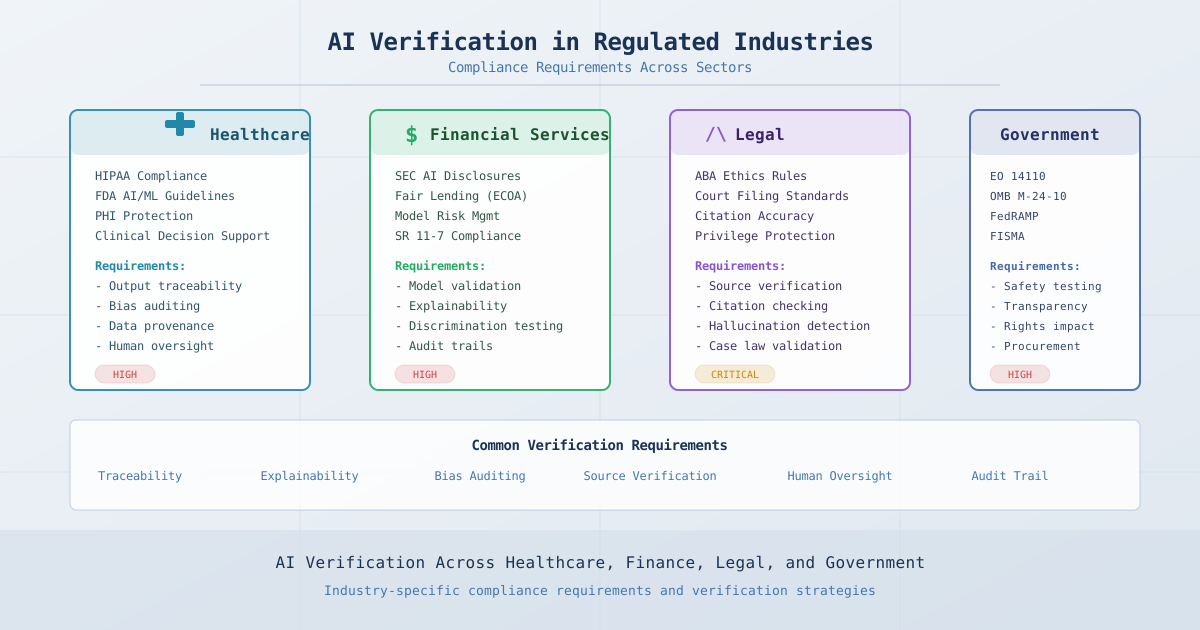
Regulatory mandates require documentation. The OCC’s SR 11-7 requires banks to validate all models, including AI models, that inform decisions. The FDA requires clinical evidence for AI-based medical devices. The SEC requires investment advisers to demonstrate that AI tools do not produce misleading outputs. These aren’t suggestions; they are enforceable requirements backed by examination authority.
Errors carry outsized consequences. A hallucinated AI output in a marketing email is embarrassing. A hallucinated AI output in a loan denial letter violates fair lending laws. A fabricated clinical recommendation can harm patients. A false legal citation creates malpractice exposure. Air Canada’s chatbot fabricated a bereavement fare policy that a tribunal later forced the airline to honor, according to CBC News, 2024. In regulated contexts, AI errors trigger regulatory action, not just customer complaints.
Audit expectations are explicit. Regulators examine records. OCC examiners review model validation documentation. FDA inspectors audit device performance records. SEC examiners review trading system controls. If your verification process doesn’t produce auditable records, it doesn’t exist from a regulatory standpoint.
Enterprises lost an estimated $67.4 billion to AI hallucinations in 2024, according to Korra, 2024. In regulated industries, those losses compound with penalties, remediation costs, and consent orders.
How AI Verification Works in Financial Services
Financial services face the most layered AI compliance environment of any industry. Multiple regulators impose overlapping requirements, and each expects evidence of AI output accuracy.
OCC SR 11-7: Model Risk Management. The Office of the Comptroller of the Currency issued Supervisory Guidance on Model Risk Management (SR 11-7) in 2011, according to the OCC, 2011. While it predates modern AI, the OCC applies it to machine learning and generative AI systems. SR 11-7 requires:
- Independent model validation separate from the development team
- Documentation of model design, assumptions, limitations, and performance
- Ongoing monitoring to detect model degradation
- Governance structures with clear accountability for model risk
For AI chatbots, research tools, and generative systems used in banking, SR 11-7 means every output that informs a client-facing or risk-related decision must be validated. A verification API provides the independent validation mechanism: it checks AI outputs against external sources without relying on the same model that generated the output.
SEC and CFTC scrutiny. The Securities and Exchange Commission and Commodity Futures Trading Commission have both issued guidance on AI use in financial markets. The SEC’s 2023 proposed rule on predictive data analytics would require investment advisers and broker-dealers to evaluate conflicts of interest when using AI tools, according to the SEC, 2023. The CFTC has examined AI-driven trading systems for market manipulation risk.
For investment advisory firms, this means AI-generated research reports, market analyses, and client communications must be demonstrably accurate. A verification API that checks factual claims in AI-generated research against authoritative financial data sources produces the evidence that SEC examiners look for.
SOX compliance. The Sarbanes-Oxley Act requires publicly traded companies to maintain internal controls over financial reporting. When AI systems generate or process financial data, SOX controls extend to those systems. Verification of AI outputs related to financial figures, projections, and regulatory filings becomes part of the internal control framework.
FINRA requirements. The Financial Industry Regulatory Authority oversees broker-dealers and requires that customer communications be fair, balanced, and not misleading. AI-generated content sent to customers, including chatbot responses, research summaries, and compliance alerts, must meet FINRA’s communication standards. Verification ensures factual claims in public-facing AI outputs are accurate.
Here is how a financial services organization integrates verification:
import requests

def verify_financial_claim(claim, context="financial_services"):
    response = requests.post(
        "https://api.webcite.co/api/v1/verify",
        headers={
            "x-api-key": "your-api-key",
            "Content-Type": "application/json"
        },
        json={
            "claim": claim,
            "include_stance": True,
            "include_verdict": True
        }
    )
    result = response.json()
    # Log for SR 11-7 model validation records
    return {
        "claim": claim,
        "verdict": result.get("verdict", {}),
        "citations": result.get("citations", []),
        "regulatory_context": context,
        "timestamp": "2026-02-19T10:00:00Z"
    }
How AI Verification Works in Healthcare
Healthcare AI operates under a dual regulatory structure: HIPAA governs data privacy, and the FDA governs AI as a medical device when it is intended for clinical purposes. The global healthcare AI market reached $20.9 billion in 2024 and is projected to grow at 38.5% CAGR through 2030, according to Grand View Research, 2024.
FDA regulation of AI/ML-based SaMD. The FDA has cleared over 1,000 AI-enabled medical devices as of early 2026, according to the FDA AI/ML Device Database. These include AI systems for radiology image analysis, pathology slide interpretation, ECG monitoring, and clinical decision support. Each cleared device must demonstrate clinical validity through controlled studies, and the FDA requires post-market monitoring of device performance.
The FDA’s framework for AI/ML-based SaMD introduces the concept of “predetermined change control plans” that allow manufacturers to update AI algorithms without seeking new clearance, provided the updates fall within documented parameters. This continuous learning framework requires ongoing verification that model outputs remain accurate as the algorithm evolves.
HIPAA intersection. HIPAA protects patient health information, but it also intersects with AI verification in subtle ways. When an AI system generates clinical content, patient summaries, or treatment recommendations, the accuracy of that content affects patient safety. HIPAA’s security rule requires covered entities to implement safeguards that protect the integrity of electronic protected health information, and AI-generated errors in clinical records can violate integrity requirements.
Clinical decision support considerations. AI systems that provide clinical decision support recommendations face particular scrutiny. Stanford HAI researchers found that AI hallucination rates vary from 3% to 20% depending on the domain, with medical domains trending toward the higher end, according to Stanford HAI, 2025. A 20% hallucination rate in a clinical decision support system means one in five recommendations could be based on fabricated or distorted information.
Healthcare organizations deploying AI must verify outputs at two levels:
-
Clinical verification. Medical claims, drug interactions, dosage recommendations, and diagnostic suggestions must be checked against authoritative medical databases and peer-reviewed literature. This is domain-specific verification that requires specialized medical knowledge bases.
-
General factual verification. Non-clinical AI outputs, such as insurance eligibility information, regulatory compliance summaries, facility statistics, and patient communication materials, require general fact-checking against public sources. A verification API handles this layer efficiently.
The World Health Organization published guidance on AI ethics and governance in health in 2024, emphasizing the need for transparency, accountability, and evidence-based deployment, according to WHO, 2024. Verification APIs provide the evidence-based documentation that WHO guidelines recommend.
How AI Verification Works in Legal Services
The legal profession faces a unique AI verification challenge because the consequences of inaccurate AI output are directly attributable to the attorney who relies on it. The legal AI market is projected to reach $3.1 billion by 2027, according to Goldman Sachs, 2024.
The Mata v. Avianca precedent. In 2023, attorneys Roberto Mata’s legal team submitted a brief containing AI-generated case citations that did not exist. The cases were entirely fabricated by ChatGPT. Judge P. Kevin Castel of the Southern District of New York sanctioned the attorneys, imposing fines and requiring them to notify the judges whose names appeared in the fabricated citations, according to Reuters, 2023. This case established a clear precedent: attorneys are responsible for verifying every AI-generated citation and claim.
Attorney work product and competence obligations. The American Bar Association’s Model Rules of Professional Conduct require lawyers to provide competent representation (Rule 1.1) and to supervise the work of associates, paralegals, and, by extension, AI tools (Rule 5.3). Multiple state bars, including California, Florida, and New York, have issued guidance on AI use in legal practice that emphasizes verification obligations.
Confidentiality constraints. Legal AI verification carries a unique constraint: attorney-client privilege and work product protections limit what information can be shared with external services. Verification of legal research must be designed to check factual claims (case existence, statute text, regulatory requirements) without exposing privileged strategy or client information.
Legal AI applications that need verification include:
| Application | Verification Need | Risk Level |
|---|---|---|
| Legal research | Case citation existence and accuracy | Critical |
| Contract analysis | Regulatory requirement accuracy | High |
| Due diligence | Company and financial fact accuracy | High |
| Client communications | Legal requirement summaries | Medium |
| Compliance monitoring | Regulatory change tracking | Medium |
The legal AI market is growing rapidly. Thomson Reuters, LexisNexis, and Harvey AI are all deploying generative AI for legal research and drafting. Each of these tools requires verification infrastructure. Even RAG-based legal AI systems hallucinate in 17% to 33% of queries, according to Magesh et al., Stanford Law School, 2024. For law firms, that error rate creates unacceptable malpractice risk without independent verification.
Cross-Industry Verification Architecture
Despite their different regulatory requirements, all three sectors need the same core verification architecture. The differences are in the confidence thresholds, audit requirements, and domain-specific source databases.
AI System Output
      |
      v
  [Extract Claims]
      |
      v
  [Verify Each Claim] --> Verification API
      |                    |
      |                    v
      |              Verdict + Confidence
      |              + Citations
      v
  [Apply Threshold]
      |
  +---+---+
  |       |
  v       v
Pass    Flag for
        Human Review
  |       |
  v       v
  [Log Audit Record]
      |
      v
  [Regulatory Evidence]
The confidence threshold varies by sector:
| Sector | Minimum Confidence | Rationale |
|---|---|---|
| Healthcare (clinical) | 95+ | Patient safety |
| Financial (consumer-oriented) | 90+ | Fair lending, FINRA compliance |
| Legal (case citations) | 99+ | Malpractice risk |
| Financial (internal) | 85+ | Operational accuracy |
| Healthcare (administrative) | 85+ | Process accuracy |
| Legal (general research) | 90+ | Professional competence |
Claims below the threshold are routed to human reviewers. Claims above are logged with their verification evidence and included in the output. The audit trail, containing every claim, verdict, confidence score, and citation, becomes the compliance documentation.
Here is how the verification call works with sector-specific thresholds:
const response = await fetch("https://api.webcite.co/api/v1/verify", {
  method: "POST",
  headers: {
    "x-api-key": process.env.WEBCITE_API_KEY,
    "Content-Type": "application/json"
  },
  body: JSON.stringify({
    claim: "OCC SR 11-7 requires independent model validation for banking AI",
    include_stance: true,
    include_verdict: true
  })
})

const result = await response.json()
const confidence = result.verdict.confidence

// Apply sector-specific threshold
const FINANCIAL_THRESHOLD = 90
if (confidence >= FINANCIAL_THRESHOLD) {
  // Include in output with citation
  // Log as verified for audit trail
} else {
  // Route to human compliance reviewer
  // Log as flagged for audit trail
}
How Verification APIs Produce Regulatory Audit Evidence
Regulators don’t accept verbal assurances. They examine records. A verification API produces exactly the structured records that regulatory auditors look for.
Each API call generates a record containing:
- Input claim: The exact text that was verified
- Verdict: Supported, refuted, or insufficient evidence
- Confidence score: A numerical measure of verification certainty (0 to 100)
- Citations: Source URLs, titles, relevant passages, and stance indicators
- Timestamp: When the verification occurred
These records map to specific regulatory requirements:
For OCC SR 11-7: Verification logs serve as model validation evidence. The records demonstrate that AI outputs are independently checked against external sources, satisfying the requirement for validation separate from the development team.
For FDA SaMD monitoring: Verification logs contribute to post-market surveillance by documenting ongoing output accuracy. Declining confidence scores signal model degradation before it affects patient safety.
For SEC/FINRA communications: Verification records prove that consumer-oriented AI content was fact-checked before distribution, satisfying the requirement that communications be fair, balanced, and not misleading.
For legal work product: Verification logs demonstrate that attorneys met their competence obligation by independently verifying AI-generated research before relying on it.
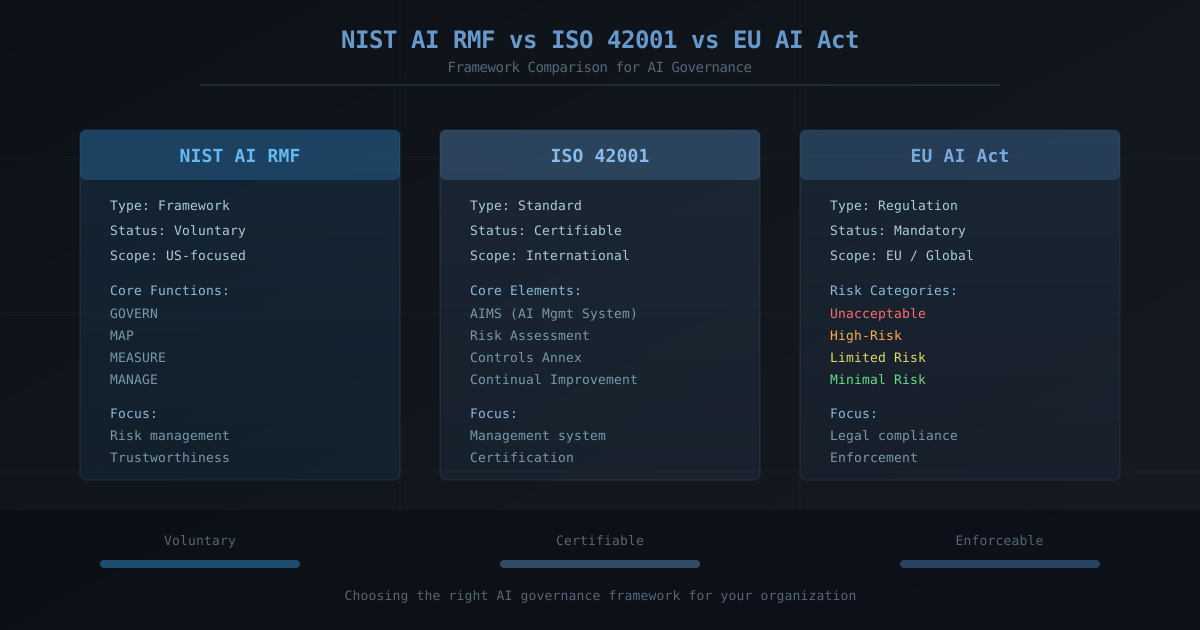
For organizations building comprehensive compliance programs, verification fits alongside broader AI trust framework components including governance platforms, guardrails, and monitoring systems. The verification layer provides the output accuracy evidence that governance policies require but rarely enforce at the technical level. For a comparison of how frameworks like NIST AI RMF, ISO 42001, and the EU AI Act define accuracy requirements, see our framework comparison.
Getting Started with Regulated Verification
Three steps to deploy verification in a regulated environment:
Step 1: Map regulated AI touchpoints. Identify every AI system in your organization that produces outputs affecting regulated decisions. In financial services, this includes customer-facing chatbots, lending models, research tools, and compliance monitoring systems. In healthcare, this includes clinical decision support, patient communication, and administrative AI. In legal, this includes research tools, contract analysis, and client-facing documents.
Step 2: Set sector-appropriate thresholds. Define minimum confidence scores for each AI touchpoint based on the regulatory requirements and risk level. Clinical healthcare outputs need 95+. Financial customer-facing outputs need 90+. Legal citations need 99+. Administrative outputs can accept 85+.
Step 3: Integrate and log. Connect the verification API to your AI pipeline and configure audit logging. Every verification result must be persisted with its full context (claim, verdict, confidence, citations, timestamp) in a format that regulatory examiners can query.
Webcite’s free tier at $0 per month includes 50 credits for testing your integration. Each verification uses 4 credits. The Builder plan at $20 per month provides 500 credits for production workflows. Enterprise plans at 10,000+ credits per month include custom pricing, dedicated compliance support, and SLA guarantees appropriate for regulated environments. Authentication uses the x-api-key header.
For more on how verification APIs work at a technical level, see our guide on what a verification API is. For current data on hallucination rates that quantify the accuracy risks in regulated AI deployments, see our AI hallucination statistics roundup.
Frequently Asked Questions
What is AI verification in regulated industries?
AI verification in regulated industries is the process of independently checking AI-generated outputs against authoritative sources to confirm accuracy before those outputs influence regulated decisions. Unlike general-purpose fact-checking, regulated verification must produce auditable records that satisfy specific regulatory requirements from bodies like the OCC, FDA, SEC, and state insurance commissions.
Does the OCC require AI output verification for banks?
The OCC requires model risk management for all models used in banking decisions under SR 11-7 (Supervisory Guidance on Model Risk Management). AI systems that influence lending, credit scoring, fraud detection, or compliance decisions must be validated, monitored, and documented. While SR 11-7 predates modern AI, the OCC has applied it to machine learning and generative AI systems used by banks.
How does the FDA regulate AI in healthcare?
The FDA regulates AI and machine learning-based systems as Software as a Medical Device (SaMD) when they are intended for medical purposes. Over 1,000 AI-enabled medical devices have received FDA clearance as of early 2026. The FDA requires clinical validation, continuous monitoring, and documentation of AI system performance for cleared devices.
What AI compliance requirements apply to financial services?
Financial services organizations face requirements from the OCC (SR 11-7 model risk management), SEC (AI in investment advisory and trading), CFTC (AI in derivatives trading), FINRA (AI in brokerage operations), and SOX (internal controls over financial reporting). Each requires documentation of AI system accuracy, validation procedures, and ongoing monitoring.
How do verification APIs help meet regulatory requirements?
Verification APIs create structured, timestamped audit records of every AI output checked, including the claim verified, sources consulted, confidence scores, and verdicts returned. These records satisfy documentation requirements across regulatory frameworks. The API call itself serves as the independent validation step that regulators expect.
What ROI does AI verification deliver in regulated industries?
GenAI delivers 3.7x ROI on average, but only 5% of AI initiatives achieve returns beyond initial investment, according to McKinsey, 2025. In regulated industries, failed AI initiatives carry additional costs from regulatory penalties, customer remediation, and reputational damage. Verification increases the percentage of AI projects that reach production by catching accuracy issues before they trigger compliance violations.