Fewer than 20% of RAG pipelines in production have any form of automated evaluation, according to a LangChain survey of 1,340 AI practitioners in 2025, LangChain, 2025. The other 80% rely on manual spot-checking or user complaints to discover quality issues. This guide covers the two evaluation approaches (offline and online), the 4 essential RAG metrics, a comparison of the 5 leading evaluation tools (RAGAS, TruLens, DeepEval, Langfuse, and Phoenix), and how external verification through Webcite adds a layer that LLM evaluator metrics cannot replicate.
- 80% of production RAG systems lack automated evaluation; most rely on manual spot-checks or user complaints.
- 4 essential metrics: faithfulness, answer relevance, context precision, and context recall.
- LLM evaluator adoption grew 300% from 2023 to 2025, replacing expensive human annotation for most evaluation tasks.
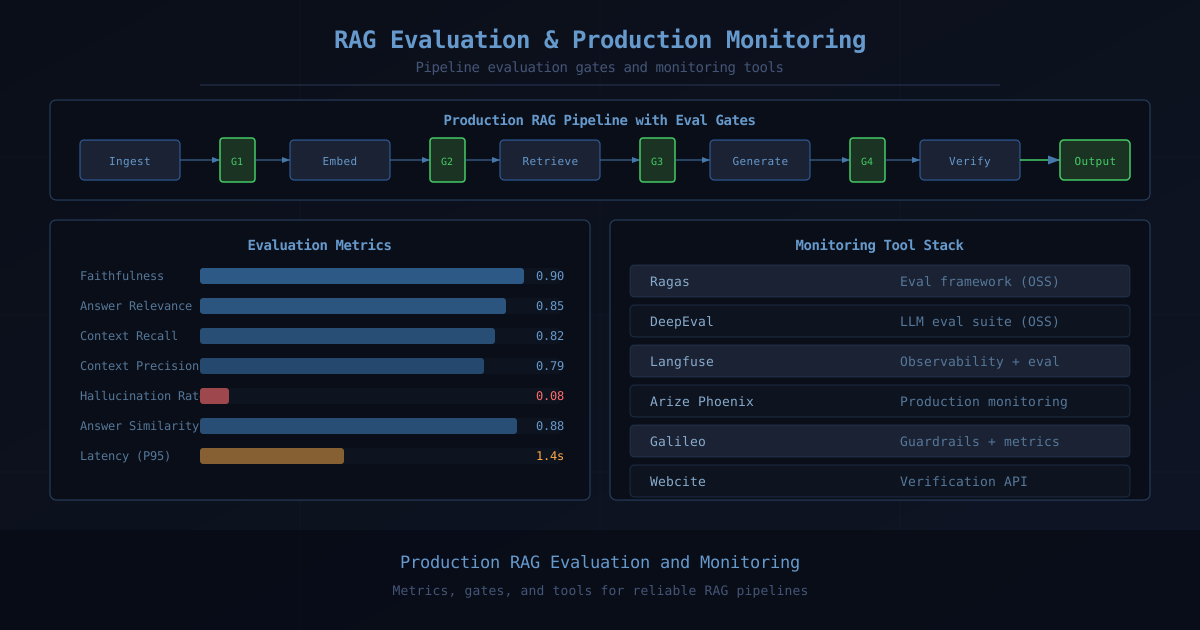
- RAGAS, TruLens, DeepEval, Langfuse, and Phoenix each serve different parts of the evaluation stack.
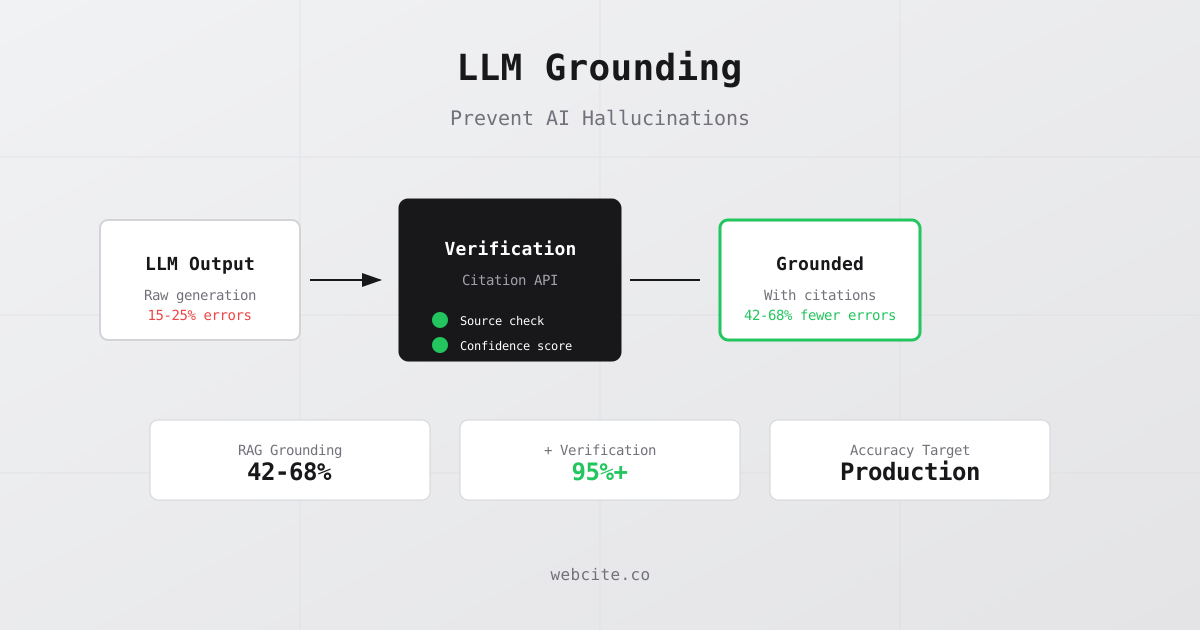
- External verification via Webcite catches a class of errors that internal LLM evaluator metrics miss: claims that are faithful to retrieved context but factually wrong.
What Are the Two Approaches to RAG Evaluation?
RAG evaluation splits into two fundamentally different approaches, and production systems need both.
Offline Evaluation: Curated Datasets
Offline evaluation uses a pre-built test dataset containing questions, expected answers, and reference documents. You run your RAG pipeline against this dataset and measure how well the outputs match expectations. This approach runs before deployment, in CI/CD pipelines, or on a regular schedule.
The dataset typically contains 200 to 2,000 question-answer pairs spanning the domains your RAG system covers. Each pair includes the ideal answer, the relevant source documents, and optionally the specific passages that support the answer. Tools like RAGAS can auto-generate evaluation datasets from your document corpus using an LLM, according to RAGAS documentation, 2025.
Offline evaluation excels at catching regressions. McKinsey found that 78% of organizations now use generative AI in at least one business function, yet fewer than half have formal evaluation processes for their AI outputs, according to McKinsey, 2025. When you update your embedding model, change your chunking strategy, or swap your LLM, running the test dataset immediately reveals whether the change improved or degraded quality. It provides a stable baseline that does not fluctuate with production traffic patterns.
The limitation is coverage. A curated dataset, no matter how large, cannot represent every query your production users will submit. Edge cases, adversarial inputs, trending topics, and novel phrasings all fall outside the test set.
Online Evaluation: Production Monitoring
Online evaluation analyzes real production traffic in real time. Every query, retrieval result, and generated response is scored against quality metrics. Alerts fire when metrics drop below thresholds. Dashboards show trends over time.
This approach catches failures that offline evaluation misses: sudden drops in retrieval quality when a data source goes stale, generation degradation when the LLM provider updates their model, distribution shifts as user behavior evolves, and adversarial queries that no test dataset anticipated.
The LangChain State of Agent Engineering survey found that 89% of organizations running agents in production have implemented some form of observability, but only 62% have detailed tracing at the individual step level, according to LangChain, 2025. RAG evaluation requires step-level tracing: you need to see what was retrieved, how it was ranked, and what the generator produced separately.
The cost of online evaluation is compute. Running an LLM evaluator on every production response doubles your LLM API spend. Most teams evaluate a sample (10% to 25% of traffic) or evaluate asynchronously to manage costs.
What Are the 4 Essential RAG Metrics?
Four metrics have emerged as the standard framework for RAG evaluation. Every major tool supports them, and they map to the three failure modes of RAG systems: bad retrieval, unfaithful generation, and incorrect answers.
Faithfulness
Faithfulness measures whether the generated answer is supported by the retrieved context. A faithful answer only makes claims that can be traced back to the retrieved passages. An unfaithful answer introduces information, statistics, or claims that the passages do not contain. Galileo AI found that general-purpose LLMs exhibit hallucination rates of 3% to 27% even with RAG augmentation, according to Galileo AI, 2025.
This is the most critical metric for hallucination detection. If your RAG system retrieves three relevant documents and the model generates a response containing five claims, faithfulness checks whether all five claims appear in or are logically derivable from those three documents. A faithfulness score below 0.8 typically indicates the model is hallucinating, according to RAGAS documentation, 2025.
Faithfulness evaluation using an LLM evaluator works by presenting the retrieved context and the generated answer to a judge model (GPT-4, Claude) and asking it to identify which claims in the answer are supported by the context. The metric is the ratio of supported claims to total claims.
Answer Relevance
Answer relevance measures whether the generated response addresses the user’s question. A response can be perfectly faithful to the retrieved context but completely miss the point of the query.
For example, if a user asks “What is the pricing for RAGAS?” and the RAG system retrieves RAGAS documentation and generates a two-paragraph explanation of RAGAS architecture, the answer is faithful but not relevant. It accurately describes RAGAS but does not answer the pricing question.
Answer relevance is computed by generating synthetic questions from the answer and measuring how similar they are to the original question. High similarity means the answer addresses the question; low similarity means the answer drifted.
Context Precision
Context precision measures whether the retrieved documents that are relevant appear at the top of the retrieval results. If your retriever returns 10 documents and only 3 are relevant, context precision evaluates whether those 3 appear in positions 1, 2, and 3 rather than positions 6, 8, and 10.
This metric matters because most LLMs pay more attention to content that appears early in the context window. Relevant documents buried at the bottom of the retrieval results are less likely to influence generation. Research from Microsoft demonstrated that LLMs perform significantly worse when relevant information is placed in the middle of long contexts, a phenomenon called “lost in the middle,” according to Liu et al., Stanford and Microsoft, 2023.
Context Recall
Context recall measures whether the retrieval step found all the relevant documents in the knowledge base. If your corpus contains 5 documents relevant to a query and your retriever only finds 3 of them, context recall is 60%. Vectara’s hallucination leaderboard shows that even top LLMs hallucinate 3% to 5% of the time, and poor context recall amplifies these rates by forcing the model to generate without complete evidence, according to Vectara, 2025.
Low context recall means your RAG system is making decisions based on incomplete information. Even if generation is perfectly faithful to the retrieved context, the answer may be wrong because critical evidence was never retrieved.
Context recall is the hardest metric to compute because it requires knowing which documents in the entire corpus are relevant to each query. In offline evaluation, this is provided in the test dataset. In online evaluation, it requires either human annotation or an approximation based on the full document set.
How Do the 5 Leading RAG Evaluation Tools Compare?
Five tools dominate the RAG evaluation landscape. Each occupies a different position in the trade-off between simplicity, features, and cost.
RAGAS
RAGAS (Retrieval Augmented Generation Assessment) is the most widely adopted open-source RAG evaluation framework. It implements all 4 core metrics plus additional metrics like answer similarity and answer correctness. RAGAS can auto-generate test datasets from your document corpus, reducing the cold-start problem for offline evaluation, according to RAGAS documentation, 2025.
The framework runs locally with minimal dependencies. A basic evaluation requires fewer than 20 lines of Python code. RAGAS integrates with LangChain, LlamaIndex, and Haystack, and supports OpenAI, Anthropic, and open-source models as judge LLMs.
Strengths: lightweight, open-source (Apache 2.0), easy to integrate, community-driven metric development. The GitHub repository has over 7,500 stars as of February 2026, according to RAGAS GitHub, 2026.
Limitations: no built-in dashboard, no production monitoring out of the box, requires custom infrastructure for online evaluation.
TruLens
TruLens, developed by TruEra, provides a comprehensive evaluation platform with a web dashboard, experiment tracking, and feedback functions. It wraps LangChain and LlamaIndex applications to automatically capture traces and evaluate them against configurable metrics, according to TruLens documentation, 2025.
TruLens coined the “RAG Triad” framework: answer relevance, context relevance, and groundedness (their term for faithfulness). The dashboard visualizes these metrics over time and supports A/B testing between pipeline configurations.
Strengths: production-ready dashboard, experiment tracking, supports custom feedback functions, integrates with LangChain and LlamaIndex natively.
Limitations: heavier setup than RAGAS, the full platform requires a database backend, some features require paid tiers.
DeepEval
DeepEval positions itself as “the Pytest of LLM evaluation.” It provides 14+ metrics, CI/CD integration via command-line tools, and a testing framework that fits into existing software development workflows, according to DeepEval documentation, 2025. Developers write evaluation tests that run alongside unit tests in their CI/CD pipeline.
The metric library is the most extensive of any tool in this category: faithfulness, answer relevance, contextual precision, contextual recall, hallucination, toxicity, bias, and several task-specific metrics. DeepEval also offers Confident AI, a cloud platform for collaboration and monitoring.
Strengths: CI/CD native, widest metric library, pytest-style test writing, both open-source and cloud options.
Limitations: cloud features require a paid subscription, steeper learning curve for teams not using pytest workflows.
Langfuse
Langfuse is an open-source observability platform for LLM applications. While not exclusively a RAG evaluation tool, it provides the tracing infrastructure that RAG evaluation requires: capturing queries, retrieval results, and generations as linked traces, according to Langfuse documentation, 2025.
Langfuse supports custom scoring functions that teams can use to implement RAG metrics. It integrates with RAGAS for metric computation while providing the production monitoring, session tracking, and cost analysis that RAGAS lacks.
Strengths: open-source (MIT license), self-hostable, excellent tracing UI, integrates with RAGAS and other evaluation frameworks, supports team collaboration.
Limitations: metrics require custom implementation or integration with RAGAS/DeepEval; not a standalone evaluation framework.
Phoenix (Arize AI)
Phoenix, built by Arize AI, provides LLM observability with built-in evaluation capabilities. It visualizes embedding spaces, tracks retrieval quality, and runs automated LLM evaluations on production traces, according to Arize Phoenix documentation, 2025.
Phoenix stands out for its embedding visualization, which lets teams see how queries cluster relative to their document corpus. This visual approach helps identify retrieval blind spots: regions of the query space where relevant documents exist but retrieval consistently fails.
Strengths: embedding visualization, production monitoring focus, open-source core, integrates with major LLM providers.
Limitations: evaluation metrics are less comprehensive than DeepEval, requires Arize cloud for some advanced features.
Tool Comparison Summary
| Feature | RAGAS | TruLens | DeepEval | Langfuse | Phoenix |
|---|---|---|---|---|---|
| License | Apache 2.0 | MIT | Apache 2.0 | MIT | Apache 2.0 |
| Core metrics | 6+ | 3 (RAG Triad) | 14+ | Custom | 4+ |
| Dashboard | No | Yes | Cloud only | Yes | Yes |
| CI/CD integration | Manual | Manual | Native | Manual | Manual |
| Auto test generation | Yes | No | Yes | No | No |
| Self-hostable | N/A | Yes | Partial | Yes | Yes |
| Production monitoring | No | Yes | Cloud only | Yes | Yes |
| GitHub stars (Feb 2026) | 7,500+ | 2,800+ | 4,200+ | 6,100+ | 8,500+ |
Why LLM Evaluator Metrics Miss a Critical Failure Mode
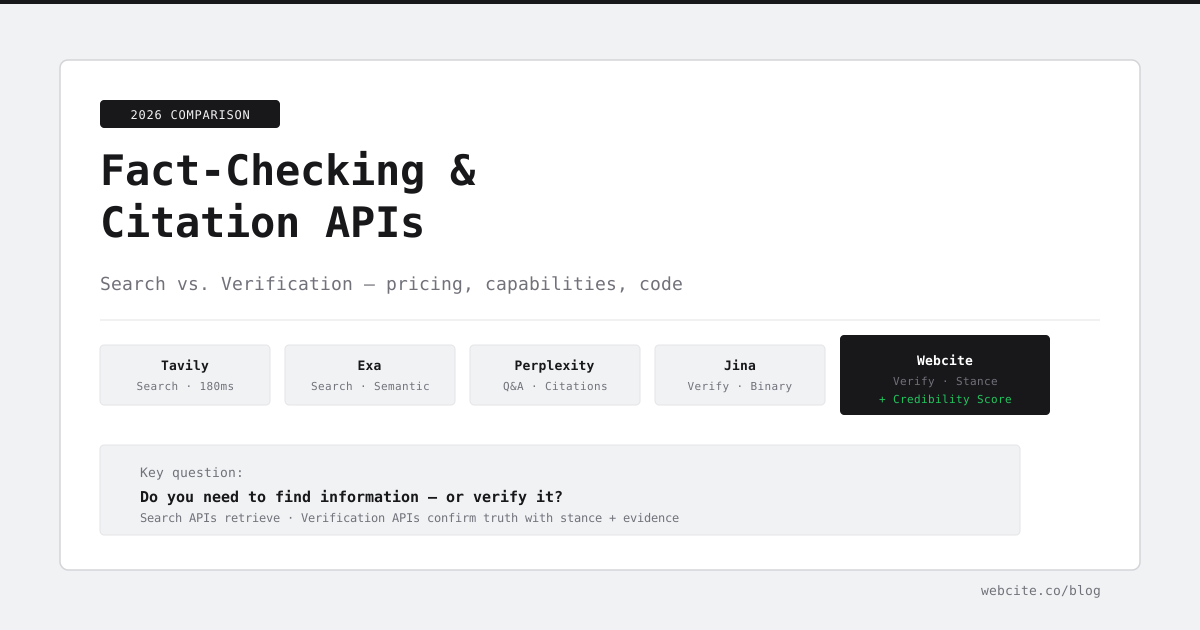
All five tools above rely on LLM evaluators for metric computation. A judge model (GPT-4, Claude, or an open-source alternative) reads the retrieved context and the generated response and scores the response on faithfulness, relevance, and correctness.
This approach has a blind spot: it evaluates faithfulness relative to the retrieved context, not relative to ground truth. If the retrieval step returns a document containing incorrect information, and the generator faithfully reproduces that incorrect information, the faithfulness score will be high. The answer is “faithful to its sources” but factually wrong.
Consider this scenario: Your RAG knowledge base contains a document from 2024 stating “GPT-4 is the most capable model available.” A user asks “What is the most capable AI model?” Your retriever finds that document. Your generator faithfully responds “GPT-4 is the most capable model available.” An automated LLM evaluation scores this as 1.0 faithfulness: the answer matches the context perfectly.
But the answer is wrong. By 2026, multiple models have surpassed GPT-4. The retrieval step returned stale information, the generation step was faithful to that stale information, and the evaluation step confirmed that faithfulness. Nobody caught the factual error.
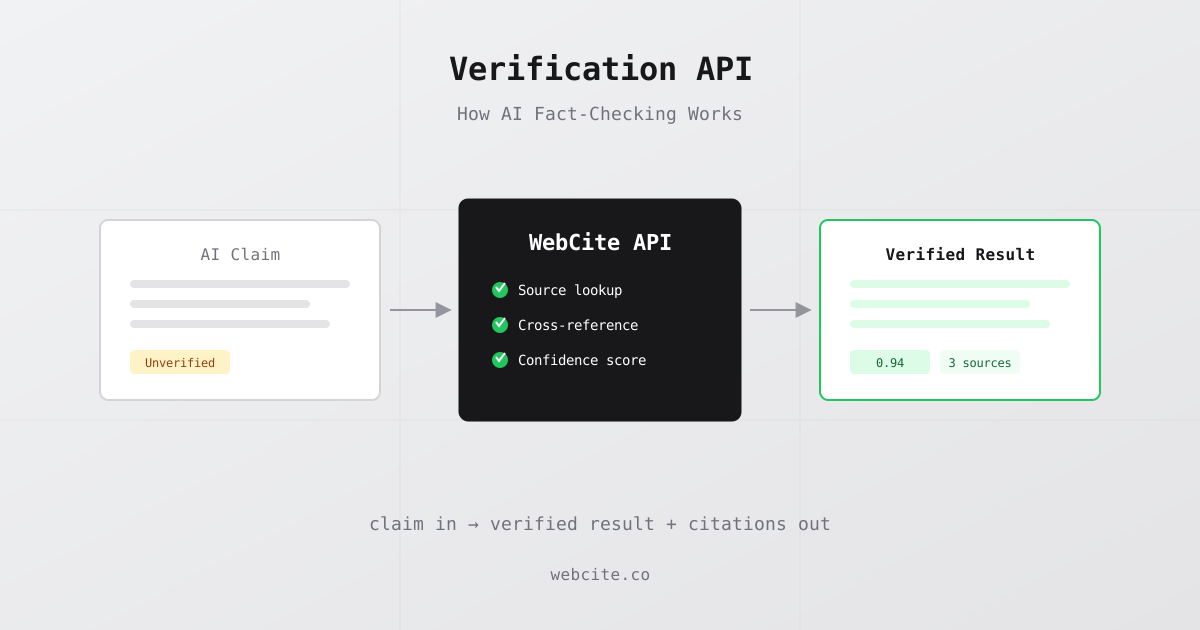
This is where external verification changes the equation. A verification API checks claims against current, real-world sources, not against the RAG system’s own knowledge base. It catches the class of errors where retrieval, generation, and automated evaluation all agree on something that is factually incorrect.
How to Add External Verification to Your RAG Evaluation Pipeline
External verification fits into the RAG evaluation stack as a complement to LLM evaluator metrics, not a replacement. The internal metrics catch generation failures (unfaithful answers, irrelevant responses). External verification catches knowledge base failures (stale documents, incorrect sources, missing context).
Here is a practical integration pattern using RAGAS for internal metrics and Webcite for external verification:
import requests
from ragas import evaluate
from ragas.metrics import faithfulness, answer_relevancy

ragas_result = evaluate(  # Step 1: RAGAS for internal RAG metrics
    dataset=your_test_dataset,
    metrics=[faithfulness, answer_relevancy]
)
print(f"Faithfulness: {ragas_result['faithfulness']:.2f}")
print(f"Relevancy: {ragas_result['answer_relevancy']:.2f}")

def verify_claims_externally(claims):  # Step 2: Webcite external verification
    results = []
    for claim in claims:
        response = requests.post(
            "https://api.webcite.co/api/v1/verify",
            headers={
                "x-api-key": "your-api-key",
                "Content-Type": "application/json"
            },
            json={
                "claim": claim,
                "include_stance": True,
                "include_verdict": True
            }
        )
        result = response.json()
        results.append({
            "claim": claim,
            "verdict": result.get("verdict", {}).get("result"),
            "confidence": result.get("verdict", {}).get("confidence")
        })
    return results

claims = extract_claims(rag_output)  # extract claims then verify externally
external_results = verify_claims_externally(claims)
factual_accuracy = sum(
    1 for r in external_results if r["verdict"] == "supported"
) / len(external_results)
print(f"External factual accuracy: {factual_accuracy:.2f}")
The internal faithfulness score tells you whether the model used its retrieved context correctly. The external factual accuracy score tells you whether the claims in the output are true. Together, they give you a complete picture of RAG pipeline quality.
Webcite’s free tier includes 50 credits per month ($0) for testing. The Builder plan at $20 per month provides 500 credits for 125 verifications. Enterprise plans start at 10,000+ credits for production evaluation pipelines. Each verification uses 4 credits.
For teams already running RAGAS or DeepEval, adding external verification requires fewer than 30 lines of code. The verification call is a standard REST API request using x-api-key authentication. For more on how verification APIs work and how they differ from search APIs, see our verification API explainer.
How to Set Up Production RAG Monitoring
A production monitoring setup combines offline baselines, online evaluation, and alerting. Here is the recommended configuration:
First, establish offline baselines. Run RAGAS or DeepEval on a curated test dataset of 500+ question-answer pairs. Record faithfulness, answer relevance, context precision, and context recall scores. These become your regression detection thresholds.
Second, implement online sampling. Evaluate 10% to 25% of production traffic using LLM evaluator metrics. Use Langfuse or Phoenix for trace capture and RAGAS or DeepEval for metric computation. Store results in a time-series database for trend analysis.
Third, add external verification for high-stakes outputs. Route customer-facing responses, published content, and regulatory-sensitive outputs through Webcite for independent factual checking. Log the results alongside your internal metrics.
Fourth, configure alerts. Set thresholds based on your offline baselines. A common configuration:
| Metric | Warning Threshold | Critical Threshold |
|---|---|---|
| Faithfulness | Below 0.85 | Below 0.75 |
| Answer relevance | Below 0.80 | Below 0.70 |
| Context precision | Below 0.75 | Below 0.60 |
| External factual accuracy | Below 0.90 | Below 0.80 |
When any metric crosses the warning threshold, the team investigates. When it crosses the critical threshold, the pipeline falls back to a cached response or routes to human review.
Fifth, schedule weekly evaluation runs on your full offline test set. Compare current scores to historical baselines. Track trends across model updates, knowledge base changes, and retrieval configuration adjustments. Gartner estimates that enterprises running AI in production will spend 30% of their AI budget on monitoring and evaluation by 2027, according to Gartner, 2025. Teams that invest in evaluation infrastructure now build the operational muscle that scales with their AI deployment.
For a deeper look at how hallucination detection works across different RAG architectures, see our guide on RAG hallucination detection.
Frequently Asked Questions
What is RAG evaluation?
RAG evaluation is the process of measuring how well a Retrieval-Augmented Generation system performs across multiple dimensions: whether it retrieves the right documents, whether the generated answer is faithful to those documents, and whether the final response correctly answers the user’s question. Evaluation happens both offline (with curated test datasets) and online (with production traffic).
What are the most important RAG evaluation metrics?
Four metrics are considered essential: faithfulness (does the answer stick to the retrieved context?), answer relevance (does the response address the question?), context precision (are the top-ranked retrieved documents actually relevant?), and context recall (did retrieval find all the relevant documents?). Faithfulness is the most critical for hallucination prevention.
What is LLM evaluator assessment?
LLM evaluator assessment uses a large language model, typically GPT-4 or Claude, to evaluate the quality of another model’s output. Instead of requiring human reviewers, the judge LLM scores responses on metrics like faithfulness, relevance, and correctness. This approach scales to thousands of evaluations per hour at a fraction of the cost of human annotation.
How is RAGAS different from TruLens and DeepEval?
RAGAS is a lightweight, open-source framework focused specifically on RAG metrics with minimal setup. TruLens provides a broader evaluation platform with a dashboard, experiment tracking, and integration with LangChain and LlamaIndex. DeepEval offers the widest metric library with 14+ metrics and native CI/CD integration. All three support LLM evaluator workflows.
Can Webcite be used for RAG evaluation?
Yes. Webcite serves as an external faithfulness validator in RAG pipelines. Unlike LLM evaluator metrics that evaluate faithfulness against the retrieved context, Webcite checks claims against independent real-world sources. This catches errors where both the retrieval and generation steps agree on something that is factually wrong.
Should I use offline or online RAG evaluation?
Both. Offline evaluation with curated datasets catches regressions before deployment and establishes baselines. Online evaluation with production traffic catches real-world failures that curated datasets miss, including distribution shifts, adversarial queries, and edge cases. The combination provides the most complete quality picture.