PDF to Markdown APIs cost between 0.10 and 3.11 cents a page among document parsers on ParseBench 2, and the most accurate ones sit at the top of that range, according to the ParseBench 2 leaderboard as of 20 November 2026. This post compares listed costs, each vendor’s own pricing, accuracy per cent, and the cost of 10,000 pages.
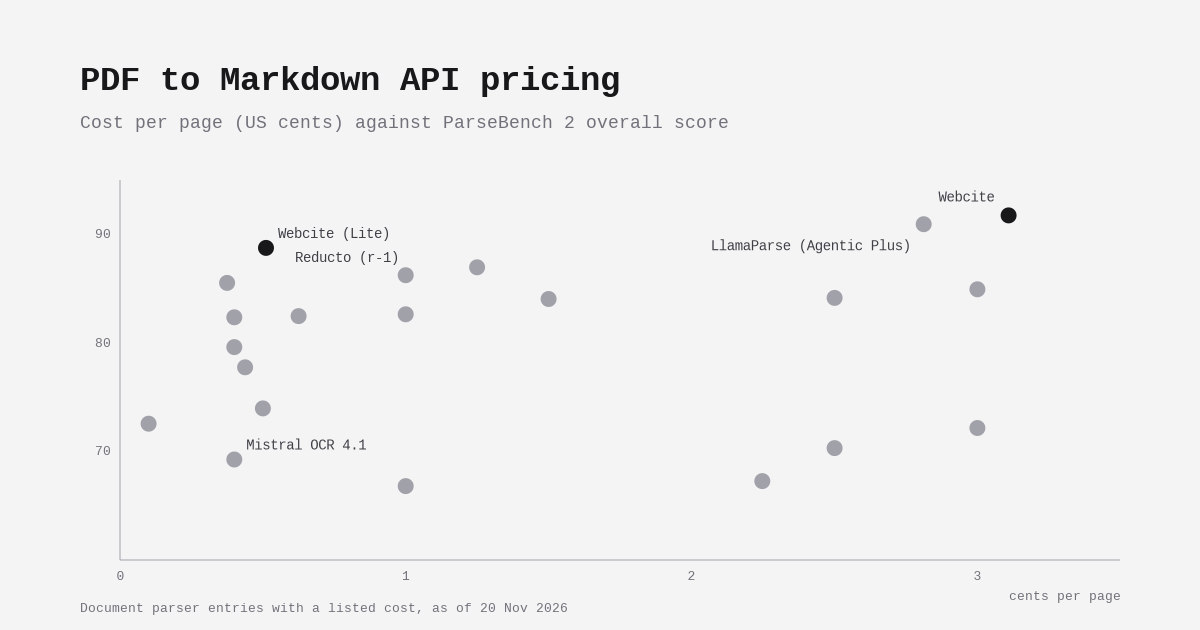
- Listed costs for document parsers on ParseBench 2 range from 0.10 to 3.11 cents a page.
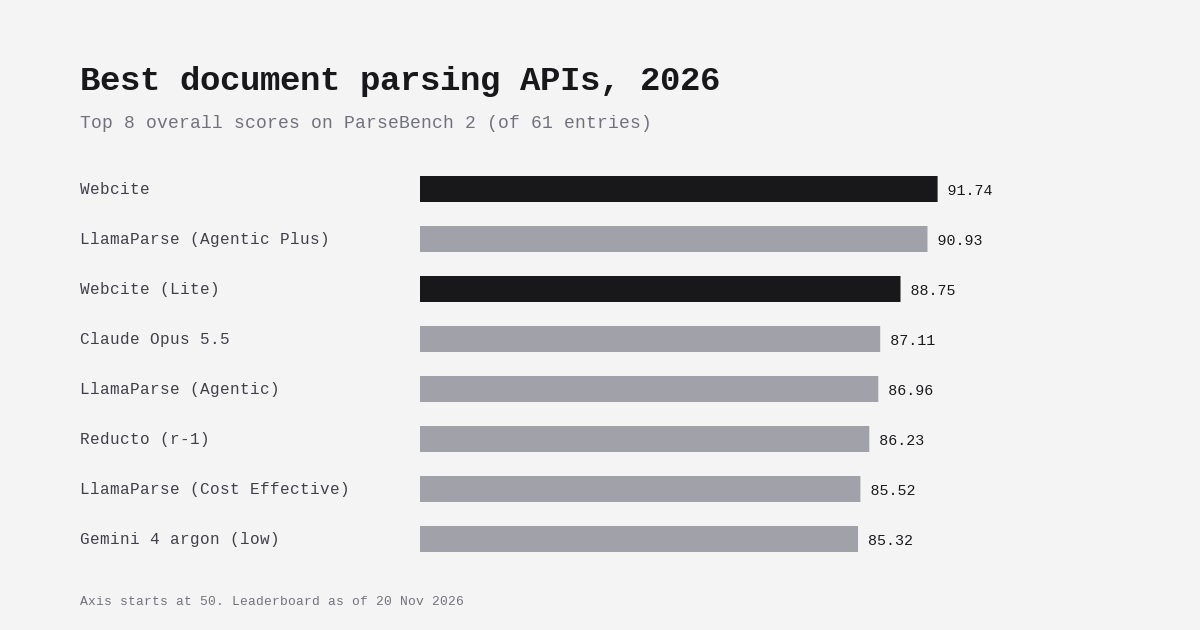
- Webcite scored 91.74 at 3.11 cents; LlamaParse Agentic Plus scored 90.93 at 2.813 cents.
- Webcite (Lite) scored 88.75 at 0.511 cents, the highest score of any entry under one cent.
- Vendors charge in three ways: flat rates per 1,000 pages, credits per page, and metered cost.
- Webcite bills verification with citations from the same credit balance as extraction.
How much do PDF to Markdown APIs cost per page?
Listed costs on ParseBench 2 run from 0.10 cents a page for Reducto (r-1-mini) to 3.11 cents for Webcite. The leaderboard was read as of 20 November 2026, and Webcite’s figure comes from its submission (source: ParseBench pull request 309). The scores behind these prices are in the best document parsing APIs of 2026 ranking.
| Most accurate tier | Overall | Leaderboard cost (cents/page) | Vendor’s own price |
|---|---|---|---|
| Webcite | 91.74 | 3.11 | Metered at cost, $0.04 a credit; a typical standard page is about 0.74 credits |
| LlamaParse (Agentic Plus) | 90.93 | 2.813 | 25 credits a page; 3.75 cents on pay as you go, 3.125 on Pro |
| LlamaParse (Agentic) | 86.96 | 1.25 | 10 credits a page; 1.5 cents on pay as you go |
| Reducto (r-1) | 86.23 | 1.00 | $10 per 1,000 pages |
| Under one cent | Overall | Leaderboard cost (cents/page) | Vendor’s own price |
|---|---|---|---|
| Webcite (Lite) | 88.75 | 0.511 | About 0.05 to 0.23 credits a page by page type |
| LlamaParse (Cost Effective) | 85.52 | 0.375 | 3 credits a page; 0.45 cents on pay as you go |
| Mistral OCR 4.1 (annotation) | 73.96 | 0.50 | $5 per 1,000 annotated pages |
| Mistral OCR 4.1 | 69.26 | 0.40 | $4 per 1,000 pages |
| Reducto (r-1-mini) | 72.55 | 0.10 | $1 per 1,000 pages |
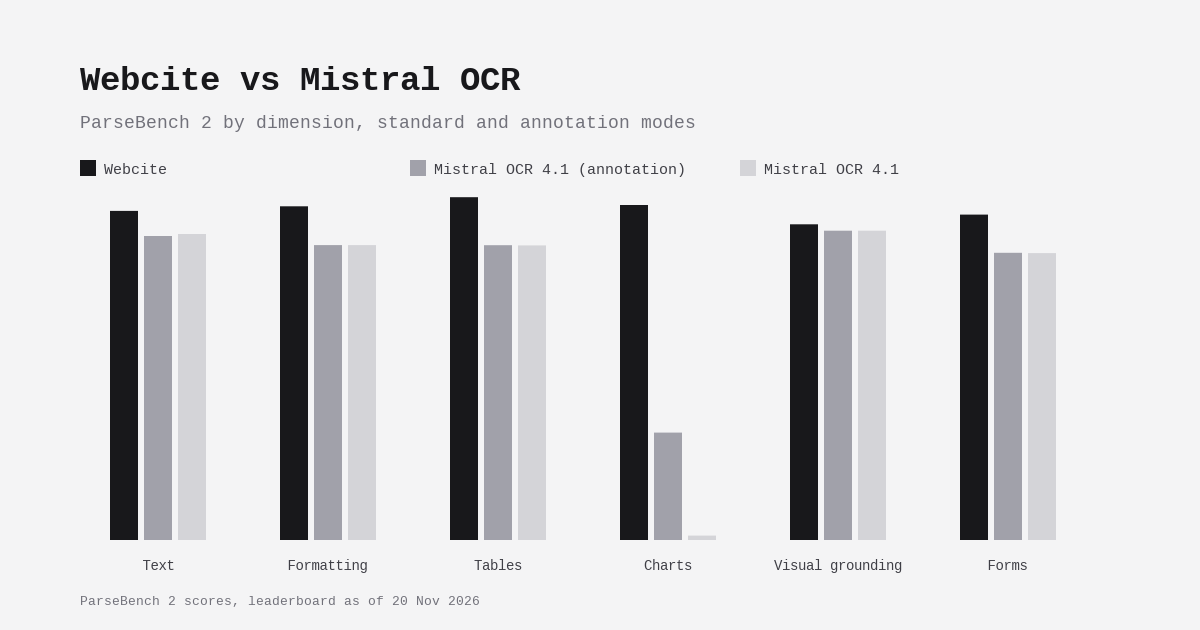
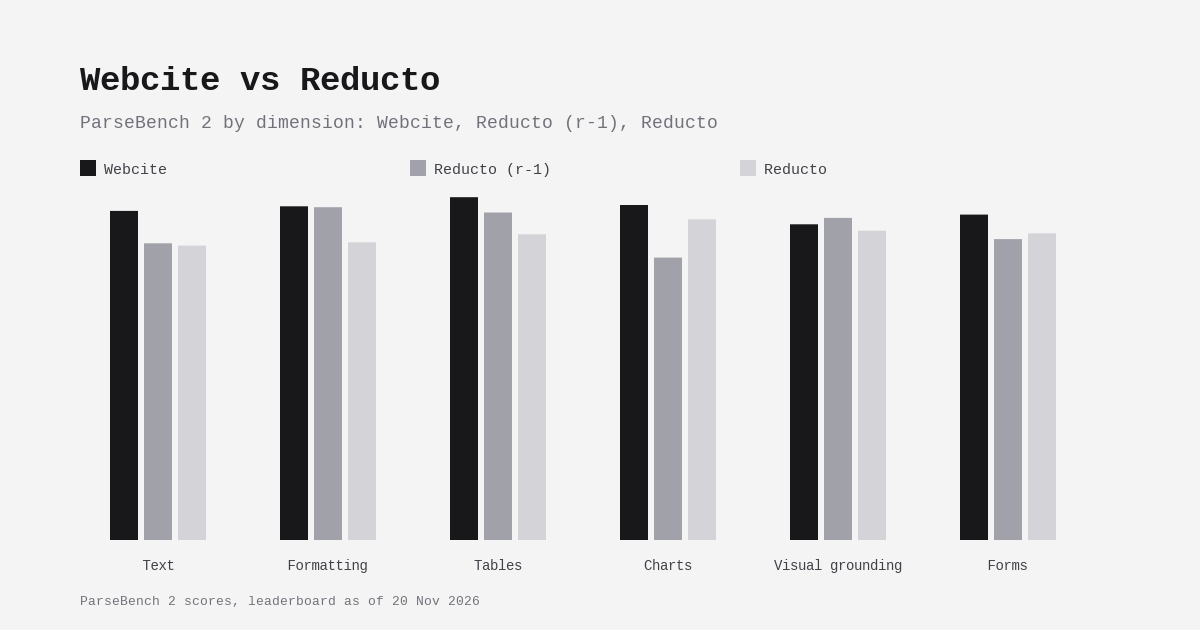
Vendor prices were checked on 24 November 2026 on LlamaIndex pricing, Reducto pricing and Mistral’s OCR 4.1 page. Where the two columns differ, the vendor’s page is the price you pay. For scores by dimension against each vendor, see Webcite vs LlamaParse, Webcite vs Reducto and Webcite vs Mistral OCR.
How do vendors charge for parsing?
Vendors use three models. Reducto and Mistral charge a flat rate per 1,000 pages. LlamaParse charges credits per page by tier, at $1.50 per 1,000 credits on pay as you go and $1.25 on Pro, plus 3 credits a page for layout extraction, according to LlamaIndex pricing.
Webcite meters each page at what its reads cost at the providers’ list prices, converted at $0.04 a credit, according to Webcite’s credits documentation. A page that could not be read costs nothing. Spreadsheets, DOCX, PPTX, HTML and text files cost 0 credits because no model reads them, and uploading is free.
Batch discounts change the picture for large jobs. Reducto takes 20% off Parse and Extract in batch, according to Reducto pricing, and Mistral’s OCR 4 announcement lists its Batch API at 50% off.
What do 10,000 pages cost?
At leaderboard prices, 10,000 pages cost between $10 and $311 across these entries. The figures below multiply each listed cost per page by 10,000, using costs from the ParseBench 2 leaderboard CSV; vendor list prices for the same pages are in the tables above.
| Entry | Cost of 10,000 pages | Overall |
|---|---|---|
| Webcite | $311.00 | 91.74 |
| LlamaParse (Agentic Plus) | $281.30 | 90.93 |
| Reducto (r-1) | $100.00 | 86.23 |
| Webcite (Lite) | $51.10 | 88.75 |
| Mistral OCR 4.1 | $40.00 | 69.26 |
| Reducto (r-1-mini) | $10.00 | 72.55 |
Real costs depend on page mix. Webcite’s 3.11 cents was measured on 325 production pages, 25 from each subset, and weighted to the benchmark’s mix, as its submission explains. A file of scanned forms costs more to read than a file of clean text.
Repeat reads also change the bill. LlamaIndex does not charge for parsing a cached file again, and in Webcite’s Lite measurement four of 325 pages repeated an earlier read of the same file and were free. If your pipeline re-reads the same documents, cache results or pick a vendor that does. The same batch and caching tactics apply to model calls, covered in LLM cost optimization strategies.
Which API gives the most accuracy per cent?
Webcite (Lite) gives the highest score under one cent a page: 88.75 for 0.511 cents. That is 3.23 points above LlamaParse Cost Effective, which costs 0.136 cents less a page, according to the ParseBench 2 leaderboard. Our list of ten LlamaParse alternatives by score and cost has more options.
Above one cent, the extra accuracy is small and the extra cost is large. Webcite’s standard mode adds 2.99 points over Lite for about six times the price. Pay for it when the pages carry charts or forms, where standard scores 93.05 and 90.38 against 88.87 and 86.79 for Lite. The guides to chart extraction from PDFs and form extraction APIs cover each.
What else does the price include?
Webcite’s credits also pay for checking what the document says. A full claim verification with citations, source stances and a verdict costs 4 credits; batch quote checks cost 1 credit an item; figure extraction costs 2 credits, according to Webcite’s credits documentation. The same key reaches every endpoint and the MCP server.
LlamaParse and Reducto price schema extraction separately from parsing. Reducto’s Extract costs $20 per 1,000 pages and returns citations with bounding boxes for each field, according to Reducto pricing. The Webcite benchmarks page lists every entry’s cost and score, and the comparison of fact checking APIs covers verification pricing in more depth.
What do the free tiers include?
LlamaIndex gives 10,000 free credits a month on pay as you go, which covers about 3,333 Cost Effective pages. Reducto’s Standard subscription includes $150 of free usage, according to Reducto pricing.
Webcite’s Free plan includes 100 credits a month, and the Builder plan is $20 a month for 500 credits with $0.04 a credit after that. To measure accuracy for yourself, the ParseBench reproduction guide runs a 100-case trial for about 28 credits. To see what your own files cost, extract a document with Webcite.
Frequently Asked Questions
How much does a PDF to Markdown API cost per page?
On the ParseBench 2 leaderboard, listed costs for document parsers run from 0.10 cents a page for Reducto r-1-mini to 3.11 cents for Webcite. The most accurate entries cost 2.8 to 3.1 cents a page; document parsers under one cent score between 69 and 89.
What is the cheapest PDF to Markdown API?
Reducto r-1-mini is the cheapest document parser on the leaderboard at 0.10 cents a page, or $1 per 1,000 pages on Reducto’s pricing page. It scored 72.55 overall and 1.35 on charts, so it suits pages without charts.
Which PDF to Markdown API gives the most accuracy per cent?
Webcite (Lite) scored 88.75 at 0.511 cents a page, the highest score of any entry under one cent. LlamaParse Cost Effective scored 85.52 at 0.375 cents. For top accuracy, Webcite scored 91.74 at 3.11 cents.
How does Webcite charge for document extraction?
Webcite meters extraction at cost. Each page is charged what its reads cost at list price, converted at $0.04 a credit; uploads are free, pages that could not be read are free, and spreadsheets, DOCX, PPTX, HTML and text files cost 0 credits.
Do PDF parsing APIs include fact checking?
Webcite does, on the same API key and credit balance. A full claim verification with citations, source stances and a verdict costs 4 credits. LlamaParse and Reducto price parsing and schema extraction separately and offer field citations with bounding boxes.