Webcite scored 91.74 overall on ParseBench 2 against 90.93 for LlamaParse Agentic Plus, at 3.11 cents a page against 2.813 cents, according to the ParseBench 2 leaderboard as of 20 November 2026 and Webcite’s submission. This post compares the six dimensions, the price, where LlamaParse leads, and what Webcite does after parsing.
- Webcite scored 91.74 overall on ParseBench 2; LlamaParse Agentic Plus scored 90.93.
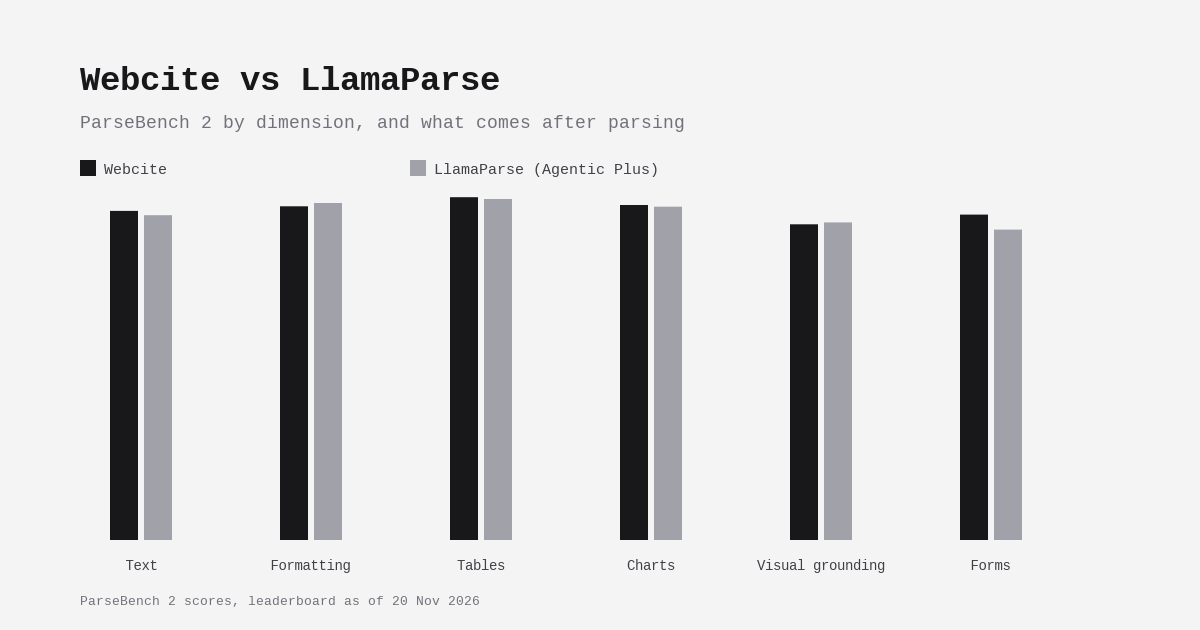
- LlamaParse Agentic Plus leads on formatting (93.60 vs 92.69) and visual grounding (88.23 vs 87.69).
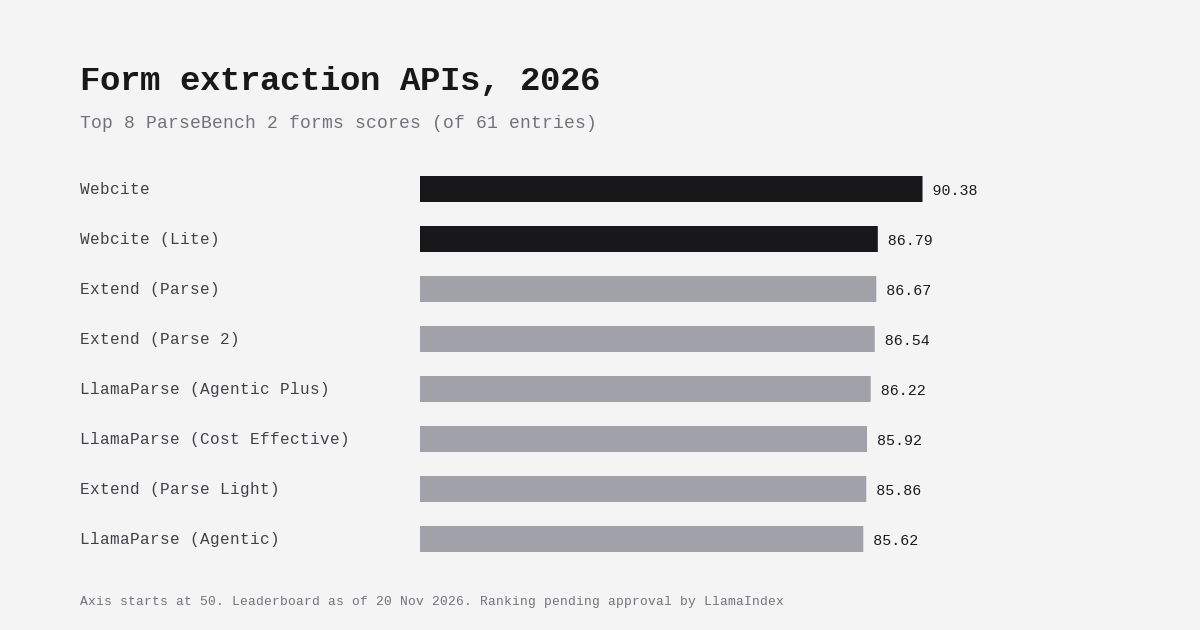
- Webcite leads on text, tables, charts and forms, with the widest gap on forms (90.38 vs 86.22).
- Webcite (Lite) scored 88.75 at 0.511 cents a page, above every LlamaParse mode except Agentic Plus.
- After parsing, Webcite verifies claims against sources and returns citations, stances and verdicts on the same API key.
How do Webcite and LlamaParse score on ParseBench 2?
Webcite is ranked first on ParseBench 2, 0.81 points above LlamaParse Agentic Plus. Ranking pending approval by LlamaIndex. The table uses the leaderboard as of 20 November 2026 and Webcite’s run of 18 November 2026, which covered 4,316 of 4,317 documents (source: run-llama/ParseBench pull request 309).
| ParseBench 2 (leaderboard as of 20 Nov 2026) | Webcite | Webcite (Lite) | LlamaParse (Agentic Plus) | LlamaParse (Agentic) | LlamaParse (Cost Effective) |
|---|---|---|---|---|---|
| Overall | 91.74 | 88.75 | 90.93 | 86.96 | 85.52 |
| Text / Formatting | 91.43 / 92.69 | 89.46 / 91.38 | 90.22 / 93.60 | 86.96 / 92.75 | 85.47 / 91.94 |
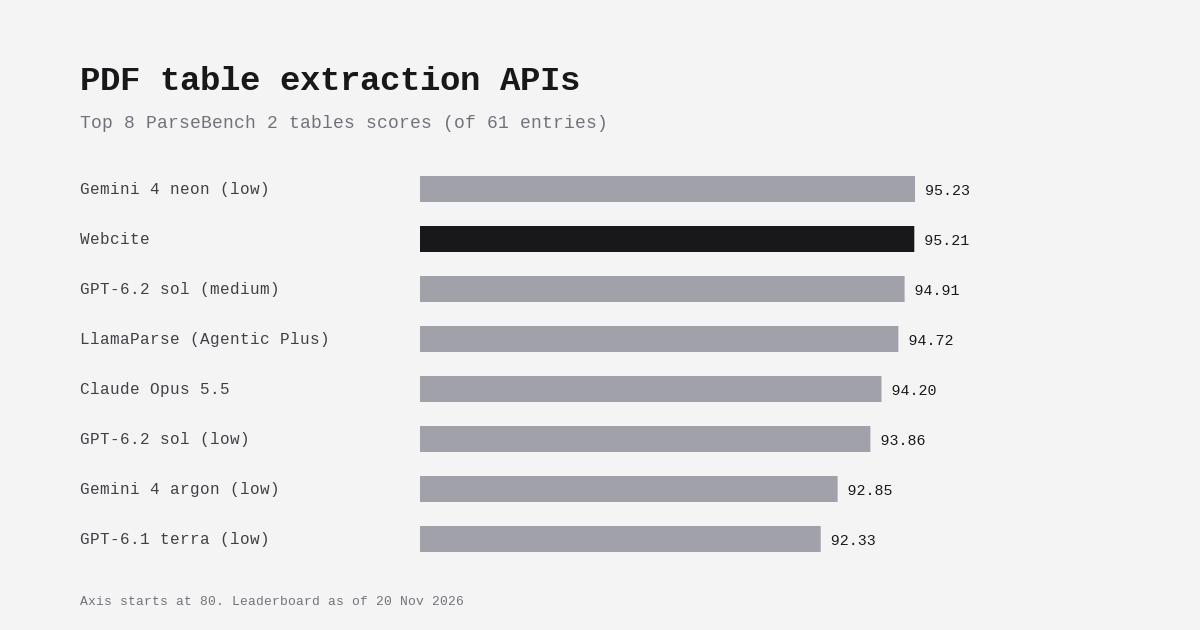
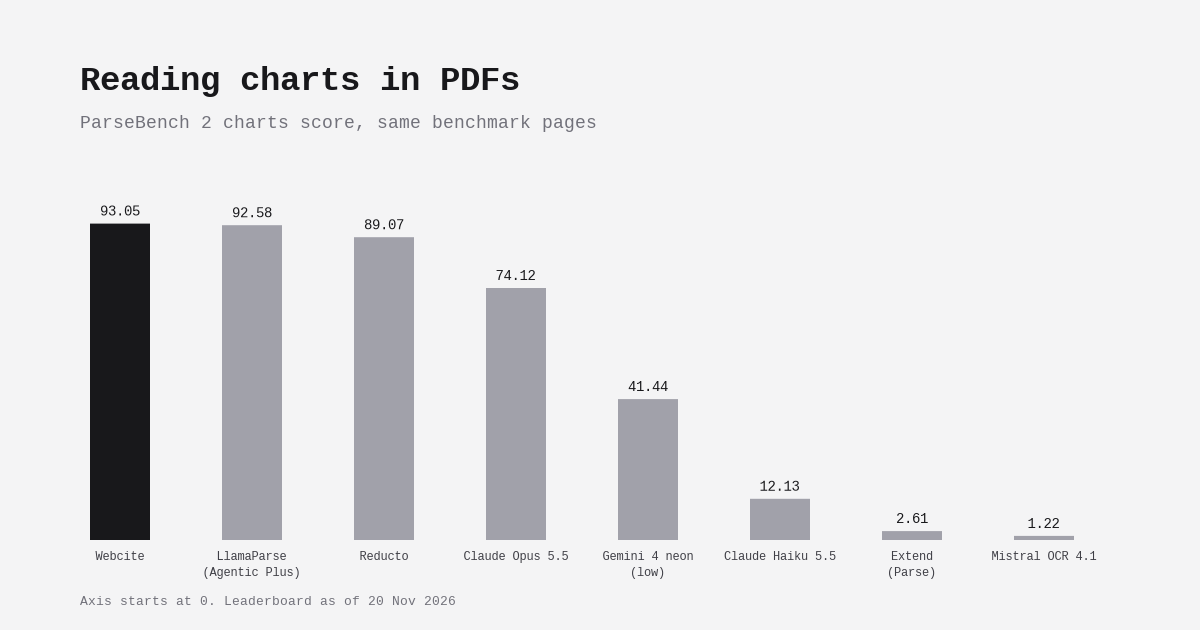
| Tables / Charts | 95.21 / 93.05 | 90.64 / 88.87 | 94.72 / 92.58 | 89.90 / 77.39 | 87.22 / 73.07 |
| Visual grounding / Forms | 87.69 / 90.38 | 85.34 / 86.79 | 88.23 / 86.22 | 89.17 / 85.62 | 89.49 / 85.92 |
| Cost per page (US cents, as listed) | 3.11 | 0.511 | 2.813 | 1.25 | 0.375 |
| Best for | Highest overall, forms and charts | Low cost at 88.75 | Formatting | Visual grounding | Lowest LlamaParse cost |
The full breakdown, with all 61 entries, is on the Webcite benchmarks page. The raw Webcite outputs are public on Hugging Face, ParseBench-2-results discussion 14, so anyone can rescore them without calling the API. The ranking of the best document parsing APIs covers the whole field, and LlamaParse alternatives for 2026 ranks ten options.
Where does LlamaParse lead?
LlamaParse leads in two of the six dimensions. Agentic Plus scored 93.60 on formatting against 92.69 for Webcite, the highest formatting score on the leaderboard, according to the ParseBench 2 leaderboard CSV. Formatting covers headings, bold and italic runs, and list structure carried into Markdown.
Visual grounding is the second. LlamaParse Agentic Plus scored 88.23 and the cheaper LlamaParse modes scored higher still, 89.17 for Agentic and 89.49 for Cost Effective, against 87.69 for Webcite. The top visual grounding score belongs to Gemini 4 neon (low) at 90.31, according to the same leaderboard. If your pipeline depends on exact element boxes for highlighting, test both on your own pages.
LlamaParse also documents features Webcite does not offer today: schema extraction through LlamaExtract with optional field citations and bounding boxes, and an Enterprise option to run single tenant in your own cloud or on premises, according to LlamaIndex pricing, checked 24 November 2026.
Where does Webcite lead?
Webcite leads on text, tables, charts and forms. Forms show the widest gap: 90.38 against 86.22, the highest forms score of all 61 entries, according to Webcite’s ParseBench submission. Charts are 93.05 against 92.58, the top chart score on the board.
Tables are close. Webcite scored 95.21 and LlamaParse Agentic Plus 94.72, while Gemini 4 neon (low) holds the top table score at 95.23. Text is 91.43 against 90.22; Claude Opus 5.5 leads text at 92.62. Three of these dimensions have their own guides: the best form extraction APIs, extracting chart data with an API and the best PDF table extraction APIs.
Scores move by about half a point per dimension between runs, as the submission states. A gap of 0.5 on tables is inside that noise. A gap of 4.16 on forms is not.
How much does each cost per page?
The leaderboard lists Webcite at 3.11 cents a page and LlamaParse Agentic Plus at 2.813 cents. LlamaIndex’s own pricing page puts Agentic Plus at 25 credits a page, with credits at $1.50 per 1,000 on pay as you go and $1.25 per 1,000 on the Pro subscription, according to LlamaIndex pricing. That works out to 3.75 cents or 3.125 cents a page, before the 3 extra credits a page for layout extraction.
Webcite meters extraction at cost. Each page is charged what its reads cost at list price, converted at $0.04 a credit, and a page that could not be read is free, according to Webcite’s credits documentation. Uploading is free. Webcite (Lite) scored 88.75 at 0.511 cents a page, which is above LlamaParse Agentic at 1.25 cents and Cost Effective at 0.375 cents. The PDF to Markdown pricing comparison works out 10,000 pages for each.
LlamaIndex gives 10,000 free credits a month on pay as you go. Webcite’s Free plan includes 100 credits a month, and the Builder plan is $20 a month for 500 credits.
What does Webcite do after parsing?
Webcite reads documents and then checks what they say. Parsing is the first layer; the ParseBench score measures only that layer. The same API key and the same MCP server cover these steps, each documented in the Webcite API reference:
- Claim verification: POST /api/v1/verify checks a claim against sources and returns citations, a stance for each source and a verdict.
- Full document review: the review_document tool checks every material claim in an uploaded file and reports coverage, including passages it could not cover.
- Figures and conflicts: extract numbers with units and source locations, then recompute and compare them across documents.
- Evidence tracing: source preview resolves a citation to its source and checks that the quoted passage is there.
- Retained sources: registered source bytes and published text units that an agent can read again later by ID.
| Documented capability (checked 24 Nov 2026) | Webcite | LlamaParse / LlamaCloud |
|---|---|---|
| Page parsing to Markdown with element boxes | /extract, standard and lite modes | Four parse tiers: Fast, Cost Effective, Agentic and Agentic Plus |
| Extracted values traced to the source | Figures with units and page locations | LlamaExtract cite_sources with bounding boxes |
| Document classification | /classify and a category checklist check (/gaps) | Classify tool in its MCP server |
| MCP server | Hosted at api.webcite.co/mcp and webcite-mcp-server on npm | Hosted at mcp.llamaindex.ai |
The numbered steps above go further than the table: a verdict for each claim, a review of every claim in a file, figure recomputation across documents, and a check that each quoted passage exists in its source. The LlamaParse column comes from the LlamaCloud MCP documentation and the LlamaExtract options page. For background on what claim verification returns, see what a verification API is.
How do I reproduce the Webcite result?
The reproduction guide runs the public ParseBench 2 harness against the production API with your own key. Clone the benchmark, set WEBCITE_API_KEY, and run one subset first, as the ParseBench reproduction guide describes. The headings subset has 100 cases and uses about 28 credits.
A full run of 4,317 cases used 3,183 credits in Webcite’s own run. The guide also shows how to rescore the published outputs without calling the API, and how to read build_sha from the health endpoint to compare builds. To move a pipeline over, start with the extraction quickstart; the playground runs a saved example without code.
Frequently Asked Questions
Is Webcite more accurate than LlamaParse?
On ParseBench 2, Webcite scored 91.74 overall against 90.93 for LlamaParse Agentic Plus, the strongest LlamaParse mode. LlamaParse Agentic Plus leads on formatting (93.60 vs 92.69) and visual grounding (88.23 vs 87.69). Webcite leads on text, tables, charts and forms.
How much does LlamaParse cost per page compared with Webcite?
The ParseBench 2 leaderboard lists 2.813 cents a page for LlamaParse Agentic Plus and 3.11 cents for Webcite. LlamaIndex prices Agentic Plus at 25 credits a page, which is 3.75 cents on pay as you go. Webcite (Lite) costs 0.511 cents a page and scored 88.75.
Who runs ParseBench?
ParseBench is an open benchmark in the run-llama GitHub organisation, maintained by LlamaIndex, the company behind LlamaParse. Webcite’s results are submitted in pull request 309, with the raw outputs published on Hugging Face so anyone can rescore them.
What does Webcite do after parsing a document?
Webcite checks claims after it reads a document. It verifies a claim against sources and returns citations, source stances and a verdict, reviews every claim in a file with a coverage report, recomputes and compares figures, and resolves each citation to the quoted passage.
Can I reproduce the Webcite ParseBench 2 score?
Yes. The reproduction guide at webcite.co/api-docs/parsebench runs the public ParseBench 2 harness against the production API with your own key. Runs vary by about half a point per dimension, so a rerun will be close but not identical.