Andreessen Horowitz surveyed 100 enterprise CIOs and found that nearly 40% spend over $250,000 annually on LLM infrastructure, with the top 10% exceeding $1 million, according to a16z, 2025. Those numbers are climbing: Gartner projects worldwide AI spending will reach $2.5 trillion in 2026, according to Gartner, 2026. Most enterprises are overspending because they route every request to their most expensive model, skip caching, and process requests synchronously when batching would cut costs in half. This guide covers 7 concrete optimization strategies with implementation details and expected cost reductions.
- Nearly 40% of enterprises spend over $250,000 annually on LLMs (a16z, 2025).
- Prompt caching alone saves 50% on OpenAI and up to 90% on Anthropic for repeated prompt prefixes.
- Model routing (70% cheap, 30% premium) reduces costs by 50-70% versus single-model deployments.
- DeepSeek-V3 activates only 37B of 671B parameters per token via MoE, cutting inference costs by approximately 70%.
- Batch processing through OpenAI's Batch API provides a 50% discount with a 24-hour turnaround.
- Verification adds roughly 3% to total costs while preventing errors that cost far more downstream.
Strategy 1: Prompt Caching
Prompt caching is the highest-impact, lowest-effort optimization available. It stores the processed representation of prompt prefixes so the model skips reprocessing them on subsequent calls. If your application sends the same system prompt or context window with every request, caching eliminates redundant computation.
OpenAI introduced automatic prompt caching in late 2024. Any prompt longer than 1,024 tokens is automatically eligible. Cached input tokens receive a 50% discount, dropping GPT-4o input costs from $2.50 to $1.25 per million tokens. No code changes are required; caching is applied server-side when the API detects a matching prefix, according to OpenAI Prompt Caching Guide, 2024.
Anthropic’s prompt caching is even more aggressive. Cached prompt prefixes on Claude receive up to 90% cost reduction. A cached read of Claude 3.5 Sonnet input tokens costs $0.30 per million instead of the standard $3.00 per million. Anthropic requires explicit cache control headers, which means a small code change, but the savings are substantial, according to Anthropic Prompt Caching Docs, 2024.
import anthropic

client = anthropic.Anthropic()

response = client.messages.create(
    model="claude-3-5-sonnet-20241022",
    max_tokens=1024,
    system=[
        {
            "type": "text",
            "text": "You are a financial analyst assistant...",  # Long system prompt
            "cache_control": {"type": "ephemeral"}  # Enable caching
        }
    ],
    messages=[{"role": "user", "content": "Analyze Q3 revenue trends"}]
)

## First call: full price for system prompt processing
## Subsequent calls: 90% discount on cached system prompt
The savings compound with prompt length. An enterprise application with a 4,000-token system prompt making 10,000 calls per day saves approximately $108 per day on Anthropic (from $120 to $12 for the system prompt tokens alone). Over a year, that single optimization saves roughly $39,000.
Google’s Gemini API also supports context caching for prompts with substantial shared prefixes, reducing costs for repeated large-context calls, according to Google AI Context Caching Docs, 2024.
Strategy 2: Model Routing
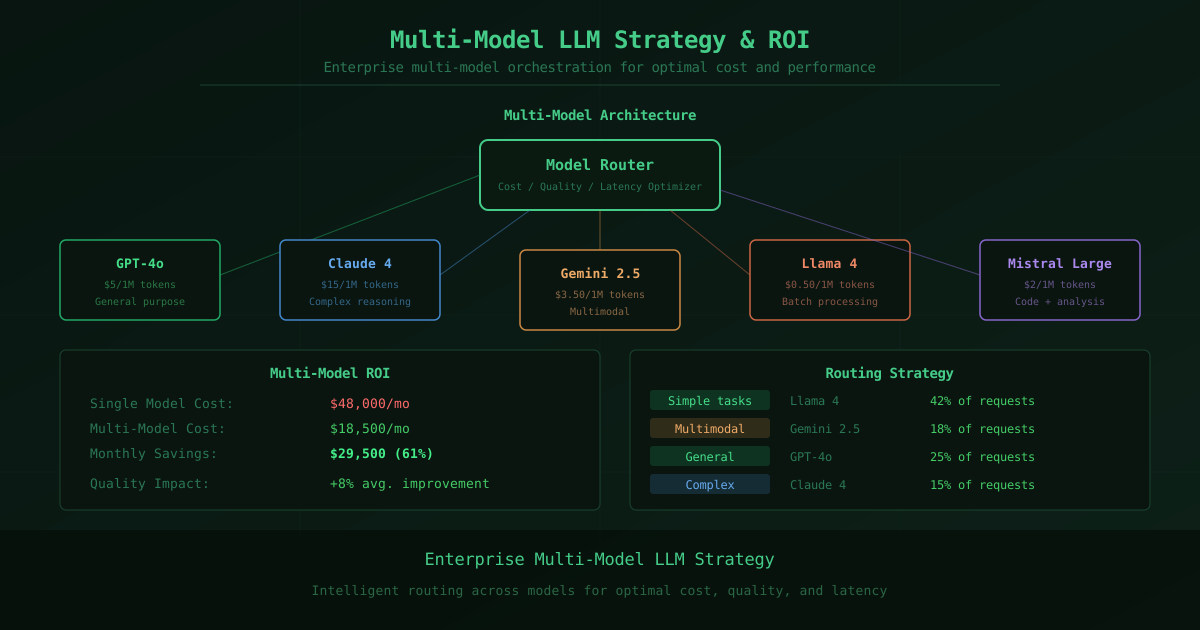
Model routing directs each request to the cheapest model that can handle it. The principle is straightforward: don’t use a $10-per-million-token model for a task that a $0.15-per-million-token model handles equally well.
The cost differences across model tiers are dramatic:
| Model | Input Cost (per 1M tokens) | Output Cost (per 1M tokens) | Best For |
|---|---|---|---|
| GPT-4o-mini | $0.15 | $0.60 | Classification, extraction, short summaries |
| Claude 3.5 Haiku | $0.80 | $4.00 | Routine generation, Q&A, simple analysis |
| GPT-4o | $2.50 | $10.00 | Complex generation, reasoning, function calling |
| Claude 3.5 Sonnet | $3.00 | $15.00 | Long-context analysis, nuanced writing |
| GPT-o3 | $10.00 | $40.00 | Multi-step reasoning, research, complex code |
Enterprise data consistently shows that 60 to 80% of production requests are routine tasks, according to internal analyses reported across a16z, 2025 and McKinsey, 2025. Routing those requests to tier-1 models while reserving premium models for the remaining 20 to 40% cuts total costs by 50 to 70%.
For a detailed breakdown of multimodel architectures and routing implementation, see our multimodel LLM strategy guide.
Strategy 3: Batch Processing
Batch processing groups non-urgent requests and submits them as a single batch job with a delayed turnaround. The tradeoff is latency for cost: you wait longer but pay less.
OpenAI’s Batch API provides a 50% discount on all tokens processed through batch mode. Requests are submitted as JSONL files and completed within 24 hours. This is ideal for tasks like content generation queues, nightly report creation, bulk classification, and data enrichment pipelines, according to OpenAI Batch API Docs, 2024.
import openai
import json

## Prepare batch requests
batch_requests = []
for i, claim in enumerate(claims_to_process):
    batch_requests.append({
        "custom_id": f"request-{i}",
        "method": "POST",
        "url": "/v1/chat/completions",
        "body": {
            "model": "gpt-4o",
            "messages": [
                {"role": "system", "content": "Summarize the following claim."},
                {"role": "user", "content": claim}
            ]
        }
    })

## Write to JSONL file
with open("batch_input.jsonl", "w") as f:
    for req in batch_requests:
        f.write(json.dumps(req) + "\n")

## Submit batch
client = openai.OpenAI()
batch_file = client.files.create(file=open("batch_input.jsonl", "rb"), purpose="batch")
batch_job = client.batches.create(input_file_id=batch_file.id, endpoint="/v1/chat/completions", completion_window="24h")
Anthropic offers a similar Message Batches API with reduced pricing for asynchronous workloads, according to Anthropic Message Batches Docs, 2025. The discount varies by model but typically provides a 50% reduction in token costs for batched requests.
The key insight is that many enterprise LLM workloads don’t require real-time responses. Report generation, content pipelines, data analysis, and bulk processing can all tolerate 24-hour latency. Moving these workloads to batch mode immediately halves their cost.
Strategy 4: Token Reduction
Every token costs money. Reducing the number of tokens per request, both input and output, directly reduces costs. Three techniques are effective.
Prompt compression removes redundant tokens from prompts without changing the semantic meaning. Microsoft’s LLMLingua research demonstrated that prompts can be compressed by 2x to 5x while maintaining 90%+ of original task performance, according to Microsoft Research LLMLingua, 2023. Commercial tools like PromptCompressor and open-source implementations on Hugging Face automate this process.
Output length control uses max_tokens and specific instructions to prevent verbose responses. Many applications set max_tokens to 4,096 by default when they only need 200-token responses. Reducing max_tokens to the minimum viable length saves output tokens, which are 2x to 4x more expensive than input tokens across most providers.
Context window pruning removes irrelevant context from RAG-augmented prompts. Instead of stuffing the entire retrieval result set into the prompt, filter to the top 3-5 most relevant passages. This reduces both input token count and hallucination risk, since irrelevant context can confuse the model. A well-configured RAG pipeline should aim for fewer than 2,000 context tokens per query, not the 10,000+ that naive implementations often produce.
Strategy 5: Semantic Caching
Semantic caching stores LLM responses indexed by query meaning rather than exact text match. When a user asks “What is the capital of France?” and another asks “What’s France’s capital city?”, a semantic cache recognizes these as equivalent and returns the cached response without making a second API call.
The architecture uses embedding models to convert queries into vectors, then checks vector similarity against the cache before routing to the LLM:
import numpy as np
from openai import OpenAI

client = OpenAI()
cache = {}  # In production, use Redis or a vector database

def get_embedding(text):
    response = client.embeddings.create(
        model="text-embedding-3-small",
        input=text
    )
    return response.data[0].embedding

def semantic_lookup(query, threshold=0.95):
    query_embedding = get_embedding(query)
    for cached_query, (cached_embedding, cached_response) in cache.items():
        similarity = np.dot(query_embedding, cached_embedding) / (
            np.linalg.norm(query_embedding) * np.linalg.norm(cached_embedding)
        )
        if similarity > threshold:
            return cached_response
    return None

def query_with_cache(query):
    cached = semantic_lookup(query)
    if cached:
        return cached  # Free, no API call

    response = client.chat.completions.create(
        model="gpt-4o",
        messages=[{"role": "user", "content": query}]
    )
    result = response.choices[0].message.content
    cache[query] = (get_embedding(query), result)
    return result
GPTCache, an open-source semantic caching library, reports cache hit rates of 30 to 60% for customer support and FAQ workloads, according to GPTCache GitHub, 2024. That translates directly to a 30 to 60% reduction in API calls for those workloads. Redis offers built-in vector similarity search that can serve as the caching backend at production scale.
The tradeoff is freshness. Cached responses may become stale if the underlying information changes. Set cache TTLs (time to live) based on content volatility: 24 hours for factual knowledge, 1 hour for news-related queries, and no caching for real-time data requests.
Strategy 6: Mixture of Experts Models
Mixture of Experts (MoE) architecture provides premium-quality outputs at reduced inference costs by activating only a fraction of the model’s parameters per token.
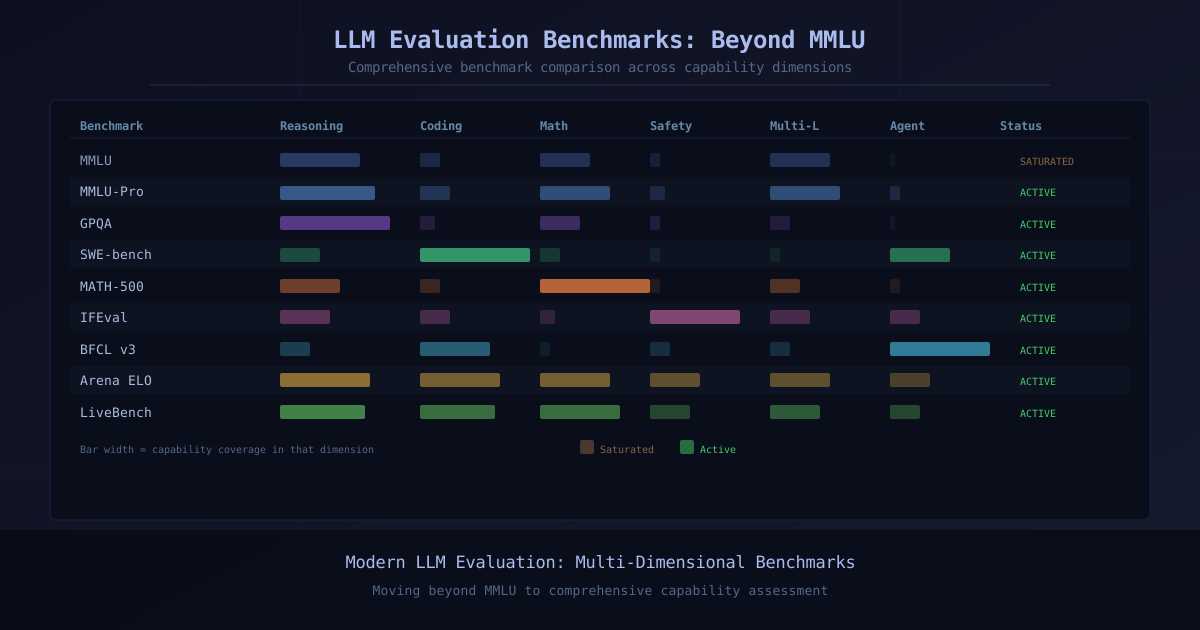
DeepSeek-V3 is the most prominent example. It contains 671 billion total parameters but activates only 37 billion per token through its MoE routing mechanism. This architectural decision reduces compute per token by approximately 70% compared to a dense model of equivalent quality, according to DeepSeek, 2024. DeepSeek-V3 matches GPT-4o-level performance on standard benchmarks at a fraction of the inference cost.
Mixtral 8x22B from Mistral AI uses 141 billion total parameters with 39 billion active per forward pass. It achieves strong multilingual performance and runs on hardware clusters that would be insufficient for a dense 141B model, according to Mistral AI, 2024.
For enterprises running self-hosted models, MoE architectures enable deploying larger, more capable models on the same hardware. For those using cloud APIs, DeepSeek and Mistral’s pricing reflects the lower inference cost, making MoE models an attractive tier-2 option in a model routing strategy.
Strategy 7: Verification as Cost Prevention
Verification is not typically framed as a cost optimization strategy, but the numbers make the case. AI hallucinations cost enterprises an estimated $67.4 billion in 2024, according to Korra, 2024. Those costs include customer churn, legal liability, manual correction labor, and reputational damage. Employees spend an average of 4.3 hours per week verifying AI-generated content manually, costing approximately $14,200 per employee annually, according to Korra, 2024.
A verification API catches errors before they reach users, eliminating downstream correction costs. The economics are clear: Webcite charges 4 credits per verification, which translates to roughly $0.16 on the Builder plan ($20/month for 500 credits). A single GPT-4o call that generates a 500-token response costs approximately $0.005 in output tokens. Verification adds about 3% to the generation cost while preventing errors that may cost thousands in corrections.
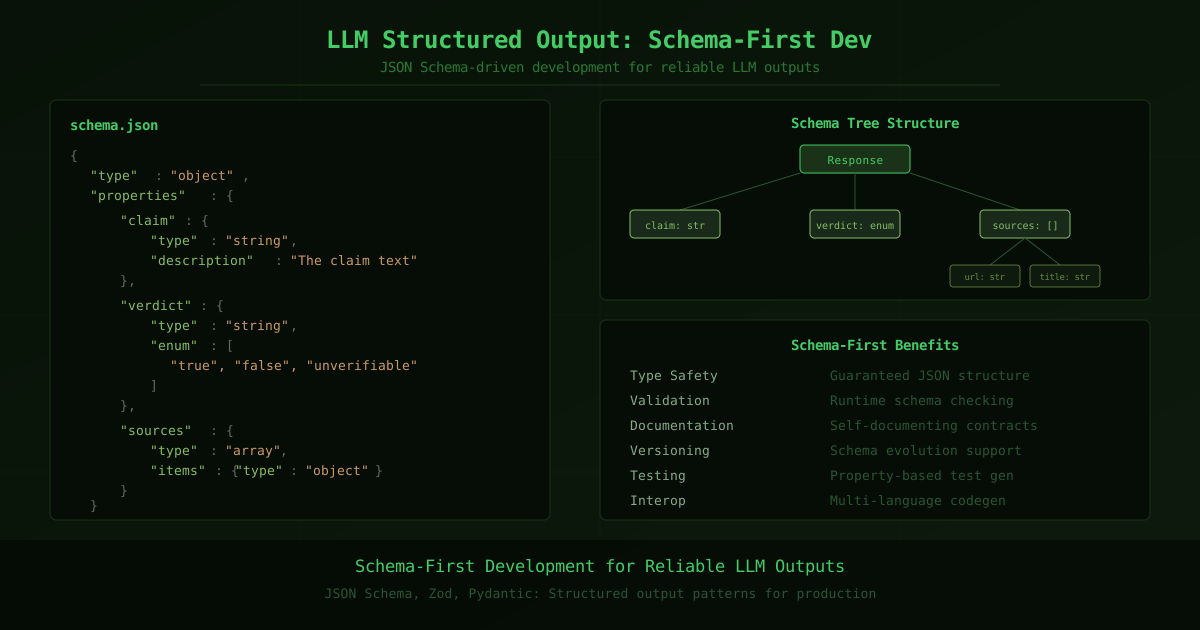
const response = await fetch("https://api.webcite.co/api/v1/verify", {
  method: "POST",
  headers: {
    "x-api-key": process.env.WEBCITE_API_KEY,
    "Content-Type": "application/json"
  },
  body: JSON.stringify({
    claim: "OpenAI prompt caching provides a 50% discount on cached tokens",
    include_stance: true,
    include_verdict: true
  })
})

const result = await response.json()
// result.verdict.result: "supported"
// result.verdict.confidence: 94
// result.citations: [{ title: "OpenAI Docs", url: "...", stance: "for" }]
The free tier at $0 per month includes 50 credits for 12 verifications. The Builder plan at $20 per month provides 500 credits for 125 verifications. Enterprise plans start at 10,000+ credits with custom pricing. For a full pricing breakdown, see the Webcite API pricing guide.
Verification is especially valuable in diverse model environments where different models have different hallucination profiles. A verification API provides consistent quality assurance regardless of which model produced the output.
Combining Strategies: The Optimization Stack
The 7 strategies are not mutually exclusive. They stack. Here is the cumulative impact for a hypothetical enterprise spending $10,000 per month on LLM API calls:
| Strategy | Cost Reduction | Monthly Spend After | Cumulative Savings |
|---|---|---|---|
| Baseline | 0% | $10,000 | $0 |
| Prompt caching | 25% on input tokens | $8,500 | $1,500 |
| Model routing (70/30) | 40% on routed tasks | $5,500 | $4,500 |
| Batch processing | 50% on eligible tasks | $4,500 | $5,500 |
| Token reduction | 15% across all calls | $3,800 | $6,200 |
| Semantic caching | 20% cache hit rate | $3,100 | $6,900 |
| MoE models for tier 2 | 10% on standard tasks | $2,800 | $7,200 |
| Verification (cost prevention) | Prevents $500+/mo in corrections | Net: $2,820 | $7,180 |
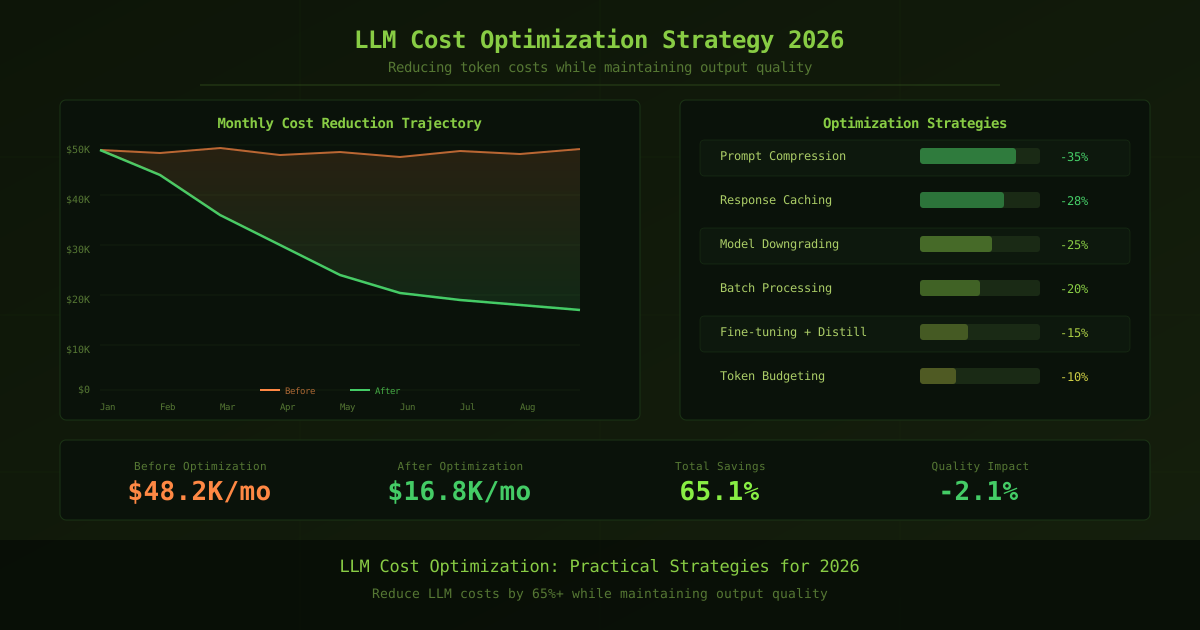
The actual savings vary by workload, but the pattern holds: layered optimization can reduce LLM costs by 60 to 80% while maintaining or improving output quality. The key is to start with the highest-impact, lowest-effort strategies (caching and routing) and layer on more sophisticated techniques as your optimization matures.
Implementation Priority Order
Not all strategies require equal effort. Here is the recommended implementation sequence, ordered by impact-to-effort ratio:
- Prompt caching: zero code changes on OpenAI, minimal on Anthropic. Implement today.
- Model routing: requires a routing layer but saves 50%+ immediately. Implement within 2 weeks.
- Batch processing: requires workflow changes for non-real-time tasks. Implement within 1 month.
- Verification: single API integration, prevents costly downstream errors. Implement within 1 week.
- Token reduction: requires prompt engineering and output configuration. Ongoing optimization.
- Semantic caching: requires vector database and embedding pipeline. Implement within 1-2 months.
- MoE model evaluation: requires benchmarking against your specific tasks. Evaluate quarterly.
Start with strategies 1 and 2. They deliver the largest cost reduction with the least implementation effort. Add verification early (strategy 4) because it prevents the most expensive type of cost: errors that reach users and require manual correction.
Getting Started
Two steps to begin reducing your LLM costs this week.
First, enable prompt caching. If you use OpenAI, caching activates automatically for prompts over 1,024 tokens. If you use Anthropic, enable caching by adding cache control headers to your system prompts. Check your API usage dashboard to see which prompts are eligible and estimate your savings.
Second, add verification to catch errors before they become expensive. Sign up at webcite.co for the free tier (50 credits/month, 12 verifications). Route your highest-risk outputs through the verification API first, then expand coverage as you validate the ROI.
The combination of caching, routing, and verification delivers the best cost-to-quality ratio for enterprise LLM deployments. Start with these three and layer on additional strategies as your optimization practice matures.
Frequently Asked Questions
How much do enterprises spend on LLMs annually?
Nearly 40% of enterprises spend over $250,000 per year on LLM infrastructure, according to Andreessen Horowitz, 2025. The top 10% spend over $1 million annually. Costs include API fees, fine-tuning compute, infrastructure, and supporting tooling.
What is prompt caching and how does it reduce LLM costs?
Prompt caching stores the processed representation of frequently used prompt prefixes so the model does not reprocess them on every call. OpenAI offers a 50% discount on cached input tokens. Anthropic provides up to 90% cost reduction on cached prompt prefixes. Both enable caching automatically for prompts longer than a minimum threshold.
What is semantic caching for LLMs?
Semantic caching stores LLM responses indexed by the meaning of the query rather than exact text match. When a new query is semantically similar to a cached query (above a configurable similarity threshold), the cached response is returned without calling the LLM. This eliminates redundant API calls for paraphrased or near-duplicate questions.
How does model routing reduce LLM costs?
Model routing directs each request to the cheapest model capable of handling it. Simple tasks like classification go to models costing $0.15 per million tokens, while complex reasoning tasks go to premium models at $10+ per million tokens. Since 70% of enterprise requests are routine, routing cuts costs by 50-70% compared to using a premium model for everything.
How much does verification cost compared to LLM generation?
Verification costs are minimal relative to generation. Webcite charges 4 credits per verification, which translates to roughly $0.16 on the Builder plan. A single GPT-4o generation call that produces 500 output tokens costs approximately $0.005. Verification adds about 3% to the total cost while catching errors that could cost far more in downstream corrections.
What is the cheapest way to start optimizing LLM costs?
Start with prompt caching, which requires zero code changes on OpenAI and minimal changes on Anthropic. Eligible prompts automatically receive the cached rate. Then implement model routing by directing simple tasks to GPT-4o-mini or Claude Haiku. These two steps alone can reduce costs by 40-60% for most workloads.