Webcite scored 91.74 overall on ParseBench 2, ahead of 86.23 for Reducto (r-1), the highest of four Reducto entries, according to the ParseBench 2 leaderboard as of 20 November 2026 and Webcite’s submission. Reducto (r-1) leads on visual grounding. This post compares scores, cost per page, documented features, and what Webcite adds after extraction.
- Webcite scored 91.74 overall on ParseBench 2; Reducto (r-1) scored 86.23.
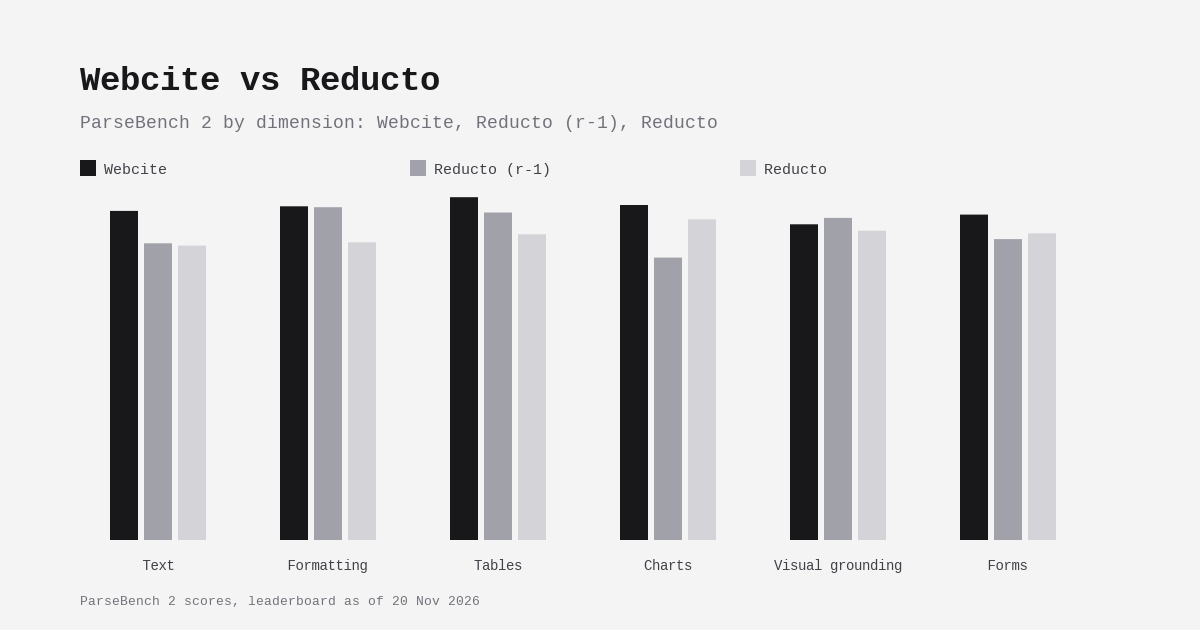
- Reducto (r-1) leads Webcite on visual grounding, 89.48 against 87.69.
- Webcite leads on charts by 14.60 points over Reducto (r-1), 93.05 against 78.45.
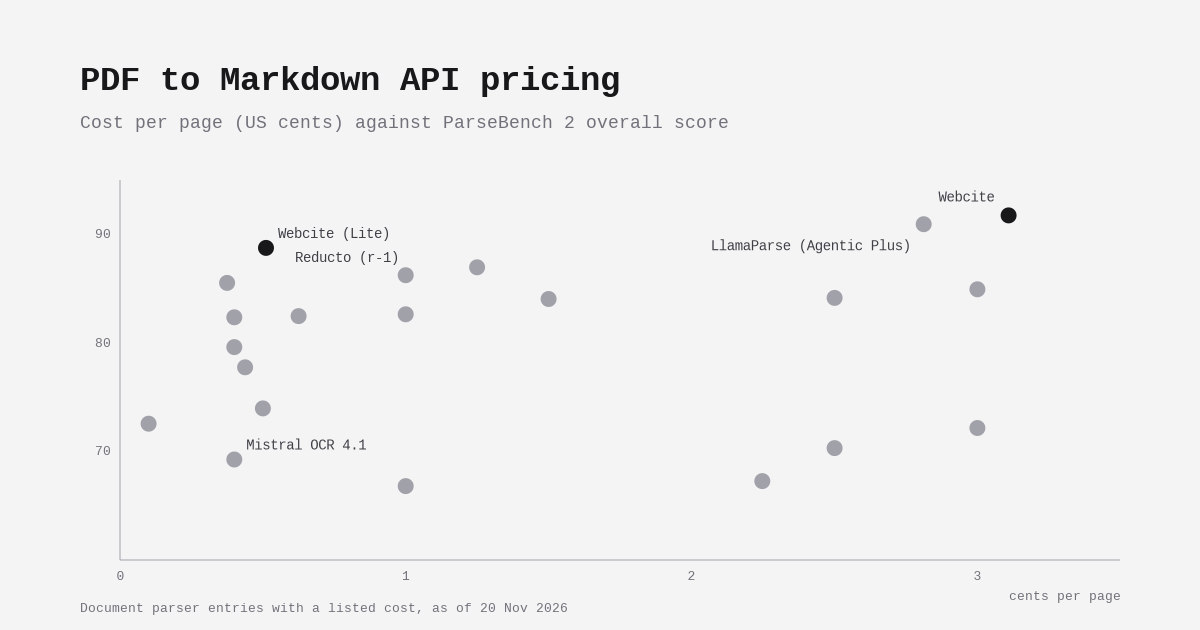
- Webcite (Lite) scored 88.75 at 0.511 cents a page; Reducto (r-1) scored 86.23 at 1 cent.
- Webcite returns verdicts with citations for claims on the same API that extracts the document.
How do Webcite and Reducto score on ParseBench 2?
Webcite is ranked first on ParseBench 2 at 91.74 overall. Ranking pending approval by LlamaIndex. Reducto’s best entry, r-1, scored 86.23. Webcite’s run on 18 November 2026 covered 4,316 of 4,317 documents (source: ParseBench pull request 309); one dense table returned an error on every attempt and scores zero.
| ParseBench 2 (leaderboard as of 20 November 2026) | Webcite | Webcite (Lite) | Reducto (r-1) | Reducto | Reducto (r-1-mini) |
|---|---|---|---|---|---|
| Overall | 91.74 | 88.75 | 86.23 | 84.93 | 72.55 |
| Text / Formatting | 91.43 / 92.69 | 89.46 / 91.38 | 82.42 / 92.45 | 81.77 / 82.70 | 85.01 / 91.55 |
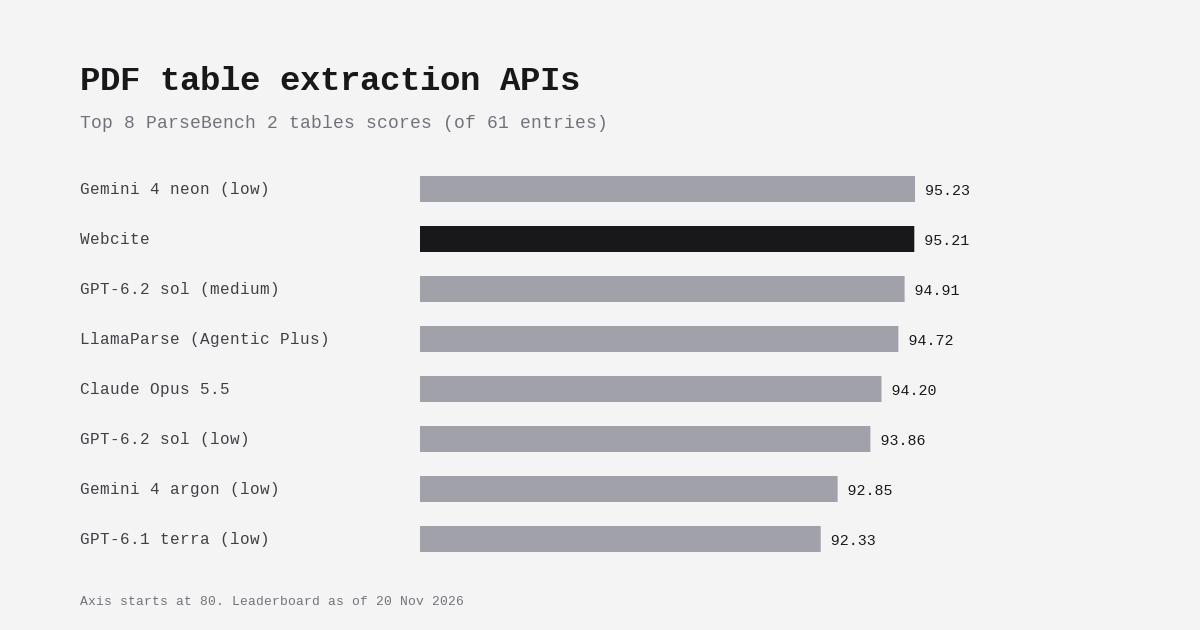
| Tables / Charts | 95.21 / 93.05 | 90.64 / 88.87 | 90.97 / 78.45 | 84.92 / 89.07 | 86.11 / 1.35 |
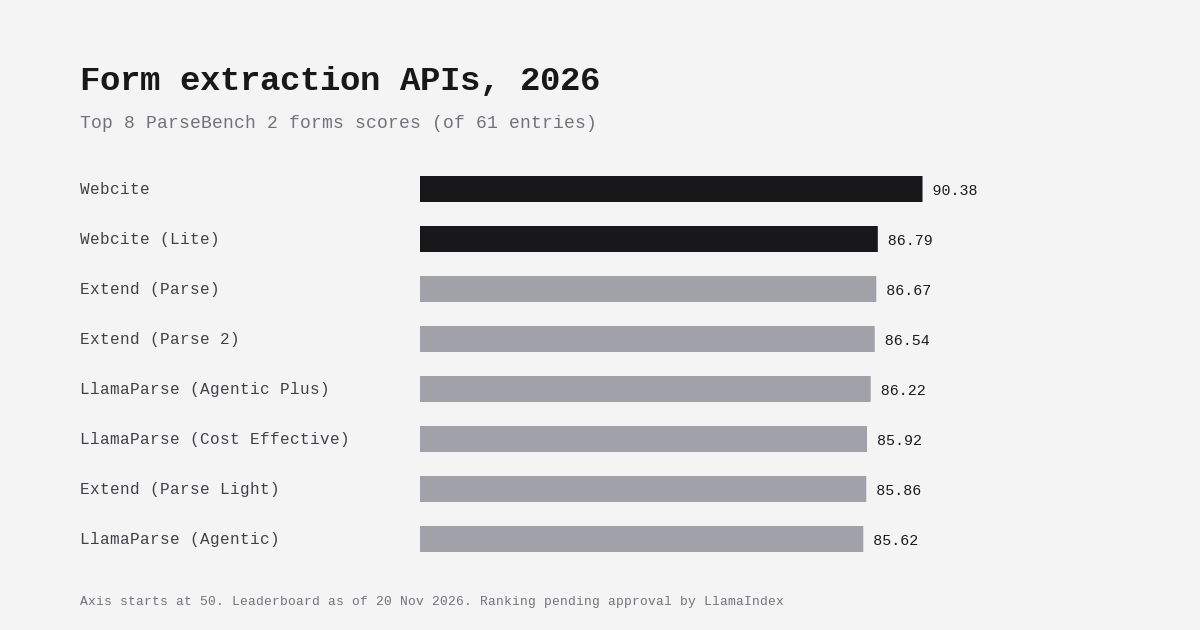
| Visual grounding / Forms | 87.69 / 90.38 | 85.34 / 86.79 | 89.48 / 83.58 | 85.93 / 85.19 | 88.53 / 82.75 |
| Cost per page (US cents, as listed) | 3.11 | 0.511 | 1.00 | 3.001 | 0.10 |
| Best for | Highest overall, charts, forms | 88.75 under a cent | Visual grounding | Charts within Reducto | Lowest cost |
The leaderboard also lists Reducto (non-agentic) at 67.27. All 61 entries are on the Webcite benchmarks page. The guide to the best document parsing APIs ranks them by dimension and price.
Where does Reducto lead?
Reducto leads on visual grounding. Reducto (r-1) scored 89.48 and Reducto (r-1-mini) 88.53, against 87.69 for Webcite, according to the ParseBench 2 leaderboard CSV. Neither tops the dimension: Gemini 4 neon (low) leads at 90.31.
Reducto (r-1-mini) is also the cheapest document parser on the leaderboard at 0.10 cents a page. It scored 1.35 on charts, so it suits pages without charts; on text and formatting it scored 85.01 and 91.55.
Reducto documents features Webcite does not offer today. Its Extract product returns a value and citations for each schema field, with the source text and a bounding box for each citation, according to Reducto’s extraction citations documentation. It also sells Split, Classify and Edit, and offers VPC and on premises deployments on its Enterprise plan, according to Reducto pricing, checked 24 November 2026.
Where does Webcite lead?
Webcite leads on text, formatting, tables, charts and forms against Reducto (r-1). The largest gaps are charts, 93.05 against 78.45, and text, 91.43 against 82.42, according to Webcite’s ParseBench submission. Forms are 90.38 against 83.58. The ranking of form extraction APIs covers that dimension.
The plain Reducto entry scored 89.07 on charts, its best chart result, and still sits 3.98 points below Webcite. Formatting is close: 92.69 against 92.45 for r-1, inside the half point that scores move between runs. Our tutorial on how to extract chart data from PDFs covers Reducto’s chart agent and the other chart tools.
How do Reducto and Webcite price extraction?
Reducto charges a flat price per 1,000 pages. Parse costs $10 per 1,000 pages on r-1 and $1 on r-1 mini, Extract $20 and Deep Extract $40, with 20% off Parse and Extract in batch, according to Reducto pricing. Reducto’s Standard subscription includes $150 of free usage.
Webcite meters extraction at cost: each page is charged what its reads cost at list price, converted at $0.04 a credit, and pages that could not be read are free, according to Webcite’s credits documentation. The leaderboard figure of 3.11 cents a page for the standard mode was measured on 325 production pages and weighted to the benchmark’s page mix. Lite averages 0.511 cents a page. Webcite’s pricing page shows what each plan costs.
For accuracy per cent, Webcite (Lite) at 88.75 for 0.511 cents scores above Reducto (r-1) at 86.23 for 1 cent. For the lowest price at any accuracy, Reducto (r-1-mini) at 0.10 cents is cheaper. The pricing comparison of PDF to Markdown APIs adds LlamaParse and Mistral OCR.
What does Webcite do after extraction?
Webcite treats extraction as the first step and then checks what the document says. The ParseBench score measures only the extraction layer. These steps run on the same API key and MCP server, each listed in the Webcite API reference:
- Claim verification returns citations, a stance for each source and a verdict for each claim.
- Full document review checks every material claim in a file and reports coverage, including passages it could not cover.
- Figure extraction reads numbers with units and source locations; conflict analysis recomputes and compares them.
- Source preview resolves a citation to its source and checks that the quoted passage is there.
- Registered sources and published text units let an agent read the same evidence again later by ID.
| Documented capability (checked 24 Nov 2026) | Webcite | Reducto |
|---|---|---|
| Page parsing with element boxes | Markdown per page with typed element boxes | Typed blocks with normalized bbox and confidence |
| Extracted values traced to the source | Figures with units and page locations | Extract citations with source text and bbox |
| Document classification | Classify, plus a category checklist check | Classify at $7.50 per 1,000 pages |
| MCP server | api.webcite.co/mcp and webcite-mcp-server on npm | mcp.reducto.ai and mcp-server-reducto |
The Reducto column comes from Reducto’s MCP server documentation and its parse response format page. If you are choosing a fact checking layer for model output, the Webcite comparison of fact checking APIs covers that market.
How do I reproduce the Webcite score?
Run the public ParseBench 2 harness against the production API with your own key, following the ParseBench reproduction guide. Start with the headings subset, 100 cases at about 28 credits, before a full run.
The published outputs on Hugging Face, ParseBench-2-results discussion 14 can be rescored without calling the API. To test your own documents first, follow Webcite’s extraction quickstart.
Frequently Asked Questions
Is Webcite more accurate than Reducto?
On ParseBench 2, Webcite scored 91.74 overall and Reducto (r-1), the highest Reducto entry, scored 86.23. Reducto (r-1) leads on visual grounding with 89.48 against 87.69. Webcite leads on text, formatting, tables, charts and forms.
How much does Reducto cost per page?
Reducto lists Parse at $10 per 1,000 pages for r-1 and $1 per 1,000 pages for r-1 mini on its pricing page, which is 1 cent and 0.1 cents a page. The ParseBench 2 leaderboard lists Webcite at 3.11 cents and Webcite (Lite) at 0.511 cents a page.
Which is better value, Webcite (Lite) or Reducto r-1?
On ParseBench 2, Webcite (Lite) scored 88.75 at 0.511 cents a page and Reducto (r-1) scored 86.23 at 1 cent a page. Reducto (r-1) scored higher on formatting, tables and visual grounding; Webcite (Lite) scored higher on text, charts and forms.
Does Reducto have an MCP server?
Yes. Reducto documents an MCP server, installed with uvx mcp-server-reducto or used at mcp.reducto.ai. Webcite has a hosted MCP endpoint at api.webcite.co/mcp and the webcite-mcp-server package on npm.
What does Webcite do after extracting a document?
Webcite verifies claims against sources and returns citations, source stances and a verdict. It can review every material claim in a file with a coverage report, recompute and compare figures across documents, and resolve each citation to the quoted passage in its source.