Webcite scored 91.74 overall on ParseBench 2, against 73.96 for Mistral OCR 4.1 (annotation) and 69.26 for Mistral OCR 4.1, according to the ParseBench 2 leaderboard as of 20 November 2026 and Webcite’s submission. Mistral costs less per page. This post covers the six dimensions, price, Mistral’s strengths, and Webcite’s checks after reading.
- Webcite scored 91.74 overall on ParseBench 2; Mistral OCR 4.1 scored 69.26, and 73.96 with annotation.
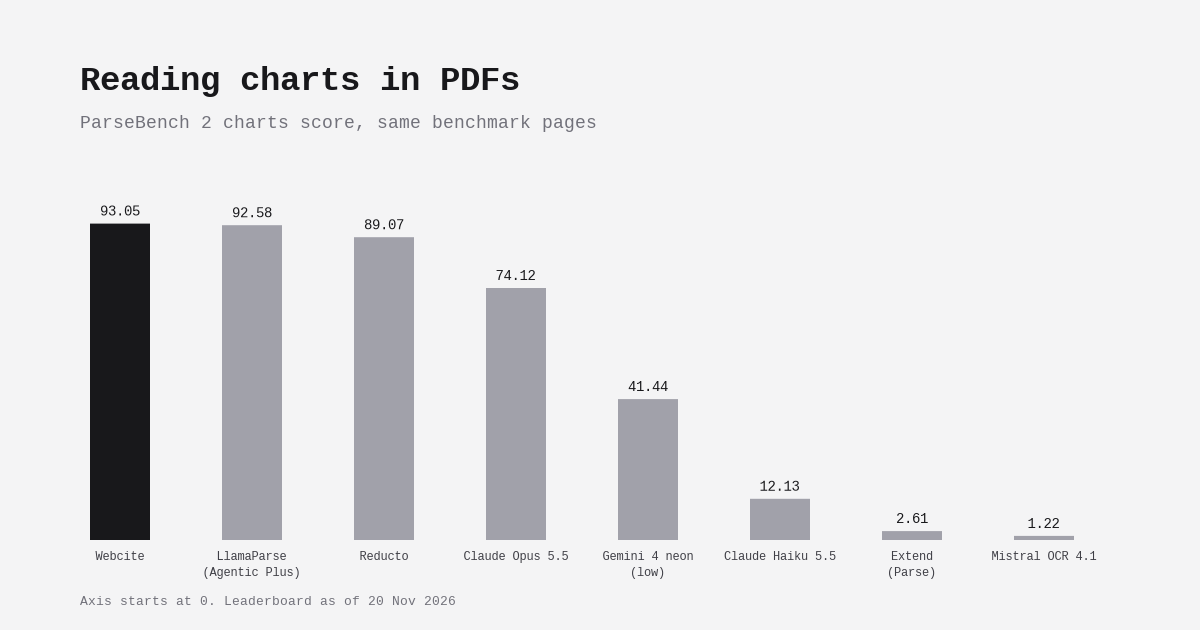
- Charts separate them: Webcite scored 93.05, Mistral OCR 4.1 scored 1.22 and 29.83 with annotation.
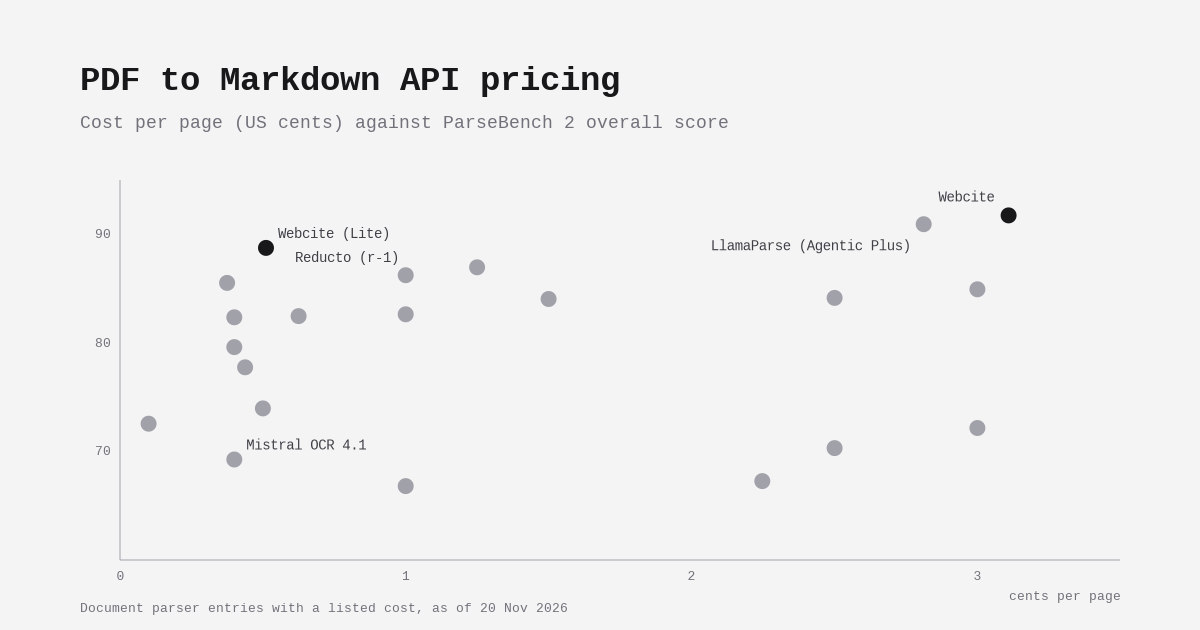
- Mistral OCR 4.1 costs 0.4 cents a page, the lower price; Webcite's standard mode costs 3.11 cents.
- Webcite (Lite) scored 88.75 at 0.511 cents, about the price of Mistral's annotated pages.
- Webcite verifies claims against sources with citations and verdicts on the same API that reads the page.
How do Webcite and Mistral OCR score on ParseBench 2?
Webcite is ranked first on ParseBench 2 at 91.74 overall. Ranking pending approval by LlamaIndex. Mistral OCR 4.1 scored 69.26 and 73.96 with annotation. Webcite’s run on 18 November 2026 covered 4,316 of 4,317 documents (source: ParseBench pull request 309).
| ParseBench 2 (leaderboard as of 20 November 2026) | Webcite | Webcite (Lite) | Mistral OCR 4.1 (annotation) | Mistral OCR 4.1 |
|---|---|---|---|---|
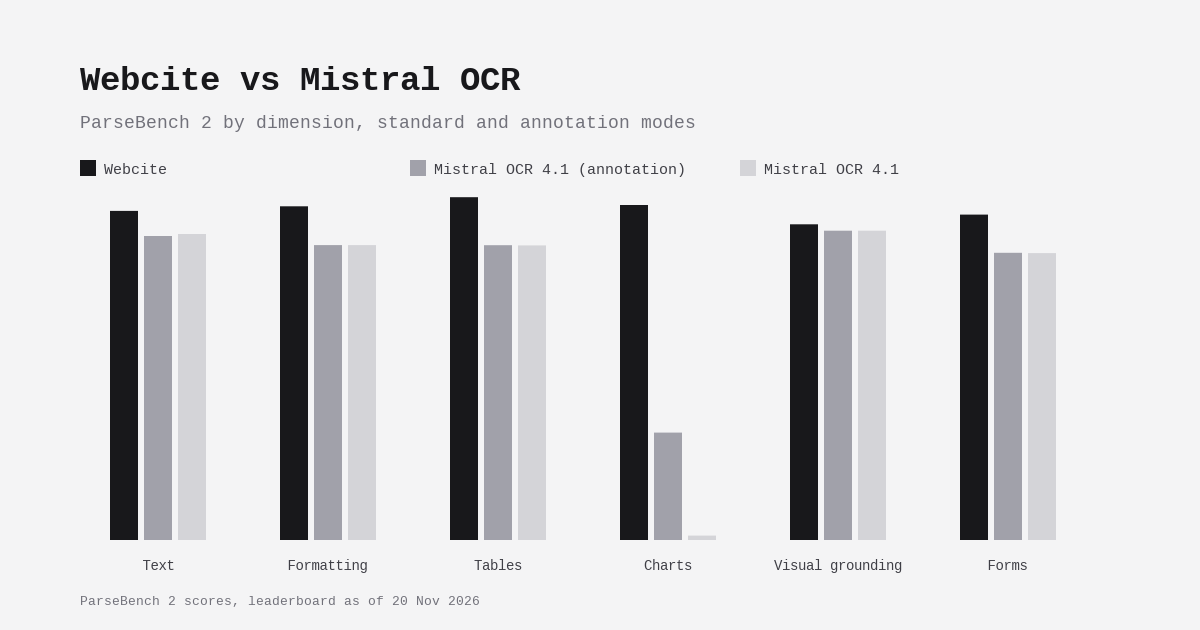
| Overall | 91.74 | 88.75 | 73.96 | 69.26 |
| Text / Formatting | 91.43 / 92.69 | 89.46 / 91.38 | 84.44 / 81.91 | 84.99 / 81.91 |
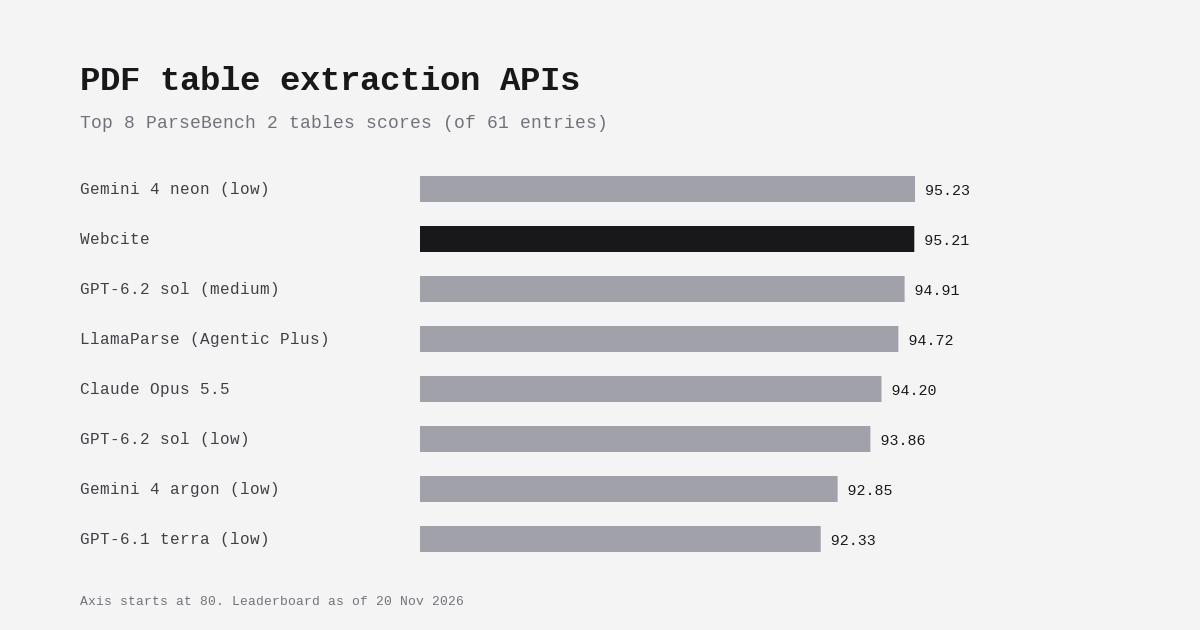
| Tables / Charts | 95.21 / 93.05 | 90.64 / 88.87 | 81.89 / 29.83 | 81.84 / 1.22 |
| Visual grounding / Forms | 87.69 / 90.38 | 85.34 / 86.79 | 85.93 / 79.78 | 85.93 / 79.69 |
| Cost per page (US cents, as listed) | 3.11 | 0.511 | 0.50 | 0.40 |
| Best for | Highest overall, charts, forms | 88.75 under a cent | Annotated output at 0.5 cents | Lowest price for text pages |
Every entry, with filters by category, is on the Webcite benchmarks page. The best document parsing APIs of 2026 ranking adds picks by dimension and price.
Where does Mistral OCR lead?
Mistral OCR leads on price. OCR 4.1 costs $4 per 1,000 pages and $5 per 1,000 annotated pages, according to Mistral’s OCR 4.1 model page, checked 24 November 2026. That is 0.4 cents a page against 3.11 cents for Webcite’s standard mode. The PDF to Markdown API pricing comparison puts both next to LlamaParse and Reducto. For OCR 4, Mistral’s launch post lists the Batch API at 50% off.
Mistral also beats Webcite (Lite) on visual grounding: 85.93 against 85.34, according to the ParseBench 2 leaderboard CSV. Webcite’s standard mode scored 87.69 on the same dimension.
Mistral also offers self-hosting: OCR 4 “runs in a single container for fully self-hosted deployments”, and “self-managed deployment is available to enterprise customers”, according to Mistral’s OCR 4 announcement. Its Annotations feature extracts fields to a JSON schema you supply.
Choose Mistral OCR 4.1 when the pages are mostly plain text, the volume is high, and a price of 0.4 cents a page matters more than chart and form accuracy. Choose Webcite when the pages carry charts, dense tables or forms, or when the next step is checking the figures and claims the document contains.
Where does Webcite lead?
Webcite leads on all six dimensions against both Mistral entries. Charts show the widest gap. Webcite scored 93.05, Mistral OCR 4.1 scored 1.22, and the annotation mode 29.83, according to Webcite’s ParseBench submission and the leaderboard.
On text Webcite scored 91.43 against 84.99, and on tables 95.21 against 81.89. Forms are 90.38 against 79.78. If your documents are mostly clean text pages, the gap narrows; if they hold charts, financial tables or forms, the gap decides the choice. The guides to extracting chart data from PDFs, PDF table extraction APIs and form extraction APIs rank each of those dimensions.
How do Mistral OCR and Webcite price a page?
Mistral charges a flat rate per 1,000 pages. Webcite meters extraction at cost: each page is charged what its reads cost at list price, converted at $0.04 a credit, and a page that could not be read is free, according to Webcite’s credits documentation. Spreadsheets, DOCX, PPTX, HTML and text files cost 0 credits because no model reads them.
The 3.11 cent figure comes from 325 production pages, 25 from each subset, weighted to the benchmark’s page mix. Webcite (Lite) averaged 0.511 cents a page on the same method. Plans and credit prices are on the Webcite pricing page. Uploads are free on Webcite. Mistral’s OCR models take PDF, image, PPTX and DOCX input, according to Mistral’s basic OCR documentation.
What does Webcite add beyond OCR?
Webcite reads the page and then checks what it says. OCR scores measure the reading layer only. These steps run on the same API key and MCP server, each listed in the Webcite API reference:
- Claim verification returns citations, a stance for each source and a verdict for each claim.
- Full document review checks every material claim in a file and reports coverage, including passages it could not cover.
- Figure extraction reads numbers with units and source locations; conflict analysis recomputes and compares them across documents.
- Source preview resolves a citation to its source and checks that the quoted passage is there.
- Registered sources and published text units let an agent return to the same evidence by ID.
| Documented capability (checked 24 Nov 2026) | Webcite | Mistral OCR |
|---|---|---|
| Page output with block positions | Markdown per page with typed element boxes | JSON pages with Markdown, blocks, boxes and confidence |
| Office file input | DOCX, PPTX, spreadsheets and HTML, read at 0 credits | PPTX and DOCX accepted |
| Questions over a document | Ask a document returns a checked answer | Document QnA combines OCR with a language model |
| Fields from a schema | Figures with units and source locations | Annotations to a JSON schema |
The Mistral column comes from Mistral’s Document QnA page and its OCR and Annotations documentation. For agent builders, the guide to MCP search and verification tools shows how a verification tool fits an agent loop; Webcite’s MCP endpoint is api.webcite.co/mcp.
How do I reproduce the Webcite score?
The ParseBench reproduction guide runs the public harness against the production API with your own key. Start with the headings subset, 100 cases at about 28 credits.
The raw outputs are on Hugging Face, ParseBench-2-results discussion 14, and can be rescored without an API key. To try it on your own pages, start with Webcite’s extraction API.
Frequently Asked Questions
Is Webcite more accurate than Mistral OCR?
On ParseBench 2, Webcite scored 91.74 overall, Mistral OCR 4.1 (annotation) 73.96 and Mistral OCR 4.1 69.26. The largest gap is charts: 93.05 for Webcite against 29.83 and 1.22 for the two Mistral modes.
How much does Mistral OCR cost per page?
Mistral lists OCR 4.1 at $4 per 1,000 pages and $5 per 1,000 annotated pages, which is 0.4 and 0.5 cents a page. The ParseBench 2 leaderboard lists Webcite at 3.11 cents and Webcite (Lite) at 0.511 cents a page.
Is Webcite (Lite) a cheaper alternative to Mistral OCR?
Webcite (Lite) costs 0.511 cents a page on the leaderboard, close to the 0.5 cents of Mistral OCR 4.1 (annotation). It scored 88.75 overall against 73.96. Mistral OCR 4.1 without annotation is cheaper at 0.4 cents a page.
Can Mistral OCR run on my own servers?
Mistral says OCR 4 runs in a single container for fully self-hosted deployments, and self-managed deployment is available to enterprise customers. Webcite runs as a hosted API at api.webcite.co with a hosted MCP endpoint.
What does Webcite add beyond OCR?
Webcite checks the claims in what it reads. It verifies a claim against sources and returns citations, source stances and a verdict, reviews every material claim in a file with a coverage report, recomputes figures across documents, and resolves each citation to the quoted passage.