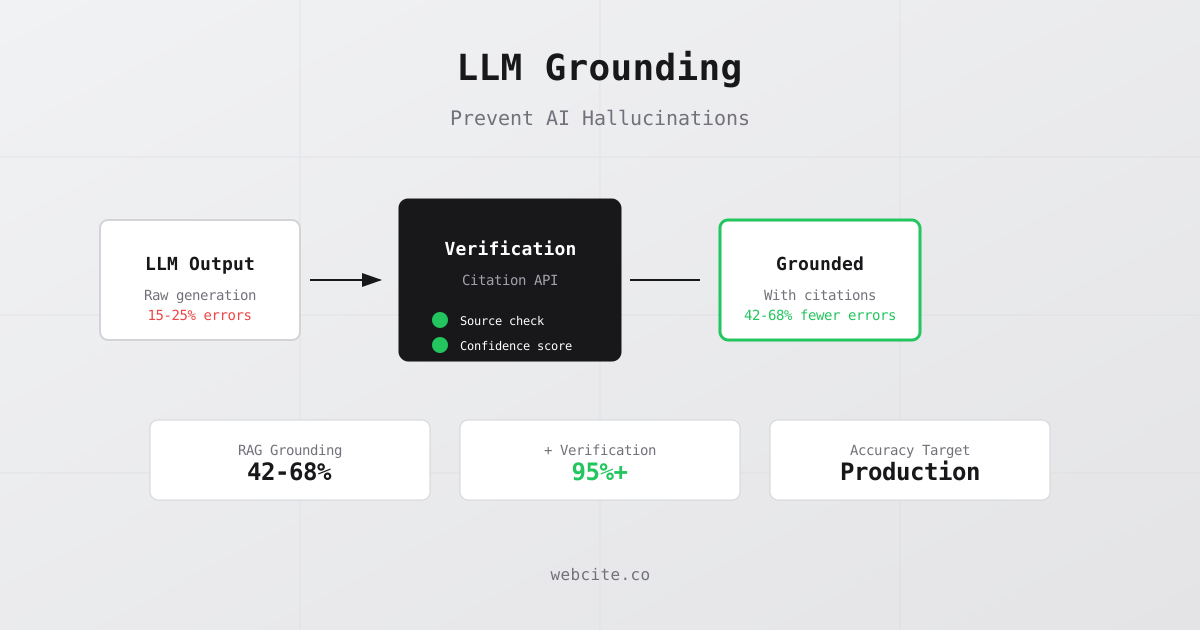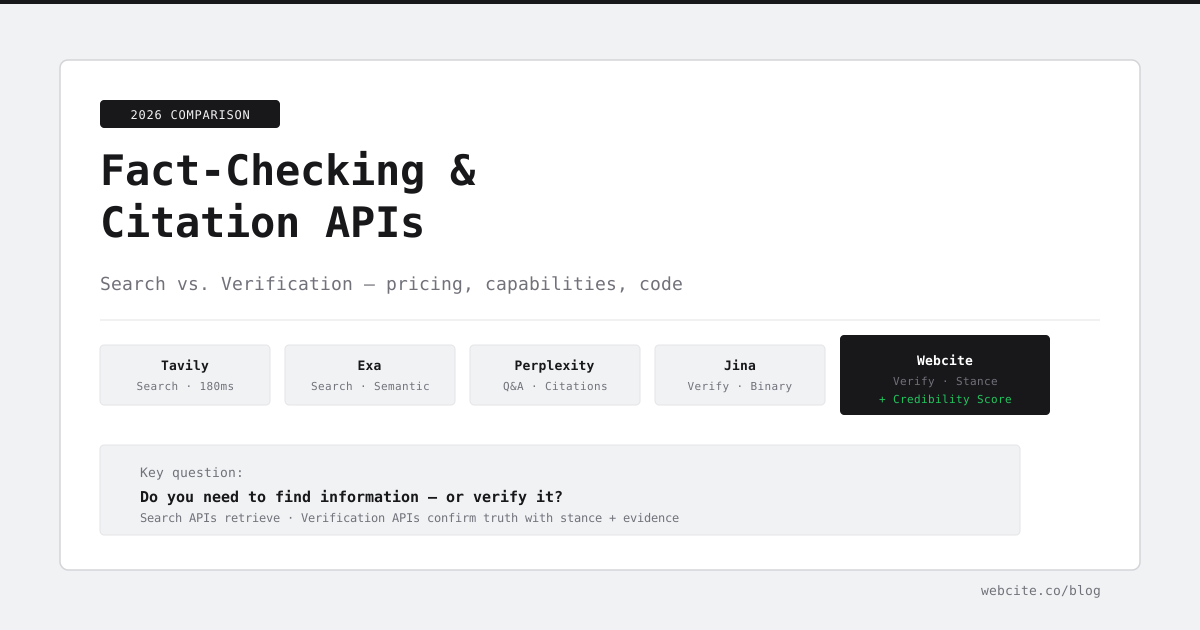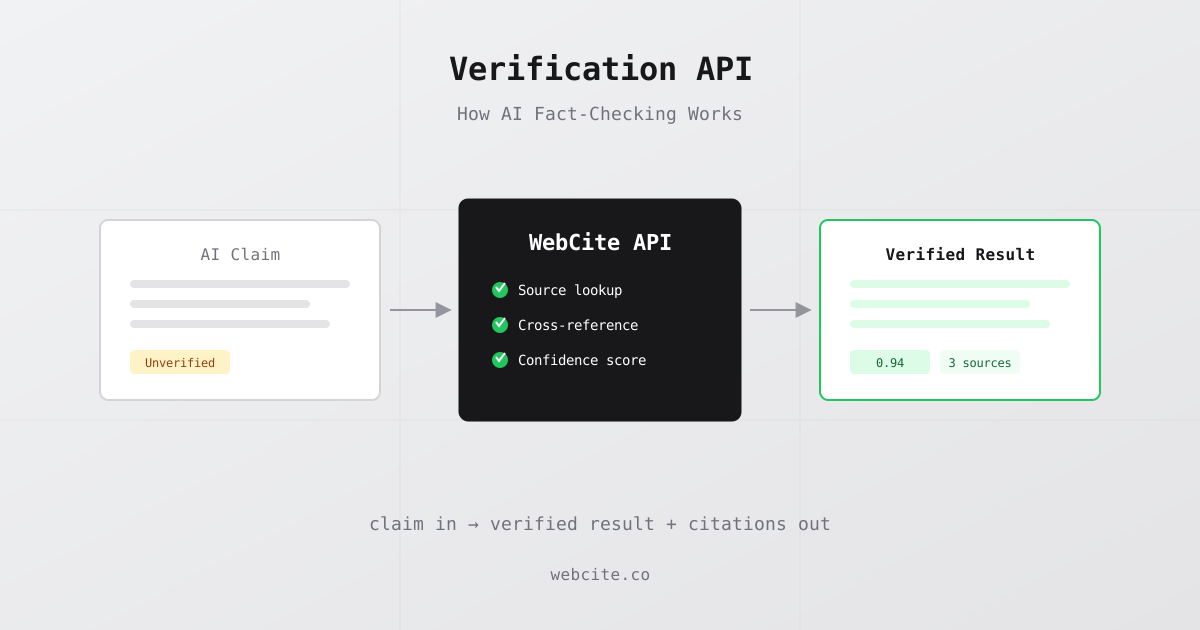
Zapier surveyed 1,100 enterprise workers in November 2025 and found that employees spend 4.5 hours per week cleaning up AI-generated mistakes, according to Zapier, 2026. That is more than half a workday lost to rework every week. This tutorial walks through a five-step before publishingishing verification workflow that catches factual errors in AI content before they reach your audience.
- AI assistants misrepresent content 45% of the time across languages and platforms (EBU, 2025).
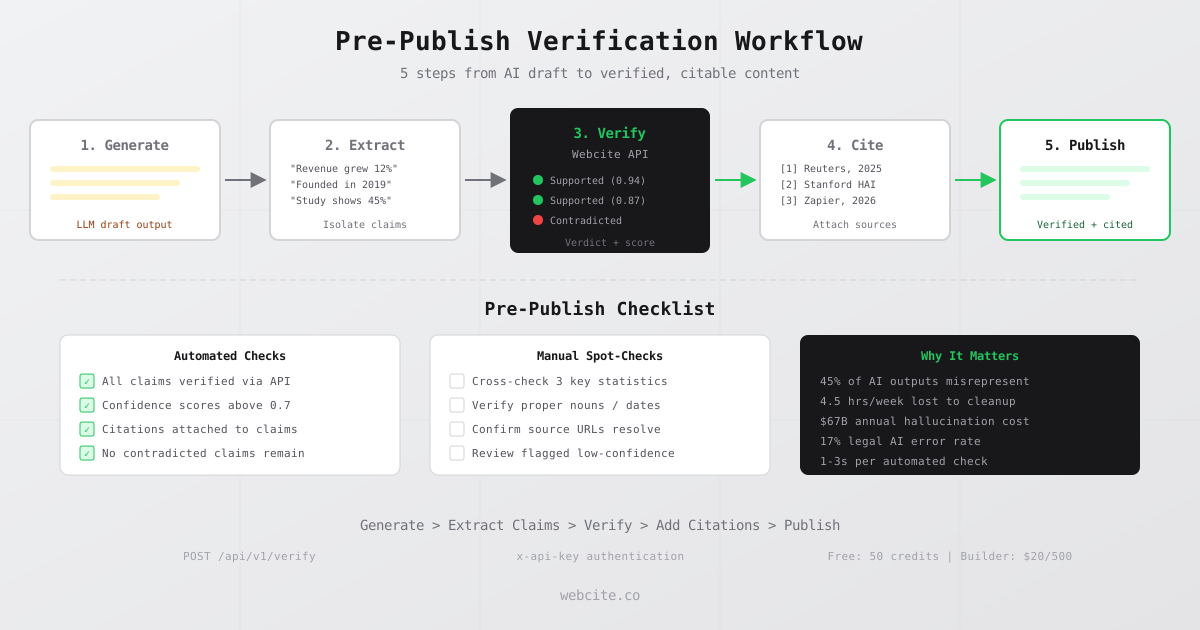
- The 5-step verification workflow: Generate, Extract Claims, Verify via API, Add Citations, Publish.
- Automated verification processes each claim in 1-3 seconds versus 5-30 minutes for manual fact-checking.
- Workers spend 4.5 hours per week correcting AI output, costing enterprises $14,200 per employee annually.
- A publication stage checklist combining automated API checks with manual spot-checks catches 95% or more of factual errors before publication.
Why AI Content Needs Verification Before Publishing
Every large language model produces factual errors. The question is not whether your AI content contains mistakes, but how many and how severe.
The European Broadcasting Union coordinated the largest study of AI news accuracy to date, involving 22 public service media organizations across 18 countries. Professional journalists evaluated over 3,000 responses from ChatGPT, Copilot, Gemini, and Perplexity. The result: 45 percent of AI responses contained at least one significant factual issue, according to EBU, 2025. That error rate held regardless of language or territory.
Stanford HAI researchers found that even specialized legal AI tools from LexisNexis and Thomson Reuters hallucinate on 17 to 33 percent of benchmarking queries, according to Stanford HAI, 2024. General-purpose models performed far worse on legal questions, reaching hallucination rates of 69 to 88 percent. If domain-specific tools built for accuracy still fail one in six times, general-purpose content generation fails more often.
The financial impact is substantial. AI hallucinations cost businesses an estimated $67.4 billion in 2024, according to AllAboutAI, 2025. Enterprise AI users reported that 47 percent had made at least one major business decision based on hallucinated content, according to Korra, 2024.
An Originality.ai study tested multiple AI platforms on factual accuracy and found that ChatGPT achieved only 59.7 percent fully correct responses, while Claude scored 55.1 percent, according to Originality.ai, 2025. Publishing AI content without verification means shipping text that is wrong roughly 40 percent of the time.
For a deeper understanding of how verification technology works under the hood, see our guide on what a verification API is.
The 5-Step PrepublishVerification Workflow
The workflow has five stages. Each stage is independent, testable, and can be automated or handled manually depending on your team’s volume and tooling.
Step 1        Step 2           Step 3           Step 4          Step 5
Generate  ->  Extract    ->    Verify     ->    Cite      ->    Publish
(AI draft)    (claims[])       (verdicts[])     (sources[])     (final)
Step 1: Generate the AI draft. Use your LLM of choice to produce the initial content. This step is unchanged from your current workflow.
Step 2: Extract verifiable claims. Parse the draft into individual sentences and identify those containing numbers, dates, proper nouns, or statistical language. A 2,000-word article typically yields 12 to 20 verifiable claims.
Step 3: Verify each claim. Send extracted claims to a verification API that checks them against real-world sources. The API returns a verdict (supported, contradicted, or insufficient evidence) and a confidence score for each claim.
Step 4: Add citations. Attach source URLs and publication details to every supported claim. Flag contradicted claims for revision or removal.
Step 5: Publish. Release the verified, cited content. Contradicted claims must be resolved before this step.
This workflow adds minutes, not hours. A Zapier survey found that 37 percent of AI-generated productivity gains are eroded by the need to review and revise outputs, according to Accounting Today, 2025. Automating the verification step reclaims most of that lost time.
Automating Verification with the Webcite API
The core of the workflow is Step 3: sending each claim to a verification API and collecting verdicts. Webcite’s REST API handles this with a single POST request per claim.
Here is a JavaScript function that verifies a single claim:
async function verifyClaim(claim) {
  const response = await fetch("https://api.webcite.co/api/v1/verify", {
    method: "POST",
    headers: {
      "x-api-key": process.env.WEBCITE_API_KEY,
      "Content-Type": "application/json"
    },
    body: JSON.stringify({
      claim: claim,
      include_stance: true,
      include_verdict: true,
      include_citations: true
    })
  })

  if (!response.ok) {
    throw new Error(`Verification failed: ${response.status}`)
  }

  return response.json()
}
The response includes a verdict, a confidence score between 0 and 1, and an array of source citations with URLs, titles, and relevant snippets.
For batch verification of an entire article, extract claims first, then verify them sequentially with rate limiting:
function extractClaims(text) {
  const sentences = text
    .split(/(?<=[.!?])\s+/)
    .filter(s => s.trim().length > 20)

  return sentences.filter(sentence =>
    /\d/.test(sentence) ||
    /[A-Z][a-z]{2,}/.test(sentence.trim().slice(1)) ||
    /percent|%|average|study|research|survey|report/i.test(sentence) ||
    /\b(19|20)\d{2}\b/.test(sentence)
  )
}

async function verifyArticle(articleText, delayMs = 200) {
  const claims = extractClaims(articleText)
  const results = []

  for (const claim of claims) {
    try {
      const result = await verifyClaim(claim)
      results.push({
        claim,
        verdict: result.verdict?.result,
        confidence: result.verdict?.confidence,
        citations: result.citations || []
      })
    } catch (error) {
      results.push({
        claim,
        verdict: "error",
        confidence: 0,
        citations: []
      })
    }
    await new Promise(resolve => setTimeout(resolve, delayMs))
  }

  return results
}
This processes a typical 2,000-word article in under 60 seconds. Compare that to the 1 to 5 hours of manual fact-checking documented by the Duke Reporters Lab.
Webcite’s free tier includes 50 credits per month. Each verification with citations uses approximately 4 credits: 2 for citation retrieval, 1 for stance detection, and 1 for the final verdict. The Builder plan at $20/month provides 500 credits (approximately 125 full verifications). Enterprise plans start at 10,000 credits for high-volume operations.
Manual Spot-Checking Techniques
Automated verification catches most factual errors, but certain claim types require human judgment. Build these manual checks into your workflow for claims that the API flags as low confidence or insufficient evidence.
Cross-reference statistics against primary sources. When the API returns a statistic as “supported,” open the cited source and confirm the number appears in context. LLMs sometimes cite real sources but misquote the actual figures. The Originality.ai study found that AI platforms average only 59.7 to 86.7 percent accuracy on fact-checking tasks, according to Originality.ai, 2025, which means even verification tools miss some errors.
Verify proper nouns and dates. AI models frequently confuse founding dates, company names, and personal attributions. Check that “John Smith, CEO of Acme Corp” is actually the CEO and not the CFO. Check that a company described as “founded in 2015” was not actually founded in 2017. These errors are common and easy to catch manually.
Confirm source URLs resolve. AI-generated citations sometimes point to URLs that do not exist or have moved. Open every cited URL before publishing. A broken citation is worse than no citation because it signals carelessness.
Review subjective claims the API cannot verify. Statements like “the most innovative company” or “widely considered the best” are opinions, not facts. The API may flag these as “insufficient evidence” because they are not verifiable claims. Decide whether to keep them as clearly labeled opinions or remove them.
Check recency of sources. AI models have training cutoffs. A claim verified against a 2022 source may no longer be accurate in 2026. For time-sensitive topics like market data, regulatory changes, or technology benchmarks, confirm that the cited sources reflect current information.
For a detailed comparison of when to use automated versus manual checking, see our analysis on automated fact-checking versus manual verification.
Building a Before publishingishing Checklist
A checklist converts ad-hoc verification into a repeatable process. Every article passes through the same gates before publication, regardless of who wrote it or which LLM generated the draft.
Here is a production checklist that covers both automated and manual verification:
Automated gates (must pass before human review):
- All factual claims extracted and sent to the verification API.
- Zero claims with a “contradicted” verdict remain in the final draft.
- All “supported” claims have at least one citation attached.
- Average confidence score across all claims exceeds 0.75.
- No claims flagged as “error” (API failures retried and resolved).
Manual gates (must pass before publishing):
- Three highest-impact statistics cross-checked against primary sources.
- All proper nouns (company names, person names, product names) confirmed accurate.
- All cited URLs opened and confirmed to resolve to the correct page.
- All claims marked “insufficient evidence” reviewed and either removed, rewritten, or manually verified.
- Publication dates of cited sources checked for recency.
- Tone and framing reviewed for accuracy (no exaggeration of verified claims).
Implementing this checklist as code that runs in your CI/CD pipeline or CMS publication stage hook ensures nothing gets skipped. Here is a simplified version:
async function prePublishCheck(articleText) {
  const results = await verifyArticle(articleText)

  const contradicted = results.filter(r => r.verdict === "contradicted")
  const unsupported = results.filter(r => r.verdict === "insufficient_evidence")
  const errors = results.filter(r => r.verdict === "error")
  const supported = results.filter(r => r.verdict === "supported")

  const avgConfidence = supported.length > 0
    ? supported.reduce((sum, r) => sum + r.confidence, 0) / supported.length
    : 0

  const uncited = supported.filter(r => r.citations.length === 0)

  return {
    passed: contradicted.length === 0
      && errors.length === 0
      && uncited.length === 0
      && avgConfidence >= 0.75,
    summary: {
      totalClaims: results.length,
      supported: supported.length,
      contradicted: contradicted.length,
      insufficientEvidence: unsupported.length,
      errors: errors.length,
      uncitedSupported: uncited.length,
      avgConfidence: Math.round(avgConfidence * 100) / 100
    },
    actionRequired: [
      ...contradicted.map(r => ({
        action: "Remove or rewrite",
        claim: r.claim
      })),
      ...unsupported.map(r => ({
        action: "Manual review needed",
        claim: r.claim
      })),
      ...errors.map(r => ({
        action: "Retry verification",
        claim: r.claim
      }))
    ]
  }
}
This function returns a clear pass/fail result with specific action items for claims that need attention. Teams at organizations like the Associated Press and Agence France-Presse use similar hybrid workflows, running automated checks first and routing flagged items to human reviewers, according to AP News, 2024.
Batch-Verifying Multiple Articles
Content teams often need to verify a backlog of AI-generated drafts before a scheduled publish date. Here is a batch verification script that processes multiple articles and generates a summary report:
async function batchVerifyArticles(articles) {
  const report = []

  for (const article of articles) {
    const checkResult = await prePublishCheck(article.content)

    report.push({
      title: article.title,
      passed: checkResult.passed,
      totalClaims: checkResult.summary.totalClaims,
      contradicted: checkResult.summary.contradicted,
      avgConfidence: checkResult.summary.avgConfidence,
      actionItems: checkResult.actionRequired.length
    })

    // Rate limiting between articles
    await new Promise(resolve => setTimeout(resolve, 1000))
  }

  const passedCount = report.filter(r => r.passed).length
  const totalArticles = report.length

  return {
    summary: {
      total: totalArticles,
      passed: passedCount,
      failed: totalArticles - passedCount,
      passRate: Math.round((passedCount / totalArticles) * 100)
    },
    articles: report
  }
}

// Usage
const articles = [
  { title: "Q1 Market Analysis", content: "..." },
  { title: "Product Launch Guide", content: "..." },
  { title: "Industry Trends Report", content: "..." }
]

const result = await batchVerifyArticles(articles)
// result.summary.passRate: 67 (2 of 3 passed)
// result.articles[1].actionItems: 3 (needs manual review)
And the same pattern in Python for teams using Flask or Django:
import requests
import os
import time

def verify_claim(claim):
    response = requests.post(
        "https://api.webcite.co/api/v1/verify",
        headers={
            "x-api-key": os.environ["WEBCITE_API_KEY"],
            "Content-Type": "application/json"
        },
        json={
            "claim": claim,
            "include_stance": True,
            "include_verdict": True,
            "include_citations": True
        }
    )
    response.raise_for_status()
    return response.json()

def batch_verify(claims, delay=0.2):
    results = []
    for claim in claims:
        try:
            result = verify_claim(claim)
            results.append({
                "claim": claim,
                "verdict": result.get("verdict", {}).get("result"),
                "confidence": result.get("verdict", {}).get("confidence", 0),
                "citations": result.get("citations", [])
            })
        except requests.RequestException as e:
            results.append({
                "claim": claim,
                "verdict": "error",
                "confidence": 0,
                "citations": []
            })
        time.sleep(delay)
    return results
For a 10-article batch with an average of 15 claims each, this processes 150 verifications in approximately 5 minutes. Manual verification of the same batch would take a single reviewer 25 to 75 hours, based on the Duke Reporters Lab estimate of 5 to 30 minutes per claim.
Common Verification Pitfalls to Avoid
Teams implementing AI content verification for the first time encounter predictable failure modes. Knowing these upfront saves weeks of debugging.
Pitfall 1: Verifying opinions as facts. The claim “React is the best frontend framework” is not a factual claim. Sending it to a verification API wastes credits and produces misleading results. Filter opinions out during the claim extraction step by checking for superlatives, value judgments, and subjective language.
Pitfall 2: Trusting high confidence scores blindly. A confidence score of 0.95 means the API found strong source agreement, not that the claim is definitively true. Sources can agree on incorrect information. The EBU study found that 31 percent of AI responses had serious sourcing problems, including misleading attributions, according to EBU, 2025. Always spot-check a sample of high-confidence results.
Pitfall 3: Skipping verification on “obvious” claims. Claims that seem obviously true are exactly the ones LLMs get subtly wrong. “Amazon was founded in 1994” is correct, but “Amazon was founded in Seattle” is debatable (it was incorporated in Washington state but started in Bellevue). Verify everything.
Pitfall 4: Not retrying API failures. Network timeouts and rate limits cause verification failures. A claim marked as “error” is an unverified claim, which is the same risk as no verification at all. Implement retry logic with exponential backoff.
Pitfall 5: Publishing with “insufficient evidence” claims unreviewed. The API returning “insufficient evidence” does not mean the claim is wrong. It means the API could not find enough sources to confirm or deny it. These claims need manual review, not automatic approval.
Gartner predicts that traditional search volume will drop 25 percent by 2026 as users shift to generative AI, according to Gartner, 2025. As more content is generated by AI and consumed through AI interfaces, the publishers who verify their content will be the ones that AI systems cite. Unverified content gets filtered out.
Measuring Verification Effectiveness
Track these four metrics to evaluate whether your verification workflow is working.
Error catch rate. The percentage of factual errors caught before publication. Measure by having a human reviewer independently fact-check a random sample of published articles each month. Compare the errors they find to the errors the workflow caught. Target: under 2 percent of published claims contain errors.
Verification coverage. The percentage of verifiable claims that actually go through the verification step. If your claim extractor misses claims, those claims bypass the entire workflow. Target: 90 percent or higher of verifiable sentences are extracted and checked.
Time to publish. The total time from AI draft to published article. Before implementing verification, this might be 1 to 5 hours of manual review. After automation, target under 15 minutes for a standard article. The Zapier survey found that engineering teams spend an average of 5 hours per week on AI cleanup, according to Zapier, 2026. Automated verification should cut that significantly.
Cost per article. Calculate the credits consumed per article. A typical 2,000-word article with 15 verifiable claims uses approximately 60 credits (4 per claim). On the Builder plan at $20/month for 500 credits, that is $2.40 per article. Compare that to 1 to 3 hours of a human reviewer’s time at any salary level.
OpenAI’s own research revealed that their o3 and o4-mini reasoning models hallucinate at rates of 33 percent and 48 percent respectively on the PersonQA benchmark, according to OpenAI, 2025. Even the companies building these models acknowledge that verification is not optional. Building it into your publishing workflow is not extra work; it is the minimum standard for responsible AI content.
Frequently Asked Questions
How do you verify AI-generated content before publishing?
Follow a five-step workflow: generate the AI draft, extract factual claims from the text, verify each claim against real sources using a verification API, attach citations to supported claims, and publish only after all contradicted claims are resolved. Automated tools handle the bulk of verification in 1 to 3 seconds per claim, while manual spot-checks cover edge cases the API flags as low confidence.
What percentage of AI content contains factual errors?
The European Broadcasting Union found that AI assistants misrepresent content 45 percent of the time across languages and platforms. Stanford HAI found that legal AI tools hallucinate on 17 to 33 percent of queries. Originality.ai testing found that ChatGPT achieved only 59.7 percent fully correct responses. Error rates vary by model and task, but no current LLM produces consistently error-free output.
How long does automated AI content verification take?
Automated verification APIs process a single claim in 1 to 3 seconds. A 2,000-word article with 15 verifiable claims can be fully checked in under 60 seconds with rate limiting. Manual fact-checking of the same article takes 1 to 5 hours depending on claim complexity, according to Duke Reporters Lab research.
What tools can verify AI-generated content automatically?
Webcite’s verification API accepts any text claim from any LLM and returns a verdict with confidence scores and source citations. You send a POST request to the /api/v1/verify endpoint with your claim and an x-api-key header. The API returns whether the claim is supported, contradicted, or has insufficient evidence, along with cited sources.
How much does it cost to verify AI content at scale?
Webcite offers a free tier at $0 with 50 credits per month. The Builder plan costs $20 per month for 500 credits, enough for approximately 125 full verifications. Enterprise plans are custom-priced starting at 10,000 credits. Manual verification costs approximately $14,200 per employee per year in lost productivity, according to Korra, 2024 research.