Deep research agents execute sequential workflows that search the web, analyze sources, and generate reports, but 57% of organizations now running agents in production report quality as their top concern, according to the LangChain State of Agent Engineering Survey, 2025. The missing step is verification: independently checking each synthesized claim before it reaches the user. This article covers the architecture pattern for adding claim-level verification to deep research agents using search tools, LLMs, and the Webcite API.
- Deep research agents search and synthesize but skip verification, allowing errors to compound across steps.
- A 5% per-step error rate compounds to a 63% failure rate on 100-step tasks.
- The architecture pattern is Search, Synthesize, Verify, Cite, with verification as an explicit pipeline stage.
- Adding Webcite verification to a LangChain agent requires fewer than 30 lines of code.
- Gartner predicts 40% of enterprise apps will embed AI agents by end of 2026.
What Are Deep Research Agents?
Deep research agents are AI systems that go beyond single-prompt question answering to execute sequential research workflows autonomously. They search the web, retrieve and read documents, cross-reference findings, and generate structured reports, all without human intervention between steps.
The category emerged rapidly in 2025. OpenAI launched Deep Research in February 2025 as a ChatGPT feature powered by a specialized version of the o3 model, according to OpenAI, 2025. It browses the web, reads dozens of pages, and produces multi-page reports. By February 2026, OpenAI upgraded it to GPT-5.2 and added MCP app connections, according to Business of Tech, 2026.
Tavily, the search API built specifically for AI agents, launched a dedicated /research endpoint for agentic deep research workflows, according to Tavily, 2025. Google released the Agent Development Kit (ADK) at Cloud NEXT 2025 with built-in support for chained agent pipelines, according to Google Developers Blog, 2025.
Exa AI shipped Exa Research in June 2025. It automates iterative querying and summarization, according to Exa AI, 2025. The open-source GPT-Researcher project on GitHub now has over 17,000 stars.
LangChain’s open_deep_research template provides a reference implementation that any developer can deploy, according to LangChain GitHub, 2025. CrewAI offers multi-agent orchestration where specialized agents handle different research subtasks. The ecosystem is maturing fast: Gartner predicts 40% of enterprise applications will embed task-specific AI agents by end of 2026, up from less than 5% in 2025, according to Gartner, 2025.
All of these systems share the same fundamental workflow: search, analyze, synthesize, report. And all of them share the same gap.
The Missing Verification Step
Deep research agents search and synthesize, but they don’t verify. The output of a search tool feeds directly into the LLM’s synthesis step, and the LLM’s output becomes the final report. No independent check confirms whether the synthesized claims are factually correct.
This is a structural problem, not a model quality problem. Even the best LLMs hallucinate. General-purpose LLMs exhibit hallucination rates ranging from 17% to 45% depending on the model, according to AIMultiple, 2025. GPT-4.5 scores the lowest at roughly 15%, but that still means one in seven claims may be fabricated or distorted.
The problem compounds in sequential workflows. Each step inherits errors from the previous step and adds its own. Field tests show that a 1% per-action error rate becomes near-certain collapse over long task chains, a phenomenon DeepMind’s Demis Hassabis has compared to “compound interest in reverse,” according to Medium (Lior Gd), 2025. The same analysis found a 63% failure rate on 100-step tasks.
Consider a typical deep research workflow:
- The search step retrieves 20 web pages. Two of them contain outdated information.
- The synthesis step reads all 20 pages and generates a summary. It incorporates the outdated data without flagging it.
- The report step formats the summary and adds inline citations. The citations point to the source pages, but the claims derived from those pages may be distorted by the LLM.
At no point did anything check whether the synthesized claims are actually supported by credible, current sources. The agent trusts its own output.
This is where a verification API fits. Verification is the explicit step that breaks the error propagation chain by independently checking each claim against external sources.
Architecture: Search, Synthesize, Verify, Cite
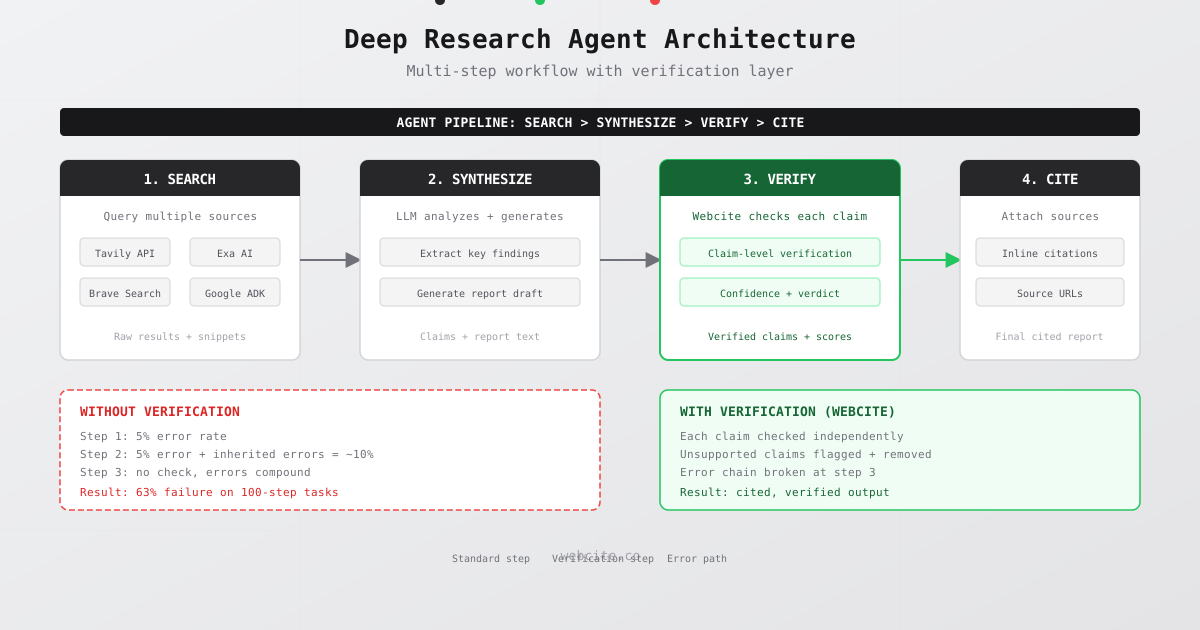
The architecture pattern inserts verification as a distinct pipeline stage between synthesis and citation. Each stage has a clear input and output contract.
Stage 1: Search. The agent queries one or more search APIs. Tavily, Exa AI, Brave Search, and Google ADK all provide structured search results optimized for agent consumption. The output is a collection of raw results: URLs, titles, snippets, and page content.
Stage 2: Synthesize. An LLM (OpenAI GPT-4o, Anthropic Claude, Google Gemini, or an open-source model like Llama) reads the search results and generates a research report. The output is a structured document containing claims, analysis, and conclusions.
Stage 3: Verify. Each claim in the synthesized report is sent to the Webcite verification API. The API checks the claim against independent sources and returns a verdict (supported, refuted, or insufficient evidence), a confidence score, and citations. Claims that score below a confidence threshold are flagged or removed.
Stage 4: Cite. Verified claims are assembled into the final report with inline citations from the verification step. Each claim maps to one or more source URLs with relevant passages. Unsupported claims are either dropped or explicitly marked as unverified.
Here is what the verification call looks like in practice:
import requests

def verify_claim(claim):
    response = requests.post(
        "https://api.webcite.co/api/v1/verify",
        headers={
            "x-api-key": "your-api-key",
            "Content-Type": "application/json"
        },
        json={
            "claim": claim,
            "include_stance": True,
            "include_verdict": True
        }
    )
    return response.json()

claim = "The global AI agents market reached $7.8 billion in 2025"
result = verify_claim(claim)
print(result["verdict"]["result"])      # "supported"
print(result["verdict"]["confidence"])  # 91
print(result["citations"][0]["url"])    # source URL
This separation of concerns is critical. The search step finds information. The synthesis step generates insights. The verification step confirms accuracy. The citation step provides attribution. Combining search and verification into one step, as most agents currently do, conflates “what sources exist” with “is this claim true,” and those are fundamentally different questions.
Why Multistep Agents Need Verification More Than Single-Call LLMs
A single LLM call generates text from a prompt. If it hallucinates, the error is contained to that one response. A chained agent is different. Errors propagate forward through the pipeline, and each step can amplify mistakes from previous steps.
Research on coordinated agent systems demonstrates this compounding effect. Without an orchestrator that validates intermediate outputs, agents descend into hallucination loops. They echo each other’s mistakes instead of correcting them, according to Galileo AI, 2025. Unstructured architectures suffer 17x error amplification compared to single-agent baselines, according to Towards Data Science, 2025. Each additional agent without coordination increases the failure surface.
LLMs also perform worse in extended conversations. Performance drops by 39% on average in multi-turn interactions compared to single-turn queries, according to arXiv (LLM Agent Hallucination Survey), 2025. Deep research agents are inherently multi-turn. The search results from step one become the context for step two, which becomes the input for step three.
Verification acts as an error circuit breaker. Instead of each step blindly trusting the output of the previous step, the verification stage independently validates claims against external sources. If a claim from the synthesis step is unsupported, it gets flagged before it can propagate into the final report. For a deeper look at how to test and validate AI agent outputs, see our guide on AI agent testing and fact-checking output.
The math is straightforward. If each step has a 95% accuracy rate, a four-step pipeline has a cumulative accuracy of 0.95^4 = 81%. Adding a verification step that catches 80% of errors brings the effective accuracy back above 96%. The cost of that verification step is a single API call per claim.
Building a LangChain Research Agent with Verification
LangChain is the most widely used framework for building AI agents. The LangChain State of Agent Engineering survey received 1,340 responses in 2025, and 57% of respondents reported running agents in production, according to LangChain, 2025. Here is how to add a verification step to a LangChain research agent.
The agent uses two tools: a search tool (Tavily) for web research and a verification tool (Webcite) for fact-checking. The LLM decides when to use each tool based on the task.
import requests
from langchain_core.tools import tool
from langchain_openai import ChatOpenAI
from langchain.agents import AgentExecutor, create_tool_calling_agent
from langchain_core.prompts import ChatPromptTemplate

@tool
def search_web(query: str) -> str:
    """Search the web for information on a topic."""
    response = requests.post(
        "https://api.tavily.com/search",
        json={"query": query, "search_depth": "advanced"},
        headers={"Authorization": "Bearer tvly-your-key"}
    )
    results = response.json().get("results", [])
    return "\n".join(
        f"[{r['title']}]({r['url']}): {r['content'][:300]}"
        for r in results[:5]
    )

@tool
def verify_claim(claim: str) -> str:
    """Verify a factual claim against real sources. Use after synthesizing research."""
    response = requests.post(
        "https://api.webcite.co/api/v1/verify",
        headers={
            "x-api-key": "your-webcite-key",
            "Content-Type": "application/json"
        },
        json={
            "claim": claim,
            "include_stance": True,
            "include_verdict": True
        }
    )
    result = response.json()
    verdict = result.get("verdict", {})
    citations = result.get("citations", [])
    cite_str = "; ".join(
        f"{c.get('title', 'Source')}: {c.get('url', '')}"
        for c in citations[:3]
    )
    return (
        f"Verdict: {verdict.get('result', 'unknown')} "
        f"(confidence: {verdict.get('confidence', 0)}). "
        f"Sources: {cite_str}"
    )

llm = ChatOpenAI(model="gpt-4o", temperature=0)
tools = [search_web, verify_claim]

prompt = ChatPromptTemplate.from_messages([
    ("system",
     "You are a research agent. For every report you produce: "
     "1) Search for information using search_web. "
     "2) Synthesize findings into claims. "
     "3) Verify each key claim using verify_claim. "
     "4) Only include claims that are supported. "
     "Cite sources for every verified claim."),
    ("human", "{input}"),
    ("placeholder", "{agent_scratchpad}")
])

agent = create_tool_calling_agent(llm, tools, prompt)
executor = AgentExecutor(agent=agent, tools=tools, verbose=True)

result = executor.invoke({
    "input": "Research the current state of AI agent adoption in enterprises"
})
print(result["output"])
The agent follows the four-stage pattern: it searches with Tavily, synthesizes findings with the LLM, verifies claims with Webcite, and outputs a cited report. The system prompt enforces this order. The verification tool returns verdicts and source URLs that the agent includes in its final response.
This pattern works with any LLM and any search provider. Swap Tavily for Exa AI or Brave Search. Swap OpenAI for Anthropic Claude or Google Gemini. The verification step remains the same: send a claim to the Webcite API, get back a verdict with citations.
Agent Adoption and the Quality Problem
The AI agent market reached approximately $7.8 billion in 2025 and is projected to exceed $10.9 billion in 2026, according to LitsLink, 2025. Adoption is accelerating: 85% of organizations have adopted agents in at least one workflow, and 23% report scaling agentic AI across their enterprises, according to McKinsey, 2025.
But quality remains the top blocker. One third of respondents in the LangChain survey cited quality as their primary concern, and among enterprises with 2,000+ employees, security is the second largest concern at 24.9%, according to LangChain, 2025. Gartner predicts that over 40% of agentic AI projects will be canceled by end of 2027 if governance, observability, and ROI clarity are not established, according to Gartner, 2025.
Nearly 89% of organizations have implemented some form of observability for their agents. Of those, 62% have detailed tracing that inspects individual agent steps and tool calls, according to LangChain, 2025. Observability tells you what happened. Verification tells you whether what happened was correct. They are complementary: tracing without verification catches execution errors but misses factual errors.
The enterprise concern about agent quality maps directly to the verification gap. When an agent produces a research report with 15 claims, how many of those claims are accurate? Without verification, nobody knows until a human reads every claim and checks every source manually. That doesn’t scale. A verification API automates the check.
Getting Started with Agent Verification
Adding verification to your research agent takes three steps.
First, get a Webcite API key. Sign up at webcite.co for the free tier, which includes 50 credits per month. Each verification uses 4 credits (2 for citation retrieval, 1 for stance detection, 1 for the verdict), so the free tier covers about 12 full verifications.
Second, add the verification tool to your agent. The code example above shows the LangChain pattern. For CrewAI, wrap your verification function as a CrewAI tool. For Google ADK, register it as an ADK function tool. The underlying REST call is the same regardless of framework.
Third, set a confidence threshold. Not every claim needs the same level of scrutiny. For a quick internal summary, you might accept claims with confidence above 70. For a published research report, require 85 or higher. For regulated domains like healthcare or finance, require 90+ and flag anything below that for human review.
const response = await fetch("https://api.webcite.co/api/v1/verify", {
  method: "POST",
  headers: {
    "x-api-key": process.env.WEBCITE_API_KEY,
    "Content-Type": "application/json"
  },
  body: JSON.stringify({
    claim: "40% of enterprise apps will embed AI agents by end of 2026",
    include_stance: true,
    include_verdict: true
  })
})

const result = await response.json()
// result.verdict.result: "supported"
// result.verdict.confidence: 94
// result.citations: [{ title: "Gartner, 2025", url: "...", snippet: "..." }]
The Builder plan at $20 per month provides 500 credits for 125 verifications, enough for a research agent that produces several reports per day. Enterprise plans start at 10,000+ credits per month with custom pricing for high-volume pipelines. For more on how verification fits into broader content pipelines, see our guide on building a citation pipeline for AI-generated content.
Frequently Asked Questions
What is a deep research agent?
A deep research agent is an AI system that autonomously searches the web, analyzes multiple sources, synthesizes findings, and generates a structured report. Examples include OpenAI Deep Research, Tavily’s /research endpoint, and custom agents built with LangChain or Google ADK. These agents execute multiple step workflows rather than single LLM calls.
Why do deep research agents need verification?
Each step in an agent pipeline introduces error. A 5% error rate per step compounds to a 63% failure rate over 100 steps. Verification breaks this error chain by independently checking each synthesized claim against real sources before including it in the final output.
How do you add verification to a LangChain research agent?
Add a Webcite verification tool alongside your search tool in the LangChain agent toolkit. After the agent synthesizes search results, it calls the Webcite API with each claim. The API returns a verdict, confidence score, and citations. Only supported claims pass through to the final report. The setup requires fewer than 30 lines of code.
What is the difference between search and verification in an agent pipeline?
Search retrieves raw information from the web. Verification checks whether a specific claim is supported by credible sources. Search answers the question “what exists on this topic?” while verification answers “is this specific statement true?” Both are necessary for accurate research output.
How much does it cost to add verification to a research agent?
Webcite’s free tier includes 50 credits per month. Each verification uses 4 credits, allowing approximately 12 verifications per month at no cost. The Builder plan at $20 per month provides 500 credits for 125 verifications. Enterprise plans offer 10,000+ credits with custom pricing.