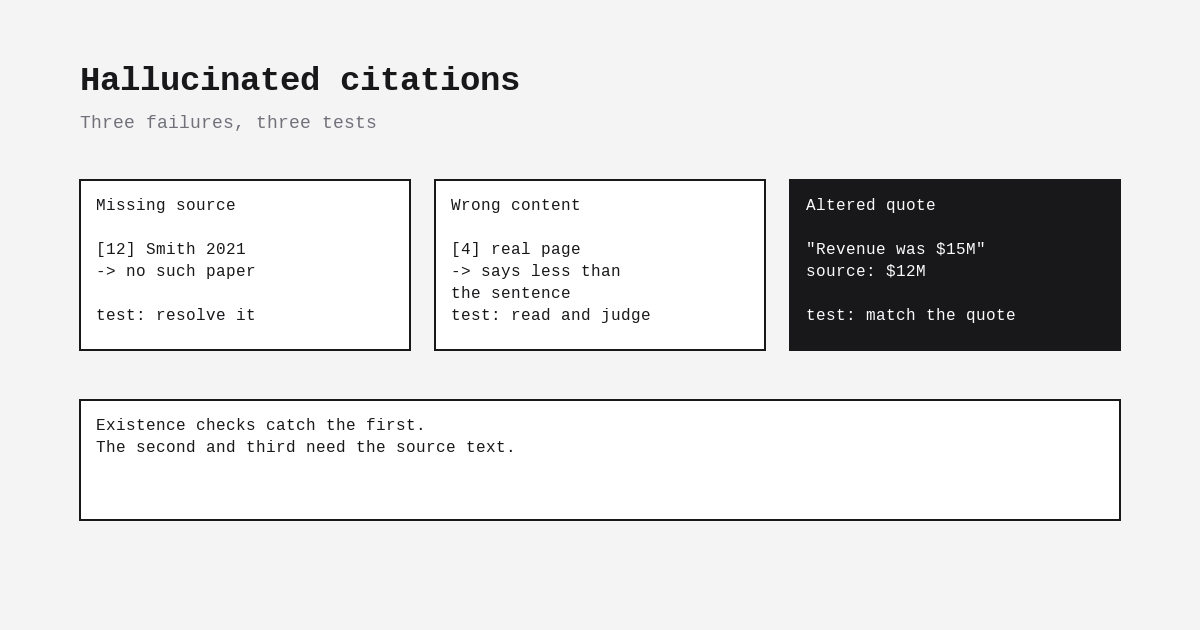
A hallucinated citation is a reference that does not hold up when you open it. It fails in one of three ways: the source does not exist, the source exists but does not say what the text claims, or the quoted words were changed. Each needs its own test. Checking that a reference exists catches only the first, and the Princeton CITP’s 2026 study found the other two are harder to catch.
What are the three ways a citation fails?
The three failures differ in what you have to read to find them. This table sets out each one and the test that catches it.
| Failure | What happened | Test that catches it |
|---|---|---|
| Missing source | The paper, case or page does not exist | Resolve the reference: DOI, case reporter, URL |
| Wrong content | The source exists but does not support the sentence | Read the source and judge whether it supports the claim |
| Altered quote | The quoted words are not in the source, or a figure was changed | Match the quote against the source text |
The first is the one people picture, and it is the easiest to test because a lookup either finds the work or it does not. The second and third need the text of the source, which is why many checkers stop at existence.
How common are fabricated references?
Fabricated references were common in early chat models and have not gone away. A study in Scientific Reports checked the references in literature reviews written by ChatGPT and found 55% of those from the earlier model were fabricated, against 18% from GPT-4.
Real references were not safe either. In the same study, about a quarter of the genuine GPT-4 references had substantive citation errors, so a reference that resolves can still point to the wrong place.
Courts see the same problem. The Princeton CITP team counted over 1,000 court filings with hallucinated citations, from lawyers and self-represented litigants alike, and found that GPT-5.1, the newest free-tier ChatGPT model they tested, hallucinated citations at a rate of 6.57% on legal drafting prompts.
Why does checking that a source exists miss so much?
An existence check answers “is there such a work?” and nothing else. A model that searches the web before answering will usually cite pages that exist, so existence checks catch less as models improve, while the second and third failures stay.
The Princeton benchmark shows the gap. Their best agent caught every non-existent case citation but only 82.6% of verbatim misquotes, according to the same CITP post. The failures that need the source text are where errors survive.
For an AI answer, the same pattern holds. A retrieval system cites a real page, but the sentence attached to it says more than the page does, or a number drifts from 12 to 15 during summarising. Only reading the page catches that.
How do you test the quote and the claim with an API?
Test the quote first, because it is cheap and exact, then test whether the source supports the sentence. Webcite’s documented batch endpoint checks whether each quote is in its source, given as text, a URL or an uploaded file.
import os
import requests

source = "The annual report states: Revenue was $12 million."
items = [
    {"id": "exact", "quote": "Revenue was $12 million.", "source_text": source},
    {"id": "altered", "quote": "Revenue was $15 million.", "source_text": source},
]
response = requests.post(
    "https://api.webcite.co/api/v1/verify/batch",
    headers={"x-api-key": os.environ["WEBCITE_API_KEY"]},
    json={"items": items},
    timeout=60,
)
response.raise_for_status()
for result in response.json():
    print(result["id"], result["binding"]["grounded"], result["verification"]["band"])
The same two quotes, checked through the hosted MCP server’s verify_batch tool on 25 November 2026, came back like this:
exact True verified
altered False unverified
The altered quote fails because the number changed, even though every other word matches. grounded says only that the words were found; it does not say the source supports the surrounding sentence. For that, send the sentence to the verify endpoint with the cited URL in source_urls, and it returns the cited source’s stance with the passage it was judged on. The guide to checking that a citation supports a claim walks through that step.
Which tools check citations without code?
The right tool depends on what you are checking. For a single quote, the free citation checker compares a quote with its source text in your browser and sends nothing. For a manuscript, the reference checker matches each citation marker to an entry in the reference list, which catches markers that point nowhere.
Legal briefs have their own tools, and the ABA Journal’s column on choosing AI citation checkers discusses how to pick one. Those check case law against legal databases; a general checker can only test what it can read, so supply the case text when you have it.
What do automated checks still miss?
Automated checks miss judgement calls. Whether a case is good law, whether a study’s method supports its conclusion and whether a quote is used out of context all need a person who knows the field. The Princeton authors also note that agents can only verify what they can access, and paywalled sources limit any checker.
So use automation to clear the mechanical failures and route the rest. Every quote that does not match and every source that does not support its sentence goes to a reviewer, with the passage beside it. That turns hours of checking into minutes of reading. For the bigger picture, see how often AI models hallucinate and source attribution in AI.
Sources
Fabricated references: Walters and Wilder, Scientific Reports, 2023. Court filings and the LePhantomCite benchmark: Liu, Stammbach and Henderson, Princeton CITP blog, 27 May 2026. Legal tools: ABA Journal. The Webcite response is a saved call to the public API.
Frequently Asked Questions
Can a reference manager catch hallucinated citations?
It catches the first kind when you import a reference and it cannot be resolved to a record. It does not read the cited work, so a real paper that does not say what the sentence claims passes.
Should I trust a citation an AI found with web search?
More than one it recalled from memory, because the page exists. You still need the second and third checks: that the page contains the quoted words and that it supports the sentence.