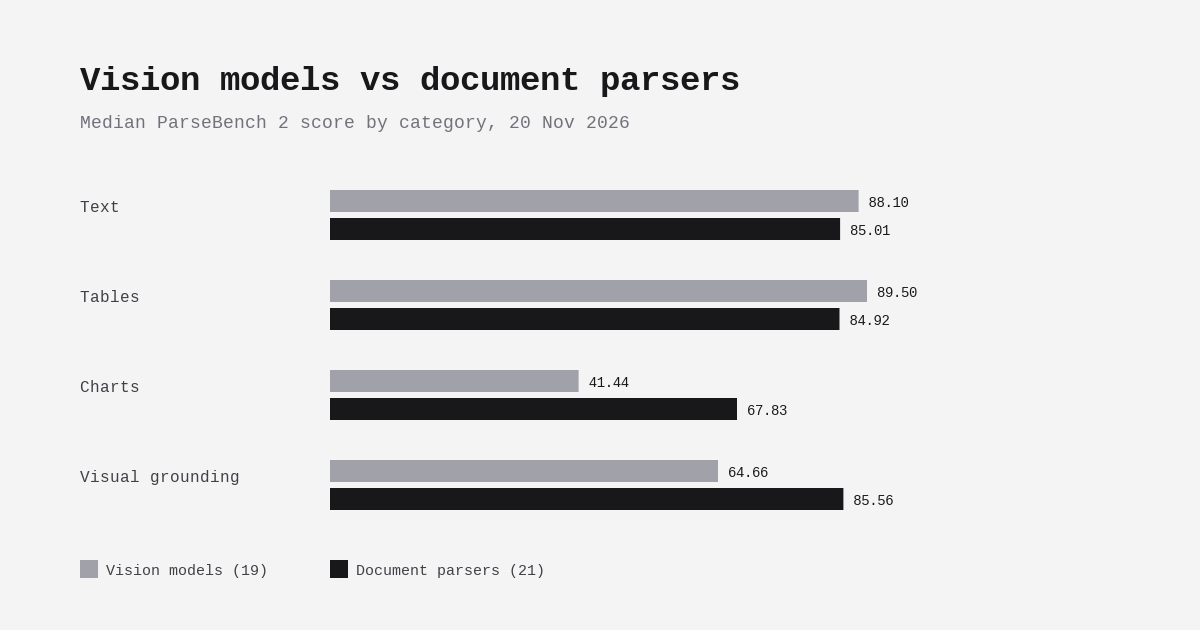
A general model such as Claude, GPT or Gemini now reads the words on a page about as well as a dedicated document parser. It still misses chart values, form fields and element positions. On ParseBench 2, the median vision model scores 41.44 on charts against 67.83 for the median parser.
Webcite wrote this comparison and makes one of the parsers in it. The scores come from the public ParseBench 2 leaderboard snapshot of 20 November 2026, listed in the sources note at the end.
Where does a general model read as well as a parser?
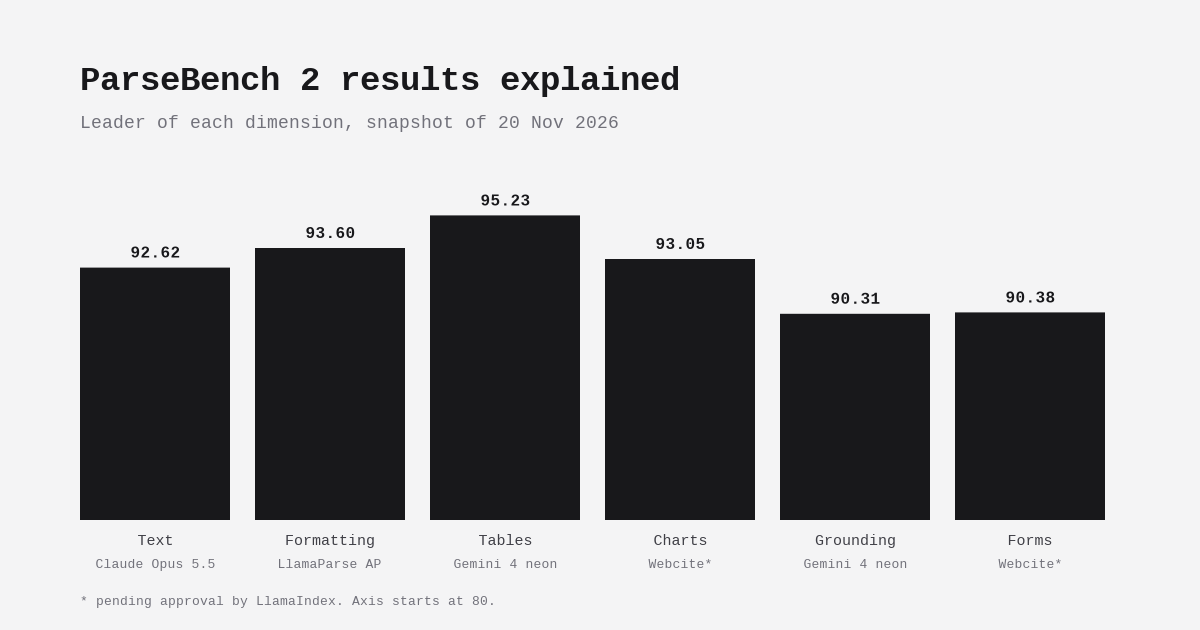
On text and tables, the gap has closed. The median vision model scores 88.10 on text against 85.01 for the median parser, and Claude Opus 5.5 has the highest text score of all 61 entries on the leaderboard.
Tables have caught up too. Gemini 4 neon (low) has the top table score, 95.23, a fraction ahead of the best parser. If your documents are contracts, papers and letters, the model you already call for chat will read them well, and adding a parser buys little.
The overall ranking hides this. Claude Opus 5.5 is fourth of 61 entries at 87.11, behind three parser rows, yet on the words alone it beats every one of them. The ParseBench 2 results explained post shows who leads each of the six dimensions.
Where does it still fall behind?
Charts, forms and positions are where general models lose, and the losses are large. Visual grounding checks that every extracted value is tied to its place on the page. There the median vision model scores 64.66 against 85.56 for parsers, according to the ParseBench 2 dataset card and the leaderboard.
A chart score measures whether the numbers behind the chart come out right. ParseBench annotates every chart with its full data table, so reading the title and axis labels earns nothing. Even the best vision model on charts, GPT-6.2 sol (medium), reaches 78.86, while two parsers score above 92.
Forms follow the pattern at a smaller margin. The best vision model on forms is GPT-6.1 terra (low) at 84.24; Webcite scores 90.38 in its own full run. Some parsers also score close to zero on charts, so judge the dimension your pages depend on rather than the category. The form extraction guide covers checkboxes and handwriting.
Why do charts and positions matter so much?
These are the pages where a wrong value turns into a wrong decision. A model that misreads a revenue bar does not say it is unsure. It writes a fluent sentence with the wrong number, and the summary, the dashboard and the answer to the next question all inherit it.
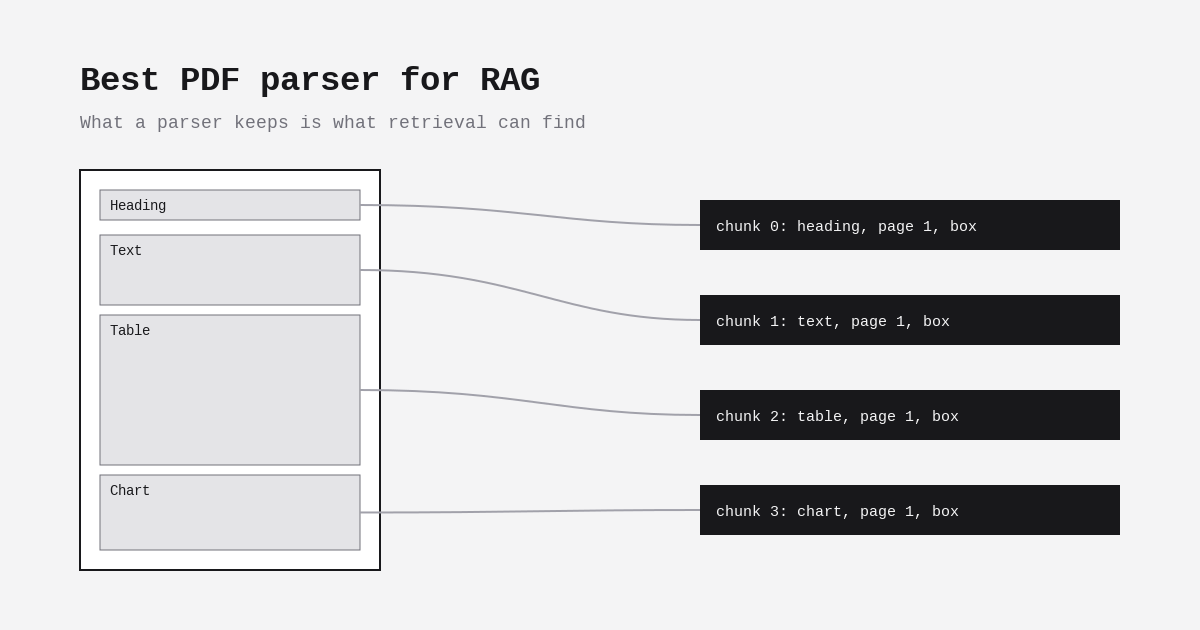
Positions matter for a different reason. Without them, nobody can click from the number in an answer to the place it came from, so every check means opening the PDF and hunting for the figure by hand. A reviewer can do that for one report. Nobody does it for every answer a product gives in a day, so errors on chart pages tend to reach users.
This is the case for treating extraction and checking as one job. An answer is only as useful as the source a reader can open and confirm, and a value without a location cannot be confirmed quickly. The guide to checking numbers in AI financial analysis shows that check on a real filing.
What does better accuracy cost?
A larger model or a higher reasoning setting helps, and most of the gain lands on charts. The price rises faster than the score.
| Entry (20 Nov 2026) | Overall | Charts | Cost per page (US cents) |
|---|---|---|---|
| Claude Opus 5.5 | 87.11 | 74.12 | 6.492 |
| Claude Sonnet 5.5 | 75.07 | 38.59 | 3.13 |
| Claude Haiku 5.5 | 71.24 | 12.13 | 0.155 |
| GPT-6.2 sol (medium) | 82.12 | 78.86 | 2.468 |
| GPT-6.2 sol (low) | 79.12 | 63.42 | 2.289 |
Text and table scores barely move between these rows; charts carry nearly all the difference. If you test a model yourself, record the version and setting with every result.
At high accuracy the parsers cost less than the models that come closest to them. Claude Opus 5.5 is the most expensive entry on the leaderboard at 6.492 cents a page, against 2.813 cents for LlamaParse Agentic Plus, which scores higher.
| Entry (20 Nov 2026) | Category | Overall | Cost per page (US cents) |
|---|---|---|---|
| Gemini 3 Flash (minimal) | Vision model | 77.73 | 0.885 |
| GPT-6 luna (low) | Vision model | 74.59 | 0.127 |
| LlamaParse (Cost Effective) | Document parser | 85.52 | 0.375 |
| LlamaParse (Agentic Plus) | Document parser | 90.93 | 2.813 |
| Webcite (Lite), the author’s product | Document parser | 88.75 | 0.2 to 0.9 (list price) |
Cheap models are cheap, but no vision model under one cent a page scores above 77.73 overall. Your own cost depends on your contract and on how many tokens each page takes; the PDF to Markdown API pricing comparison sets vendor list prices beside these figures.
How should you choose?
Call a model directly when your pages are mostly running text, you already pay for that model, and nobody needs to trace a value back to the page. Use a parser when your documents carry charts, forms or dense tables, or when your product must show where each number came from.
The test takes an afternoon. Take 50 to 100 of your own pages, weighted to the kinds you see most. Run them through your current model and through one or two parsers that lead the dimensions you care about. Check chart values, form fields and table cells against the page by hand, then compare the cost per page at the accuracy you need. The ParseBench reproduction guide shows how to run the public set against an API.
Whichever reads the page, check what is built on it. With Webcite, the same key that runs extraction can verify a claim and return the sources that support or contradict it. The chart extraction comparison looks at chart pages in more detail. What a document parser returns is shown on Webcite’s document parsing API page.
Sources and method
Scores and costs: ParseBench 2 leaderboard at commit 1908f9a, snapshot of 20 November 2026, with Webcite’s two rows from its own full run in pull request 309 and its outputs published on Hugging Face. Medians are across the 19 vision models and the 21 document parsers on that leaderboard. Current scores are on the Webcite benchmarks page.
Frequently Asked Questions
Can an LLM replace a document parser?
For running text and plain tables, often yes: the median vision model on ParseBench 2 scores higher than the median parser on both. For charts, forms and element positions, not yet, and those are the pages where a wrong value is expensive.
Which LLM is best at parsing PDFs?
Claude Opus 5.5 has the highest overall score of the 19 vision models on ParseBench 2, at 87.11 in the 20 November 2026 snapshot. It is also the most expensive entry listed, at 6.492 cents a page.
Is it cheaper to parse PDFs with an LLM?
Only at low accuracy. No vision model under one cent a page scores above 77.73 overall, while LlamaParse Cost Effective scores 85.52 for less than half a cent.