The best PDF parser for RAG is the one that keeps what your pages hold: table headers, chart values, reading order and where each passage sits. Retrieval can only find what the parser kept. On ParseBench 2, Webcite scores 91.74 in its own full run and LlamaParse Agentic Plus 90.93, as of 20 November 2026.
Webcite wrote this guide and makes one of the parsers in it. Scores, costs and licences come from the sources in the note at the end.
What does a parser have to keep for RAG to work?
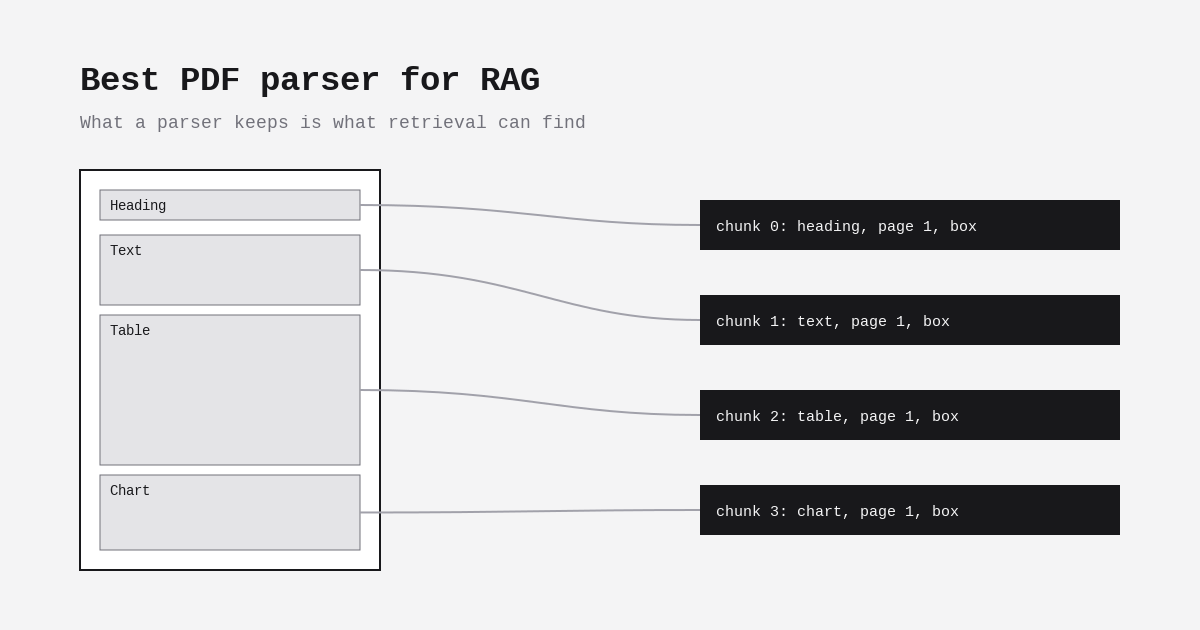
A RAG answer is assembled from chunks, and every chunk is only as good as the parse it came from. If the parser drops a header row, a figure lands under the wrong column and retrieval returns it for the wrong question. If a chart comes back as an image or a caption, its numbers never reach the index at all.
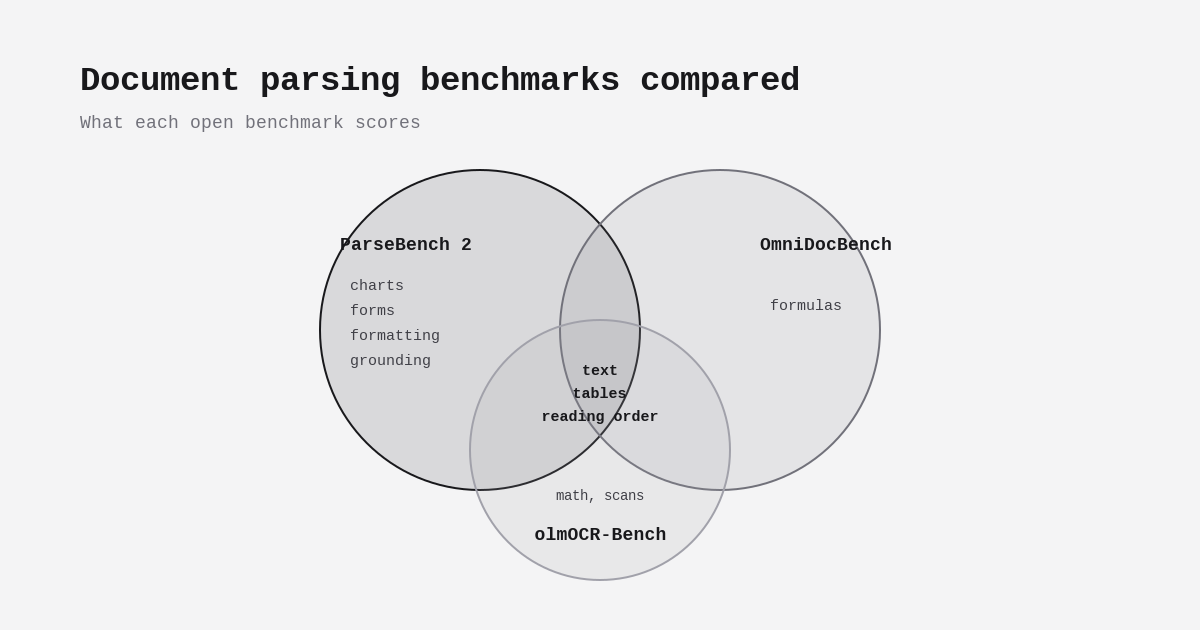
Order and location matter as much as content. Text read out of order splits a sentence across two chunks, so neither half matches the query. A chunk without its page cannot be cited, and an answer that cannot be cited has to be taken on trust. ParseBench 2 scores text, tables, charts and the location of each element, according to its dataset card.
It does not score chunking. Chunks that keep their page and section carry a citation into the answer; chunks that lose them do not. Webcite’s anchored chunks endpoint returns each chunk with its page, sheet or nearest heading for that reason.
Which parser fits your pages and budget?
Start from the constraint you cannot move, then test the two or three options in that row on your own pages. Options are listed alphabetically.
| Your need | Options (ParseBench 2 overall) | Cost per page (US cents) |
|---|---|---|
| Free, local, with a public score | Chandra 2 (77.54), KDL-Frontier-Parser-nano-v2 (80.13), MinerU2.5-Pro (76.86) | Your hardware |
| Free, local, widely used | Docling, MarkItDown, Unstructured (score them on your own pages) | Your hardware |
| Hosted, highest scores | LlamaParse Agentic Plus (90.93), Webcite (91.74), the author’s product | 2.813, about 3 (list price) |
| Hosted, under one cent | LlamaParse Cost Effective (85.52), Webcite Lite (88.75), the author’s product | 0.375, 0.2 to 0.9 (list price) |
| Lowest price | Reducto r-1-mini (72.55) | 0.10 |
| Inside a data platform you use | Azure Document Intelligence layout (66.81), Databricks AI Parse (77.75) | 1.00, 0.438 |
Source: ParseBench 2 leaderboard, 20 November 2026; costs as listed there, and your contract price can differ.
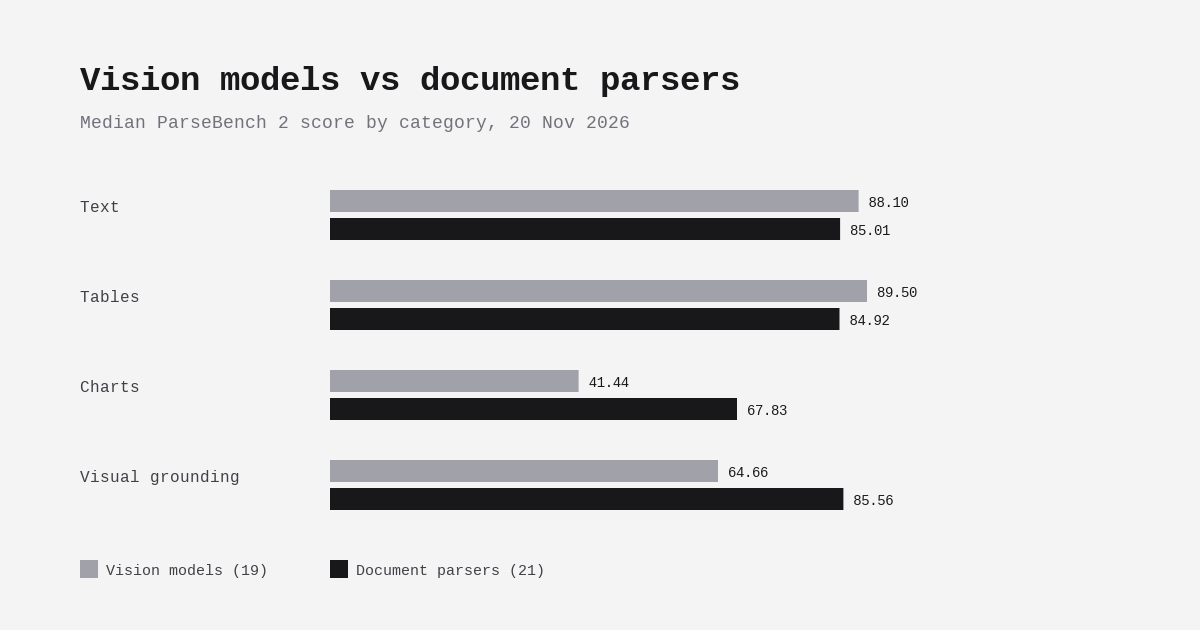
The cheapest row is cheap for a reason. Reducto r-1-mini scores 1.35 on charts, so a pipeline over financial reports would index almost none of their chart values. A general model is another route: Claude Opus 5.5 scores 87.11 but is the most expensive entry listed, and Claude, GPT and Gemini against document parsers shows where models still fall behind.
How do the hosted parsers differ?
The leading hosted parsers are close overall and far apart on the dimensions that decide what a RAG index holds. Charts separate them most.
| Parser (mode) | Overall | Tables | Charts | Visual grounding | Cost per page (US cents) |
|---|---|---|---|---|---|
| Datalab (Accurate) | 82.63 | 90.38 | 67.83 | 73.32 | 1.00 |
| Extend (Parse 2) | 84.14 | 84.20 | 85.08 | 85.47 | 2.501 |
| LlamaParse (Agentic Plus) | 90.93 | 94.72 | 92.58 | 88.23 | 2.813 |
| Reducto (r-1) | 86.23 | 90.97 | 78.45 | 89.48 | 1.00 |
| Webcite, the author’s product | 91.74 | 95.21 | 93.05 | 87.69 | about 3 (list price) |
Source: ParseBench 2 leaderboard, 20 November 2026.
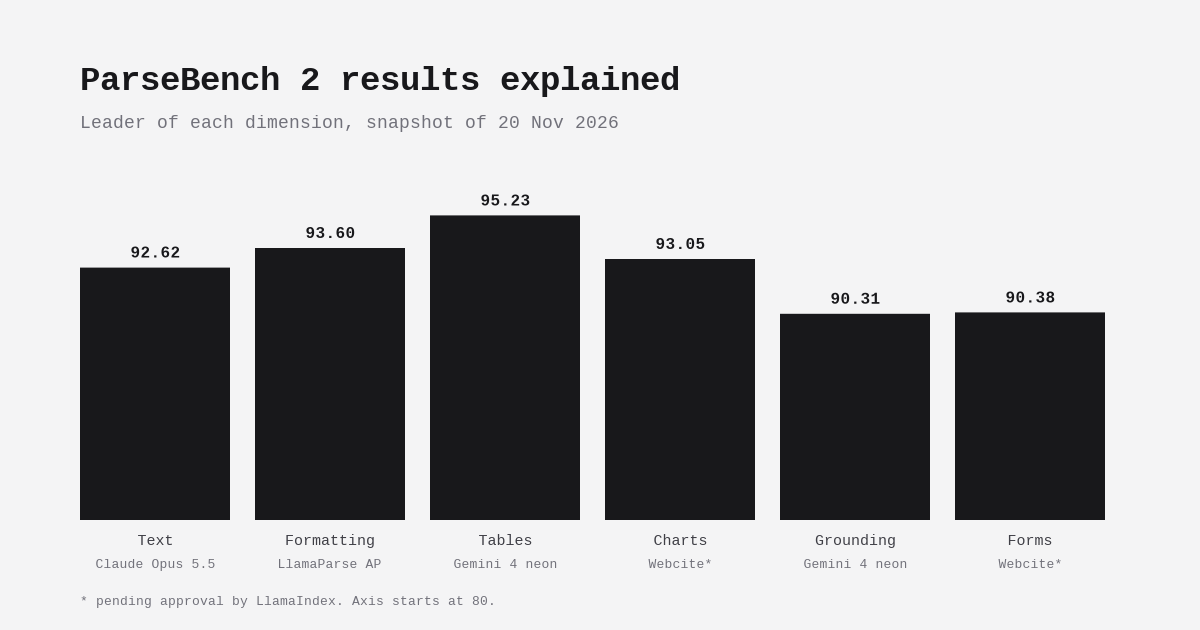
Mode matters as much as vendor. Mistral OCR 4.1 scores 1.22 on charts in its default mode and 29.83 with annotation turned on, so the same vendor can index a chart or lose it. Check which mode a score was measured in before you compare it with your own setup. The best document parsing APIs guide covers every hosted row, and ParseBench 2 results explained shows who leads each dimension.
What about open-source parsers?
Open-source parsers cost nothing per page and keep documents on your own machines. The most popular ones have no ParseBench 2 score yet, so you score them yourself. Star counts are from the GitHub API on 25 November 2026.
| Project | What its README says it does | Licence (from the repository) | Stars |
|---|---|---|---|
| Docling | Parses many formats, PDFs included, with integrations for generative AI tools | MIT for the code; models carry their own licences | 70,992 |
| Marker | “Converts documents to markdown, JSON, chunks, and HTML” | Apache 2.0 code; weights free for research, personal use and startups under $5M funding or revenue | 41,062 |
| MarkItDown | “Converting various files to Markdown for use with LLMs” | MIT | 198,292 |
| MinerU | “A command-line document reader for agents” | MinerU Open Source License, based on Apache 2.0 with extra conditions | 84,292 |
| Unstructured | Components “for ingesting and pre-processing images and text documents” | Apache 2.0 | 15,778 |
Check the licence before you ship. MinerU’s LICENSE file allows commercial use but requires a separate commercial licence above 100 million monthly active users or USD 20 million monthly revenue. The Marker README says its model weights are free only for research, personal use and startups under $5M in funding or revenue.
The version 1 leaderboard scored Docling and MarkItDown, and its scores do not carry over to version 2. Running an open weight model yourself also needs a GPU and a serving setup, a cost the leaderboard does not list. For a direct comparison with Docling, see Webcite vs Docling: local parsing or an evidence API.
How do you test a parser on your own pages?
Test 50 to 100 of your own pages before you commit, weighted to the page types you index most. ParseBench runs a supported parser on a folder of your PDFs with uv run parse-bench run <pipeline_name> --input_dir ./my_docs, according to its README; the guide to benchmarking a document parser walks through scoring.
To see what a parser hands your index, read one page and look at the elements. This script sends a public table from the U.S. Bureau of Labor Statistics to Webcite’s documented extract endpoint. It prints each element with its page and box.
import os
import requests

API = "https://api.webcite.co/api/v1"
HEADERS = {"x-api-key": os.environ["WEBCITE_API_KEY"]}
PDF = "https://webcite.co/samples/bls-employment-situation-2026-10-summary-table-a.pdf"

response = requests.post(
    f"{API}/extract",
    headers=HEADERS,
    json={"asset_url": PDF, "mode": "standard"},
    timeout=(10, 900),
)
response.raise_for_status()
document = response.json()

print(document["state"], document["usage"]["credits"])
for unit in document["units"]:
    for element in unit["elements"]:
        box = [round(value, 3) for value in element["bbox"]]
        print(unit["provenance"]["page"], element["type"], box)
The saved response for this page, recorded on 24 November 2026, prints:
complete 0.3981
1 page_header [0.063, 0.044, 0.217, 0.055]
1 title [0.062, 0.058, 0.496, 0.071]
1 text [0.07, 0.072, 0.227, 0.084]
1 table [0.058, 0.072, 0.94, 0.749]
1 footnote [0.059, 0.737, 0.43, 0.749]
1 text [0.058, 0.751, 0.923, 0.782]
The table element holds the whole table as HTML with both header rows, and its box lets you highlight it on the page. The full saved response is at https://webcite.co/samples/doc-bls-table.json.
Parsing is half the job. A perfect parse can still feed a wrong sentence into an answer, so check answers against the page before you show them. The same key can verify a claim, and the guide to checking that a citation supports a claim shows that step.
Sources and method
Scores and costs: ParseBench 2 leaderboard at commit 1908f9a, snapshot of 20 November 2026. Webcite’s rows are from its own full run, proposed in pull request 309, with outputs on Hugging Face. Licences, descriptions and star counts come from each project’s repository, checked 25 November 2026.
Frequently Asked Questions
What is the best PDF parser for RAG?
The one that keeps what your pages hold. For mixed reports with tables and charts, the top hosted parsers on ParseBench 2 are Webcite, at 91.74 in its own full run, and LlamaParse Agentic Plus at 90.93.
What is the cheapest PDF parser for RAG?
Reducto r-1-mini is the cheapest entry on the ParseBench 2 leaderboard at 0.10 cents a page, for an overall score of 72.55. Spending a few tenths of a cent more buys much higher accuracy.
What is the best open-source PDF parser for RAG?
Of the open weight models with a ParseBench 2 score, KDL-Frontier-Parser-nano-v2 is highest at 80.13. Docling, MarkItDown and Unstructured have no version 2 score, so run them on a sample of your own pages.