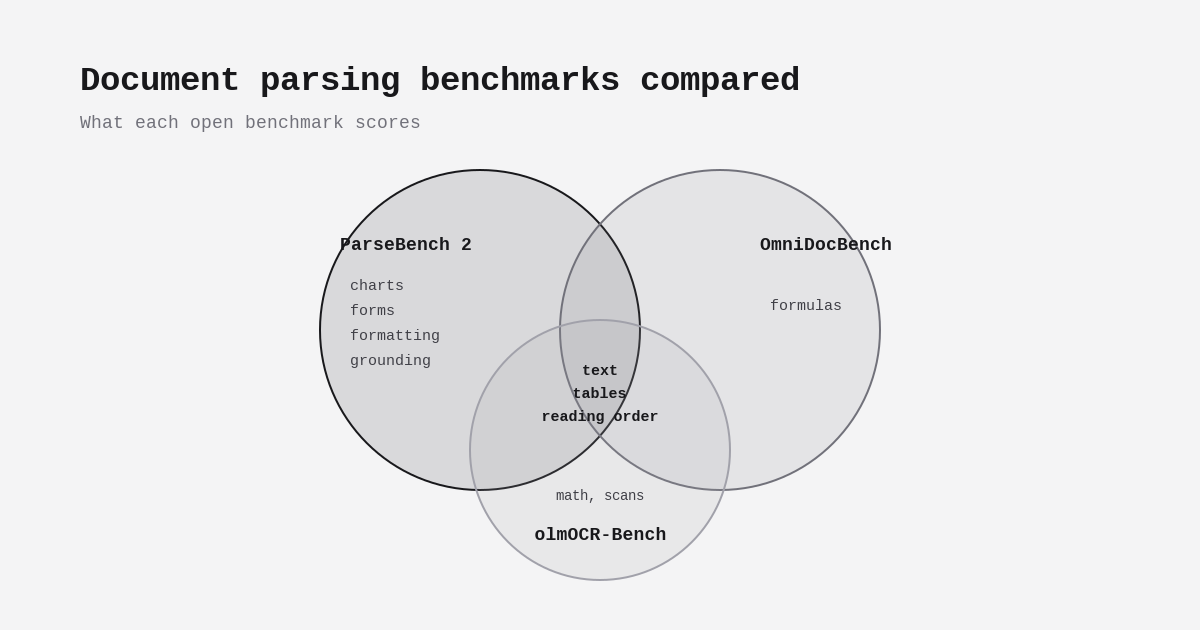
Document parsing benchmarks disagree because they score different pages. Of ParseBench 2, OmniDocBench and olmOCR-Bench, only ParseBench 2 scores charts and forms, OmniDocBench gives formulas a third of its overall score, and almost half of olmOCR-Bench’s tests are math. TeleOCR is second on OmniDocBench yet scores 14.50 on ParseBench 2 charts. Pick the benchmark whose pages look like yours, then test your own.
Webcite wrote this comparison and has a row on ParseBench 2; it has not submitted results to the other two.
How do the three document parsing benchmarks differ?
The three benchmarks differ in what they score, how they score it and who may use the data. Each is a fixed set of pages with reference answers, and each maintainer also has its own parser on its own leaderboard: LlamaParse on ParseBench 2, MinerU on OmniDocBench and olmOCR on olmOCR-Bench. Check a maintainer’s parser on a second benchmark before relying on its rank.
| ParseBench 2 | OmniDocBench | olmOCR-Bench | |
|---|---|---|---|
| Maintainer | LlamaIndex (run-llama) | OpenDataLab | Allen Institute for AI |
| Size | 4,317 pages from 2,645 documents | 1,651 PDF pages, per the README | 1,403 PDFs, 7,010 tests |
| What it scores | Text, formatting, tables, charts, visual grounding, forms | Text, tables, formulas, reading order | Text presence and absence, reading order, tables, math |
| How it scores | Severity-capped page scores, unweighted mean of six | Edit distance, TEDS for tables, CDM for formulas | Share of pass or fail unit tests |
| Data licence | Apache 2.0 | Research only, not commercial | ODC-BY-1.0 |
| Best for | Business documents with charts and forms | Academic, textbook and formula-heavy pages | Scans, math and layouts with several columns |
Source: each benchmark’s own documentation, from the ParseBench 2 dataset card to the olmOCR-Bench dataset card; all are listed in the sources note.
What does each benchmark reward?
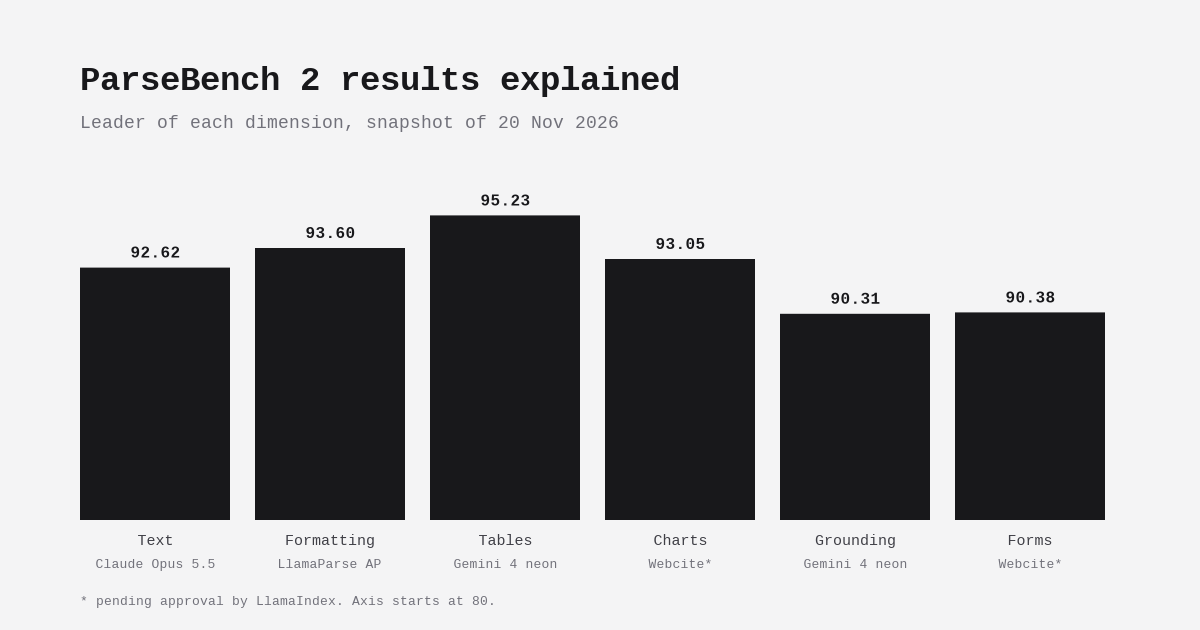
ParseBench 2 rewards getting every value on a business page right. A page score is capped by the severity of its worst error, so one flipped negation or misread digit caps the page, according to the ParseBench README. Charts are scored against full data tables, and forms on real government and fillable form pages. The ParseBench 2 results explained post covers each dimension and its leader.
OmniDocBench rewards clean transcription of text, tables and formulas across 10 document types, “including academic papers, financial reports, newspapers, textbooks, and handwritten notes”, per its README. Its overall score averages text edit distance, table TEDS and formula CDM, so formulas carry a third of the headline number. Reading order is reported but left out of it.
olmOCR-Bench rewards keeping specific facts intact. “All facts checked about documents are either pass/fail”, and the authors “stay away from soft metrics like edit distance comparisons”, according to the olmOCR-Bench README. Math tests are almost half the total, so math-heavy pages weigh heavily in the result.
Why do the leaderboards disagree?
The leaderboards disagree because each leaves out content the others score, and they were updated on different dates. Different systems lead each one.
| Benchmark (snapshot) | First | Second | Third |
|---|---|---|---|
| ParseBench 2 (20 Nov 2026) | Webcite, 91.74, the author’s product | LlamaParse (Agentic Plus), 90.93 | Webcite (Lite), 88.75 |
| OmniDocBench (v1.6_full table) | OXR-1.0, 97.03 | TeleOCR, 96.91 | OvisOCR3, 96.69 |
| olmOCR-Bench (README table) | Chandra OCR 0.1.0, 83.1 | Infinity-Parser 7B, 82.5 | olmOCR v0.4.0, 82.4 |
Source: the ParseBench 2 leaderboard and the leaderboard tables in the OmniDocBench and olmOCR READMEs, read 25 November 2026. Webcite’s ParseBench 2 rows are its own full run.
The clearest evidence is the four entries listed under the same name on both OmniDocBench and ParseBench 2. All four score near 90 or above on the first and land between 27th and 52nd of 61 on the second.
| Entry | OmniDocBench overall | ParseBench 2 overall | ParseBench 2 charts |
|---|---|---|---|
| HunyuanOCR | 89.95 | 68.06 | 58.69 |
| MinerU2.5-Pro | 95.75 | 76.86 | 63.96 |
| PaddleOCR-VL 1.6 | 96.34 | 71.49 | 57.45 |
| TeleOCR | 96.91 | 65.85 | 14.50 |
Source: OmniDocBench README and ParseBench 2 leaderboard, 20 November 2026.
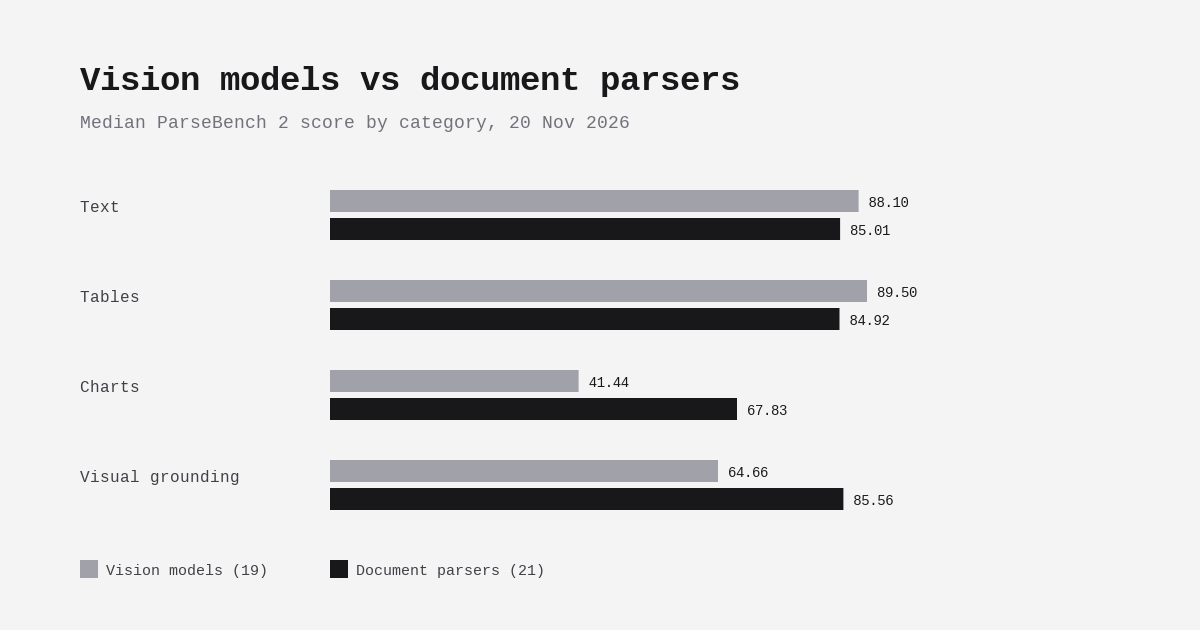
The scales differ, so compare ranks rather than raw numbers. A model trained to transcribe academic pages and formulas does well where those are the test, and loses points on charts and forms where they are. A team that picked TeleOCR from the OmniDocBench table for investor decks would get a parser that scores 14.50 on ParseBench 2 charts, and would only find the bad values by checking pages by hand.
Which benchmark fits your documents?
Match the benchmark to the pages you process. ParseBench 2 suits invoices, filings, insurance documents, forms and reports with charts. OmniDocBench suits academic papers, textbooks and anything with formulas. olmOCR-Bench suits old scans, math and multi-column pages, and its leaderboard reports those sources separately.
Check data licences before you build a commercial evaluation pipeline. The OmniDocBench README says its dataset is “for research purposes only and not for commercial use”, and olmOCR-Bench is licensed under ODC-BY-1.0 for research and educational use under Ai2’s guidelines.
Use public scores to build a shortlist and your own pages to decide. A parser near the top of the benchmark that matches your documents, and close behind on the others, is safer than one that leads a single board. Then run two or three candidates on 50 to 100 of your own pages; Webcite’s reproduction guide shows a full ParseBench 2 run against a live API with your own key. Record the benchmark version and snapshot date with every score, since all three changed in 2026.
None of the three checks whether a parsed document’s claims are true, so a wrong number in the source still reaches the answer. For business documents, the best document parsing APIs guide ranks options by budget, and Claude, GPT and Gemini against document parsers covers general models. The form extraction guide covers the dimension only ParseBench 2 scores. The Webcite benchmarks page lists every ParseBench 2 entry.
Sources and method
Each benchmark’s description comes from its own documentation, read 25 November 2026: the ParseBench README and dataset card, the OmniDocBench README, and the olmOCR-Bench dataset card and README. ParseBench 2 scores are from leaderboard-v2.csv at commit 1908f9a, snapshot of 20 November 2026. Webcite’s two rows are its own full run, proposed in pull request 309, with outputs on Hugging Face. The OmniDocBench table was last updated 23 November 2026; its caption reads v1.6_full while the changelog records version 1.7 on 30 April 2026. The olmOCR-Bench table carries no date; the nearest dated entry is the v0.4.0 release of 21 October 2025.
Frequently Asked Questions
What is the best benchmark for document parsing?
The one whose pages look like yours. ParseBench 2 suits business documents with charts and forms, OmniDocBench suits academic and formula-heavy pages, and olmOCR-Bench suits scans, math and multi-column layouts. None replaces a test on your own sample.
Why does a model rank high on OmniDocBench and low on ParseBench 2?
Because it was never tested on what ParseBench 2 adds. OmniDocBench has no chart, form or element position test, so a model tuned to transcribe papers and formulas can top it and still lose heavily on charts in ParseBench 2.
Can I use these benchmark datasets commercially?
Check each licence before building a pipeline on one. ParseBench data is Apache 2.0, OmniDocBench is for research only and not commercial use, and olmOCR-Bench uses ODC-BY-1.0 for research and educational use under Ai2’s guidelines.