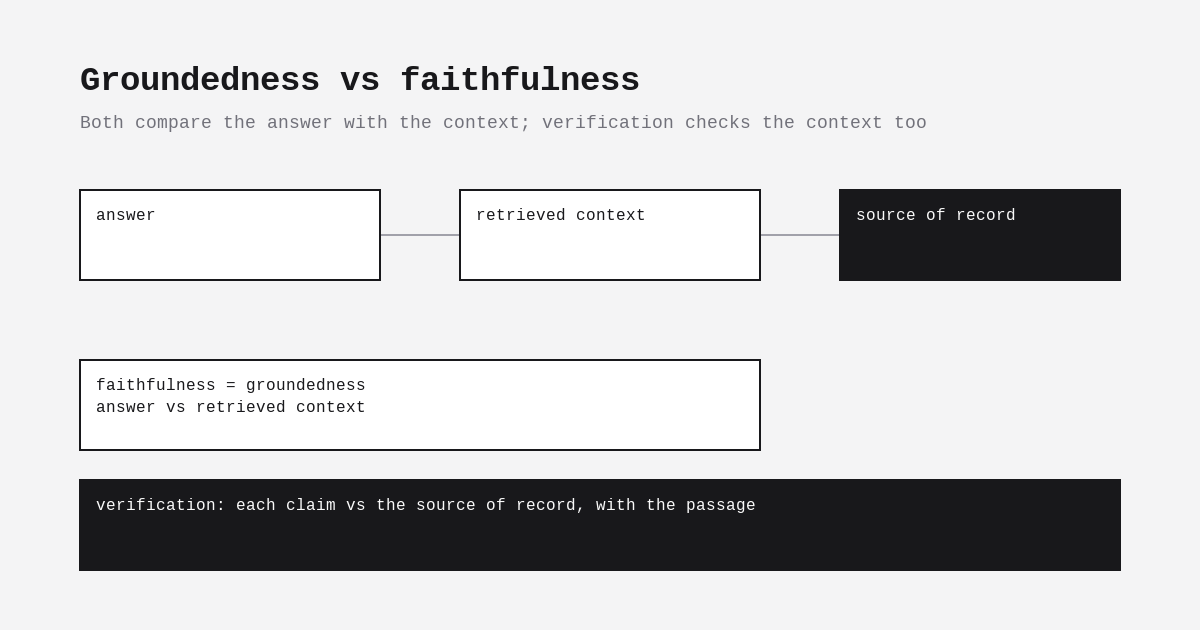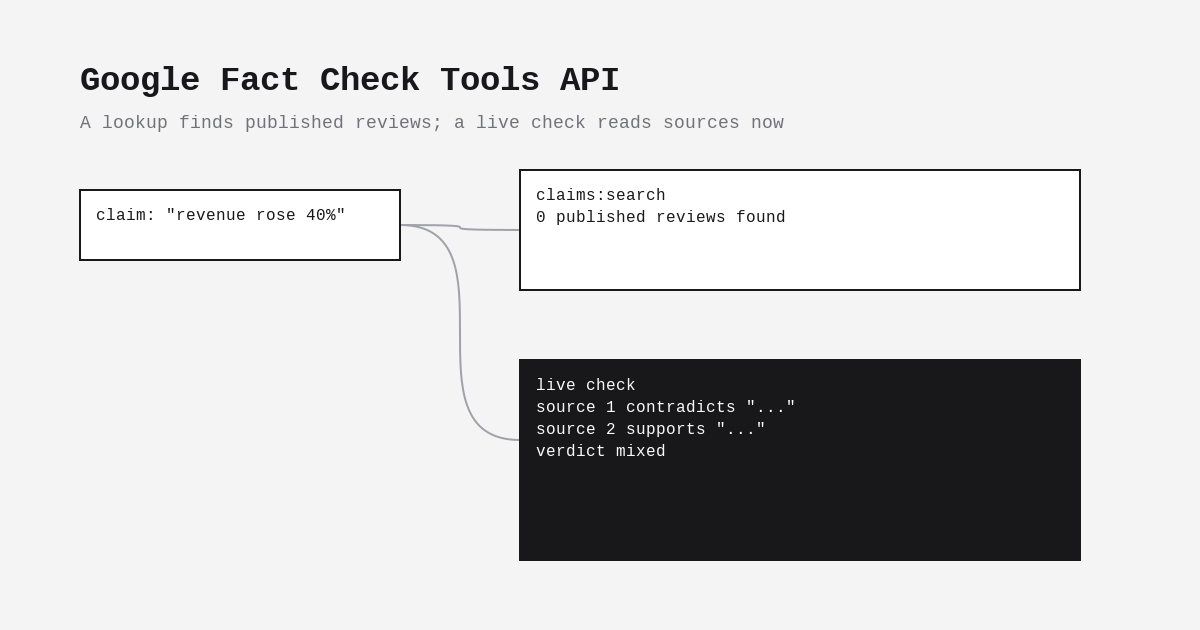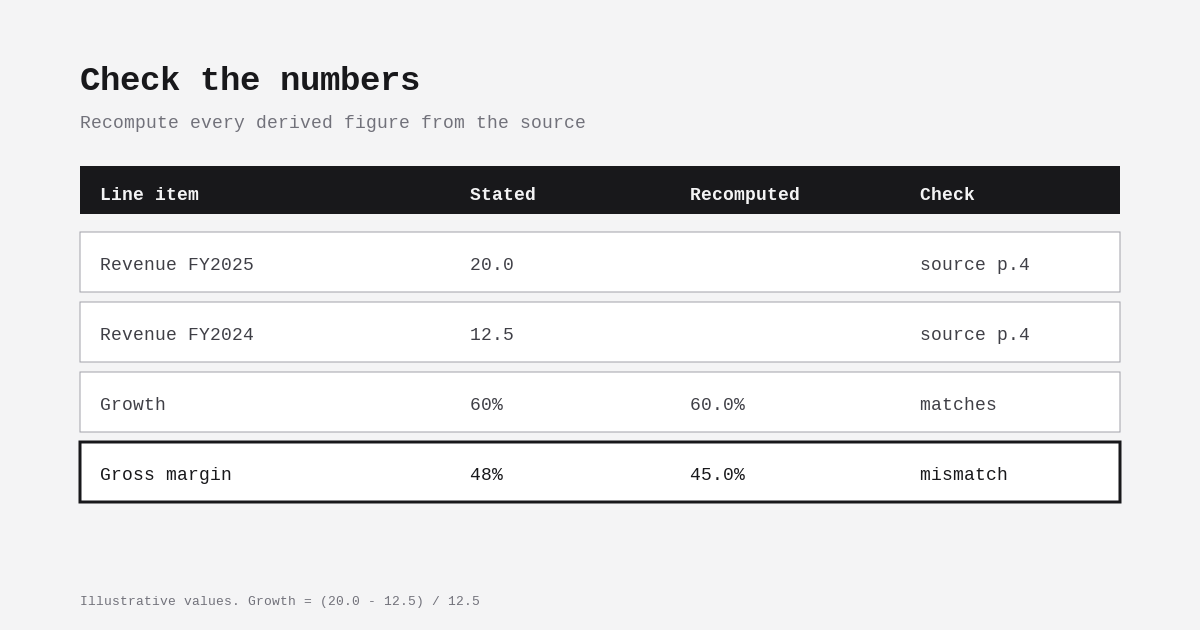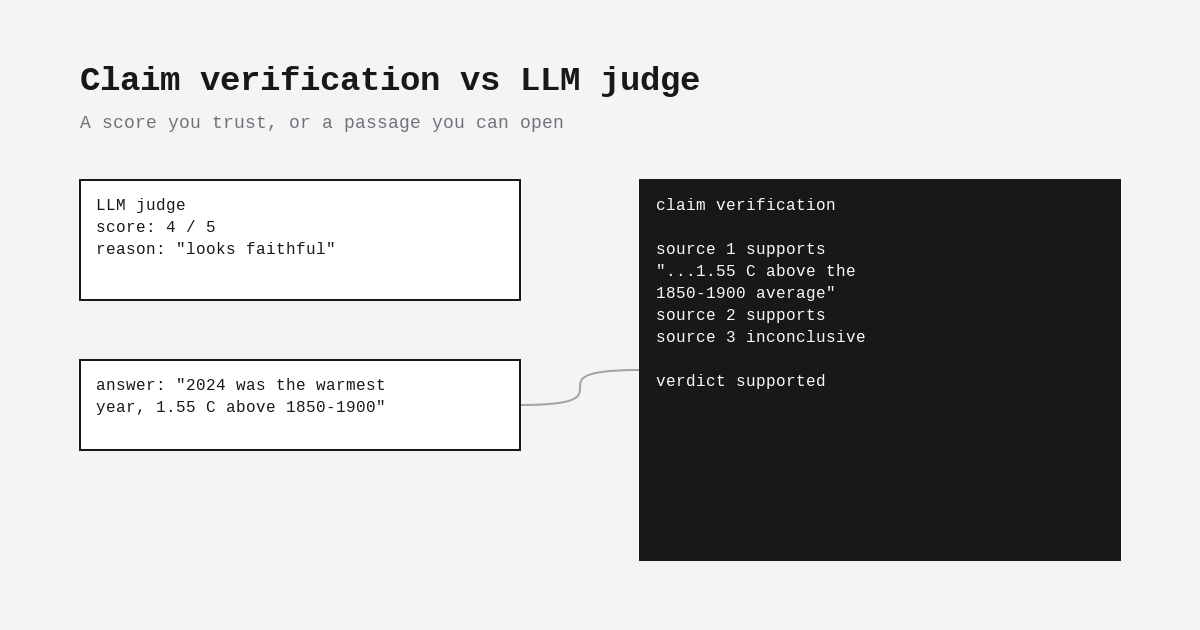
LLM-as-a-judge means asking a language model to grade another model’s answer, usually with a score and a short reason. Claim verification checks each factual statement in the answer against sources and returns the passage that supports or contradicts it. A judge tells you how good an answer looks. Verification shows you where each claim came from, which is what you need when a wrong fact has a cost.
What does an LLM judge measure?
An LLM judge measures agreement with a rubric, as read by another model. The method is well studied: Zheng and colleagues found that strong judges such as GPT-4 reach over 80% agreement with human preferences, about the level humans reach with each other.
The same paper names the weak points. Judges show position, verbosity and self-enhancement biases, and limited reasoning on some questions. Those matter less for “which answer reads better” than for “is this number right”, because a judge without sources has only its own memory to check the number against.
A judge’s output is a score and a sentence of reasoning. If the judge says an answer is faithful, there is nothing for a reader to open. You either trust the score or you re-check the answer yourself.
What does claim verification measure?
Claim verification measures support. It splits an answer into individual claims, finds sources for each and records what each source says about it. The idea has a research lineage: FActScore breaks a generation into atomic facts and scores the share a reliable knowledge source supports, and found ChatGPT reached only 58% on people biographies.
The output is evidence rather than an opinion. For each claim you get the sources, the passage each was judged on, a stance for each source and a verdict. A reviewer can click through and check the sentence in seconds, and a disputed result can be traced to the exact page that caused it.
How do the two compare?
The two answer different questions, so they fail in different ways. This table sets them side by side.
| LLM-as-a-judge | Claim verification | |
|---|---|---|
| Question it answers | How good is this answer, by this rubric? | Is each claim supported, and by what? |
| What it reads | The answer, and the context you pass in | Each claim, plus sources it finds or you supply |
| Output | Score and a short reason | Sources, quoted passages, stance per source, verdict |
| Can a reader check it? | Only by redoing the work | Yes, by opening the quoted source |
| Best at | Tone, helpfulness, format, regressions across prompts | Facts, figures, dates, names, quotes |
| Typical failure | Confident score on a wrong fact | No good source found, so no clear verdict |
The last row is the important one. A judge rarely says “I don’t know”, so its errors look like normal scores. Verification fails visibly: when it cannot find support, it says so, and you can route that claim to a person.
What does a verification result look like?
A verification result is a list of sources with the passage each was judged on. This request sends one claim to Webcite’s documented verify endpoint with stance and verdict on by default.
import os
import requests

claim = ("The World Meteorological Organization reported that 2024 was the warmest year "
         "on record, about 1.55 °C above the 1850-1900 average.")
response = requests.post(
    "https://api.webcite.co/api/v1/verify",
    headers={"x-api-key": os.environ["WEBCITE_API_KEY"]},
    json={"claim": claim},
    timeout=(10, 300),
)
response.raise_for_status()
group = response.json()["claim_groups"][0]

print(group["verdict"]["result"])
for citation in group["citations"][:2]:
    print(citation["stance"], citation["url"])
    print("  ", citation["passage"]["text"][:110])
The saved response, recorded on 24 November 2026, prints:
supported
supports https://news.un.org/en/story/2025/01/1158891
   UN weather experts from the World Meteorological Organization (WMO) confirmed on Friday that 2024 was the hott
supports https://wmo.int/news/media-centre/wmo-confirms-2024-warmest-year-record-about-155degc-above-pre-industrial-level
   The global average surface temperature was 1.55 °C (with a margin of uncertainty of ± 0.13 °C) above the 1850-
Four of the six sources supported the claim and two were inconclusive. The second passage is the WMO’s own announcement, so a reader can see the figure in the primary source rather than take a score on trust. The full response is at https://webcite.co/samples/claim-wmo-2024.json.
When should you use each?
Use a judge where the question is quality and a person would accept a grade. Ranking prompt variants, catching regressions in a test suite and scoring tone or format across thousands of outputs are all judge work, and the agreement figures above suggest it does them well.
Use verification where the answer states facts someone will act on. A figure in a financial summary, a date in a support reply or a claim in a published article should arrive with its source, because the reader needs to check it and you need to show where it came from if it is challenged.
Most production systems do both. The judge runs on every response in evaluation and the verifier runs on the factual sentences a user sees. The guide to testing agent output shows how to wire checks into a test suite, and hallucination detection tools compared covers the scoring libraries.
How do you start?
Start by verifying the claims a user will rely on and leave the rest to the judge. The fact-check API takes one claim per call or many in a batch, and a full check with sources, stance and verdict costs 4 credits. The Free plan’s 100 credits cover 25 full checks on your own answers; pricing lists the paid plans. For what a verdict does and does not mean, read what a claim verification API is.
Sources
LLM judges: Zheng et al., Judging LLM-as-a-Judge with MT-Bench and Chatbot Arena. Atomic fact scoring: Min et al., FActScore. The Webcite response is a saved call to the public API.
Frequently Asked Questions
Can I use an LLM judge to check facts?
For a rough signal in testing, yes. A judge that sees no sources is checking the answer against its own memory, so its factual calls carry the same risk as the model that wrote the answer.
Which is cheaper per answer?
A judge call is usually cheaper, since it is one model call per answer. Verification costs more per claim but is spent only on the sentences a user will rely on, so you can limit it to that share of output.