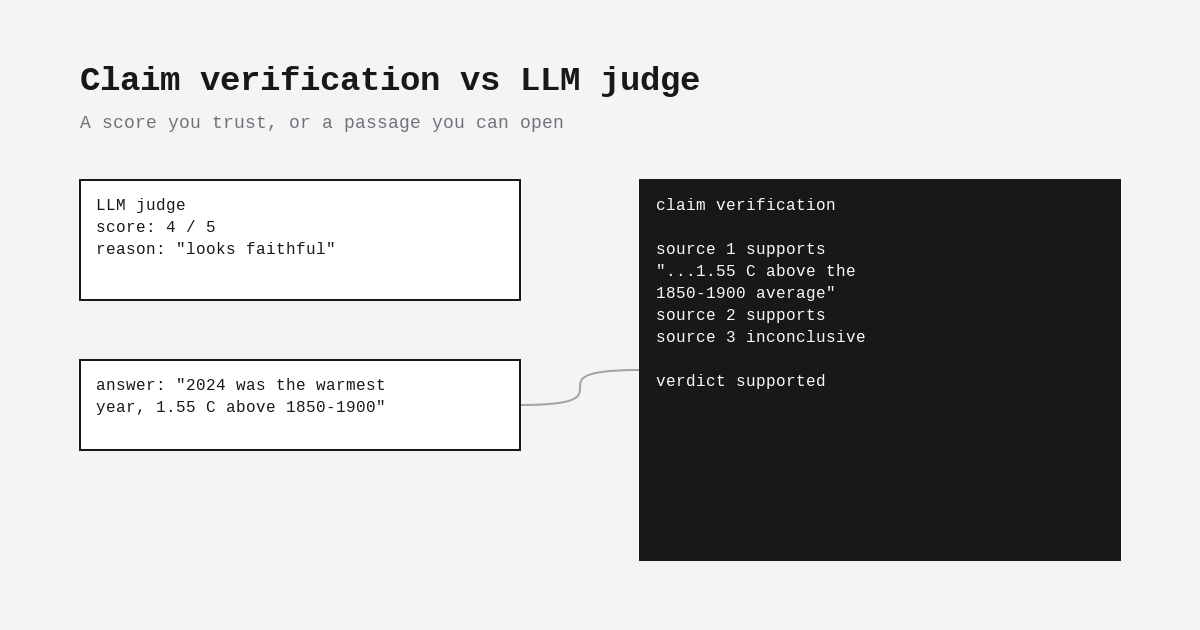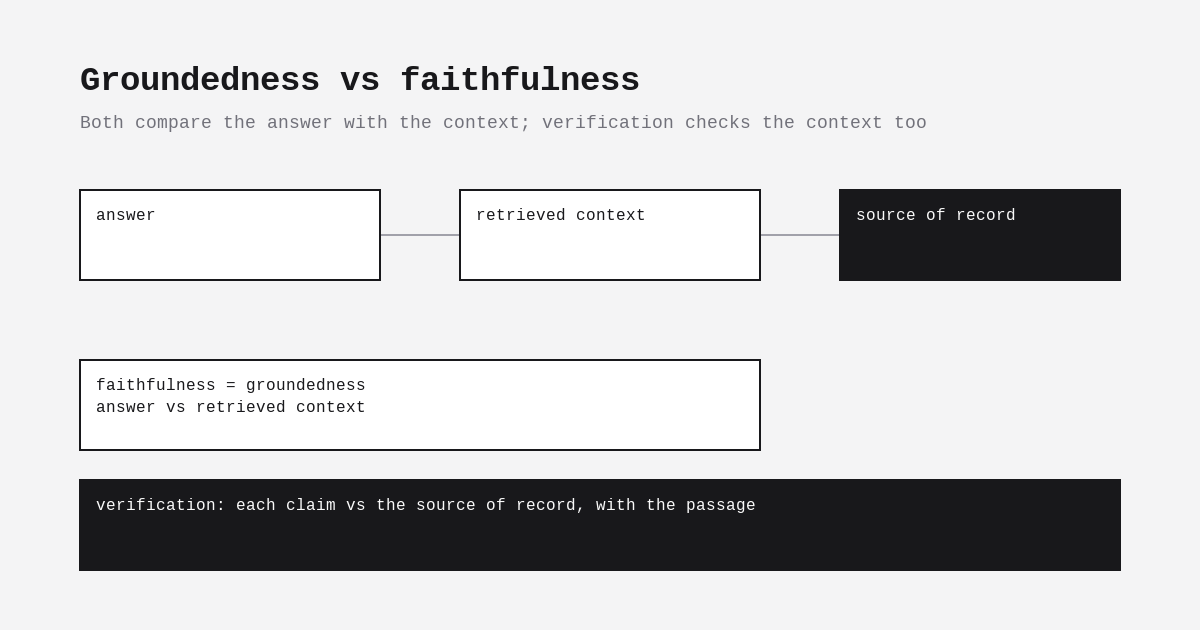
Groundedness and faithfulness are two names for one test: does a RAG answer agree with the context you retrieved? Ragas calls it faithfulness and scores it from 0 to 1; TruLens calls it groundedness. Neither checks whether the context itself was right, and neither gives a reader anything to open. Verification checks each claim against a source and returns the passage, so it can catch an answer that is faithful to the wrong document.
Webcite wrote this comparison and makes a claim verification API; the definitions of the other two metrics come from their own documentation.
What does faithfulness measure?
Faithfulness measures how much of an answer the retrieved context supports. The Ragas documentation defines it as “how factually consistent a response is with the retrieved context”, counts the answer’s claims and divides the supported ones by the total. A response is faithful when “all its claims can be supported by the retrieved context.”
The score is a ratio, so it tells you how far an answer strayed from what it was given. It is the right metric for catching a model that adds facts the context never mentioned.
What does groundedness measure?
Groundedness measures the same thing under another name. TruLens describes it as separating the response into individual claims and searching for evidence that supports each one within the retrieved context, as one leg of its RAG triad alongside context relevance and answer relevance.
Microsoft uses the word for a detection service. Its groundedness detection documentation says it helps ensure that model responses “are based on your provided source material”. The input is again the answer and the sources you hand it.
How do the three compare?
The three differ in what they compare the answer against and in what they return. This table sets them side by side.
| Faithfulness | Groundedness | Claim verification | |
|---|---|---|---|
| Question | Does the context support each claim? | Does the context support each claim? | Do sources support each claim? |
| Compared against | Retrieved context | Retrieved or supplied context | Sources it finds, or your own files |
| Catches | Claims the context never made | Claims the context never made | Wrong claims, including ones faithful to bad context |
| Output | Score from 0 to 1 | Score or flagged spans | Sources, quoted passage, stance per source, verdict |
| Reader can check it | No | No | Yes, by opening the passage |
The first two columns are the same test. The third answers a different question.
What do none of the metrics prove?
None of the context metrics prove the answer is true. If retrieval returns last year’s price list, an answer that quotes it exactly scores 1.0 on faithfulness and is still wrong. If retrieval returns the right report but the wrong section, the answer can be faithful to a passage that is about something else.
They also leave no trail. A score of 0.92 tells an engineer something useful in aggregate, but it does not tell a user which sentence to doubt or where to look. When an answer is challenged, you need the passage behind each claim, not the average.
That is the gap verification fills. It checks each claim against a source of record, which can be the open web or your own files, and returns the passage it judged, so the result is both a check and a citation.
What does a verification result look like?
A verification result reports, for each claim, whether the quoted words were found in the source and how sure the check is. This request checks three quotes against two uploaded U.S. government documents with the documented batch endpoint.
import os
import requests

BLS, W9 = os.environ["BLS_ASSET_ID"], os.environ["W9_ASSET_ID"]
items = [
    {"id": "labor-force", "quote": "Civilian labor force", "asset_id": BLS, "page": 1},
    {"id": "unemployment-rate", "quote": "Unemployment rate 4.1", "asset_id": BLS, "page": 1},
    {"id": "w9-purpose", "quote": "Request for Taxpayer Identification Number and Certification",
     "asset_id": W9, "page": 1},
]
response = requests.post(
    "https://api.webcite.co/api/v1/verify/batch",
    headers={"x-api-key": os.environ["WEBCITE_API_KEY"]},
    json={"items": items},
    timeout=60,
)
response.raise_for_status()
for result in response.json():
    print(result["id"], result["binding"]["method"], result["verification"]["band"])
The saved response, recorded on 25 November 2026, prints:
labor-force exact needs_review
unemployment-rate fuzzy needs_review
w9-purpose fuzzy needs_review
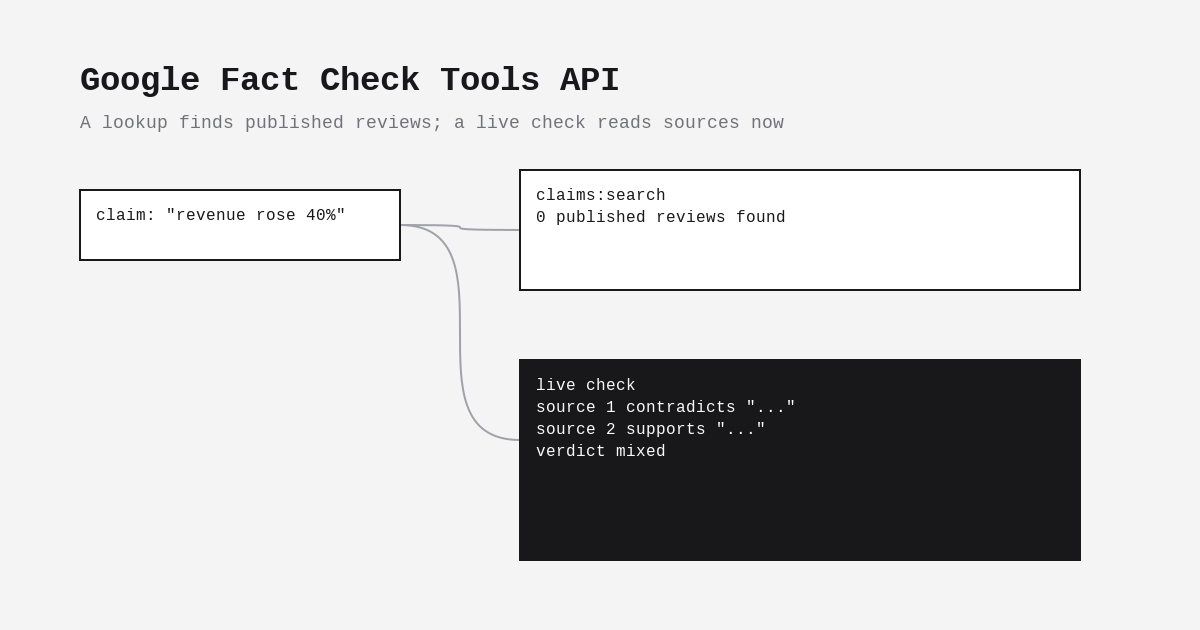
All three quotes were found, and all three are marked for review: the first because the page was transcribed, the other two because the match was fuzzy. A faithfulness score would have averaged these into one number. Here each claim says what was matched and why a person should glance at it, and the response carries the matched text so the reviewer does not have to search. To check whether a source supports a whole claim rather than a quote, the fact-check API returns a stance and a verdict for each source.
Which should you run?
Run faithfulness or groundedness on every answer in evaluation and monitoring. They are cheap, they catch a model drifting from its context, and the trend line tells you when a prompt or model change made things worse. The RAG evaluation tools guide compares the libraries.
Run verification on the claims a user will act on, against the source of record. That catches the faithful-but-wrong answers the context metrics cannot see and gives the user a passage to open. For what grounding means more broadly, read what grounding in AI is, and for the difference between scoring and checking, see claim verification vs LLM-as-a-judge.
Sources
Faithfulness: Ragas documentation. Groundedness: TruLens RAG triad and Microsoft groundedness detection, read on 25 November 2026. The Webcite response is a saved call to the public API, at https://webcite.co/samples/batch-bls-w9.json.
Frequently Asked Questions
Is a faithfulness score of 1.0 good enough to ship?
It means every claim matched the retrieved context. Ship it if you trust that context; if the context can be stale, wrong or from the wrong document, check the claims that matter against the source of record.
Should I stop tracking groundedness if I verify claims?
No. Groundedness is cheap to run on every answer and catches drift from the context early. Verification costs more per claim, so spend it on the answers users act on.