Consulting and professional services: sourced decks and checked deliverables
Webcite checks each statistic in a deck against the source it cites, reviews a finished deliverable claim by claim with a coverage report, and traces a pasted chart back to the publication it came from. A deck figure of $82,400 for 2023 US median household income came back unbound against the Census page, with the published $80,610 sentence returned beside it.
Last updated
Market sizing decks: every statistic tied to its source
Documents: the market sizing model, the steering committee deck, and the government statistics, industry association reports and company filings that feed each layer of the estimate.
Decision: whether the market size and growth rate shown to the client hold up when their own analysts trace the footnotes.
What goes wrong: a statistic is copied from a secondary article that misquoted the release, or rounded and relabelled, and the error compounds through every multiplication in the model.
Three recorded checks, 25 November 2026, against the Census Bureau's Income in the United States: 2023 page show what each footnote comes back as:
- List each statistic in the deck with the URL its footnote cites.
- Run batch quote checks of each footnote quote against its cited page, up to 200 in one call, or source preview one at a time.
- For a statistic with no usable footnote, verify the claim with
filterssuch asis_primary_source,domainandpublication_year, so only official and current sources count. - Link each
exactornormalizedmatch to its passage with the returneddeep_link, a text-fragment link that scrolls the browser to the quote.
| Quote sent | Grounded | Match | Score |
|---|---|---|---|
| The sentence as published: "Real median household income was $80,610 in 2023, a 4.0 percent increase from the 2022 estimate of $77,540" | true | exact | 1 |
| Reworded, with the figures kept: "real median household income was $80,610 in 2023 - a 4.0% increase from the 2022 estimate" | true | fuzzy | 1 |
| Wrong figures: "Real median household income was $82,400 in 2023, a 6.3 percent increase" | false | unbound | 0.5 |
The engagement team sees which footnotes match their source word for word, which were reworded (shown with the passage actually found), and which came back unbound, with the real sentence to correct them from.
Client deliverables: a fact-check before release
Documents: the final report, the board presentation, a benchmarking study or a commercial due diligence report going to a client.
Decision: whether the partner signs off the deliverable for release.
What goes wrong: a late edit changes a number or a claim after the last check, and the client finds the error before the team does.
A recorded review, 25 November 2026, on pages 1 and 2 of the Federal Reserve's FOMC statement of 18 December 2024: of 11 claims, 10 were checked and 1 was set aside as non-factual, with 0 pending. The job ended partial_coverage with coverage_complete: false and 9 uncovered source spans. Saved review.
- Upload the deliverable with
upload_fileor, for a published version,upload_url, through the MCP server. - Call
review_documentwith theasset_idand a stablethread_id. It returns ajob_idat once. - Poll
get_document_review_jobuntil it reachescomplete,partial_coverage,credits_exhaustedorfailed, then read every page of claims withget_document_review. - Read each uncovered passage with
get_review_source_span. Record a heading or chart title as a non-claim withrecord_review_nonclaimand a rationale, or check it.
The partner sees every claim with its page, result and sources, the sentences set aside as opinion, and the uncovered passages still to clear. How document review works.
Finding the original source behind a chart in a deck
Documents: a chart pasted into a deck as an image, inherited from an earlier engagement, with a vague source line or none.
Decision: whether the chart can be cited, and updated with the latest release, or must be rebuilt.
What goes wrong: the team cites a secondary report that reproduced the chart, or cannot update it because nobody knows which table it came from.
A recorded example, 25 November 2026: a PNG of a Census chart was extracted as a scan page with OCR. The chart came back as a table titled "Figure 1. Median Household Income and Percent Change by Selected Characteristics", with the all households row reading 80,610 and 4.0 percent. Saved response.
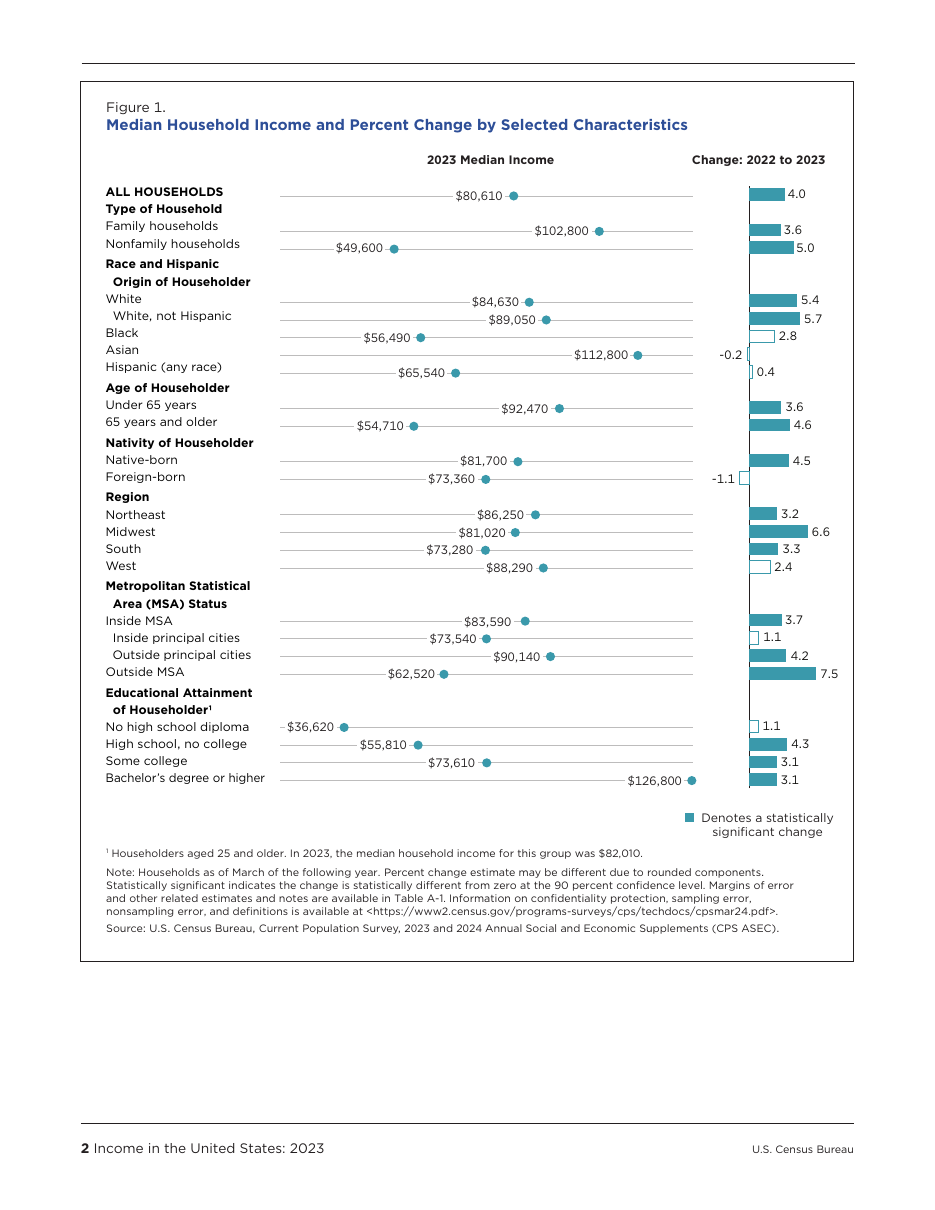
Those values point to the Census income report, and a source preview on that page returned exact with a deep_link to the sentence. Saved preview.
- Extract the image or slide. Values read from an image are OCR reads, so keep the extracted table beside the picture.
- Search sources with the exact table values, units and year. Search returns candidate sources only, with no verdict.
- Run source preview on each candidate URL with the values as the quote, and keep the candidate whose passage binds.
- Once the source is confirmed, verify the chart's headline claim with that URL in
source_urls.
The team sees the chart as a table, the candidate sources, and the one whose passage binds, with a link to the exact sentence for the source line.
Research memos: statements sourced before they reach the storyline
Documents: research memos, literature scans, industry primers and the team's library of past memos.
Decision: what the team states as fact in the storyline, and which source each statement carries.
What goes wrong: a statement travels from memo to memo without its source, and by the final deck nobody can say where it came from.
A recorded source search for the statement "2024 warmest year on record 1.55 °C above pre-industrial WMO" returned 5 candidates from wmo.int, news.un.org, climate.copernicus.eu and www.preventionweb.net, each with a passage read from the page. The narrative status was model_text: search lists candidates and gives no verdict. Saved response.
- Search sources for each statement, with
filtersfor source type, domain and publication year. - Verify the statement with the chosen URLs in
source_urls, up to five, to get each source's stance and a verdict. - Split the memo library into anchored chunks for retrieval, so every passage an assistant cites keeps its page or section anchor.
- Find earlier checks again through saved records, filtered by thread.
The memo author sees candidate sources, each source's stance on the statement, and the saved check to cite in the deck's footnote.
What still needs a reviewer
- Source search returns candidates, not verdicts. A source supports a statement only after a verification or quote check against it.
- A
fuzzyorreflowedmatch staysneeds_review; show the matched passage, not the deck's wording. - A quote binds only when every figure in it matches the source: value, digit order, decimal point, sign, percent versus percentage points, currency, and million versus billion. Formatting differences such as thousands separators, non-breaking spaces, dash styles, a space before a percent sign and line breaks still bind.
- Values read from a chart image are OCR reads. Check them against the picture before they go into a model.
- A deliverable review covers the whole document only when it reports
coverage_complete: trueand no pending claims. - Judgments, forecasts and recommendations are the team's own. Document review sets opinion aside as non-factual rather than checking it.
Inside your own environment
Client material is usually under a non-disclosure agreement. Webcite runs self-managed in your own cloud tenant, and model calls stay inside your tenant through private endpoints. A CycloneDX software bill of materials is produced for each release. How private deployments run.
Start
Connect the MCP server to your assistant and ask it to review a deck, or start with the API. Show the source of an AI answer explains text-fragment links, and the Citation API shows one citation field by field.
Create a free account